
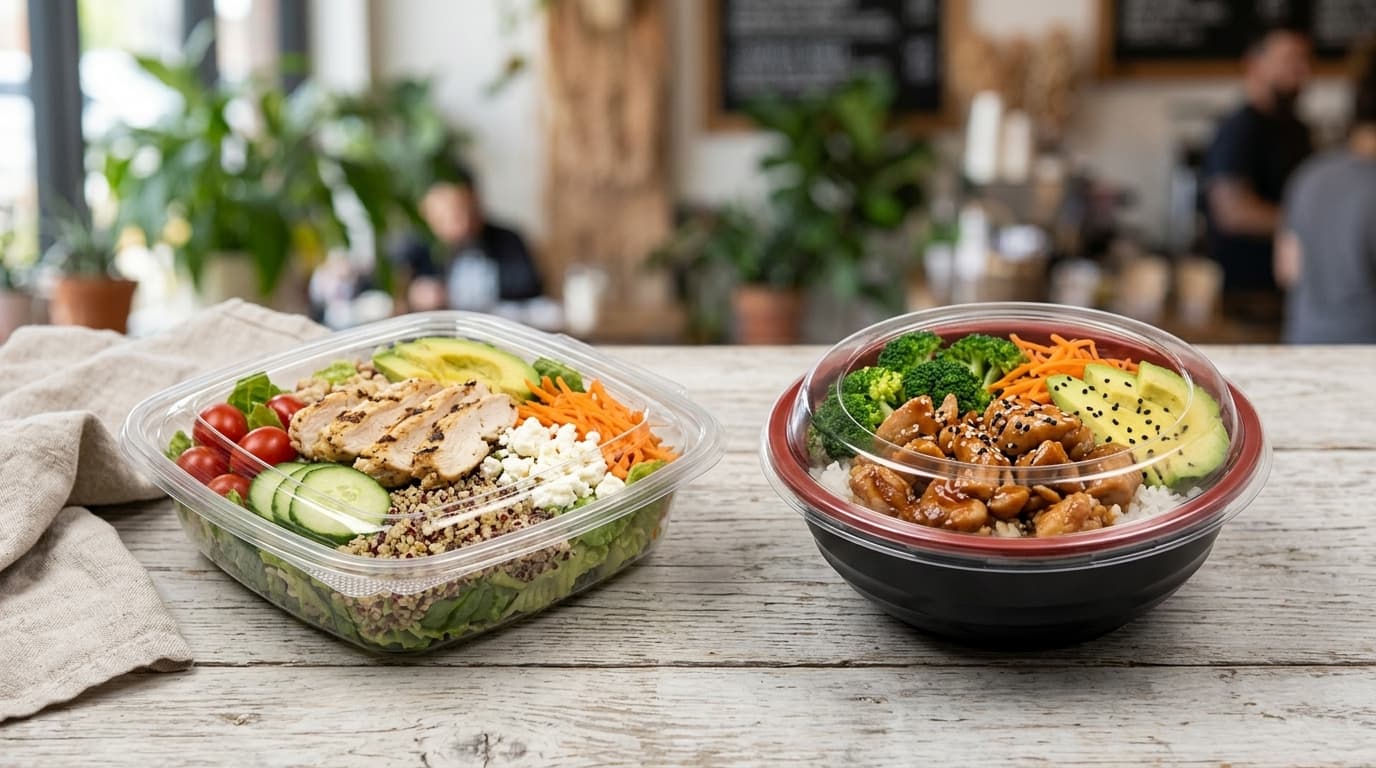
Updated May 2026
TL;DR
Knowing how to choose takeout containers for your restaurant comes down to three decisions: material, size, and compliance. Polypropylene handles hot food. PET is the call for cold display and grab-and-go. Foam is being phased out across a growing number of U.S. states. A three-size core system, with 48 oz added only when family portions or catering call for it, covers most menus without the storage chaos. Get these right and your containers work with your food, your customers, and your local regulations.
Every week, 47% of U.S. adults pick up takeout at least once, and nearly 75% of all restaurant traffic now happens off-premises. Knowing how to choose takeout containers for your restaurant is no longer a back-of-house afterthought. It is a front-line business decision that directly affects food quality, customer satisfaction, and your bottom line.
That is not just a packaging detail. Research also found that 90% of off-premises customers would likely order a wider variety of food if upgraded packaging kept meals closer to dine-in temperature, taste, and quality.
Pick the wrong container and you are handing customers lukewarm soup in a leaking box. Pick the right one and your food arrives looking like it just left the kitchen. At Plastic Container City, we supply thousands of food professionals across the U.S., from food trucks to catering operations, and the most common packaging problem we see is operators buying whatever is cheapest without knowing if it actually suits their food type. This guide cuts through that.
We will cover the full decision framework: materials, sizes, compliance, and the four specialist topics that have their own full guides. Consider this your operating overview before you go deeper on any single topic.
What Are the Main Types of Takeout Container Materials?
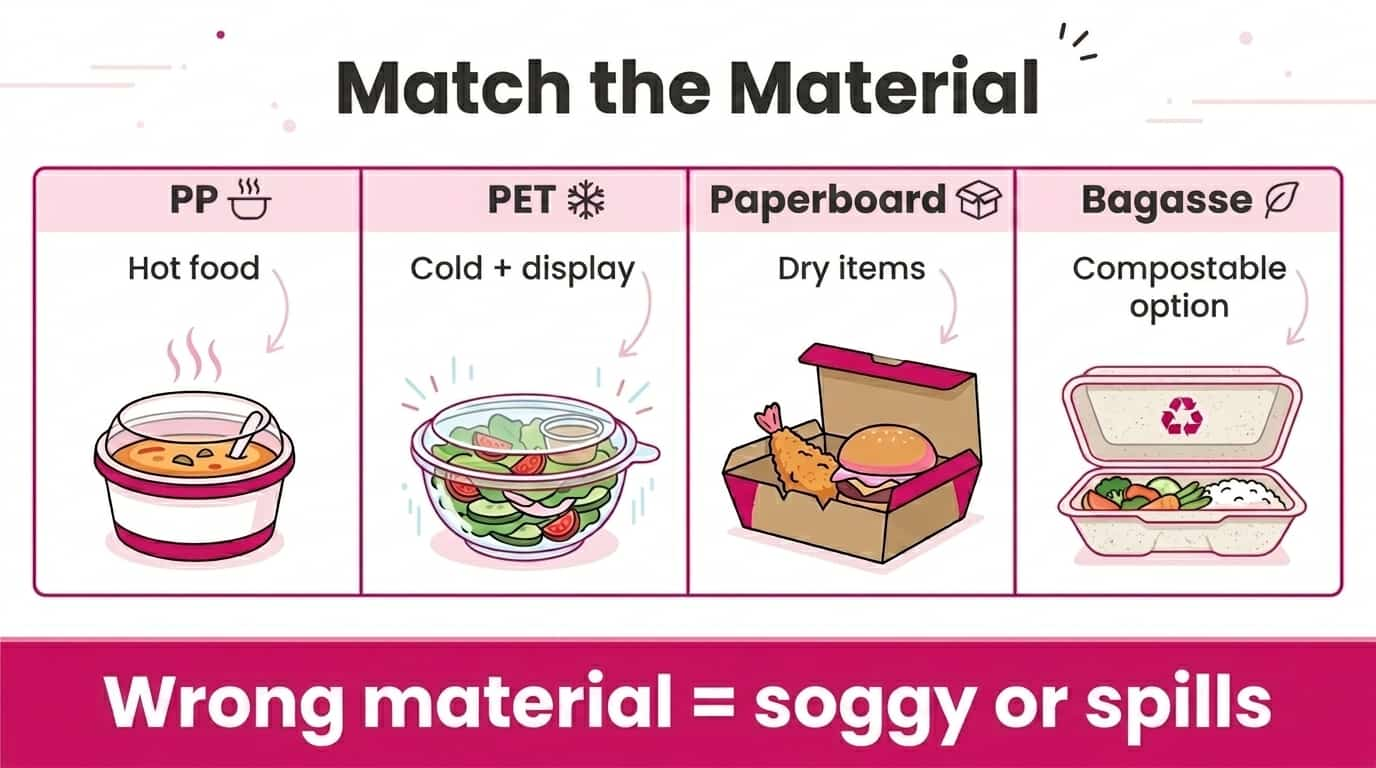
Direct Answer: The four main takeout container materials are polypropylene (PP), PET plastic, paperboard, and bagasse. PP handles heat. PET excels at cold and display. Paperboard suits dry items. Bagasse is compostable for operators who need it.
Material choice is where most operators make their first mistake. They default to whatever their broadline distributor has in stock rather than asking what the food actually demands. Here is how the four main materials stack up:
- Polypropylene (PP): The workhorse for hot food. Heat-tolerant, shape-stable, and commonly used for hot food when the product is food-contact safe and rated for the serving temperature. Works well for entrees, soups, and saucy dishes. One important note from NRA operator guidance: some plastics may degrade if food exceeds 140°F, so always verify your PP product's rated temperature.
- PET #1: Crystal-clear, rigid, and the right call for cold items, grab-and-go, salads, sushi, and anything where customers need to see the product before they buy. Not suitable for hot food.
- Paperboard and kraft: A solid option for dry items and sandwiches. For soups or saucy dishes, you need a moisture-barrier liner, though the liner can make recycling more complicated.
- Bagasse (sugarcane fiber): Compostable and increasingly popular with sustainability-focused operators. The cost premium over conventional materials is narrowing as adoption scales.
One practical point: PP is commonly used as a foam replacement in EPS ban markets, but operators should still check local rules and supplier documentation. More on that in the compliance section below.
What Size Takeout Containers Does a Restaurant Actually Need?
Direct Answer: A four-size system built around 4 oz, 16 oz, 32 oz, and 48 oz covers most restaurant menus from sauce cups to family portions, without the inventory headache of stocking a dozen different container types.
Over-assortment is a real cost. Walk into most independent restaurant kitchens and you will find six container types when three would handle the same menu. Every extra SKU means more storage space, more ordering errors, and more cash sitting idle in stock.
| Size | Best For | Recommended Material |
|---|---|---|
| 4 oz | Sauces, dressings, condiment cups | PP or PET |
| 16 oz | Soups, sides, small entrees | PP (hot), PET (cold) |
| 32 oz | Full entrees, pasta, grain bowls, stir-fry | PP clamshell or round container |
| 48 oz | Family portions, large salads, catering | PP or clear PET deli container |
One standardization move that pays dividends immediately: choose a lid system that fits across multiple container sizes. The National Restaurant Association's operator packaging guidance calls this out as a key SKU-reduction lever. Fewer lid types, simpler production, less storage chaos.

Which Container Material Works Best for Each Food Type?
Direct Answer: Use PP for all hot food including soups, rice, and saucy entrees. Use PET for cold items, salads, and display cases. Use kraft with a moisture-barrier liner for wet sandwiches or burritos. Wrong material means spills or soggy texture.
The rule is not complicated, but it is routinely ignored. Putting hot curry into a thin PET container is a spill waiting to happen at a customer's front door. Here is the practical matching guide:
- Soups and stews: Round PP container with a tight snap-on lid. The round shape distributes liquid more evenly during transport. Pizza still travels best in cardboard boxes, per NRA packaging guidance.
- Fried food and crispy items: Vented PP clamshell. Ventilation reduces condensation buildup that turns crispy coatings into steam-damaged mush. See the dedicated guide below for the full breakdown.
- Cold salads, sushi, grain bowls: Clear PET container. Customers can see exactly what they ordered, and the clarity signals freshness before the lid even comes off.
- Desserts and cold grab-and-go: PET clear dome or deli containers. Visibility is a direct driver of impulse purchases, especially for food trucks and cafe counter displays.
- Wet sandwiches or burritos: Kraft wrap or box with a moisture-barrier liner for the interior. The liner stops soak-through but check recyclability in your local market.
Are Foam (EPS) Containers Still Legal for Restaurants in the U.S.?
Direct Answer: Foam rules vary by state and city. EPS food containers are restricted in several U.S. markets, and PP is a common replacement.
If you are still ordering foam takeout containers, run a compliance check before your next purchase. The U.S. is in a rolling wave of EPS bans at the state level, and the momentum is firmly in one direction. The current active and near-term enforcement dates:
- Oregon and Rhode Island: foam bans active since January 1, 2025
- Delaware: EPS foam rule active since July 1, 2025
- Virginia: chains with 20 or more locations complied July 1, 2025; all remaining food vendors must comply by July 1, 2026
- New York: foam ban in place since January 1, 2022, expanded to EPS cold-storage containers as of January 1, 2026
- New Jersey: foam ban active since May 4, 2022
The list can move quickly, especially when city and county rules are involved. Check local rules before reordering foam, then choose a food-contact-rated PP option that fits the food temperature and menu use. For a full state-by-state breakdown of active restrictions, the 2026 state-by-state foam guide is worth bookmarking, along with this guide to foam packaging alternatives that lays out the practical swap options.
What Is the PFAS Rule and Does It Affect My Takeout Containers?
Direct Answer: PFAS rules mainly affect coated paper and fiber foodware, but state rules can be broader, so check supplier documents.
PFAS are chemical coatings historically used to make paper packaging grease-resistant. The FDA pulled authorization for 35 food-contact notifications covering PFAS-containing grease-proofers on paper and paperboard packaging in January 2025, with a compliance date of June 30, 2025.
State-level PFAS rules are spreading too. Oregon banned intentionally added PFAS in foodware containers from January 1, 2025. Maine's rule covering plant-fiber food packaging takes effect May 25, 2026. The key takeaway for operators: if you use kraft or fiber-based containers in a state with active PFAS rules, verify your supplier's compliance status. If you use PP and PET, you are usually outside the main paper-coating issue, but you should still check state rules that use broader "intentionally added PFAS" language. The full compliance picture, including state-by-state timelines, is covered in the 2026 packaging compliance guide.
Why Do Food Trucks and Small Operators Need a Different Approach?
Direct Answer: Small operators need fewer container families, shared lids, compact storage, and formats that work across pickup, display, hot food, and cold food.
Most packaging guides are written for chain restaurants with procurement teams. If you are running a food truck, cottage food operation, or neighborhood cafe, the calculus is different. You are buying in lower volumes, storing in tighter spaces, and often serving both hot and cold items from the same setup.
Clear PET containers work especially well here. When customers can see the product before they buy it, a vibrant grain bowl or a layered dessert cup sells itself without a single word of signage. Food trucks running a grab-and-go model often standardize around one clear container family in two or three sizes, with a shared lid. That setup cuts storage requirements, simplifies ordering, and projects a polished, professional look even on a lean budget. For a full playbook on building this setup, the grab-and-go packaging guide is the place to start.
How Do I Keep Fried Food Crispy in Takeout Containers?
Direct Answer: Vented PP clamshells reduce steam buildup that turns crispy coatings soggy during transport. Ventilation strategy, hold time, and container format all factor into the outcome.
Fried food is the hardest item to package well, full stop. The moment you seal crispy chicken wings, fries, or fried shrimp in a tight container, moisture from the food attacks the coating from the inside out. Steam is the enemy. Vented clamshells in PP interrupt that cycle, but the right container choice depends on your menu, your delivery radius, and whether the food holds at a counter or goes straight into a bag.
The core rule is simple: fried food needs venting, delivery distance matters, and the container should be tested with the actual menu item before rollout. For the full specialist article, see How to Keep Fried Food Crispy in Takeout Containers.
What Makes Delivery-Proof Packaging Different from Regular Takeout?
Direct Answer: Delivery packaging needs tamper-evident seals, leak-proof construction, and stackable design. Third-party delivery puts food through more handling than a direct counter pickup, so the container has to survive the full journey.
Counter pickup and self-delivery give you more control. Third-party delivery is a small obstacle course. Containers get stacked, jostled, and carried alongside other orders in insulated bags. Tamper-evident seals, tight lid retention, and leak-proof construction stop being a nice-to-have and become a baseline requirement.
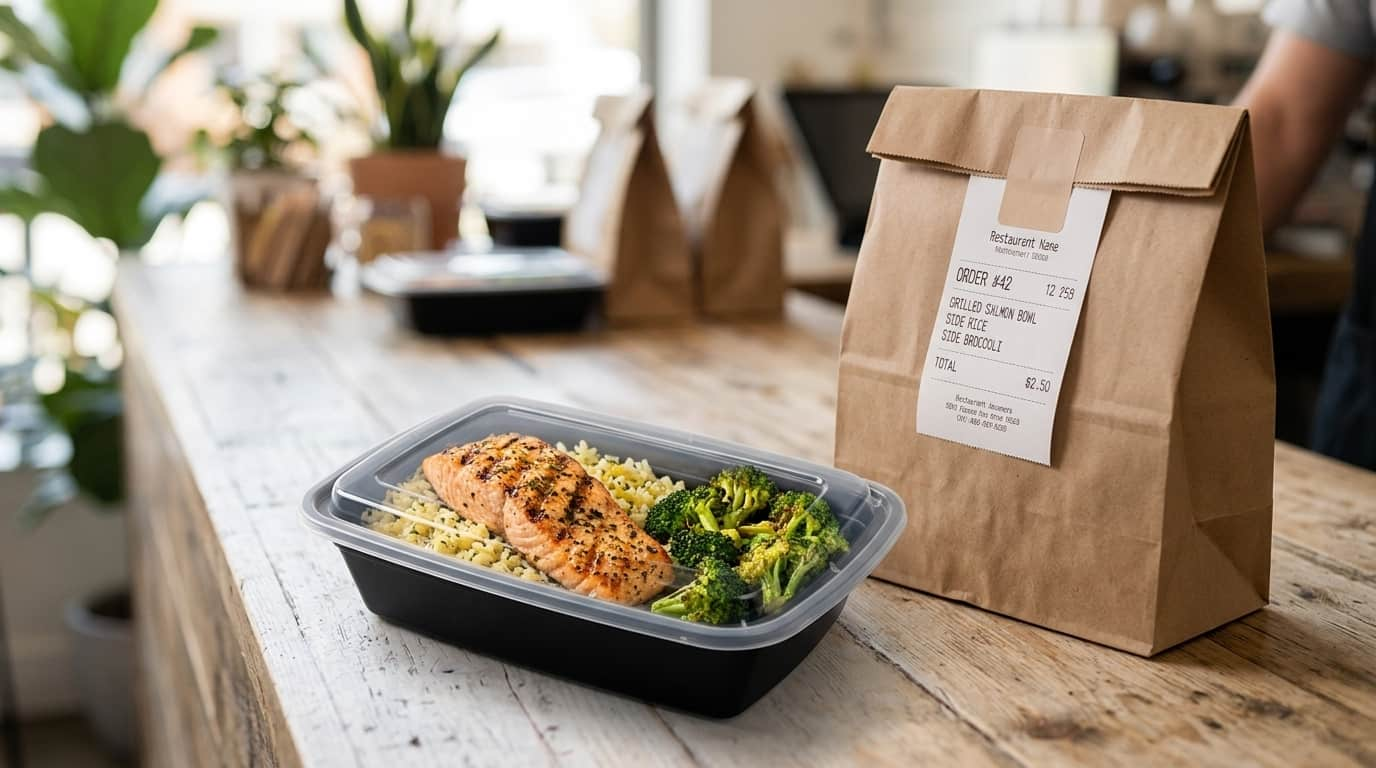
For delivery handoff, simple details matter: printed receipts, bag numbers for multi-bag orders, tamper-evident seals, and one final courier check before the order leaves.
There is also the condensation question for hot items and the crush risk for anything positioned under heavier bags. The choice between self-delivery and a third-party platform also affects what container spec makes sense. For a complete guide on preventing spills, managing condensation, and protecting food quality through a full delivery run, see Delivery-Proof Packaging: How to Prevent Spills, Condensation, and Crushed Food.
How Do Portion Cups and Sauce Containers Fit Into My Packaging Setup?
Direct Answer: Portion cups control sauce cost, keep orders cleaner, and help restaurants serve dips, dressings, and condiments consistently.
Sauce cups and portion containers are the detail that separates a polished order from a chaotic one. They are also a compliance consideration in some markets: New Jersey's updated foodservice rules, which include restrictions on automatic distribution of single-use utensils and condiment packets from August 1, 2026, still explicitly allow single-use portion cups for sauces and dressings served with food.
The challenge is matching the right cup size to the right use case without over-portioning or under-serving. Getting this right reduces waste, keeps food cost in check, and gives customers a consistent experience every time. For a full size guide covering portion cups across sauces, dressings, dips, and condiment service, see Portion Cups and Sauce Containers: Size Guide for Restaurants.
How Do I Reduce Packaging Costs Without Downgrading Quality?
Direct Answer: Standardizing to fewer SKUs, using shared lid systems across container sizes, and buying deeper volume on fewer product lines cuts packaging spend without touching quality. The wrong container costs more in complaints and waste than it ever saves upfront.
Packaging cost pressure is not going away. The Foodservice Packaging Institute's Q1 2025 survey found more than 80% of packaging manufacturers reported profits that worsened or stayed flat versus 2023, and tariff pressure on materials including steel and aluminum may add further cost to operator supply chains in 2026. The instinct is to buy the cheapest container. The problem is that cheapest often means wrong: wrong material, wrong seal, wrong fit for the food. That generates complaints, remakes, and refunds that cost far more than a better container ever would.
Standardization is where the real savings live. Fewer container types, deeper volume buys, and a lid system that works across your full product range. For a tactical breakdown on cutting packaging spend while protecting the customer experience, see How to Reduce Packaging Costs at Your Restaurant Without Downgrading Quality.
The Right Container Is Part of the Meal
Off-premises dining is not a side channel anymore. It is the channel for most restaurants. According to the National Restaurant Association, 3 out of 4 meals served across restaurant types are now intended for off-premises consumption. The container is the last physical touchpoint between your kitchen and your customer's experience. Get the material wrong and the food suffers. Ignore the compliance picture and you are one inspection away from a real problem. Over-assort your container inventory and your storage room quietly drains your margins.
The good news is that learning how to choose takeout containers for your restaurant does not require a procurement background. PP for hot, PET for cold, three core sizes plus a 48 oz add-on when needed, and a compliance check for your state covers the majority of the decision. The supporting guides linked throughout this article take each specialist topic the rest of the way. For more resources built for working food professionals, visit the Plastic Container City blog.
Frequently Asked Questions
What are the best containers for takeout?
Direct Answer: The best takeout containers match the food: PP for hot meals, PET for cold display, lined paperboard for wet items, and vented PP for fried food.
The right choice depends on heat, moisture, visibility, delivery distance, and lid fit. A container that works perfectly for a noodle soup will fail for crispy chicken.
What type of plastic are takeout containers made of?
Direct Answer: Restaurant takeout containers are most commonly made from PP or PET #1. PP suits hot food when rated for the temperature. PET suits cold food and clear display.
PP is used for soups, rice bowls, pasta, and hot entrees. PET is better for salads, sushi, desserts, parfaits, and grab-and-go displays where customers can see the product before buying.
What features should I look for in a good takeout container?
Direct Answer: Look for leak resistance, secure lid fit, stackability, transport durability, and a material that matches the serving temperature.
The National Restaurant Association identifies five performance criteria for off-premises packaging: temperature retention, food texture integrity, visual appeal, package integrity, and branding impact. A good container protects the meal after it leaves the kitchen, not just while it sits on the prep table.
Is it safe to microwave plastic takeout containers?
Direct Answer: PP containers with a microwave-safe symbol on the base can generally be reheated. PET and most single-use containers are not designed for microwave use. Always check the symbol before reheating.
Operators choosing PP containers for hot food should confirm the microwave-safe rating on the product spec if customers are likely to reheat. Single-use containers are generally not intended for repeated reheating, even when made from PP.
Do takeout containers contain microplastics?
Direct Answer: All plastic materials carry some microplastic risk when scratched, worn, or heated beyond their rated temperature. Using food-grade PP and PET within rated conditions, and replacing damaged containers, reduces the risk.
For operators, the practical steps are to use restaurant-grade, food-contact-rated containers, replace scratched or worn packaging before it reaches the customer, and follow the temperature rating on each product. Consumer awareness of microplastics is growing, and operators who use properly rated food-grade materials are in the strongest position to answer those questions confidently.