
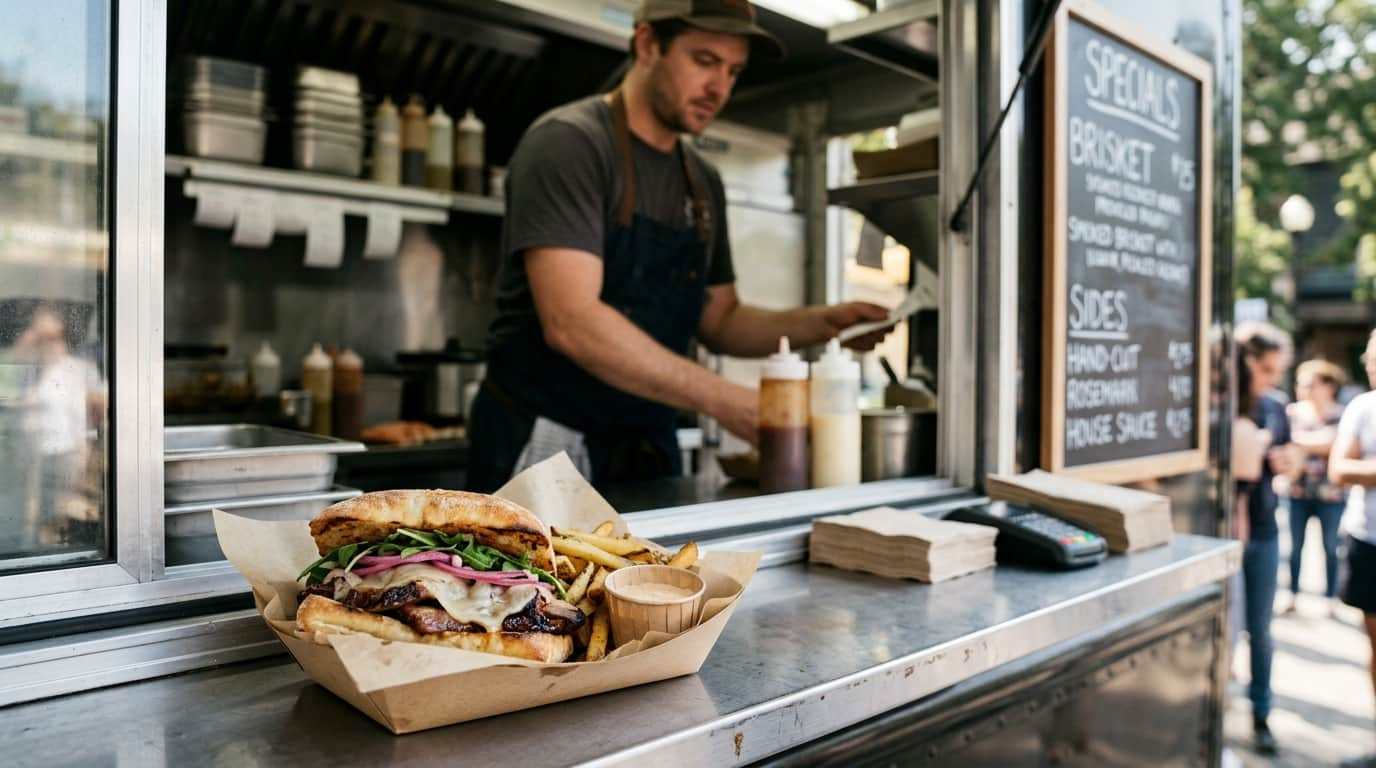
TL;DR: There is no proven magic number, so build the menu around what your window can serve fast. Start small, add an item only when it shares ingredients and prep with what you already make, and let your busiest rush be the judge. A tighter menu can also simplify the packaging you need to stock.
So, how many menu items should a food truck have before the line starts checking its watch? Too few and customers feel boxed in. Too many and the window slows, the fridge overflows, and quality slips on dishes you only make twice a shift.
Here is the catch. A food truck is one small kitchen, one service window, and one crew keeping a queue moving. Every item you add can mean another ingredient to stock, another prep step, and another thing to get right at the peak of the lunch rush. A big restaurant can spread a long menu across extra stations. A truck cannot.
You will see tidy number ranges floating around online. Skip them. Your cuisine, your crew, and your window decide the number, not a listicle. This guide gives you the logic to find yours: why smaller menus tend to run smoother, a worksheet for testing any new item, what a menu board has to do, and a packaging check most menu guides skip.
How Many Menu Items Should a Food Truck Have?
Direct Answer: There is no proven magic number. Start with a short menu your crew can make fast at the window, then add one item at a time.
Here is the honest answer: the right number is the most items your crew can serve quickly and consistently when the line is longest. A taco truck, a dessert truck, and a coffee cart will all land differently.
So skip the headcount debate and use a window test instead:
- Can you name your top sellers without thinking? If not, the menu is probably longer than customers can hold in their heads.
- Does every item survive your busiest hour? An item that only works when the line is short slows everyone else down.
- Can one person on the window explain the whole menu? If it takes a speech, trim it.
If you are launching, aim low. It is far easier to add a crowd favorite later than to retire a dish people have already learned to order.
Why Do Fewer Menu Items Work Better on a Truck?
Direct Answer: Every item shares one small kitchen and one window, so each addition can add prep and stock. Complex, made-to-order dishes often mean longer waits.
The best hard evidence comes from bigger kitchens, but the logic travels. In its 2026 counter-service study, Intouch Insight sent mystery shoppers to 10 quick service chains, 75 visits per brand. Orders arrived in just over four minutes on average. Subway came in at just over two, while some brands took about six. Intouch said the longer times were often tied to more complex or made-to-order items.
That study did not count menu items and was not about food trucks. It shows where minutes pile up: in the dishes that ask the most of the kitchen.
Big brands are chasing the same idea. Starbucks said it planned to cut roughly 30% of its U.S. menu items by the end of fiscal 2025, and named shorter waits among its aims. It was also changing staffing and processes at the same time, so the menu cut is part of the story, not the whole story. On the restaurant side, Bubbakoo's Burritos told QSR Magazine that simplifying its menu meant dropping slower-moving items, which reduced kitchen complexity and cut prep times. It is a restaurant brand, not a truck, and no numbers were shared.
Here is the takeaway: complexity has a cost, and a small kitchen pays it fastest. A dish with its own prep method or assembly step asks more of your window than one built from the same core setup.
Money plays a part too. Our guide to what it really costs to run a food truck treats menu simplicity as a cost control, since every extra ingredient is another thing to track, store, and potentially waste.
What Is a Good Menu for a Food Truck?
Direct Answer: A good food truck menu is short, shares ingredients across items, and is quick to assemble at the window, anchored by a few signature items.
Think of it as a short playlist, not a jukebox. Menu quality beats menu size, and every track should earn its spot. Use this quick worksheet on any item before it hits the board, or to audit the ones already there.
| What to record for each item | What it tells you |
|---|---|
| Portions sold, or expected, per busy shift | Shows observed or expected demand for the item |
| Ingredients used only for this item | Reveals extra stock to store, track, and use up |
| Extra prep or assembly steps | Makes the added work at the window visible |
| Container and lid required | Shows whether existing packaging can be shared |
| Case quantity and expected daily use | Estimates how long a case of packaging would last |
This is a planning tool, not a scoring system, so there is no magic cutoff. The point is to make the extra work visible. If an item adds new ingredients, new steps, and a new container on top of modest demand, it needs to be a proven favorite to earn its spot. Give your signature items the most board space and let everything else play backup.

What Is the Typical Size of a Menu Board for a Food Truck?
Direct Answer: Size the board to your window and your line, so every item reads clearly from where customers stand.
Skip the tape measure and run a field test. Stand where your customers wait and ask whether you can read every item and decide in a few seconds. If you have to squint, the board is too small or the menu is too long. The board is a hard limit on your menu.
A clear board also saves your crew from repeating themselves. In its 2025 drive-thru study, Intouch Insight found that orders that did not need to be repeated were 1:25 shorter. That is drive-thru data, not food truck data, but a confusing board is a fine way to get orders repeated at the window.
What Are Common Menu Mistakes?
Direct Answer: Common food truck menu mistakes include adding items on request, stacking slow made-to-order dishes, and copying a menu your window cannot support.
- Adding items reactively. A customer asks, a trend pops up, and suddenly there is a new dish with its own ingredients and prep.
- Stacking slow dishes. Intouch tied longer waits to complex and made-to-order items. Stack several at once in a rush and the line stalls.
- Hoarding one-off ingredients. An ingredient that only appears in a single dish still needs storage, tracking, and a plan for when it goes unused.
- Copying a bigger kitchen. Restaurant menus are usually built around more stations and more hands than a truck has.
- Cramming the board. Tiny print and walls of description slow the decision and the line.
How Does a Smaller Menu Simplify Packaging?
Direct Answer: A smaller menu can mean fewer container and lid types to stock, store, and reorder, especially when several dishes can use the same packaging format.
Here is a side of menu planning that is easy to overlook. A smaller menu does not automatically mean fewer packaging types. Count the containers and lids each dish requires, then check where formats can be shared. If two dishes need two different container families, that is more stock to store, count, and reorder in a space that is already tight.
Plastic Container City is a family-run business established in 1999, so packaging math is home turf for us. Here is how to keep the packaging side tight:
- Count your combinations. List every container and lid your current menu needs before you add anything.
- Try existing sizes first. Our deli containers with lids come in 8, 16, 32, and 64 oz. The 8, 16, and 32 oz sizes are packed 240 to a case, and the 64 oz is packed 120. Check whether a size you already stock works before opening a new format.
- Narrow the family. Our guide to choosing takeout containers covers how small operators and food trucks can keep container choices tight.
Then do the case math. Here is an illustration with made-up sales, so swap in your own. Say a new side sells 10 portions per selling day and each portion takes one container. A 240-count case of 8 oz deli containers would last 24 selling days (240 divided by 10). That commits a full case of packaging to one side dish. Before you add the item, estimate its daily use and ask whether it can borrow a size you already stock. For the storage side of that decision, see how food trucks can manage limited storage space.

What Should You Do First With Your Menu?
Direct Answer: Start small, track what sells through your busiest rushes, and add or cut one item at a time to see what each change does.
Quick recap. There is no verified magic number, so let your prep, your crew, and your line set the limit. Shared ingredients, simple assembly, and a readable board do the heavy lifting, and every new item should earn its container too. Treat your own ticket times as the final word.
If your menu is manageable but orders still back up, see how food trucks can reduce wait times during a rush. And the next time someone asks how many menu items should a food truck have, the best answer is as many as your window can serve fast, and not one more.
Frequently Asked Questions
What is the golden triangle in menu design?
Direct Answer: It is a design theory about where eyes land first on a menu. Treat it as an idea, not a proven food truck rule.
You will hear it a lot in menu design talk, but it is a theory about eye movement, not a proven rule for a food truck board. Spend your effort on a clear hierarchy and readable type instead.
How many dishes should a food truck have?
Direct Answer: Dishes and menu items are the same count. There is no proven number, so keep it to what your crew can make fast and well.
How should a menu be laid out?
Direct Answer: Group items by type, give your signature items the most space, and keep print large enough to read from where customers wait.