

TL;DR: Grab-and-go bakery packaging is the difference between a product that sells out and one that wilts on the shelf. Choosing the right container, sealing at the correct temperature, and positioning items at eye level are the three levers that protect freshness and drive impulse sales. This post gives you the containers, the freshness rules, and the display strategy to get both right.
Grab-and-go bakery packaging is either working for you or quietly costing you sales every single day. A cookie behind a foggy lid. A muffin that turned stale before the afternoon rush. A croissant that nobody bought because the packaging made it look like an afterthought.
The frustrating part? Most of these losses are completely avoidable. The wrong container, the wrong sealing temperature, or the wrong display position can cut shelf life and kill impulse purchases at the same time.
At Plastic Container City, we work with thousands of food professionals across the U.S. Packaging decisions are consistently where operators leave the most money on the table.
This guide is direct and practical. You get a clear container-to-product match, a freshness system that actually works, and the display and compliance rules that help grab-and-go items move. Let us start with the container.
What Container Should You Use for Each Bakery Item?
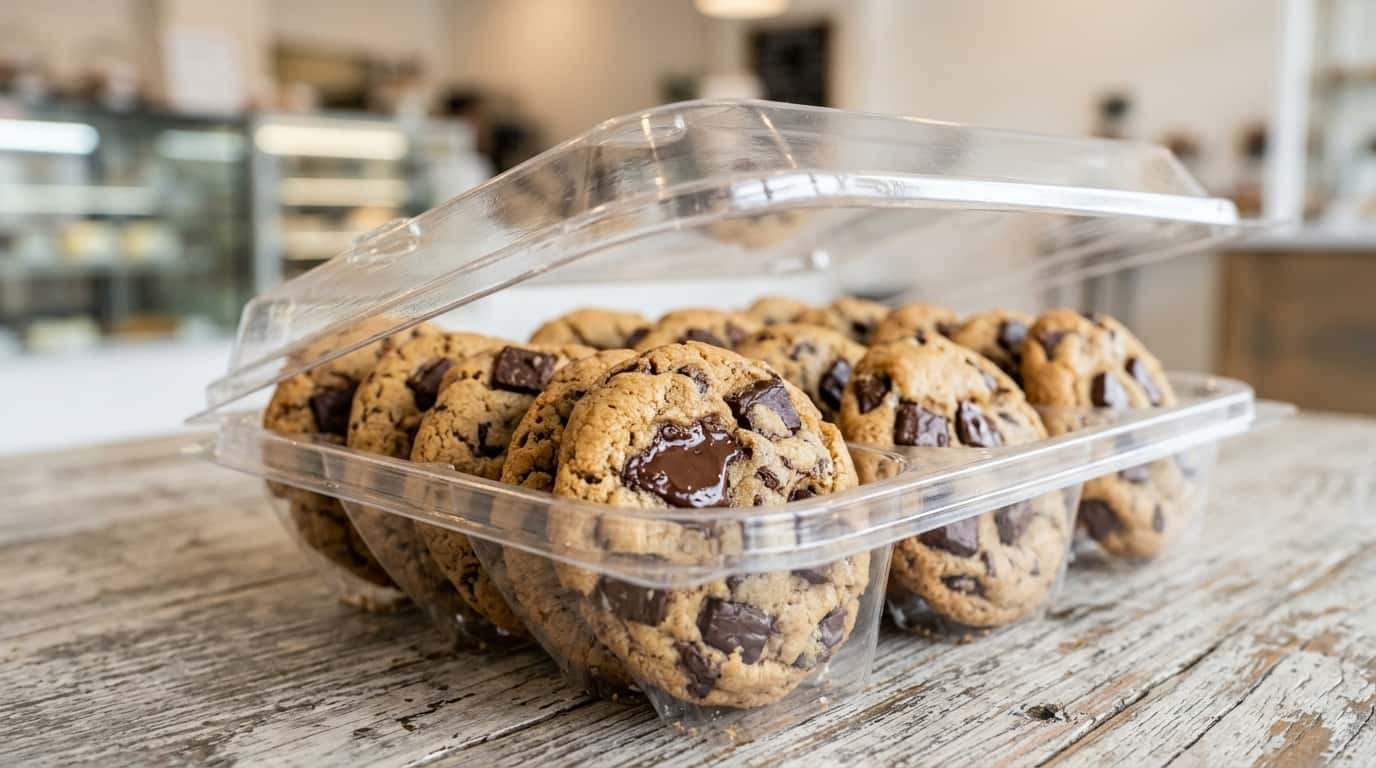
Direct Answer: The right container matches the product's moisture level. Windowed clamshells suit cookies and muffins; paperboard boxes work for laminated pastries.
Grab-and-go packaging formats are not one-size-fits-all. PET (polyethylene terephthalate) clamshells and windowed boxes dominate high-visual display cases because customers buy with their eyes first. Paperboard boxes provide structure and a degree of breathability for croissants and laminated pastries. Kraft paper bags handle lower-moisture items like scones or biscotti, where eco-friendly appeal also matters to today's buyer.
With over 867 SKUs of food packaging designed for retail grab-and-go display, Plastic Container City stocks the formats food professionals across the U.S. rely on daily. Matching the right format to the right product is the fastest way to cut waste and increase sell-through.
Spotted a format that fits your product? We stock all of these at wholesale prices for food service professionals: windowed clamshells, PET transparent boxes, kraft bags, tamper-evident hinged containers, and more. Browse the full selection at Plastic Container City.
| Bakery Item | Recommended Container | Why It Works |
|---|---|---|
| Cookies | PET windowed clamshell or polythene pouch | Visibility drives impulse purchase; low moisture suits a sealed format |
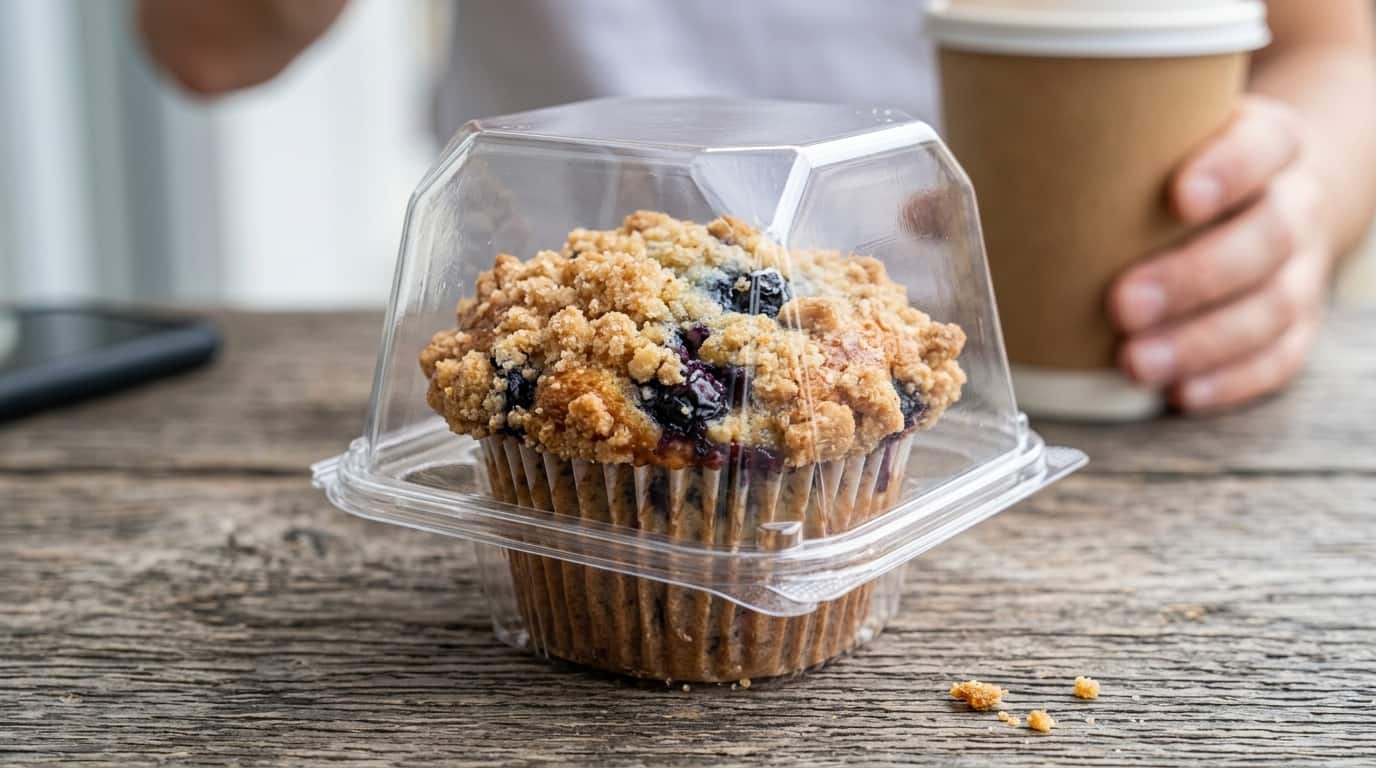
| Muffins | PET transparent box | Clear lid maintains color presentation; rigid shell protects the top |
| Croissants and laminated pastries | Paperboard box or kraft bag | Allows micro-ventilation; prevents sogginess from trapped steam |
| Sliced cake and brownies | Windowed PET clamshell | Portion control with full product visibility |
| Cream-filled pastries | Sealed PET box with tamper-evident label | Refrigeration required; tamper-evident seal reassures the buyer |
| Scones and biscotti | Kraft paper bag with window | Breathable format suited to drier texture; strong eco-friendly appeal |
| Savory and sandwich pastries | Tamper-evident hinged container | Food safety compliance for protein-containing fillings |
Airtight or Breathable? The Freshness Decision That Changes Everything
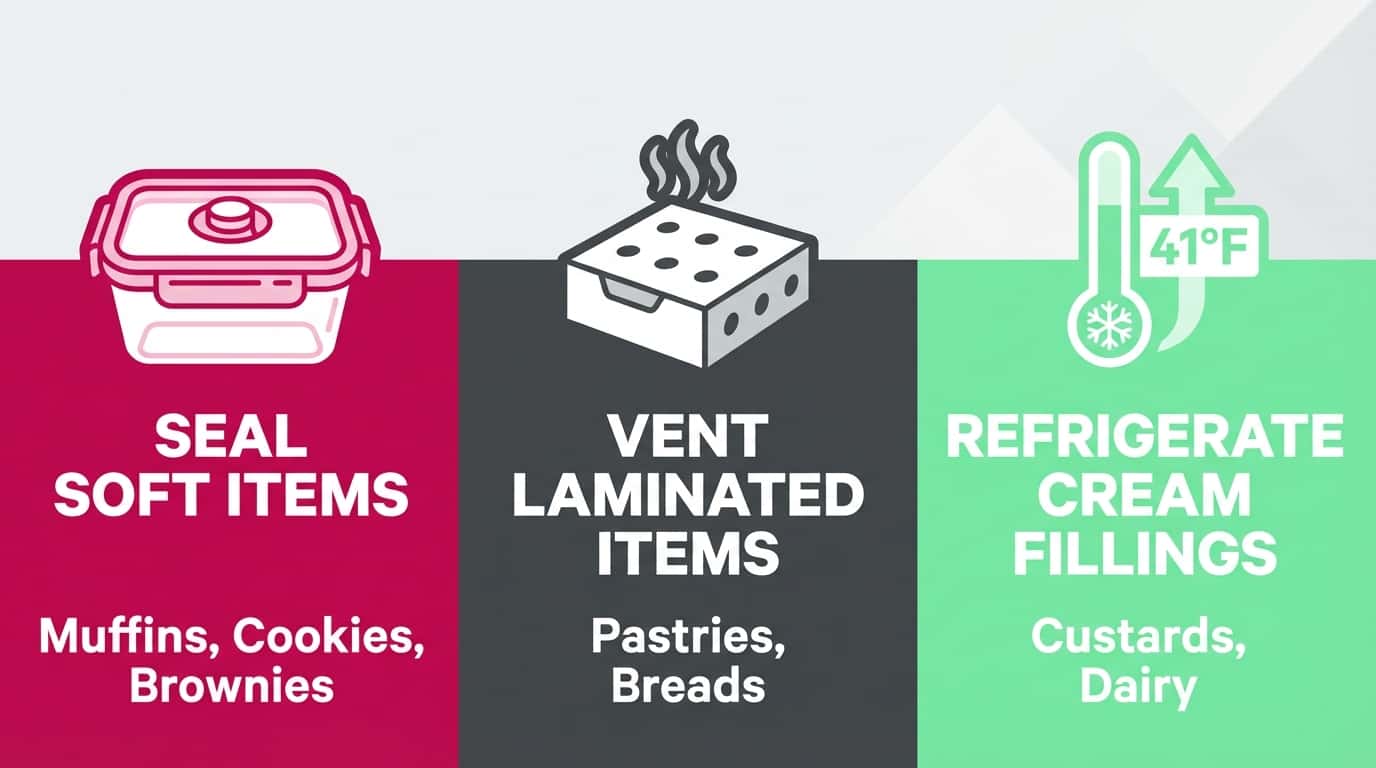
Direct Answer: Seal soft items like muffins and cookies airtight. Use breathable packaging for croissants. Refrigerate cream-filled pastries at 41°F or below.
This is where most grab-and-go operators get it wrong, and the cost shows up in shrink reports and returned product.
Soft items need a sealed environment. Moisture retention is the priority for muffins, soft cookies, and cake slices. Once exposed to dry air, starch retrogradation begins and the item stales fast. A good seal slows that clock down considerably.
Laminated pastries need to breathe. Croissants and puff-based items hold steam close to the surface. Trap that steam and you turn a flaky, delicate pastry into something soft and disappointing within the hour. A paperboard box, a vented lid, or a loosely folded kraft bag give the product room to release residual heat without drying out.
Cream-filled items play by entirely different rules. Completed custard-filled and cream-filled pastries must be refrigerated at 41°F or below unless served immediately after filling. That is not a suggestion. It is a health code requirement.
The Shelf Life Benchmarks Worth Knowing
- Bread packaged at 86°F (30°C) at the moment of sealing achieves up to 7 days of shelf life. Sealing the same loaf at 104 to 113°F accelerates condensation and mold.
- Muffins in PET transparent boxes showed stable sensory scores across an 8-day ambient storage period.
- Cookies in sealed polythene pouches showed no detectable yeast or mold through day 75.
Your actual results depend on your kitchen environment, product formulation, and how consistently your team manages sealing temperature. These are working targets, not guarantees.
The Foggy Lid Problem and How to Stop It
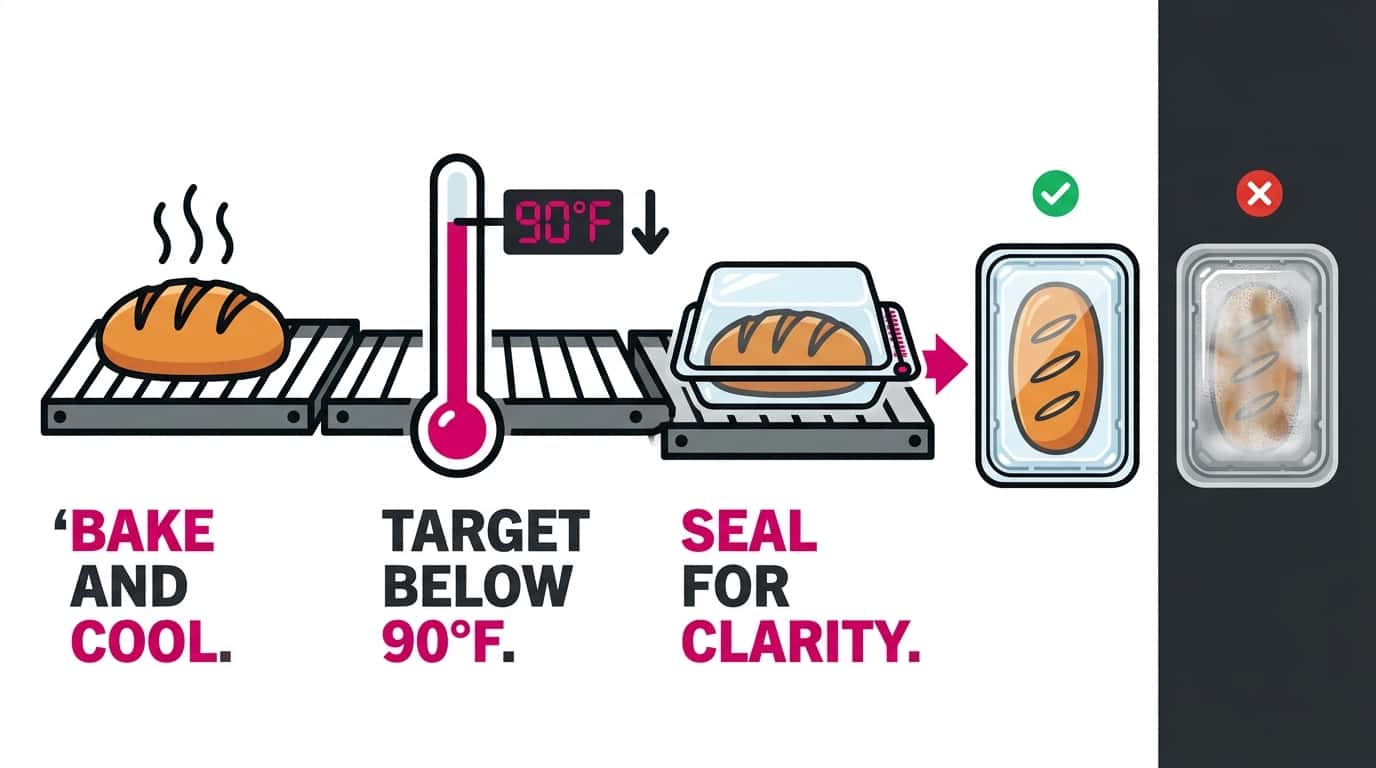
Direct Answer: Condensation forms when warm product meets a cooler container. Cool baked items below 90°F before sealing to prevent fog and extend shelf life.
Nothing kills a grab-and-go sale faster than a foggy lid. Customers see moisture droplets and assume the product is old, improperly stored, or both. The science is actually simple.
Condensation happens when warm product meets a cooler container wall. When internal product temperature is high, water vapor condenses on the lid surface. A 2025 bread packaging study confirmed this directly: bread sealed at 104 to 113°F (40 to 45°C) showed faster condensation buildup and a much shorter shelf life than bread sealed at 86°F (30°C). The physics do not negotiate.
The fix:
- Let product cool on a rack after baking until internal temperature drops to 86 to 90°F before sealing
- Use vented containers for croissants and anything with high residual steam
- Never seal a container that is still warm to the touch at the base
It sounds basic. Plenty of operators still skip it, and bad packaging choices cost more than most bakeries realize.
Refrigerated or Dry Display? A Product-by-Product Guide
Direct Answer: Cream-filled pastries and savory items need refrigeration at 41°F or below. Cookies, scones, and unfilled pastries are safe at room temperature.
Getting this wrong is both a food safety issue and a margin issue. Under-refrigerating cream-filled items is a compliance failure. Over-refrigerating dry items like cookies or brownies accelerates staling, with no food safety benefit to justify the quality loss.
| Product Type | Display Type | Temperature Rule |
|---|---|---|
| Cream-filled and custard pastries | Refrigerated case | 41°F (5°C) or below |
| Savory pastries with meat or dairy | Refrigerated case | 41°F (5°C) or below |
| Croissants and laminated pastries (unfilled) | Dry display | Room temperature; sell within 2 to 3 days |
| Muffins and soft cookies | Dry display | Room temperature; follow product shelf-life window |
| Sliced cake (unfrosted, no dairy filling) | Dry display | Room temperature; 2 to 3 days maximum |
| Frosted cakes and cheesecakes | Refrigerated case | 41°F (5°C) or below |
What Has to Be on the Label? The Grab-and-Go Compliance Checklist
Direct Answer: U.S. packaged bakery items must show the product name, ingredient list, net weight, business address, and all nine FDA major food allergens.
Label compliance trips up more operators than almost anything else in grab-and-go, especially cottage food sellers and growing bakeries moving into wholesale. Here is what U.S. law requires on a pre-packaged retail bakery item.
- Product name
- Ingredient list (in descending order by weight)
- Net weight or count
- Business name and address
- Allergen declaration: The FDA recognizes nine major food allergens: milk, eggs, fish, shellfish, tree nuts, peanuts, wheat, soybeans, and sesame. Sesame became the ninth effective January 1, 2023.
The "Contains" statement is reserved for major food allergens only. Do not include non-allergen ingredients in that field. One important update worth knowing: per the latest FDA allergen Q&A guidance (5th edition), coconut no longer requires declaration as a major tree nut allergen in the "Contains" statement, though it must still appear in the ingredient list whenever used. This is the kind of detail that separates a compliant label from a confident one. For a full compliance breakdown, the 2026 Bakery Packaging Laws guide is worth bookmarking.
When Does Tamper-Evident Packaging Apply?
Tamper-evident packaging is not legally mandated for most retail bakery items in the U.S. It becomes best practice the moment your product leaves your direct supervision: wholesale accounts, café resellers, corporate catering, and delivery channels. It signals food safety credibility to the buyer before they even open the package. For cream-filled or refrigerated items especially, tamper-evident removes doubt at the point of sale and positions your brand as one that takes quality seriously.
Display Placement Rules That Move Product
Direct Answer: Place your highest-margin grab-and-go items at eye level and front-row in the display case. Proper positioning and cross-sell placement can lift impulse sales by 15%.
Packaging is half the job. If your best items are sitting on the bottom shelf behind a fogged door, they are not selling themselves.
Eye level is buy level. Products positioned at the customer's eye line consistently outperform placements above or below. Your top-margin grab-and-go items belong in that zone, full stop.
Front row always. Display cases draw the eye toward items closest to the glass. Products pushed to the back of a tray lose visual presence fast, regardless of how good they look up close.
Keep SKU count tight. Too many options overwhelm buyers and slow decisions. A well-edited display of 8 to 12 items in matching containers reads as premium and curated. Push past that and the display starts to look cluttered, even when everything is fresh and properly packaged.
Cross-sell logic: Pair complementary items in adjacent positions. Cookies next to single-serve coffee cups. Muffins beside protein bars or fresh fruit. The goal is to lift basket size without a single word of selling.
For more on building a grab-and-go profit strategy, the grab-and-go margin breakdown goes deep on the numbers.
The Margin Case for Grab-and-Go Bakery Packaging
The business case for investing in grab-and-go packaging is clean and direct. Properly packaged and priced grab-and-go bakery items can reach a 70 to 80% gross margin when labor and portioning are optimized. The math works because packaging and labor costs are low relative to the sale price, but only when you price with confidence.
U.S. convenience channel tracking data shows grab-and-go bakery generating an average gross margin of 45.37% at the store level, with gross profits of $1,725 per store per month and year-on-year profit growth of 7.8%. Snack cakes, pastries, and desserts account for 55.3% of grab-and-go bakery sales, followed by muffins and donuts at 27.2% and cookies at 17.4%.
The packaging investment is minimal against those returns. A windowed PET clamshell or a kraft box costs cents. The visual quality it adds to the product justifies a price point that a plain plastic bag never could. Good packaging is not a cost line. It is a sales driver.
Because we supply food packaging to businesses across the U.S., we see the difference packaging quality makes at the shelf level firsthand. The operators who invest in the right container consistently sell more at higher price points than those who treat packaging as an afterthought.
Grab-and-go bakery packaging that keeps and sells comes down to a handful of decisions made well: the right container, the right sealing temperature, the right display position, and the right label. None of them are complicated. All of them matter.
The operators who get this right are not doing anything exotic. They match containers to products, cool items before sealing, keep displays edited and eye-level, and price for the margin the product deserves. Start with the table above and work your way through each decision point.
For more on grab-and-go bakery packaging, display strategy, and food industry insights, visit the Plastic Container City blog.
Frequently Asked Questions
What are the ways to present and display bakery products?
Position items at eye level and front-row in a clean display case. Use clear, windowed containers so the product sells itself visually. Keep SKU count to 8 to 12 items and pair complementary products in adjacent positions to lift basket size.
How to preserve baked goods for display?
Cool products to below 86 to 90°F before sealing to prevent condensation. Seal moist items in PET containers and use breathable packaging for croissants and laminated pastries. Refrigerate cream-filled items at 41°F or below.
How to package baked goods for display?
Match the container to the product type using the table in this guide. Seal moist items in PET or polythene. Use vented or paperboard packaging for pastries and breads. Apply a compliant label with full allergen information, and position packages at eye level in the display case.
How long can baked goods stay fresh?
Bread packaged at 86°F (30°C) lasts up to 7 days. Muffins in PET transparent boxes maintain quality for up to 8 days in ambient storage. Cookies in sealed polythene pouches show no detectable mold through day 75. Cream-filled items must be discarded within 7 days when held at 41°F or below.
What is the most profitable bakery item to sell?
Snack cakes, pastries, and desserts represent 55.3% of U.S. grab-and-go bakery sales. Cookies and muffins follow as strong performers. Across grab-and-go bakery categories, margins can reach 70 to 80% when products are packaged correctly and priced with confidence.
