
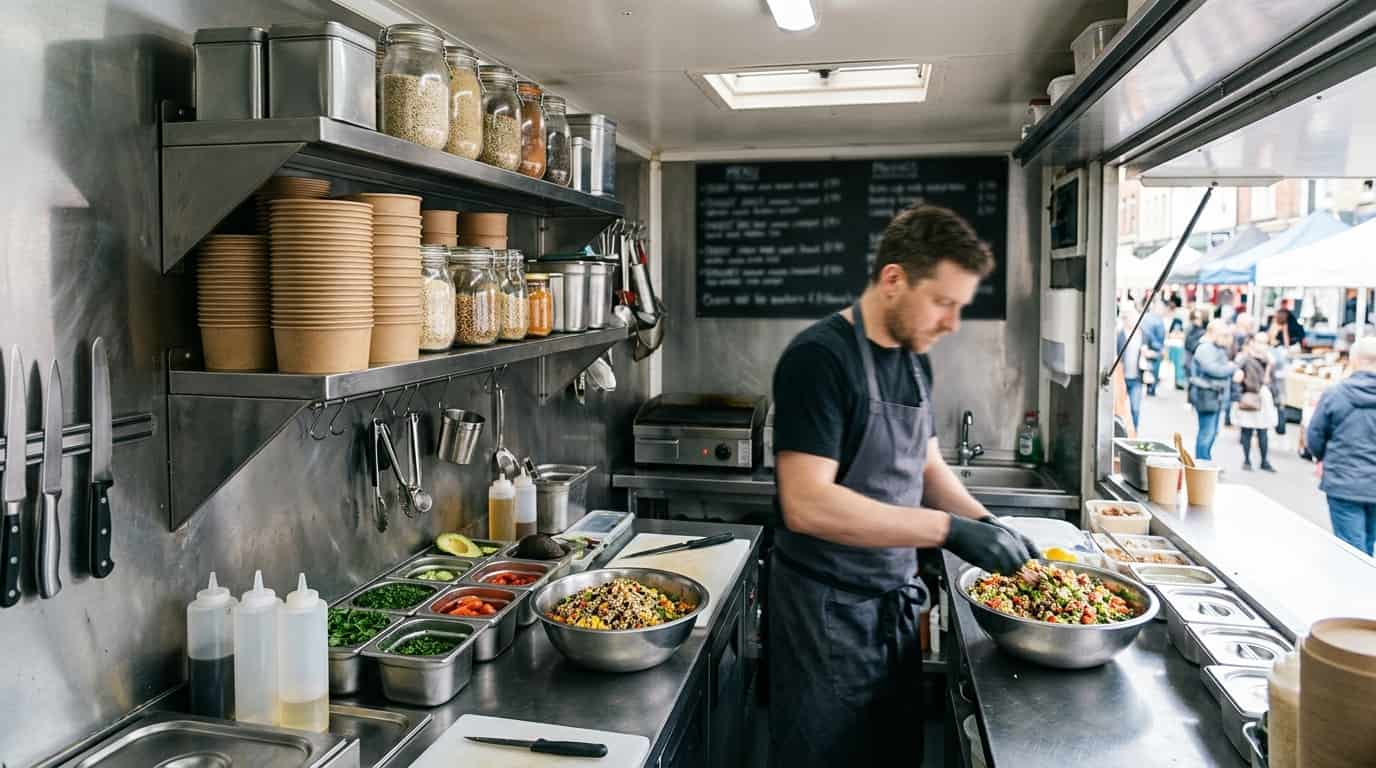
TL;DR: Food truck storage space is fixed, so the win comes from using it better. Zone your truck by workflow, build up the walls, and count stock before every order. Then check your containers: formats that stack when closed make better use of vertical shelf space. Exact space savings depend on the container and shelf, so measure both before you order.
Food truck storage space is the one thing you can't upgrade between lunch and dinner. You can swap a slow fryer or train a faster crew, but the kitchen stays the same size, and every case, tub and sauce bottle fights for the same few square feet.
If you're wondering how to store food with limited space, most advice starts and stops with shelves. Shelves help. They're also only half the answer. The other half is what goes on them: container shape, case size and how much you order.
At Plastic Container City, we supply wholesale food packaging to bakeries, restaurants, caterers and food trucks across the U.S. That gives us a close-up look at how packaging choices and order sizes shape the room a kitchen has left. Below you'll find layout basics, hidden storage ideas, a clear answer on stackable containers, an inventory routine, and a quick food safety check.
How Do You Store Food With Limited Space on a Food Truck?
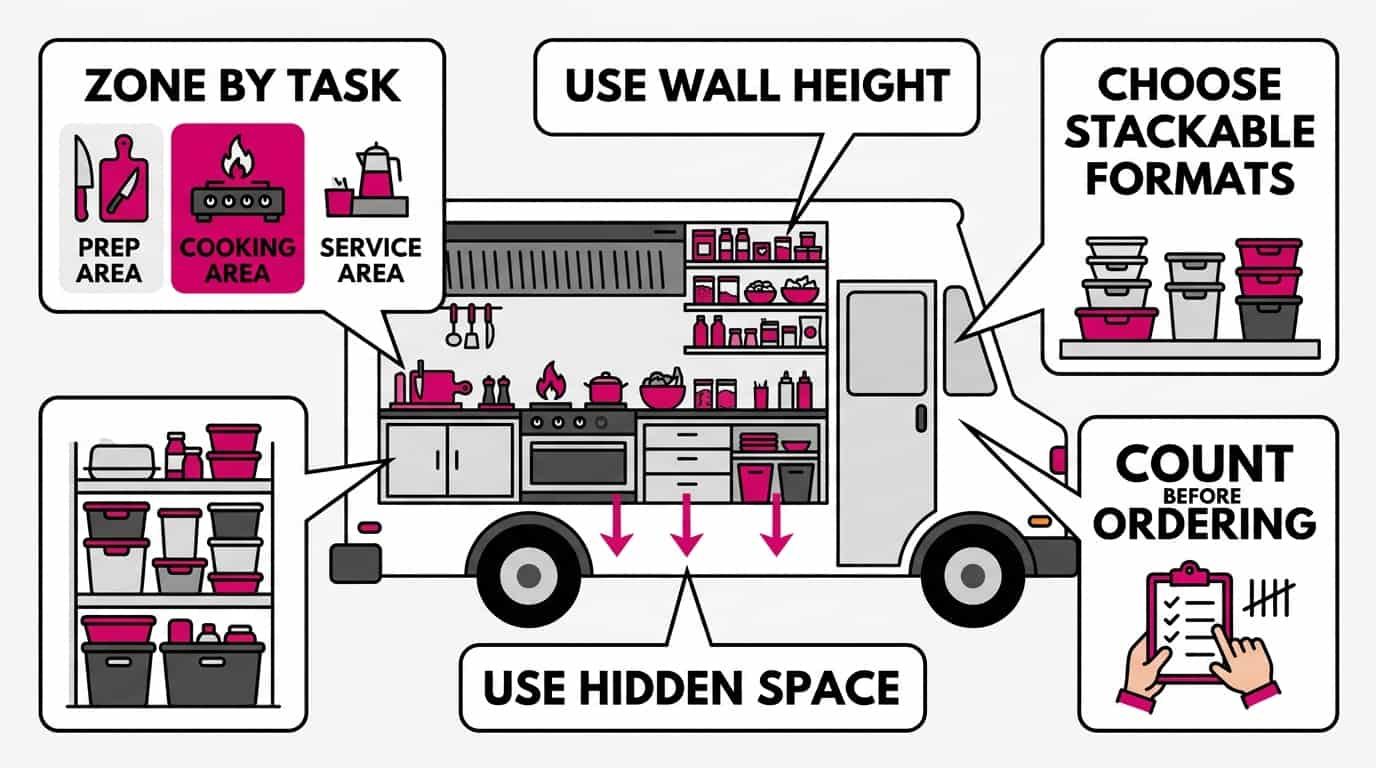
Direct Answer: Store by workflow zone, use wall height first, and give every item one home. Floor space is for your crew, not your stock.
The rule that does most of the work: store things where you use them. Cold items belong beside the prep station, and dry goods stay within a step or two of the line that uses them. Packaging lives near the service window, because that's where the handoff happens.
Then look up. Walls and the space above the counter are already yours, and shelving or wall-mounted racks pull stock off the counter and out of the aisle.
Not sure where your zones should go? Run a walk test. During one busy service, have someone tally every time the crew crosses the truck for an item. Whatever shows up most earns the spot closest to where it gets used. It costs nothing and settles most arguments about where things go.
- Zone by task: keep cold, dry, prep and packaging items in their own areas so nobody crosses the truck for a lid.
- Go vertical: fill the wall before you fill the floor.
- Give every item one home: an item without a home ends up on the counter, and counter space is for work.
What Is the Best Layout for a Food Truck?
Direct Answer: A straight-line galley or U-shaped layout works best, with a flow from storage and prep to cooking and service. Match the shape to your menu.
Both layouts organize the truck by workflow, which also organizes your storage.
- Straight-line galley: equipment runs along one or both walls. It suits fast-assembly menus like burgers or tacos.
- U-shaped: counters and appliances wrap the cook on three sides, with the open side facing the service window. Everything stays within arm's reach, which suits small trucks.
- Open central: equipment sits around the edge and the middle stays open, which fits larger trucks with several staff.
Whichever you choose, put refrigeration and dry storage toward the back or entry, away from the customer window. Put the prep station next to cold storage and the pickup window near the front for quick handoffs. For more on keeping the line moving, see how food trucks can reduce wait times during a rush. Keep the handwashing and sink area near the workspace, but out of the traffic path. If your truck is already built, the layout is a given, so the next two sections matter more.
What Are Some Creative Hidden Storage Ideas?
Direct Answer: Wall-mounted shelving, magnetic strips and prep tables with built-in storage add room to a food truck without eating into your aisle.
Think of surfaces you already own and aren't using. Walls hold shelves and magnetic strips for metal tools. A prep table with built-in storage turns the dead space underneath into a drawer or shelf.
| Tactic | What it frees up | Check before you commit |
|---|---|---|
| Wall-mounted shelving | Counter and floor space | Can you reach every shelf during a rush? |
| Magnetic strips | Drawer and counter space | They only hold metal tools. |
| Prep table with built-in storage | The space under the prep surface | Do your containers actually fit inside? |
| Stackable containers | Shelf and cooler footprint | Confirm stacking on the product page. |
Hidden spots work best when you know what's going in them. Measure a container before you build or buy a drawer or under-table shelf for it, because an awkward gap is still wasted space.
Do Stackable Containers Free Up More Space Than Shelving?
Direct Answer: Neither wins alone: shelving adds usable height, and stackable containers let several packed units share the same shelf footprint vertically. Use both.
Here's the angle most storage advice misses: the container is a space lever, not just a vessel. A format that stacks when filled and closed lets you build up on the shelf and in the cooler instead of spreading out sideways.
Don't plan around a generic space-saving percentage. Measure the container and the shelf where it will sit before you order. Here's what to verify before you buy:
- The page says it stacks. Look for stacking or nesting on the product page. If it isn't stated, don't assume it.
- Test it loaded. Stack a few with real food inside before you commit to a full case.
- The case fits your space. Pick a case your space can safely hold, not the biggest one available.
Think about where each stack will live. A stack on a dry shelf, in the cooler, or beside the service window has a different job: bulk storage, cold holding, or quick handoffs. Pick a container height that fits the shelf it will sit on.
If your truck sells desserts, our stackable cupcake containers are one example of a format sold as stackable, and the full Cupcake Containers category lists the rest. Check the product page for exact dimensions before you plan shelf space. For other formats, our guide to choosing takeout containers includes a section on why food trucks and small operators need a different approach.
How Do You Track Inventory to Avoid Over-Ordering?
Direct Answer: Count what's on hand before every order, then buy the smaller of what your shelves hold and what you'll use before the next reorder.
Over-ordering is a storage problem and a cash problem rolled into one. Stock you don't need takes room you don't have, and you've already paid for it.
The routine is simple. Count first, order second, and write the count down so you can see what you actually use. Before you order, work out how many cases fit on your shelves, then compare that limit with what you expect to use before the next reorder. Our guide to calculating packaging case quantities was written for bakeries, but the case math carries over to a truck. Fewer container sizes also means fewer boxes to stash, so trim your lineup where the menu allows. Not sure where to cut? Start with how many menu items a food truck should have.
A paper tally taped inside a cabinet door works. So does a spreadsheet. The tool matters less than doing it every time.
You can't add square footage, but you can stop wasting it. Zone the truck, use the walls, pick containers that stack, and let your shelves and your sales set your order size. Work through them one at a time and the truck starts to feel bigger without changing a single measurement. Food truck storage space is fixed. How far it stretches is up to you.
Frequently Asked Questions
What is the 2-2-2 rule for food storage?
Direct Answer: The 2-2-2 rule is a leftovers guideline published in New Zealand: refrigerate within 2 hours, eat within 2 days, or freeze for up to 2 months. It is not a U.S. Food Code rule.
New Zealand's Love Food Hate Waste campaign publishes it as everyday leftovers advice. For a working truck, the number that counts is the Food Code's two-stage cooling rule. The FDA released the 2026 Food Code on September 17, 2026, as a model for retail and foodservice that jurisdictions may adopt, so check which version your local health department enforces. Section 3-501.14 covers cooling for cooked foods that need time and temperature control:
| Cooling stage | Requirement |
|---|---|
| Stage 1 | Cool from 135°F to 70°F within 2 hours |
| Stage 2 | Cool to 41°F or less within a total of 6 hours |
Federal emergency guidance, last reviewed in 2023, adds that food held above 40°F for two hours or more should be discarded during a power outage or disaster. That's not your daily routine, though it's a fair reminder that food truck storage space includes the cooler, not just the shelves.