
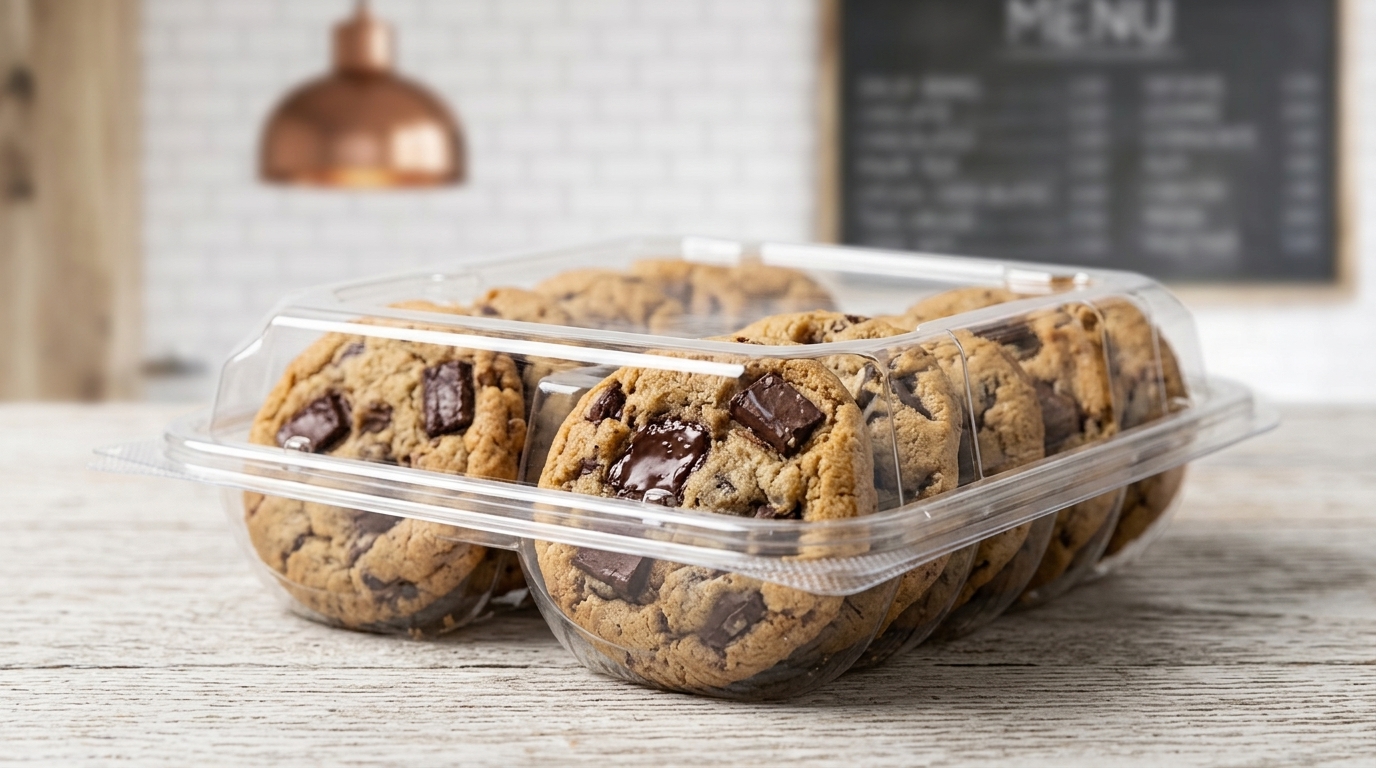
TL;DR: Foam bans are now live in 12 U.S. states plus Washington D.C., with more deadlines approaching. The primary replacement for bakery packaging is clear PET (rigid plastic) clamshells, which protect products, keep them fully visible, and work across nearly every bakery format. Paper, bagasse, and PLA bioplastic each serve specific narrower use cases. This guide breaks down which material fits which product, what freshness looks like after the switch, and what the cost reality actually is.
What is replacing Styrofoam? That question is landing in bakery kitchens and group chats across the U.S. right now, and for good reason. Foam bans are no longer on the horizon. They are live in 12 states plus Washington D.C., including California, New York, Oregon, Virginia, New Jersey, Colorado, and Vermont. Verified penalties range from a $25 Vermont second-offense fine to California's up to $50,000 per day exposure for producers and sellers of EPS food service ware. If you have been putting off the switch, the window is tightening.
The replacement market is not a mystery. Four material categories have stepped in to fill the void left by polystyrene foam, and each one has a clear job to do. The challenge is knowing which fits your operation, your products, and your bottom line. That is exactly what this post covers.
What Is Replacing Styrofoam in Bakery Packaging?
Direct Answer: Clear PET (rigid plastic) clamshells are the primary Styrofoam replacement for bakeries. Paper, bagasse (sugarcane fiber), and PLA bioplastic are also available, each suited to specific products and conditions.
The Maryland Department of the Environment already laid out the replacement field in official guidance: paper-based containers, plant-fiber containers such as sugarcane and bamboo, PLA-lined paper for hot and cold items, and recyclable plastics including PET and PP. These are not experimental alternatives. They are in active use across U.S. food service operations right now.
What replaces Styrofoam is not one single answer. It is a decision based on your product. The operator selling frosted cupcakes and the one selling dry shortbread cookies will land on different choices, and both can be correct. The key is knowing which material does what.
The 4 Main Styrofoam Alternatives for Bakeries
Here is what each material actually does, where it falls short, and where it fits best in a commercial bakery context.
| Material | See-Through | Grease-Resistant | Moisture-Resistant | End-of-Life | Best For |
|---|---|---|---|---|---|
| PET Clamshell | Yes | Yes | Yes | Recyclable (plastic #1) | Cupcakes, cookies, pastries, brownies, donuts, macarons |
| Paper / Molded Fiber | No | Only if coated | Only if coated | Compostable | Dry items: shortbread, biscotti, plain cookies |
| Bagasse (Sugarcane) | No | Yes | Yes | Compostable | Greasy items, hot pastries, savory baked goods |
| PLA Bioplastic | Yes | Partial | Partial | Certified compostable | Cold display, short shelf life items |
PET Clamshells: The Workhorse of Bakery Packaging
PET is transparent, lightweight, grease-resistant, and moisture-resistant. It stacks cleanly, ships without issue, and lets your product do the selling before a customer ever opens the container. The Recycling Partnership is actively funding improvements to PET thermoform collection and reclaim capacity across the U.S., and PET carries the #1 plastic recycling label, making it the most defensible choice in states moving toward stricter packaging rules.
Paper and Molded Fiber: Right for Dry Products
Paper containers are compostable and familiar to customers. The catch, confirmed by a USDA 2025 technical report, is that plant fibers readily absorb moisture and grease unless treated with additives or coatings. Some molded fiber formats use coatings or additives for grease control, moisture resistance, or added strength, so performance varies by product spec. For dry baked goods like shortbread or biscotti, paper is a reasonable choice. For anything with frosting, glaze, or a greasy base, it creates a freshness problem quickly.
Bagasse: Sturdy but Opaque
Bagasse containers are built from sugarcane fiber and handle grease and moisture well. They are compostable and sturdy. The trade-off: they are not clear, so your product stays hidden until the customer opens the box. For display-driven grab-and-go retail, that is a real disadvantage. Bagasse earns its place for hot or heavily greasy items where visibility matters less than containment.
PLA Bioplastic: Clear but Heat-Sensitive
PLA looks and feels similar to PET but behaves differently under heat. It can crack or warp in warm environments, which creates a real risk for a bakery grab-and-go case or summer delivery. If you are choosing compostable packaging, the EPA advises verifying BPI certification or another recognized compostability standard before relying on the claim, since not all products marketed as compostable actually meet certified standards.

Which Container Works for Which Bakery Product?
Direct Answer: PET clamshells fit most bakery items. Use paper for dry goods, bagasse for hot or greasy foods, and PLA for cold display only.
| Product | Recommended Container | Why It Works |
|---|---|---|
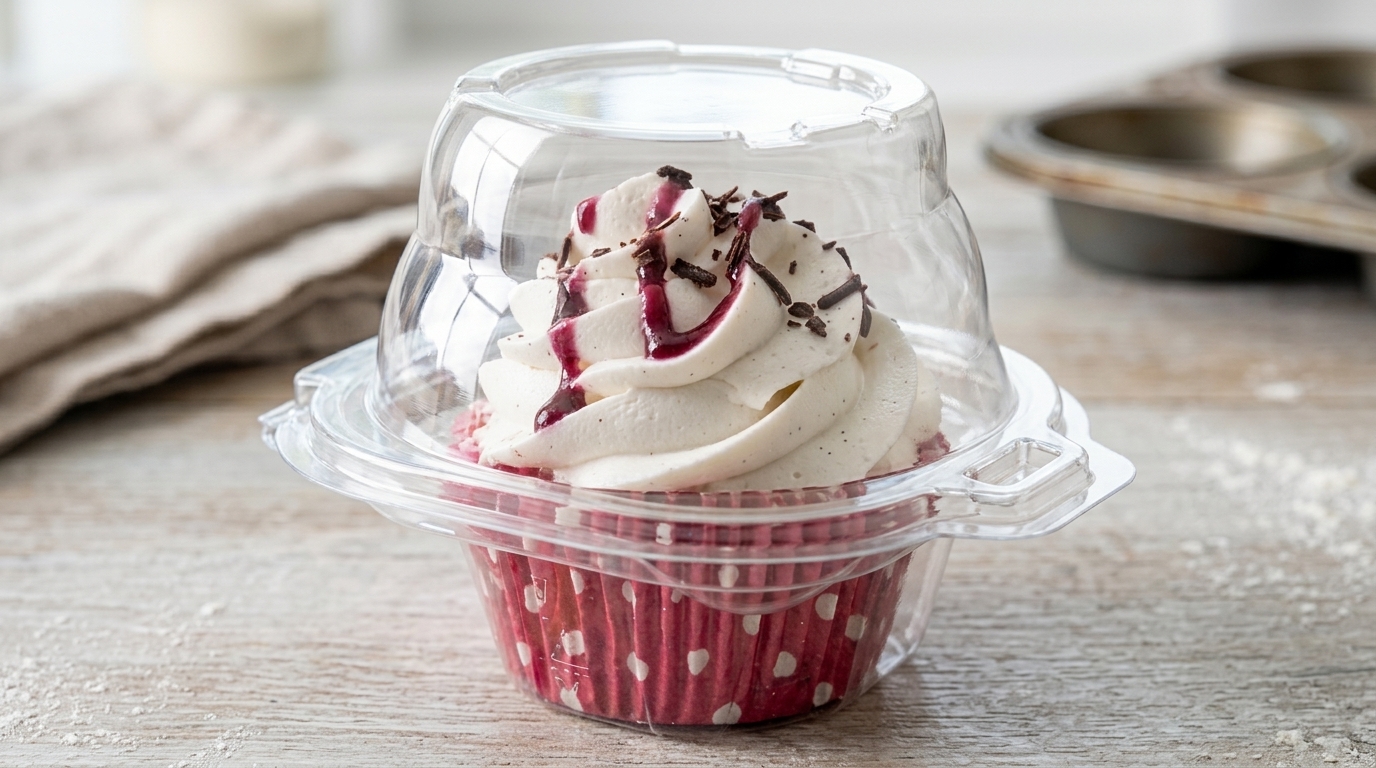
| Cupcakes | PET dome lid clamshell | Dome height protects frosting; crystal-clear walls drive grab-and-go sales |
| Muffins | PET 2- or 4-count clamshell | Clear display, moisture barrier, fits standard retail shelf footprint |
| Cookies | PET flat clamshell or paper (dry only) | PET for display value; paper suits dry, room-temperature cookies with fast turnover |
| Brownies and Bars | PET flat clamshell | Grease resistance is key; PET keeps the base clean and product visible |
| Cake Slices | PET wedge or slice container | Clear all sides, grease-resistant base, structured walls prevent leaning |
| Pastries | PET (display focus) or bagasse (greasy or hot) | Match to grease level and whether product visibility drives purchase |
| Donuts | PET clamshell | Grease resistance, shape support, full product visibility at point of sale |
| Macarons | PET flat clamshell | Protects the delicate shell; lets color and detail work as a sales driver |
At Plastic Container City, we work with thousands of food professionals across the U.S., from cottage bakers to large-scale catering operations. The consistent pattern from operators who have already made the switch: matching the container to the product matters more than the material choice alone. Get the product fit right first, and the rest follows. For a broader look at how packaging choices affect your retail setup, see our guide to grab-and-go bakery packaging.
Does Switching from Foam Change How Your Products Look?
Direct Answer: Yes, and usually for the better. Clear PET containers give customers an unobstructed view of your product. The Foodservice Packaging Institute's 2025 consumer survey ranked the ability to see food through packaging as a top performance priority for single-use containers.
Foam always had a quiet weakness in bakery retail: it hid the product. The Foodservice Packaging Institute's 2025 consumer survey tracked the ability to see food through a clear pack as one of the top performance attributes customers care about, alongside leak prevention, grease control, and temperature retention.
Crystal-clear PET containers give your cookies, cupcakes, and brownies full visibility from every angle. Dome designs protect frosting and decorations while the customer can see exactly what they are getting before they reach for it. In any grab-and-go retail format, the product does the selling when the packaging stays out of the way. Foam never offered that. PET does.
What Happens to Freshness and Shelf Life When You Switch?
Direct Answer: The material matters. PET provides strong barrier performance, while paper and bagasse risk moisture loss unless treated with grease-resistant coatings.
This is the question that keeps bakery operators up at night, and it deserves a direct answer. A 2026 review published in Nature confirmed that moisture sorption, moisture loss, and oxygen ingress are the most critical variables for bakery product shelf life. Packaging barrier performance is a functional issue, not just a compliance one.
How each material stacks up on freshness:
- PET: Performs well on both moisture and oxygen barriers. Reliable for most bakery shelf life requirements.
- Paper and uncoated bagasse: Weaker on moisture and oxygen. Real freshness risk for products with frostings, glazes, or softer textures.
- PLA: Adequate for short-term cold storage. Not reliable for warm environments or extended hold times.
- Coated bagasse: Improved moisture resistance but still opaque, and compostability claims vary by certification.
The same Nature review noted that many sustainable films still show higher permeability than conventional materials. If freshness is critical for your product (and in a commercial bakery, it almost always is), your packaging choice needs to treat barrier performance as a primary spec, not an afterthought.
At Plastic Container City, we see many bakeries moving to PET specifically because it maintains the "snap" of cookies longer than fiber alternatives, a detail that matters when products sit in a grab-and-go case for several hours before purchase. For a deeper look at how packaging choices affect perceived freshness, see our guide to Bakery Packaging Freshness: Science & Perceived Quality.
What Does the Switch Actually Cost?
Foam was cheap. There is no point softening that. PET clamshells sit closest to foam in per-unit cost of the four alternatives, which is why they are the most common first choice for operators making the switch. Bagasse and PLA carry higher per-unit costs. Paper pricing varies depending on spec and coating requirements.
Packaging Dive reported in July 2025 that sustainable packaging still carries a price premium over conventional options, though the gap is narrowing as production scales and adoption grows. Supply-side pressure is also real: FoodNavigator reported in March 2026 that food and beverage operators are facing rising packaging costs tied to supply disruption and resin exposure.
The cost concern is valid. But it has to sit alongside what non-compliance costs in states with active bans. California penalties for EPS food service ware can reach $50,000 per day for producers and sellers. Virginia's civil penalty runs up to $50 per day. Rhode Island fines up to $100 per violation. For most operators, the cost math becomes straightforward once the penalty exposure is on the table.
For a complete look at which states have active bans, who is covered, and what the fine ranges are, see In What States Is Styrofoam Illegal? 2026 Food Business List. Ask your supplier about lead times before the effective date, especially if you need a less common size, count format, or case quantity.
Can You Still Buy Styrofoam Containers?
Direct Answer: In ban states, foam food service containers can no longer be legally sold, distributed, or used by food operators. In non-ban states, foam is still available, but operators should verify their state's current status before placing new orders.
Foam has not disappeared from every shelf in the country, but the legal window for ordering it without compliance risk is narrowing. In California, Oregon, Washington, New York, Maryland, and several others, selling or distributing EPS food service ware is no longer permitted. The Farewell to Foam Act (H.R. 1918), reintroduced in Congress in March 2025, proposes a federal ban effective January 1, 2028 if enacted.
For operators in ban states, the question is no longer whether to switch. It is which alternative fits your products and how fast you can source it. The answer is in the tables above.
For the full compliance picture across packaging types beyond foam, including label requirements, container standards, and what food businesses need to know this year, the Bakery Packaging Laws 2026 guide has the detail.
The Bottom Line on Styrofoam Alternatives
What is replacing Styrofoam is not one magic material. It is a decision based on your product, your customer's experience at the point of sale, and your state's compliance requirements. Clear PET clamshells handle the broadest range of bakery applications and sit closest to foam on price. Paper, bagasse, and PLA each have valid but narrower roles.
Operators making this transition cleanly are the ones who matched material to product first, checked barrier specs second, and then looked at price. That order matters. Skip straight to price and you can end up with packaging that fails your product on freshness or display before it saves you a penny.
Browse the full range of food-safe bakery containers at Plastic Container City, or head to the Plastic Container City blog for more guides on packaging compliance, product display, and bakery operations.
Frequently Asked Questions
Is Styrofoam being banned in 2026?
Foam bans are already active in California, New York, Oregon, Washington, Maryland, Delaware, Rhode Island, and others. Virginia extends its ban to all food vendors on July 1, 2026. A federal proposal (H.R. 1918) targets January 1, 2028 if passed. Check your state's current status before ordering new stock.
What is the cheapest Styrofoam alternative for bakeries?
Clear PET plastic clamshells sit closest to foam in per-unit cost and cover the broadest range of bakery products. They are the most cost-competitive starting point for operators making the switch without compromising on display or freshness performance.
Are plastic clamshells better than foam for bakeries?
For most bakery applications, yes. Clear PET offers better product visibility, similar structural protection, grease resistance, and no compliance risk in ban states. The main trade-off is a modestly higher per-unit cost compared to foam, which narrows as PET adoption scales.
What is the best container for cupcakes after the foam ban?
Clear PET containers with dome lids are the strongest option. Dome designs protect frosting and decorations while keeping the product fully visible. Choose the cupcake container size that fits your display case, pickup orders, and event trays.
Will plastic packaging be banned next?
A full ban on food-safe rigid plastics like PET is not currently proposed or enacted in any U.S. state. Regulatory attention has focused on EPS/polystyrene foam and single-use plastic film. Rigid PET food service packaging remains a legally viable and widely recommended replacement across ban states.
What is the best container for cupcakes after the foam ban?
Clear PET containers with dome lids are the strongest option. Dome designs protect frosting and decorations while keeping the product fully visible. A 24-count cupcake tray can work well for larger retail and event orders.