
TL;DR: Food truck wait times during a rush shrink when you find the slowest step and fix that one first. This guide shows how to time your own rush, what chain benchmarks can and cannot tell you, how to speed up order taking, where POS and QR ordering help, and how pack and handoff choices cut handling. Start with a stopwatch, not a shopping cart.
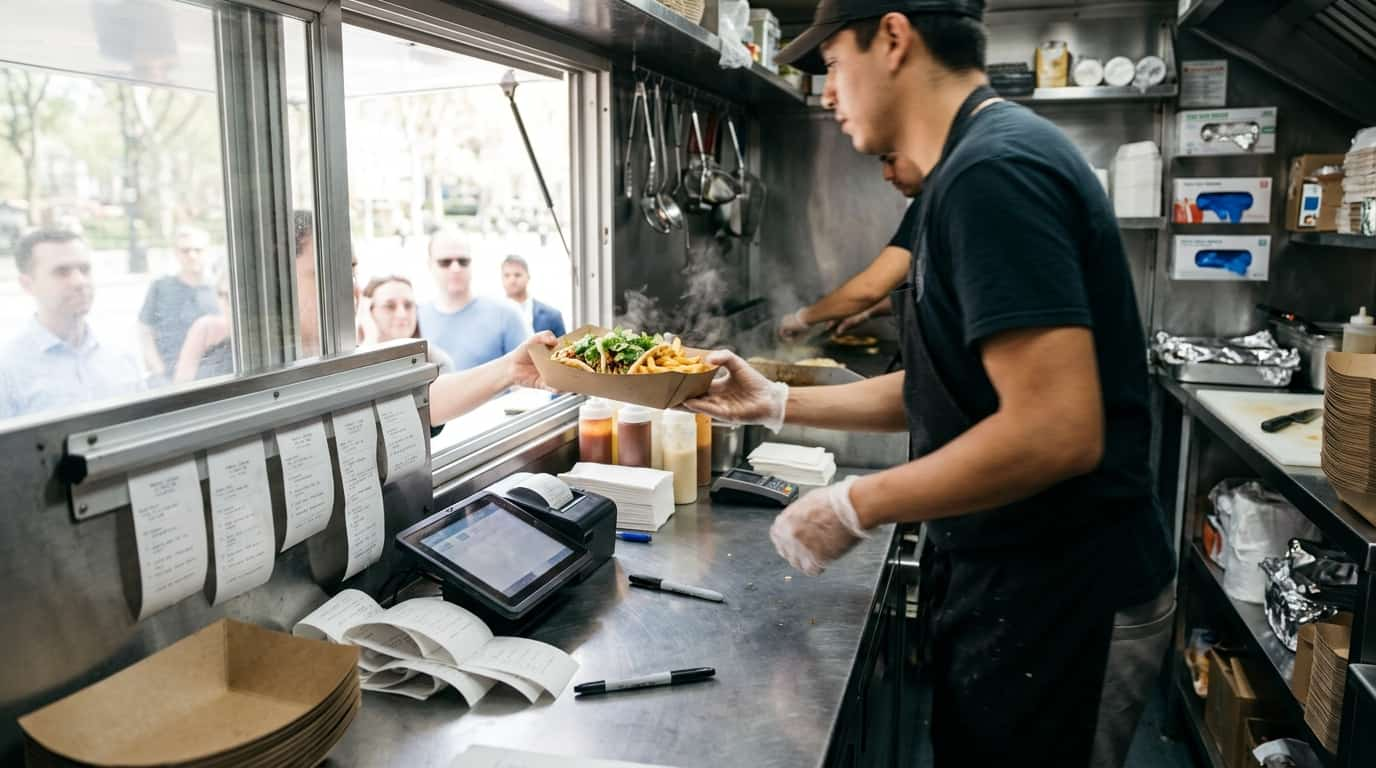
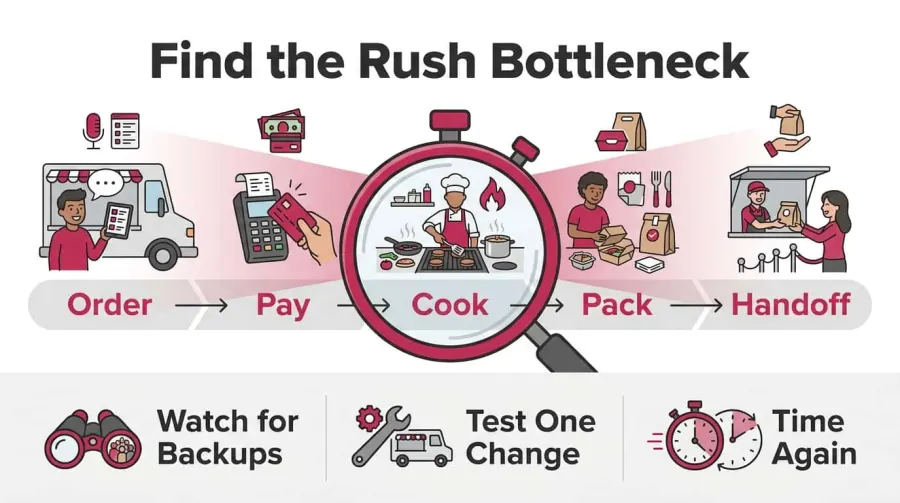
Food truck wait times during a rush are rarely one big problem. They are five small ones stacked in a line: taking the order, taking payment, cooking, packing and handing it over. Customers do not see the stack. They see a queue, check the time and decide whether your tacos are worth it. For an operator, every lost customer is a sale walking away while you cook.
If you want to know how to reduce customer waiting time, hold off on the new menu and the new gadget until you know which step is eating your minutes. This guide covers a rush audit, what counts as a long wait, faster order taking, POS and QR ordering, and the pack and handoff step most guides skip.
Plastic Container City sells disposable food packaging, so we are biased. That is why packaging comes last here, beside the other levers and not above them. It earns its spot only where it takes a decision or a motion out of your rush.
How to Reduce Customer Waiting Time?
Direct Answer: Time each step of a busy rush and watch where orders pile up. Find the bottleneck, change one thing and measure the results.
Guessing is expensive. A truck can buy a faster POS and still have a line, because the real hold-up was the packing counter. At your next rush, grab a phone timer, a notepad and one person who is not cooking. Also measure how long customers wait before reaching the order window. That time falls outside the five service stages but matters to the customer.
| Step | What to record | What it tells you |
|---|---|---|
| 1. Order taking | Seconds from the customer reaching the window to the order entered | If longest, look at your menu board, how orders are heard and your POS |
| 2. Payment | Seconds from order entered to payment complete | If longest, fix the payment flow first |
| 3. Cook line | Seconds from ticket received to food ready | Points to prep, menu complexity or station layout |
| 4. Pack | Seconds from food ready to container closed and bagged | Points to container choice and how you stage packaging |
| 5. Handoff | Seconds from container closed to the customer holding the order | Points to where finished orders wait and how you call them |
Time a handful of orders and note where tickets or customers build up. The longest average step is not always the bottleneck, especially when tasks overlap. Change one thing, then time the next rush.
How Long Is It Acceptable to Wait for Food?
Direct Answer: There is no single wait-time target for every food truck. In 2026, U.S. quick-service drive-thrus averaged 5:24 total time, but customer expectations also matter.
That 5:24 comes from the 2026 drive-thru study by Intouch Insight: 2,145 mystery-shop visits across 13 U.S. quick-service brands in June and July 2026. It is chain data, not food truck fieldwork, so use it as a yardstick and not a promise.
Perception matters more. In Intouch's 2026 counter-service study, satisfaction was 98.5% when service felt quicker than expected and 76.9% when it felt slower, regardless of the actual clock. Your goal is a ticket that beats the expectation you set.
| Measure (chain restaurants, not food trucks) | Figure |
|---|---|
| Average total drive-thru time, 2026 | 5:24 |
| Counter service, order received, 2026 | Just over 4 minutes (Subway just over 2, some brands about 6) |
| Satisfaction, service felt quicker vs slower than expected, 2026 | 98.5% vs 76.9% |
The counter-service research also found that longer service times were often tied to more complex or made-to-order items. That lesson travels well: every made-to-order item is another step at your window.
How to Speed Up the Server?
Direct Answer: Make orders easy to hear and confirm. A 2025 drive-thru study linked clear speakers and fewer repeated orders with faster drive-thru interactions.
In its 2025 drive-thru research, Intouch found that clear speaker systems were associated with interactions 54 seconds faster, and orders that did not need repeating saved 1:25. That is 2025 chain data, but a truck window has the same weak spot: street noise, a crowd and a customer leaning in to shout.
- Give order taking one owner. Everyone else stays off the window, so each order is heard once and entered once.
- Put the menu where people read it before they reach you. Customers who arrive ready to order take less window time.
- Read the order back once, from the screen or ticket. Mistakes get caught before the cook line, not at the handoff.
- Give each station one job. Switching between taking payments and bagging food costs seconds on every order.
Does a Smaller Menu Make the Line Faster?
Direct Answer: A simpler menu can shorten service, because complex and made-to-order items were often tied to longer waits in 2026 research. There is no magic menu-item count.
Starbucks planned a roughly 30% cut to its U.S. menu by the end of fiscal 2025 and said simplification was meant, among other aims, to help reduce wait times. Other operating changes ran at the same time, so read it as a signal, not proof. For a truck, extra menu items can add prep steps, packing decisions and more container types. To assess which dishes earn their place, see our guide to how many menu items a food truck should have.
What Is the Best POS System for a Food Truck?
Direct Answer: No single POS is best for every truck. The best one is the system your crew can use fastest at the window, with quick payments and tickets that reach the cook line.
We are not ranking brands, because the right pick depends on your menu, your payment mix and how many hands are on the window. Test instead. During a quiet hour, run your three most common orders through each option and record:
- Taps needed to enter each order
- Seconds to take payment
- Whether the ticket shows up where the cook can see it
Then match the winner to your audit. If payment was your slowest step, payment speed beats a fancy menu screen.
Should Food Trucks Use QR Ordering or a Virtual Queue?
Direct Answer: QR ordering can move orders off the window, but it will not make the kitchen cook faster. Match online-order capacity to what the crew can prepare on time.
Intouch's 2026 mobile-order study found that one in five orders was not ready at the expected time. Satisfaction was 97% when orders were ready on time and 76% when late, and late orders stretched time spent in the restaurant from 2:51 to 7:10. For a truck, only promise what your cook line can deliver, and cap online orders at that number.
Can Packaging Choices Speed Up a Food Truck Rush?
Direct Answer: Packaging helps at the pack and handoff steps by cutting decisions per order: fewer container types, lids attached to the container and portions staged before the rush.
The pack step is where a rush gets physical. Hands are full, the line is watching and every order needs a container, a lid and often a sauce. Four choices take decisions out of that moment, and your audit is the proof: if pack time drops, it worked.
- Choose a lid that is part of the container. A hinged clamshell has the lid attached, so nobody hunts for a match mid-rush. Our 9" and 6" white hinged clamshells are PET (#1) and come in 150 and 250 per case. Match the container material to the food's serving temperature. Check the product's temperature suitability before choosing PET for hot food.
- Portion sauces before the window opens. Our 4 oz portion cups with lids are clear, stackable PET (#1), so a packer can see what is inside and drop one in without pouring. Hold pre-portioned items as your local health code allows.
- Pre-pack cold items between rushes. Salads, fruit cups and sides can be packed ahead so the window only hands them over. Keep foods that require refrigeration at the required cold-holding temperature until handoff, following local food-safety rules. Our Grab N Go category includes tubs, compartment trays and fruit cups.
- Standardize on fewer container families. If two dishes need two different container families, that creates more stock to store, count and reorder, plus one more choice for the packer on every order.
Then fix the handoff. The same 2026 mobile-order research found that only 65% of studied locations had a clearly designated pickup area, and only 66% of orders were confirmed before handoff. The truck version is easy: one spot where finished orders sit, a name or number call, and a quick check that the bag matches the ticket. Not sure which format suits your menu? Our guide to choosing takeout containers walks through it.
What Should You Fix First Before the Next Rush?
Direct Answer: Run the stopwatch audit at your next rush, then fix the slowest step. Change one lever at a time so you can see which one moved your numbers.
Chain data gives you a useful reference, but your own rush tells you where to act. Try one change, measure the next rush and see what moved. Fix the bottleneck, and food truck wait times during a rush stop feeling like weather you cannot control.
Food Truck Wait Time FAQs
What Is the Average Wait Time at Chick-fil-A?
Direct Answer: In Intouch Insight's 2024 drive-thru study, Chick-fil-A averaged 479.42 seconds in total time, about 7 minutes 59 seconds.
That measures the full drive-thru visit in 2024, not just the time spent waiting in line. The same 2024 report put the overall average at 329.05 seconds, about 5:29. Intouch reports wait, service, window and total time as separate measures, so keep the terms straight.
How to Make Waiting Feel Shorter?
Direct Answer: Give an honest estimate once the line grows, keep the line visibly moving and greet every customer. A wait that beats the promise feels shorter.
Call names clearly, keep the menu readable from the queue so people decide before the window, and look each customer in the eye. A friendly touch costs nothing and softens a long line.
How to Deal With Customer Complaints About Waiting Too Long?
Direct Answer: Acknowledge the wait, give a real time estimate and fix what you can right away. Keep it short, because the rest of the line is listening.
Do not argue with the clock. Say it is running long, give an honest number and then hit it. A complaint handled at the window beats a bad review written from the sidewalk.