
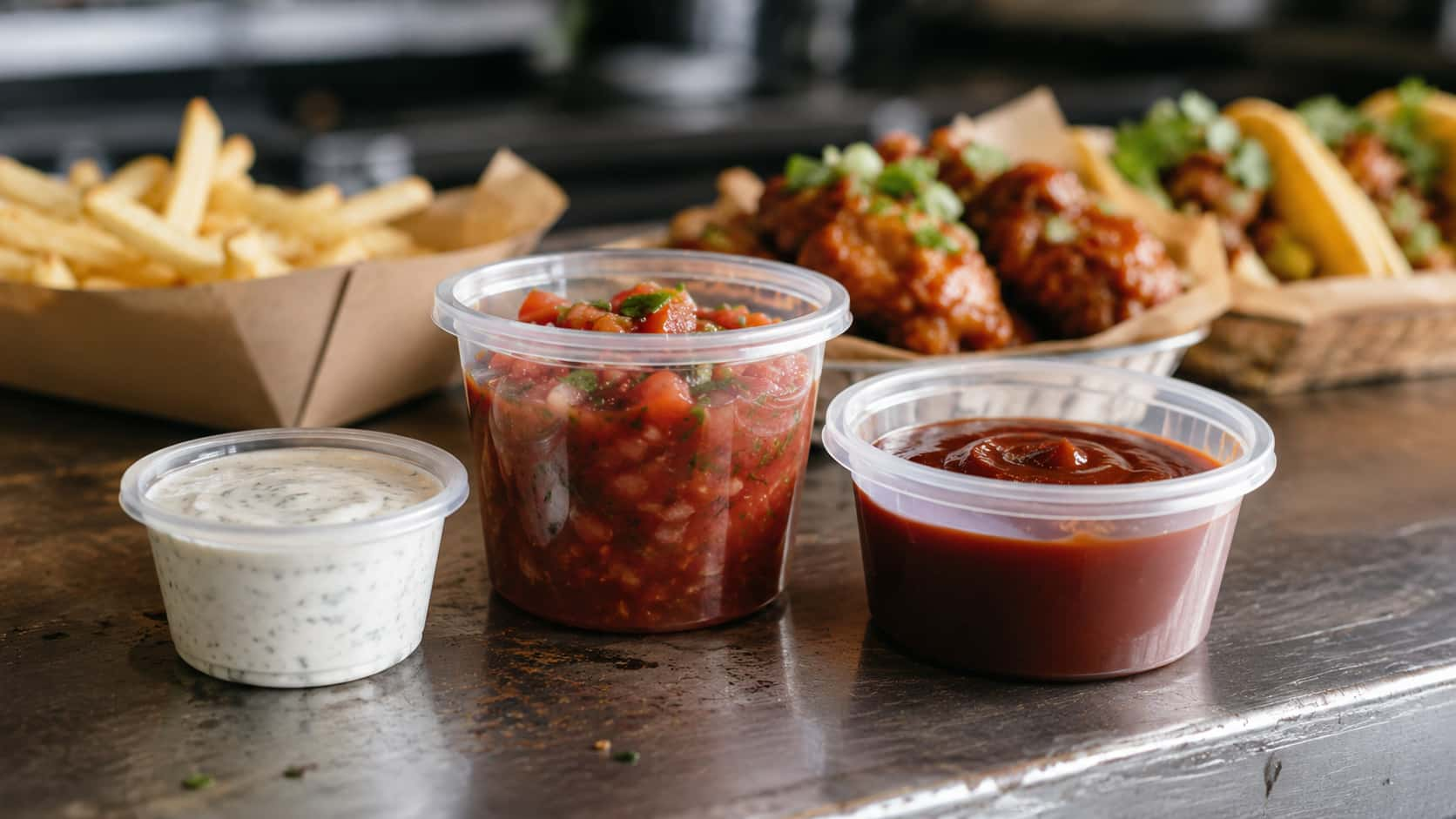
If you are guessing at portion cup sizes for your restaurant, you are probably overspending on every single order. Standardizing portion cup sizes is one of the quietest cost leaks in off-premises packaging, and most operators don't notice it until they do the math. Three or four cup sizes get ordered. They get used inconsistently. Staff grab whatever is closest. And every week, someone runs out of the right size at the wrong time.
TL;DR: Getting portion cup sizes right is a cost-control move, not a chart exercise. For most menus, 1 oz, 2 oz, and 4 oz cover sauces, dips, and dressings. Souffle cups suit dine-in service. Lidded cups belong in takeout and delivery. The real win is simple: stop guessing, stop overfilling, and buy fewer sizes with more intent.
The good news? For most menus, three core sizes do the heavy lifting: 1 oz for tight portion control on single condiments, 2 oz for dipping sauces and dressings, and 4 oz for larger sauce portions and combo orders. Everything beyond that is a choice, not a necessity.
At Plastic Container City, we work with food professionals across the U.S., from food trucks to fast-casual spots to caterers, and the same pattern shows up constantly: operators over-order the wrong size, under-order the right one, and pay twice for the same inefficiency. This guide cuts through that. By the end, you will know exactly which size goes where, when a lid is mandatory, and why the cup you are currently using for delivery might already be a problem.
What Are the Standard Portion Cup Sizes for Restaurants?
Direct Answer: For most menus, 1 oz, 2 oz, and 4 oz cover tight condiments, dips, dressings, and larger sauce portions.
Most restaurants don't need a cup for every occasion. They need the right three. Here is how the core sizes break down operationally:
| Cup Size | Best Use Case | Recommended Format |
|---|---|---|
| 1 oz | Ketchup, mustard, mayo, single-serve condiments | Souffle (dine-in) or lidded (delivery) |
| 2 oz | Dipping sauces, dressings, hot sauce, sour cream | Souffle (dine-in) or lidded (delivery) |
| 4 oz | Generous dips, gravy, chunky sauces, coleslaw | Lidded strongly recommended |
| 6 oz+ | Soups, large sides, catering portions | Use a dedicated food container, not a sauce cup default. |
The 2 oz cup is the workhorse. It covers most table-service dipping needs and most delivery dressings without looking stingy or wasting product. The 1 oz cup earns its place for high-volume, single-use condiments where tight portioning is a feature, not a limitation. The 4 oz cup belongs on menus where sauce is a main event: BBQ platters, wing baskets, loaded dipping boards.
With National Restaurant Association data showing that nearly 75% of all restaurant traffic is now off-premises, the way you package sauces for transit has a direct line to customer satisfaction, and to your per-order costs.

Which Lid Type Is Required for Delivery vs. Dine-In?
Direct Answer: Use open-top souffle cups for dine-in condiment stations. Use lidded portion cups for takeout, delivery, catering, and transport.
This is where operators make the most consistent mistake. Souffle cups, the thin, fluted paper or plastic cups you see at condiment stations and fast-casual counters, are built for a table. Unlidded souffle cups belong at the counter, not in a delivery bag. Once sauce has to travel, the cup needs a fitted lid made for transit.
Lidded portion cups look similar in size but come with snap-on lids that keep sauces contained through transit. The lid adds a small cost per unit. It also prevents a one-star review from a customer who opens their bag to find ranch dressing all over their fries.
The rule by service format:
- Dine-in counter service: souffle cups are the right call
- Takeout bags: always use a lidded cup
- Third-party delivery: lidded cup with a snap-on lid, no exceptions
- Catering and event transport: lidded cup throughout
It is also worth noting that New Jersey's updated foodservice guidance, which restricts automatic distribution of condiment packets from August 1, 2026, explicitly still permits single-use portion cups for sauces and dressings served with food. The lid, not the cup format itself, is the delivery variable that matters.
Does Over-Sizing Portion Cups Actually Cost You Money?
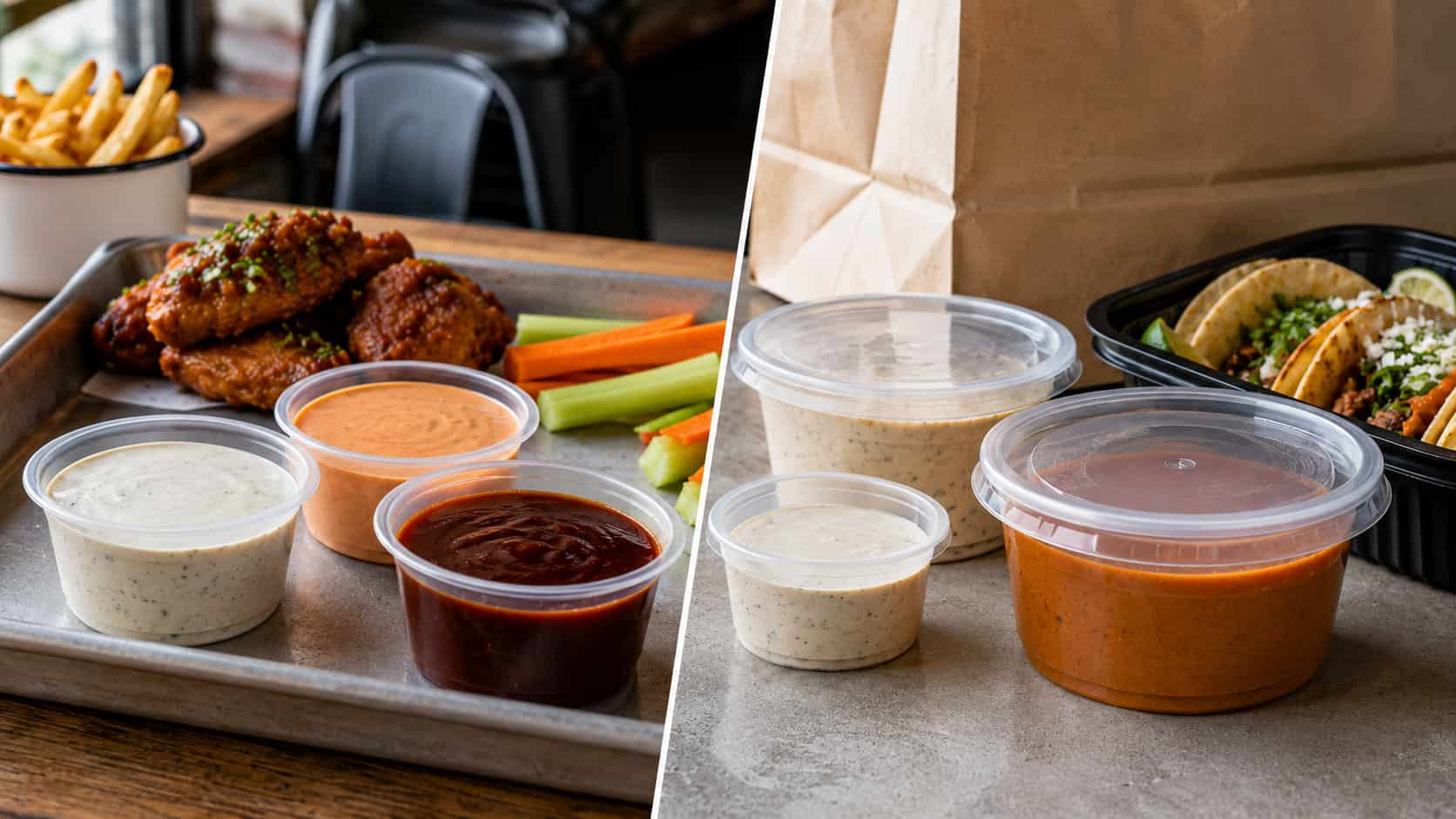
Direct Answer: Yes. Upsizing raises cup cost and nudges staff to fill the larger cup, so packaging cost and sauce cost climb at once.
This is the over-sizing trap, and it runs on a logic that sounds reasonable in the moment: "bigger is safer." The fear is that a customer complains about not getting enough sauce. The reality is that there are two costs in play, and most operators only see one.
Cost one is the cup itself. Larger cups usually cost more across a full case, and the gap shows up over weeks, not on one ticket. The unit gap may look small on one ticket, but it gets louder when you multiply it across a full week of service.
Cost two is the product inside it. When a staff member sees a 4 oz cup, they fill a 4 oz cup. When the intended portion is 2 oz of sauce, you have just doubled your sauce cost per serving, without anyone making a deliberate decision to do so. In a high-volume kitchen, that is real money leaving through an unnoticed hole.
The answer is not to go stingy. It is to right-size. A well-filled 2 oz cup of your house dipping sauce looks far more intentional and generous than a half-empty 4 oz cup. Presentation matters, consistency matters, and so does the cost structure behind every plate that goes out the door. For more on packaging cost leaks and how to close them, see How to Reduce Packaging Costs at Your Restaurant Without Downgrading Quality.
How Does Portion Cup Choice Directly Affect Per-Order Packaging Cost?
Direct Answer: Portion cup cost comes from size, lid choice, and SKU count. Fewer right-sized cups are easier to buy, stock, and train staff on.
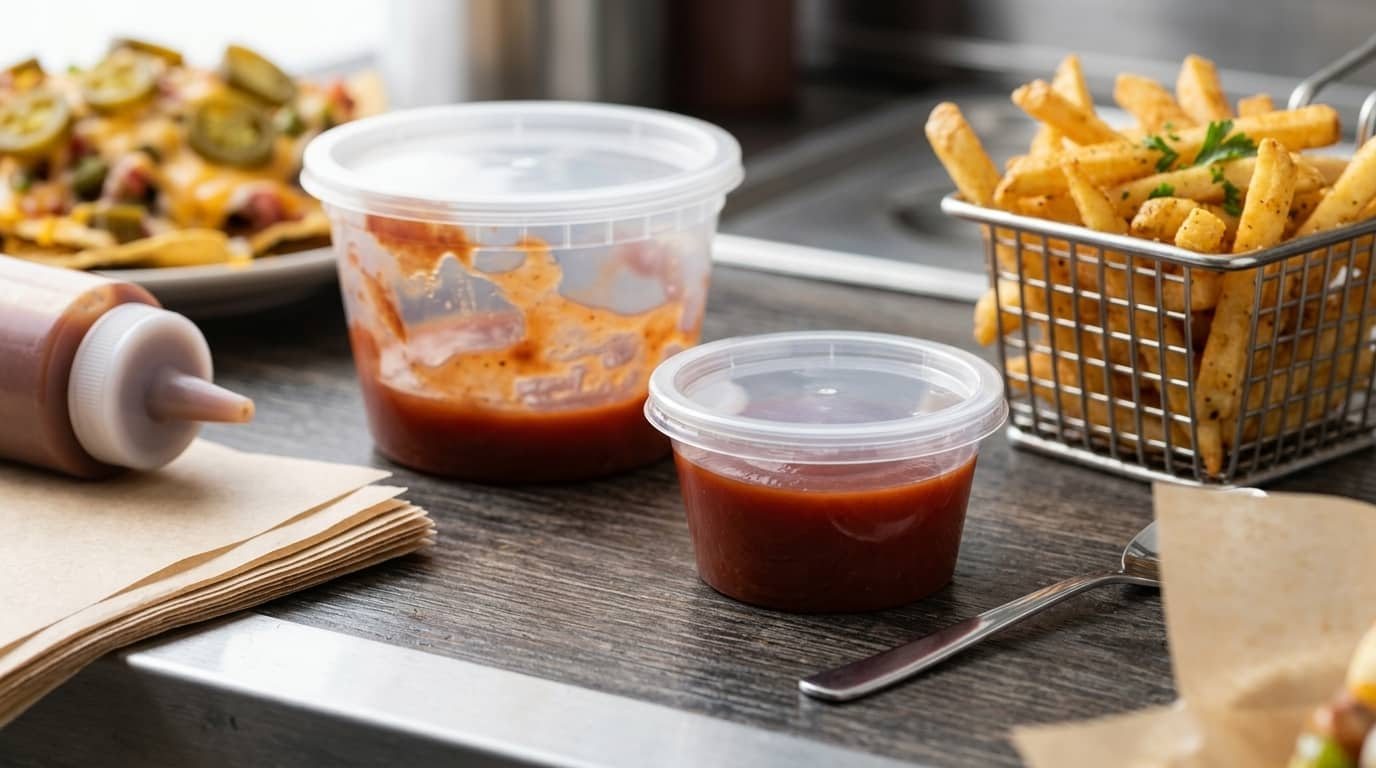
Every sauce cup that goes into an order has a unit cost. Multiply that across a week of service and the packaging line item is a real figure, particularly for high-volume, sauce-heavy menus like wings, tacos, or loaded fries, where sauce cups can appear several times on the same ticket.
For food trucks, this matters fast because portion cups are touched on nearly every order and storage space is tight.
The three variables that control per-order cost in portion cups are: size selected, lid requirement, and number of SKUs stocked. Buying in bulk can lower the per-unit cost, but only when you are buying enough of the right size to make the case count work. Splitting volume across six sizes leaves you with smaller case buys, more storage pressure, and more chances to run short of the size you need. The Plastic Container City range covers portion cups in the key sizes, at volumes that make sense for restaurant-scale buying.
What Is a Sensible Portion Cup Budget Per Order?
Direct Answer: Track cups per order, unit cost, and weekly order volume. That shows the real spend before you change sizes.
As a starting point for calculating your own packaging costs: total up the number of sauce cups going out per cover, multiply by your current unit cost, and annualize it. That number is often enough to show whether cup choice is a tiny detail or a quiet weekly leak.
The National Restaurant Association's May 2025 off-premises guidance points operators toward packaging systems that reduce SKU complexity, including shared lid setups across compatible container sizes.
How Do You Reduce the Number of Portion Cup Sizes You Stock?
Direct Answer: Use 1 oz for single condiments and 2 oz for most sauces. Add 4 oz only when a menu item needs a larger dedicated pour.
SKU bloat is a real operational drag in foodservice packaging, and portion cups are one of the worst offenders. Operators who stock 1 oz, 1.5 oz, 2 oz, 3 oz, and 4 oz cups are managing five separate reorder points, five different storage positions, and five separate chances to run short of the wrong size on a Friday night rush.
The National Restaurant Association's packaging guidance directly notes that systems allowing the same lid to fit different container sizes reduce SKU complexity, a principle that applies directly to portion cups. Fewer sizes means simpler buying, simpler storage, and simpler training. Everyone on the line knows: small cup for single condiments, medium cup for sauces. That is the whole system.
If your menu includes a dish where sauce is a headline item (a wing platter, a loaded nacho, a dipping board), add the 4 oz as a dedicated use case, not as a general default. Keep it purposeful and targeted. When staff know which cup belongs with each dish, portions stay consistent and product waste is easier to control.
What Are Portion Cups Made Of, and Does Material Matter?
Direct Answer: Most portion cups are PP or paper. Check heat rating, lid fit, supplier specs, and state rules before choosing a material.
Polypropylene is common in foodservice portion cups because it works well for many lidded sauce applications. For hot sauces, check the supplier's temperature guidance and lid-fit specs before buying. Do not treat "plastic" as one blanket answer.
Paper souffle cups work well for dry or semi-dry dine-in condiments. For wet sauces, especially sauces that will travel, a fitted plastic cup and lid usually gives a cleaner seal.
Operators in states with active foam or PFAS food-packaging rules should check the exact material on their portion cup supply, especially if paper, fiber, or EPS is involved. For the full material picture across takeout packaging, see How to Choose Takeout Containers for Your Restaurant.
How Do You Choose Portion Cup Sizes Without Overspending?
Standardizing portion cup sizes for your restaurant is a small buying change with real operational bite. For most menus, 1 oz, 2 oz, and 4 oz do the work. Two rules cover the format call: souffle cups for dine-in, lidded cups for takeout and delivery. Once the team stops guessing, ordering gets cleaner, pours get more consistent, and fewer dollars disappear into the sauce station.
The operators who get this right don't spend more on packaging. They spend smarter, reduce waste, and send out orders that look considered rather than thrown together. That is the kind of detail that builds repeat business.
For more food-industry packaging guidance, explore the Plastic Container City blog to choose portion cup sizes for your restaurant with less guesswork and more control.
Frequently Asked Questions
How many ounces is a portion cup?
Direct Answer: Portion cups commonly appear in 1 oz, 2 oz, and 4 oz sizes. Supplier ranges vary, so match size to sauce use.
Treat 1 oz, 2 oz, and 4 oz as a practical restaurant framework, not a universal industry rule. The right size depends on sauce thickness, portion promise, service format, and whether the order is staying in-house or traveling.
What are dipping sauce containers called?
Direct Answer: Dipping sauce containers are usually called portion cups, condiment cups, dip cups, sauce cups, or souffle cups.
In restaurant supply ordering, they are listed by ounce size and lid style. For delivery, choose a lidded portion cup. For dine-in condiment counters, souffle cups can work well.
How big is a 2 oz condiment cup?
Direct Answer: A 2 oz condiment cup holds about 4 tablespoons. Physical dimensions vary by supplier and lid style.
Do not match lids by sight. Check the product spec, diameter, and lid compatibility before ordering. A 2 oz cup is often the most useful size for dips, dressings, sour cream, hot sauce, and house sauces.
What is the rule for serving condiments?
Direct Answer: Use open cups for dine-in counters and lidded cups for takeout, delivery, catering, or any order that travels.
Match the cup format to the service format. The lid prevents spills during transit and helps keep the order clean from kitchen handoff to customer opening.
What are common sauce container sizes?
Direct Answer: Common working sauce sizes are 1 oz, 2 oz, and 4 oz, but the best choice depends on the menu item and service format.
Use 1 oz for tight condiments, 2 oz for most dipping sauces and dressings, and 4 oz when the sauce is part of the dish, not a small side.