
TL;DR: Delivery app fees are not fixed, and they are not fully negotiable either. DoorDash, Uber Eats, and Grubhub each run separate pricing tiers, and picking the wrong one for your order volume can cost real money. Some fee pieces shift with plan changes and platform wide updates, and packaging failures can add refunds and remakes to the cost of a delivery order. Check your current tier against your actual order volume, then fix what you control first.
Wondering how to lower your DoorDash service fee without walking away from the orders it brings in? You are not alone, and the good news is the commission you are paying today is not carved in stone. DoorDash, Uber Eats, and Grubhub each publish tiered pricing plans, and picking the wrong one for your order volume can quietly raise what you pay across a year of orders. Add fee jumps that appear overnight, confusing "which app is cheapest" comparisons, and the nagging feeling that delivery orders earn less than the table next to them, and it is easy to feel stuck paying whatever the app decides to charge.
This piece assumes you are staying on the apps and are not weighing whether to quit them. This one is about what you are actually paying, what you can influence, and one overlooked lever hiding in your packaging.
How Much Are You Actually Paying DoorDash?
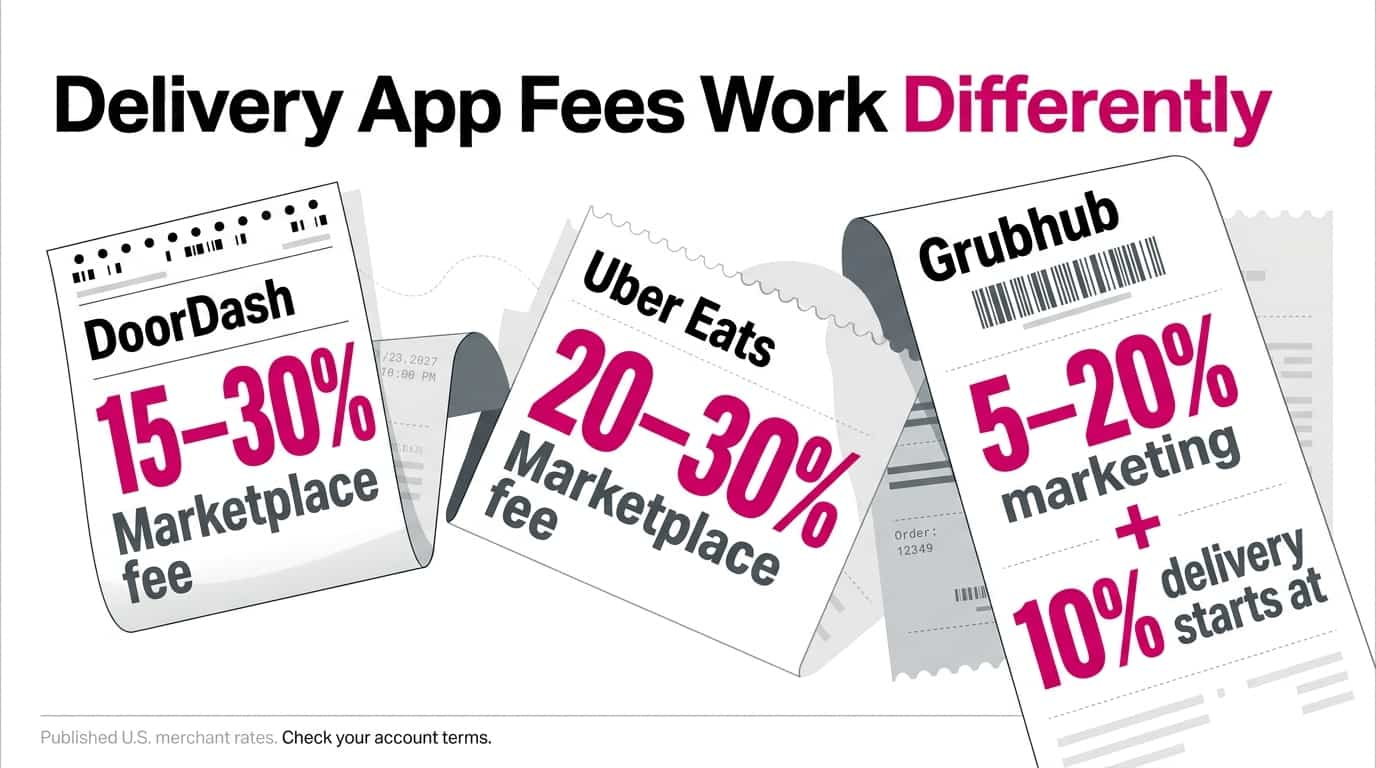
Direct Answer: DoorDash lists Basic at 15%, Plus at 25%, and Premier at 30% for delivery; Pickup is 6% when menu prices match in-store.
Source: DoorDash Merchant Pricing
That commission is charged per order, not as a flat monthly bill, and DoorDash's Marketplace pricing page is the most reliable place to confirm which tier your restaurant is actually on, since older quotes and vendor blog posts tend to lag behind the live rate. New merchants also get a temporary break: 0% commission for the first 7 days on Basic, or 30 days on Plus and Premier, before the standard rate kicks in.
Basic looks cheapest on paper, but it also comes with less in app exposure and no built in loyalty perks for customers. If your order volume depends on DoorDash showing you to new customers, Plus or Premier may justify the higher commission if their wider reach produces enough extra orders for your restaurant. Pull last quarter's DoorDash data before assuming the cheapest tier is actually saving you anything.
How to Lower Your DoorDash Service Fee
Direct Answer: Cut DoorDash cost by checking your plan, comparing it with actual order volume, and moving suitable orders to direct channels.
DoorDash does not publish a general discount program for independent restaurants, so treat any offer of a lower rate as account based, not a rule you can demand. What you can control is which plan you are on and how much of your volume depends on the app at all.
More than half of restaurants surveyed in a recent Market Leader report from Restaurant Business and Nation's Restaurant News said they were working to reduce third party delivery reliance, not by quitting the apps, but by pulling orders toward channels they control. The most common tactics:
- Linking loyalty rewards to direct orders (59% of operators)
- Offering exclusive deals only through direct ordering (51%)
- Advertising the direct order option on the same packaging that shows up in a third party delivery bag (51%)
- Investing in a first party mobile app (38%)
That packaging tactic is worth pausing on. A sticker or printed line pointing customers back to your own site costs almost nothing, and it works because the customer is already holding your container. Packaging itself is also one of the few restaurant costs you can trim without customers noticing. How to reduce restaurant packaging costs without downgrades covers where that room usually is.
What to Do When Delivery Fees Suddenly Jump
Direct Answer: Platform-wide fee changes can raise restaurant costs. Uber Eats changed U.S. Marketplace pricing for restaurants in March 2026.
In March 2026, Uber Eats raised its published Marketplace tiers and increased custom delivery fee arrangements by 3 percentage points, capped at 30%, according to Restaurant Dive. Uber said it was the first marketplace fee update for some U.S. restaurants in roughly a decade, citing higher costs to run the platform.
Rave Restaurant Group, which owns Pizza Inn and Pie Five, ended its Uber Eats relationship after the change. CEO Brandon Solano said the new economics left little or no profit on some Uber Eats orders, and the company was reportedly exploring an exclusive arrangement with DoorDash instead, though that deal was not finalized at the time of publication. That is one operator's call, not a rule for every restaurant, but it shows a fee jump is a real decision point, not just something to grumble about.
When a platform wide repricing hits your account, confirm your new tier, decide whether the order volume still justifies it, and check whether a different tier or a competing platform fits your order mix better.
Uber Eats Fees: What You're Paying and Why
Direct Answer: Uber Eats lists Lite at 20%, Plus at 25% or 30% for Uber One, and Premium at 30%; Pickup is 7% with validated pricing, 10% without.
Source: Uber Eats Merchant Pricing
Those are the post March 2026 rates. Uber says fee structures can differ by market, so confirm the exact number that applies to your restaurant inside Uber Eats Manager rather than assuming the published tier is universal.
The Uber One detail matters more than it looks. If a meaningful share of your customers are Uber One members, your effective commission on Plus quietly climbs to Premium level for those orders. Ask your Uber Eats account contact how many of your orders come from Uber One members before deciding Plus is actually the cheaper plan.
Is Switching Platforms Actually Cheaper?
Direct Answer: Compare total platform charges for your own order mix. Grubhub marketing starts at 5%, with delivery priced separately.
Here is the current published picture across all three platforms.
| Platform | Marketplace / marketing fee | Delivery / pickup notes |
|---|---|---|
| DoorDash | Basic 15%, Plus 25%, Premier 30% | 6% |
| Uber Eats | Lite 20%, Plus 25% (30% for Uber One orders), Premium 30% | 7% validated, 10% unvalidated |
| Grubhub | Marketing commission: Basic 5%, Plus 15%, All access 20% | Grubhub Delivery starts at 10%; no delivery fee on self delivery orders |
Sources: DoorDash, Uber Eats, Grubhub
Rates shown reflect current published pricing as of this writing. Confirm your exact plan in your merchant portal, since some fees vary by market and account.
Grubhub's pricing page also describes its marketing commission as negotiable, though it does not publish a typical negotiated rate for independent restaurants, so treat that as a conversation with your account representative rather than a guaranteed discount.
The honest comparison is never just the headline commission. A restaurant doing high volume on self delivery pays no Grubhub delivery fee at all, while the same restaurant relying on DoorDash's driver network pays commission on every order regardless of plan. Run the math on your own order mix, not a generic app ranking, before deciding switching platforms is worth the disruption.
Does Better Packaging Actually Lower Your Delivery Costs?
Direct Answer: Refunds and remakes charged to the restaurant reduce delivery contribution. Track whether packaging failures are adding to that cost.
There is no reliable platform-wide percentage tying a packaging change to fewer refunds. Measure the effect using your own refund, remake and delivery-cost data. What the research does support: 90% of off premises customers said they would order a wider variety of items if packaging kept food closer to on premises temperature, taste, and quality, and more than half said they would pay extra for it, according to the National Restaurant Association. Among Gen Z and millennial diners, that number climbs to 60%.
Delivery execution backs this up. Intouch Insight's 2025 mystery shop study, covering 600 orders across DoorDash, Uber Eats, Grubhub, and first party apps, found accurate orders scored 45 percentage points higher on satisfaction, and orders arriving at the correct temperature scored 42 points higher.
Run your own numbers instead of guessing. Delivery contribution per order equals delivery revenue, minus food cost, packaging cost, variable labor, platform and processing charges, restaurant funded promotions, and refunds or remakes you eat. Every leaking clamshell or crushed cake box that triggers a refund comes straight out of that line, on top of whatever DoorDash already took. Delivery packaging that stops spills, steam, and crushed food is worth a look if that refund line looks bigger than it should.
At Plastic Container City, we supply take out packaging to thousands of bakeries, restaurants, and caterers across the U.S., and packaging that fails in transit is one of the most preventable costs sitting inside that delivery contribution formula.
Frequently Asked Questions
Can a DoorDash Delivery Fee Be Waived?
Direct Answer: It depends on the fee. New restaurants get a temporary 0% Marketplace rate, but standard pricing applies afterward unless a custom arrangement is offered.
That depends on which fee you mean. The restaurant's Marketplace commission is not generally waived: new restaurants get a temporary 0% introductory rate (7 days on Basic, 30 days on Plus and Premier), but the published tier rate applies after that unless your account team offers a custom arrangement. The separate delivery fee a customer sees at checkout is set by DoorDash, not the restaurant.
Has DoorDash's Fee Structure Changed?
Direct Answer: DoorDash currently uses three published plans: Basic, Plus, and Premier. Rates can change, so confirm current pricing in your merchant portal.
The structure has stayed built around three published plans, Basic, Plus, and Premier, for restaurants with 75 or fewer locations. Rates can shift at the plan level, so check your merchant portal rather than an older quote.
Do Restaurants Make Less Money on Delivery App Orders?
Direct Answer: Delivery orders can earn less, but there is no universal margin gap. Compare your own contribution per order, delivery against dine in.
Delivery app orders can earn less, but there is no universal margin gap. Compare contribution per order using your own costs, delivery against dine in, on the same menu item, to know for your own restaurant.
Does Uber Eats Really Take 50% of an Order?
Direct Answer: No. Uber Eats' published U.S. Marketplace rate tops out at 30%; other restaurant costs may sit on top.
Not as the published Marketplace fee. Uber Eats' U.S. Marketplace rate tops out at 30%; other restaurant costs may sit on top.
Is There a Way to Bypass DoorDash Fees Entirely?
Direct Answer: Yes. Orders placed through your own website, phone, or first-party app do not carry DoorDash Marketplace commission.
The only way to avoid DoorDash's commission completely is to take the order off DoorDash, through your own website, phone orders, or a first party app. Restaurants reducing delivery app dependence often do this alongside tactics like loyalty rewards for direct orders, without necessarily leaving the platform.
The commission you pay DoorDash, Uber Eats, or Grubhub is not a mystery tax you have to accept at face value. It is a published or contracted rate tied to your plan or merchant agreement, and plans can be revisited as order volume changes. Pair that with packaging that survives the ride over, and you are working two real levers instead of just absorbing whatever shows up on the statement. Still weighing whether third party delivery belongs in your mix at all? Are DoorDash and Other Delivery Apps Hurting Restaurants? walks through that decision. For more packaging and food business tips, visit the Plastic Container City blog. Either way, the first place to look when you want to lower your DoorDash service fee is the plan you are actually on.