
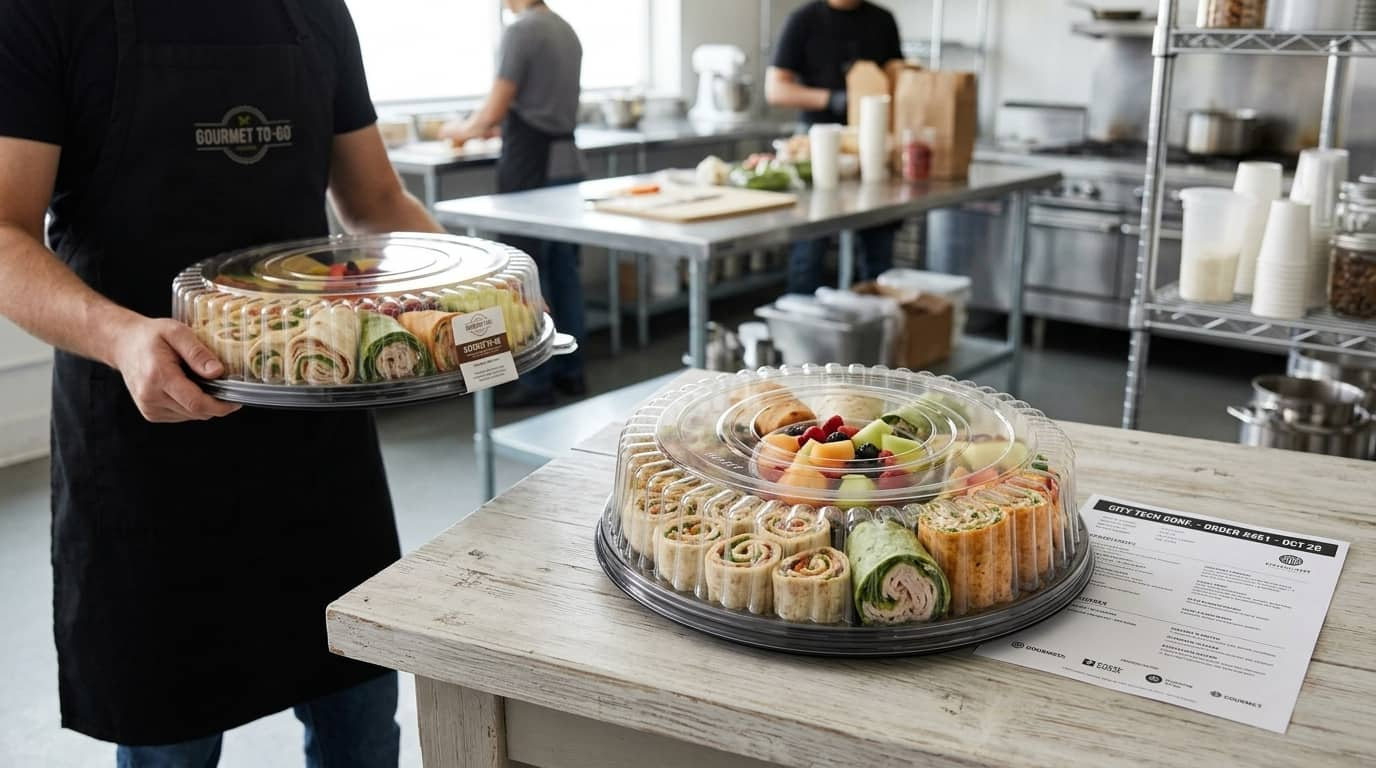
TL;DR: The challenges caterers face all start in the same place: the moment food leaves your building you stop controlling temperature, timing, plating and service. This guide walks a job in order, from guest count to handoff, and gives each challenge a mechanism instead of a platitude. Start by rebuilding your prep schedule around departure time.
The challenges caterers face are not restaurant problems at a larger scale, though nearly every operator starts out believing they are.
You can cook the food. You can price the job. Then the first event goes sideways for reasons your counter trade never produced. Something arrives lukewarm. The count moves on Thursday. You run out of lids at guest 96. Here is the difference nobody states plainly: a restaurant chef controls the food until the second it is eaten. A caterer hands it over.
At Plastic Container City we work with thousands of food professionals across the U.S., and the bakeries and cafés adding catering hit the same wall in the same order. What follows walks that order and gives each challenge a mechanism. For the failure list, see What Are Common Catering Mistakes to Avoid?.
What challenges do caterers face that are different from restaurant chefs?
Direct Answer: Caterers lose control of the food before it is eaten. Temperature, timing, plating and service all pass to someone else, somewhere else.
A restaurant is a closed loop: pass to table in ninety seconds, in a room you own, served by your own staff. Get a plate wrong and you fire another one. Catering breaks that loop, and you own fewer links at every step, until the food is plated by people who may not work for you in a room you have never seen. There is no refire.
| The job | In a restaurant | In catering |
|---|---|---|
| Volume | Flexes with the door | Committed days ahead |
| Timing target | Service time | Departure time |
| Temperature | Held feet from the pass | Held in a vehicle, then a room with no kitchen |
| Plating | Your staff, your standard | Often venue staff you do not employ |
| Fixing a mistake | Refire it | No second chance |
| Packaging | Mostly for what leaves the building | Everything leaves the building |
Staffing, logistics, temperature and last minute changes are not four problems. They are four versions of that one.
Why is a guest count harder than a restaurant cover?
Direct Answer: Restaurants flex service all night. Caterers buy, prep and staff against a number agreed days early, so every change lands on money already spent.
Forty walk into a restaurant, you cook forty, and a quiet night costs you only what you did not sell. A caterer buys for 120 on Tuesday, hires for 120 on Wednesday, and hears 96 on Friday. The client is not being difficult. Their RSVP list is moving too.
The mechanism is contractual, not culinary. No national standard sets the final-count cutoff, so the deadline you can actually plan around is the one printed in your own agreement, along with how late changes get charged. That belongs in the quote, alongside pricing the job properly.
Then version control. A banquet event order is an operations document, and its legal effect depends on the signed agreement and the jurisdiction. Freeze the kitchen's copy at your cutoff, keep a dated change log, reissue with a version number. Most count disputes are version disputes, where the kitchen packed from an order the client had already changed.
Why do caterers cook to departure time, not service time?
Direct Answer: A caterer's clock ends when the vehicle leaves, not when guests eat. Cooling and packing have to fit inside the schedule before departure.
A restaurant kitchen works backwards from pickup. A catering kitchen works backwards from the moment the last box goes in the car. Everything after that is holding, and holding is not cooking.
Cooking earlier is not free, because cooled food runs its own clock. The FDA model Food Code gives you 2 hours to get cooked food from 135°F down to 70°F, and 6 hours in total to reach 41°F. That clock sits inside your production schedule whether you planned for it or not. A Saturday event is three plans stacked together: cook, cool, pack.
| Control | Model Food Code requirement | On the day |
|---|---|---|
| Cold holding | 41°F or less | Check the food, not the cooler air |
| Hot holding | 135°F or above | Check at dispatch, arrival and through service |
| Cooling cooked food | 135°F to 70°F in 2 hours, then 41°F within 6 hours total | Shallow pans, smaller portions, built into prep |
| Reheating for hot holding | 165°F for 15 seconds, reaching that temperature from 41°F within 2 hours | Not the same as warming one portion now |
How do you hold food safely without a kitchen?
Direct Answer: Keep cold food at 41°F or below and hot food at 135°F or above, or run a written time control that your jurisdiction allows.
Two routes, and most articles explain neither.
Route one is temperature. Keep food under the adopted limits and prove it with a thermometer in the food, not a reading from the surrounding air.
Route two is time as a public health control, and it is widely misquoted. It does not mean food may sit out for four hours. The Food Code wants written procedures prepared in advance and discard times marked on the food, to a maximum of 4 hours. A 6 hour route exists for cold food only, starting at 41°F or less and never passing 70°F. Putting it back in the fridge buys you nothing.
Two things to pin down first:
- The "2 hour / 4 hour rule" quoted in forums is Food Standards Australia New Zealand guidance, not the U.S. framework.
- The Food Code is a model, not federal law. Jurisdictions adopt different editions, so confirm the version your jurisdiction enforces.
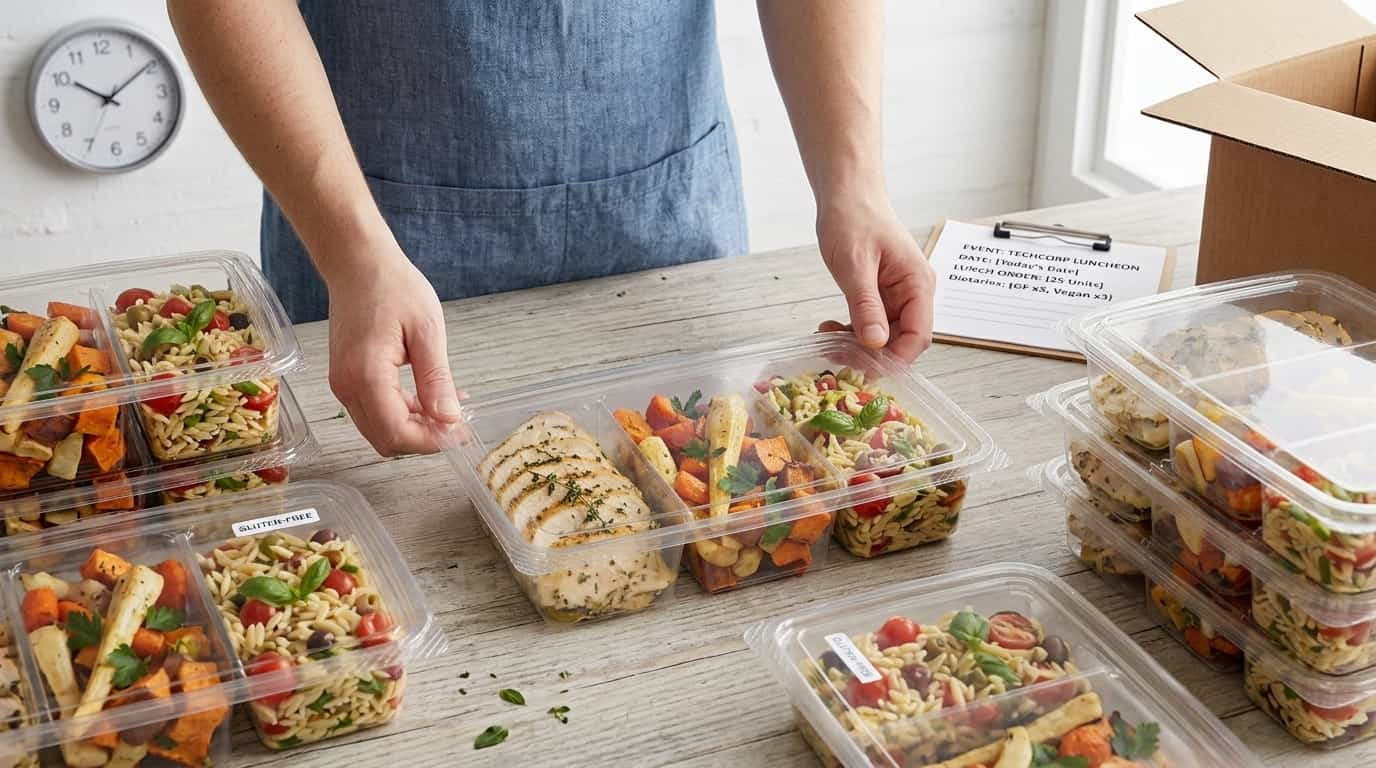
Packaging earns its place here. The code requires food to be protected in transport but names no mandated container. Your containers are the protection layer, not a substitute for temperature control, and a lid does not make a cold format safe for a hot course. If you are matching format to dish, the take-out container range answers the fit questions on the category page.
What makes staffing and the handoff harder off-site?
Direct Answer: Off-site work runs on evenings and weekends, in a room you have not seen, with no back of house there to absorb a mistake.
Staffing in a restaurant is a schedule against known covers. Catering labor is a spike: five people for six hours on a Saturday, then nothing until the next weekend. No federal food-safety rule sets a server-to-guest ratio, so treat any number you are handed as one operation's example, not a standard. Build your own from the service sequence: how the food is served, the distance from kitchen to room, stairs or an elevator, bar service, setup and breakdown. Log the real labor hours every time and your own records will beat a borrowed ratio.
Two events on one Saturday is where the spike turns into a fault line. Overlapping timelines mean shared vehicles, shared staff and one packing bench, so build the schedule around the constraint you cannot duplicate.
The venue is the part operators underestimate, and you are often working alongside people who do not report to you. Confirm the dull details in writing: access time, where the vehicle parks, power, water, handwashing, refrigeration, waste, and what happens if it rains.
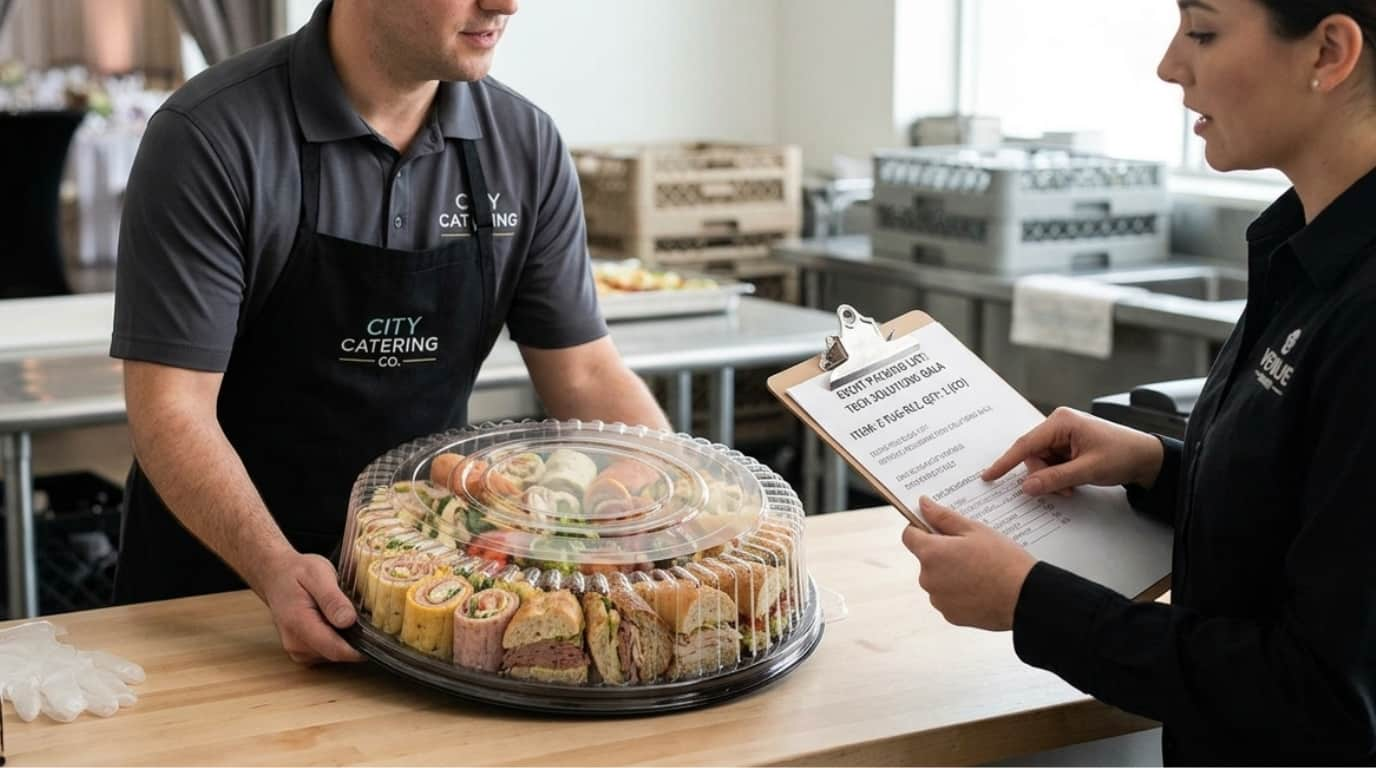
The handoff decides the job, and most small operators have no procedure for it. Check the delivery against the current event order. Record the temperature status of anything under control. Note count discrepancies before you leave. Name one person responsible for transport, setup and service. This is not invented paperwork: Michigan's plan review material asks operators the same questions about transport, vehicles and food protection.
Why do containers belong in your inventory count?
Direct Answer: Containers, lids and portion cups are stock, not supplies. Running out mid-service is an inventory failure, not a packaging one.
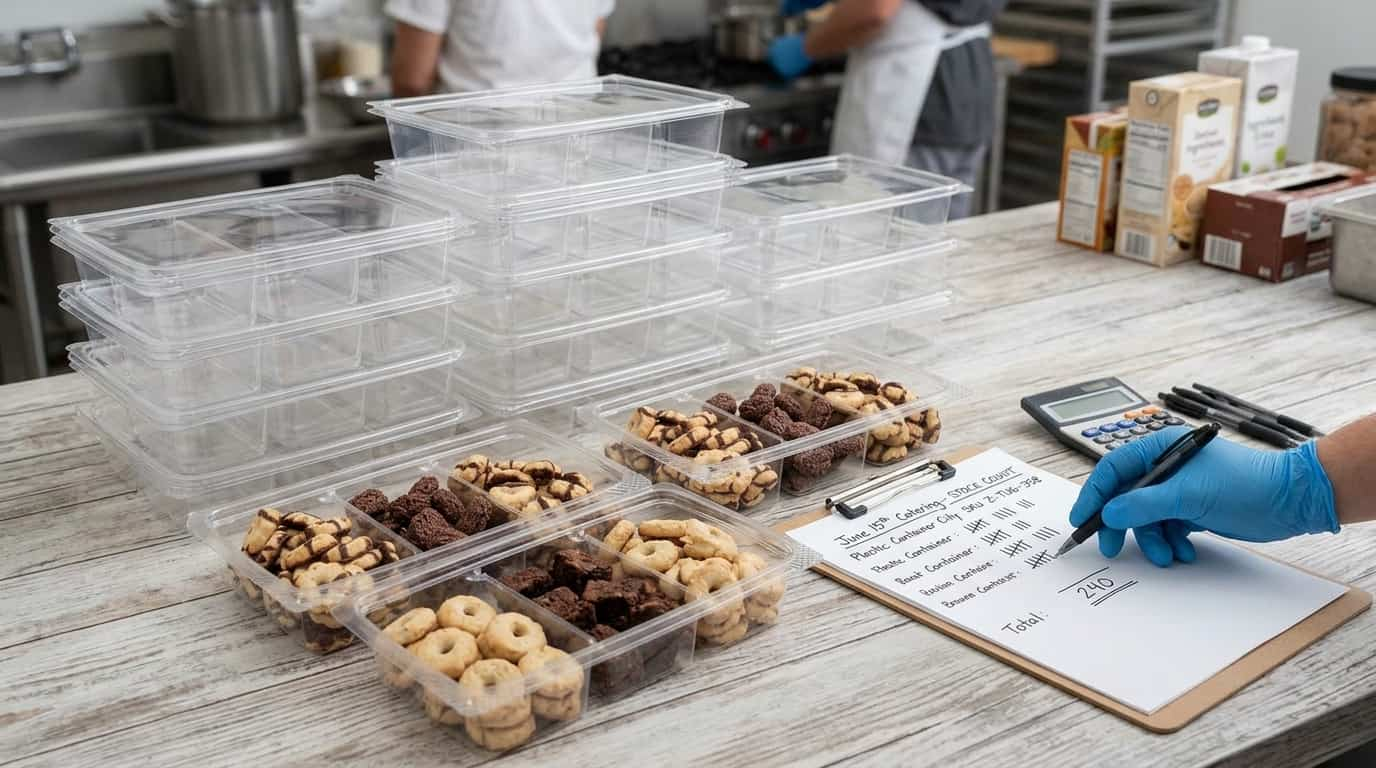
Catering adds a second inventory problem: everything the food travels in. Food turns over on a rhythm you know. Containers do not. They sit on a shelf until the weekend a large job needs 300 of one format.
Most operators track flour to the gram, then count containers by glancing at the shelf. Then a 140 cover job runs out of lids at 96 and someone is driving to a restaurant supply store mid service.
The fix is arithmetic: usage per event type, times the events in your booking window, plus a margin for jobs not yet confirmed, bought in case quantities that match. The case quantity method is what bakeries use for retail, applied to a lumpier pattern. Keep the format list short too, since every extra container type is another line to count. If you are building that list from scratch, the six format checklist is a sane starting point, and the menu side of it belongs in What Makes a Good Catering Menu?.
Which challenges caterers face should you fix first?
Direct Answer: Fix departure planning, count control and packaging stock first. Those three catch avoidable failures before the food ever leaves your building.
Catering demand clusters, and the pattern belongs to your town and your client list rather than any published season. Your own booking history is the only forecast worth trusting: it shows where staffing pressure and packaging demand rise, and where the cash gap opens between paying for an event and being paid.
Nearly 75% of restaurant traffic was off premises in the National Restaurant Association's 2025 off-premises research, and 90% of consumers surveyed said they would order a wider variety if food maintained its on-premises quality in transit. Restaurant data, not catering data, but the same physics.
Three changes, in order
- Rebuild the prep schedule around departure time, with cooling written in as a task rather than an assumption.
- Put the count deadline and the change charge in writing, and version the event order.
- Move containers onto the stock count, with a reorder point you actually check.
The rest of the failure modes sit in What Are Common Catering Mistakes to Avoid?, and there is more operator material in the Plastic Container City blog. Get the mechanisms in place and the challenges caterers face stop being surprises and start being line items you planned for.
Frequently asked questions
What are common catering challenges?
Committing to a guest count before the client is certain, cooking to a departure time rather than a service time, holding food without a kitchen, staffing evenings and weekends, coordinating with venue teams, and keeping enough containers in stock. All of them trace back to serving food somewhere you do not control.
What are the disadvantages of catering?
Food, labor and packaging are committed before the final payment lands. Demand is lumpy rather than steady. And mistakes are harder to fix once the food is off-site: a restaurant refires a plate in four minutes, a caterer hears about it from the guest.
How do you transport and deliver food off site correctly?
Keep food under the temperature control your jurisdiction adopts, or a written time control with marked discard times, and protect it in covered containers. Check temperatures at dispatch and on arrival rather than assuming the food stayed in range. The CDC advises checking temperatures during transport, particularly for dishes linked to Clostridium perfringens outbreaks.
What is the difference between catering and bakery?
Baking is a production method. Catering is a service commitment: a set menu, for a set count, at a set time, in a building belonging to someone else. Plenty of bakeries do both, and the challenges caterers face are what the second job adds.