
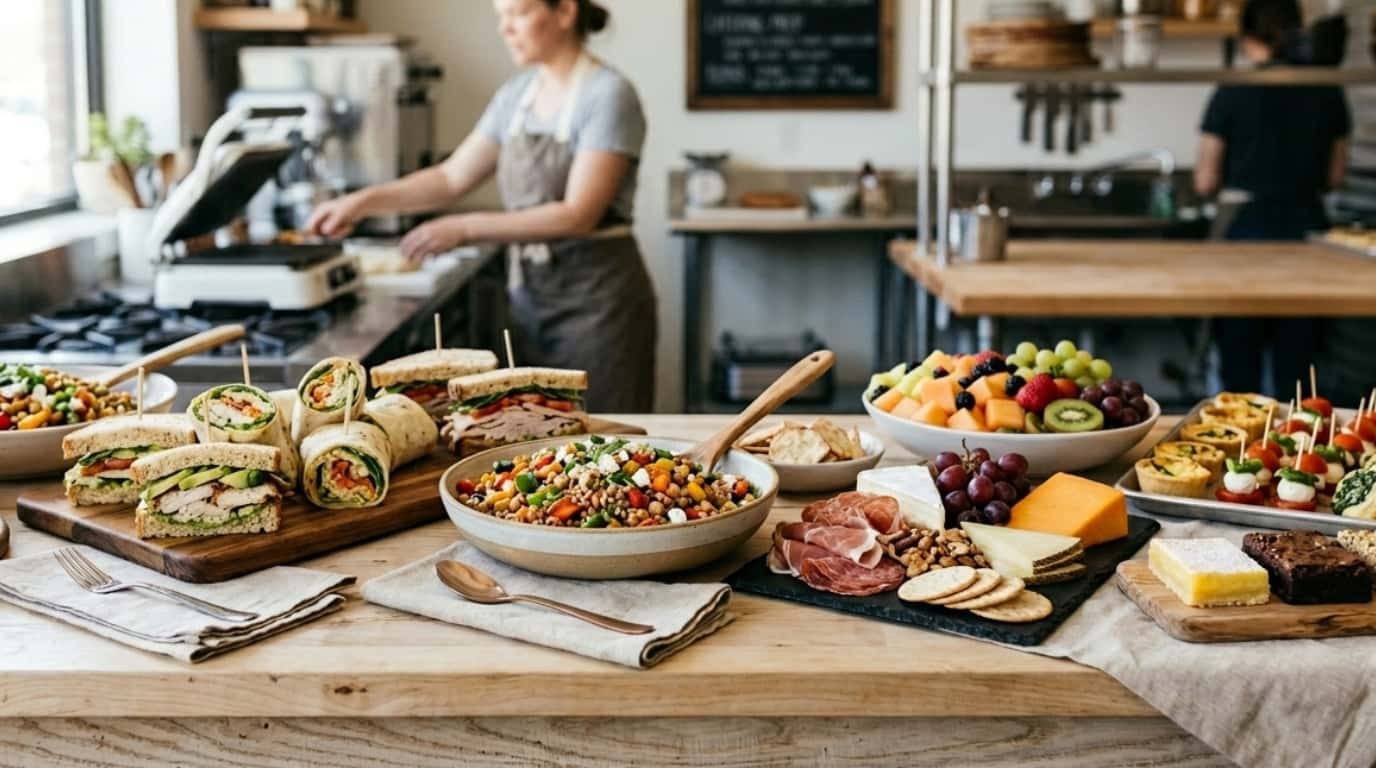
TL;DR: A good catering menu is not your best retail dishes in bigger portions. It is a short list of items that survive a journey, hold without a kitchen, portion the same way every time, and pack into something you can buy by the case. This guide gives you the four tests a dish has to pass, and a way to try one before it ever reaches a client.
A good catering menu looks nothing like the menu that made your shop popular, and that catches almost every operator out the first time.
The dishes are proven. Customers order them daily. Then you send fifteen of them to an office park for an 11am setup and half the list arrives as a lesser version of itself. The salad has wept into the corner of the box. The thing that was crisp is not crisp. The dish you were proudest of needed a plate, a spoon and someone to serve it, and the client gave you a folding table.
Here is the split nobody puts plainly: a retail dish only has to survive the walk from your counter to a table. A catering dish has to survive a vehicle, a room with no kitchen, and an hour of people helping themselves. Every menu decision follows from that.
Because we supply caterers, bakeries and cafés across the U.S., we see which menus settle into a steady reorder and which ones rewrite their packing list after every event. The steady ones are shorter. For the wider failure list, see What Are Common Catering Mistakes to Avoid?.
What should be on a catering menu?
Direct Answer: A catering menu should hold a small number of dishes that travel well, cover the room's dietary needs, and portion the same way every time.
Three jobs, and most menus only do the first one. You need anchors, the two or three items people ask for by name. You need sides that carry volume, because they fill the table without asking the mains to do all the work. And you need one item that quietly handles dietary coverage rather than sitting there as an obvious afterthought.
The dish types that reliably earn a slot are the ones built to eat well right through the service window: sandwiches and wraps cut and packed, grain and pasta salads dressed late, cured meat and cheese, cut fruit, finger foods that need no cutlery, and desserts that sit happily at room temperature. Braises and saucy dishes work too, because their texture forgives time better than anything crisp.
What earns a place on a good catering menu?
Direct Answer: A dish earns its slot if it travels, holds without a kitchen, portions consistently, and packs into a container you can buy by the case.
Four tests. Run a candidate through all of them and the answer stops being a matter of taste.
| Test | What you are really asking | Usually passes | Usually fails |
|---|---|---|---|
| It travels | Does it survive movement, stacking and a closed lid? | Undressed grain salads, braises, bars, cured meat and cheese | Fried food meant to stay crisp, dressed leaves, soft stacked items |
| It holds | Does it still eat well at the end of service, not just at the start? | Cold composed dishes, room temperature bakes, grazing items | Anything that only works inside a narrow temperature band |
| It portions | Does the 40th portion look like the first? | Anything scooped, cut on a grid, or portioned in advance | Anything hand plated, garnished per guest, or sauced to order |
| It packs | Is there a container it fits, and can you buy it by the case? | Items sized to a footprint you already stock | Items sized to nothing, needing a one-off container per event |
That fourth test trips people up, because they answer it with a resin name. The FDA treats food contact suitability as a condition of use that depends on the food, the temperature and the contact time. What counts is what the finished container says it is for, not what plastic it is made from.
Which dishes scale to event volume?
Scaling is the portions test with the head count turned up. Dishes made in one batch and divided afterwards multiply cleanly: braises, grain and starch sides, sheet pan bakes and bars. Dishes assembled one at a time do not, because the labor is linear while your prep window is fixed. A dish that takes twenty seconds a portion is nothing at twenty guests and a staffing problem at two hundred, which is where large groups stop forgiving you. Time a portion before you promise a number.
Shared tray or individually packed?
Direct Answer: Shared service usually means fewer containers and less packing labor. Individual packing adds one unit per guest but suits moving rooms better.
This decision sets your packing labor, your container spend and how the food looks when the lid comes off, so it belongs in menu design rather than in the packing area on the morning.
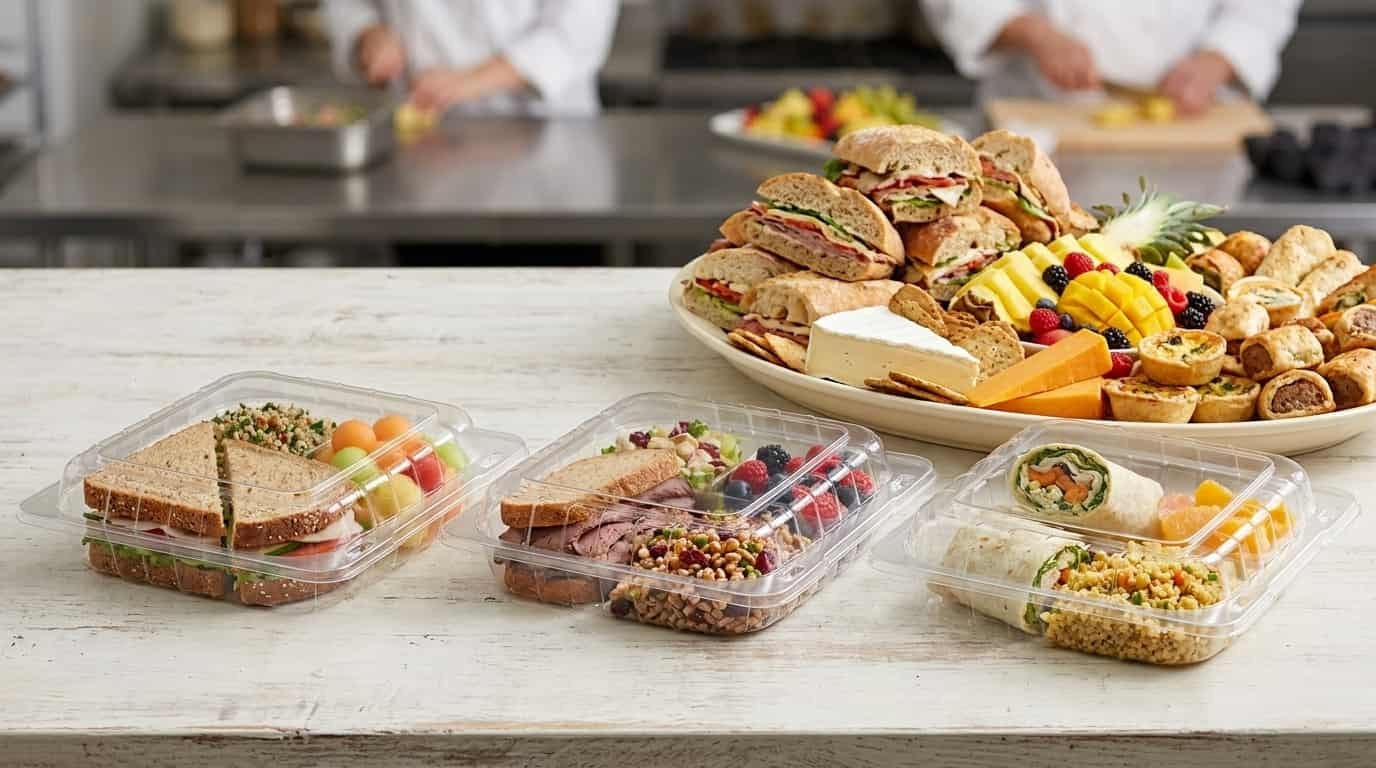
Shared service means fewer units to fill, one format to stock and food that reads as generous. Buffet-style needs a table, serving utensils and a room willing to queue. Family-style needs the same table and utensils, just seated. Our 12" round catering tray is the shared option, and its limits are worth stating plainly: one compartment, 12 by 12 by 3 1/2 inches, PET #1, snap on lid with an airtight seal, refrigerator and freezer, stackable, 50 per case. One compartment means nothing needing wet and dry separation belongs on it. PCC lists it for refrigerator and freezer, so treat it as a cold format: sandwiches, cold appetizers, desserts, grazing. Never a hot course.
Individual packing gives every guest an identical portion with no serving equipment and no queue. The boxed lunch is the default for a corporate drop for a reason. It works standing up, with one hand and no plate to balance, and it works when people arrive in waves. It also makes an allergen meal easier to identify and keep separate at the handoff, though the container is not the control. Cross-contact gets settled in your kitchen, not in the packing area. It costs a unit per guest, and someone to fill each one.
| Shared tray | Individually packed | |
|---|---|---|
| Packing labor | One unit serves a group | One unit per guest |
| Container cost | Divided across the table | Multiplied by the head count |
| The room it suits | Seated, with a table and staff | Standing, timed, or spread across desks |
| Allergen meals | Needs a separate packed portion anyway | Easier to identify and keep separate |
| Weak spot | Looks picked over once service starts | Slowest part of your pack out |
On the individual side the format follows the food. A 9" white 3 compartment hinged clamshell in PET #1 handles an entree and two sides. A 3 compartment container in PP #5 is microwave safe and freezer safe, so it is the one to reach for when the client intends to reheat. A 6 compartment 10" round in PET #1, 2 inches deep, suits grazing and snack sets. They all sit in Take-out, where the format fit questions are already answered.
Before you treat packaging as a pure cost line: in the National Restaurant Association's 2025 off premises research, more than half of consumers surveyed said they would pay more for premium packaging that kept food at on premises quality in transit. Restaurant data, not catering data, but the same guest opening the same lid.
How do you handle sides, salads and wet components?
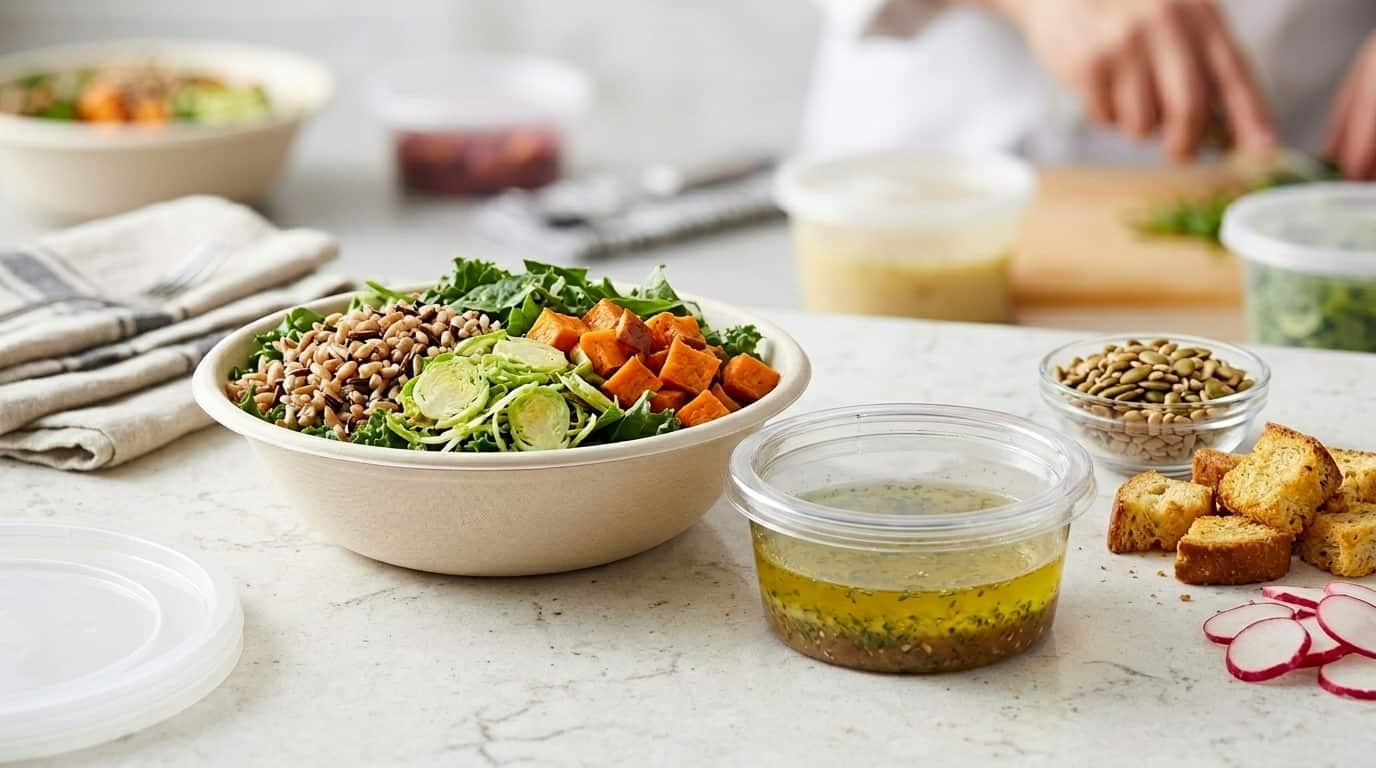
Direct Answer: Wet and dry should travel apart and meet on-site. Dress leaves at the venue, ship sauces separately, and keep moisture away from anything crisp.
Side dishes are where menus get lazy, and that is a mistake. A good side makes the table feel generous and often batches more easily than a composed main.
The physics are not complicated. Moisture moves between food, headspace and packaging, and a 2025 review of moisture migration treats it as one of the real variables in packaging design. That gives you three rules:
- Dress on arrival. Anything leafy travels undressed, with the dressing in its own portion cup or deli container.
- Sauce travels alone. Saucy items get their own container, or go on the menu knowing they will soften whatever they touch.
- Crisp gets its own space. Trapped steam is what turns a good item into a soft one.
Spills, steam and crushing are covered properly in our delivery packaging guide. What belongs here is the decision that comes first: if a dish only works when its parts stay apart, the menu has to say so.
How do you cover dietary needs without doubling the menu?
Direct Answer: Build coverage into the main list instead of running a parallel menu. Choose dishes that already meet common needs rather than duplicating every item.
Menu sprawl almost always starts here, with good intentions. Someone asks about dietary restrictions, a vegan version of everything gets added, and you have doubled your prep, your container formats and the number of things that can run short on the day.
Design dishes that are already inclusive instead. A grain salad that happens to be plant-based and gluten-free is not a compromise item, it is an anchor doing two jobs. Two or three of those go a long way without adding a line to the prep list.
Allergen meals are the exception. They should be physically separate and clearly identified, not plated alongside everything else. On labeling, federal menu labeling rules apply to chains with 20 or more locations selling substantially the same items. A small independent caterer is not automatically covered by that federal chain rule. Packaged food labeling and allergen declaration can still apply, and that is a question for the authority with jurisdiction over your kitchen.
What is the most profitable food to cater?
Direct Answer: There is no single winner. A profitable catering dish has to cover food, labor, packaging and waste at the price you can charge.
The dishes that earn their place are usually cheap to portion rather than cheap to buy. Ingredient cost is the number everyone checks first, and on a catering job it answers the least interesting question. Four other costs do more to move it:
- Labor per portion. A cheap dish that takes twenty seconds a head can cost you more at two hundred guests than a pricier one you scoop.
- Container cost per guest. Individually packed multiplies with the head count. Shared service divides.
- Waste. Dishes that hold well let you pack tight to the confirmed count instead of padding it.
- Stocking cost. Every extra format is another case sitting on a shelf between events.
Hold all four against your selling price, not just against your food cost. Scooped sides, grain and starch dishes, braises and anything portioned by weight tend to win on all four at once. We will not hand you a margin figure, because no single one fits every catering business. Price from your own labor hours and your own case costs, and let your booking history tell you which dishes are worth keeping.
How many items should a catering menu have?
Direct Answer: Fewer than you think. Every item you add is another prep and another thing to run short of, and often another packaging format to stock.
Menu length is a packaging decision wearing a chef's hat. Each new item can bring its own footprint, and every footprint is another case to buy, store, count and reorder. Cut the menu and the packing bench speeds up, the shelf empties, and the formats you stock drop to a number you can manage.
A workable shape for a first catering menu: two or three anchors, three or four sides, one dessert format, one genuinely inclusive item. Anything new has to displace something rather than join it. The stock side of this, including how to count containers so you do not run out mid service, sits in the challenges caterers face.
How do you test a dish before you put it on the menu?
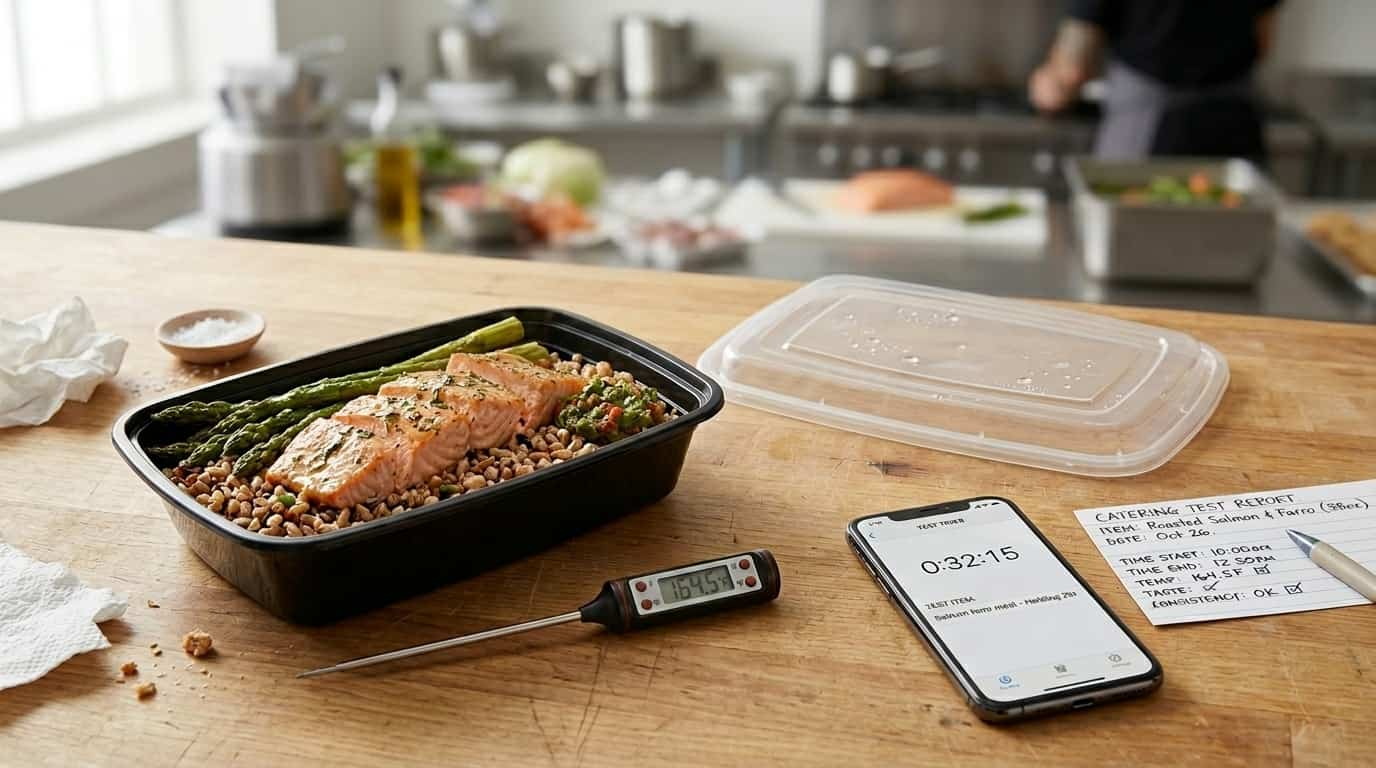
Direct Answer: Pack it, drive it, hold it, then eat it. Run the real container, the real service window and the real temperature control first.
One afternoon of your own time, and it settles arguments no tasting can:
- Pack it for real. The container you would actually use, filled to the portion you would actually sell.
- Move it. Same route length, same stacking, same vehicle, lid closed.
- Hold it. For the full service window, under the same temperature control you will use on the day. Take a reading, not just a verdict on taste.
- Time the packing. Seconds per unit, multiplied by a realistic head count.
- Open it in front of someone who did not cook it. Their first reaction is the guest's reaction.
Write down what failed and whether a container change fixed it. If a dish fails twice, it is a retail dish. Leave it on the counter where it earns its keep.
Design backwards from the handoff, keep the list short enough to pack fast, and test before you promise. There is more for operators in the Plastic Container City blog. Do those three things and you have a good catering menu.
Frequently asked questions
What are 5 things to consider when planning a menu?
For catering: how the food travels, how it holds without a kitchen, whether it portions the same way at volume, what it will be packed in, and how it will be served in the room you have been given. Guest preferences matter, but that is the part you already know.
How should caterers design their menu?
Backwards. Start at the handoff and work back toward the kitchen: how the food gets served, what it is packed in, how long it sits, how it travels, and only then what you cook. A menu designed forwards from a recipe usually needs rescuing at the venue.
What are four types of catering?
There is no official four part classification in the U.S., whatever the listicles tell you. What matters for your menu is not the label but what you have signed up to deliver: who serves the food, where, and with what on hand. A menu built for a room with staff and a table is a different menu from one built for a drop-off, and designing backwards from that is what keeps a good catering menu workable once it leaves your kitchen.