
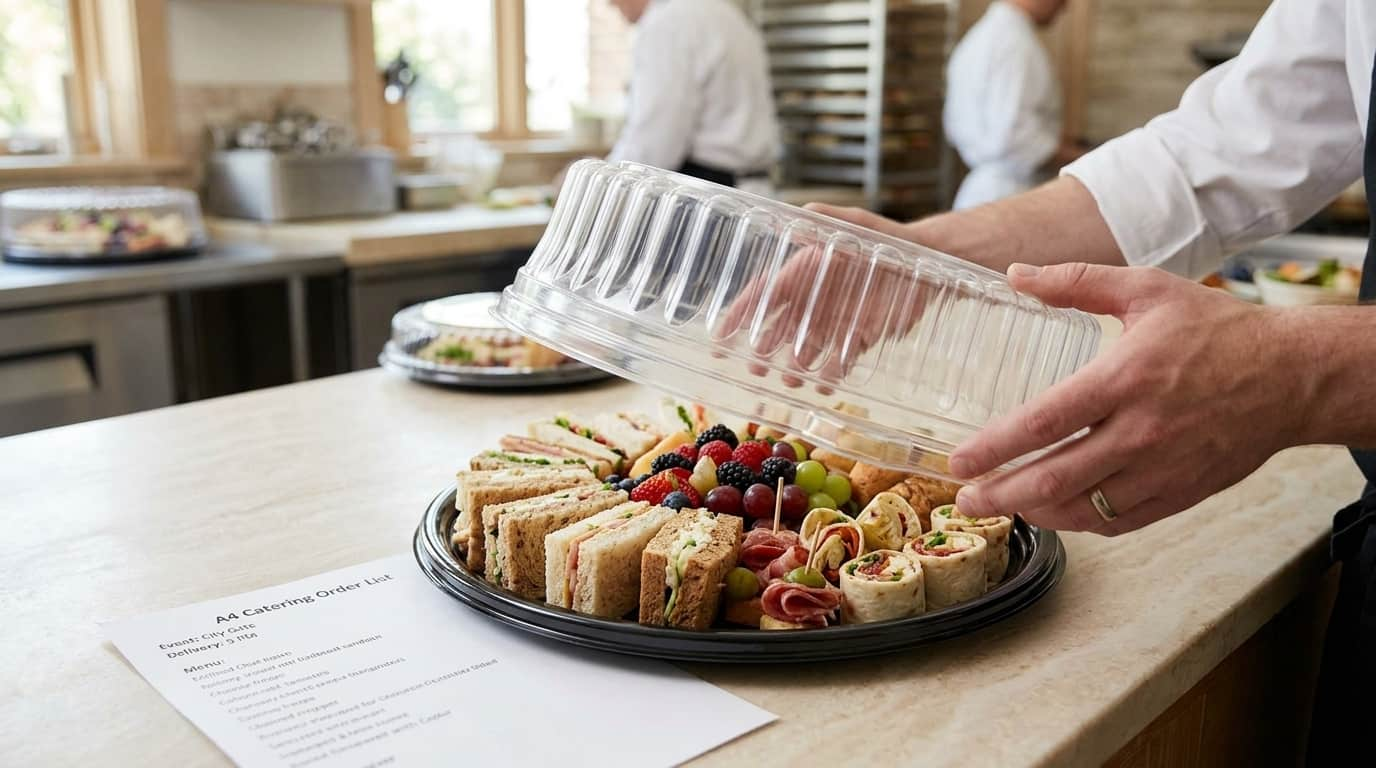
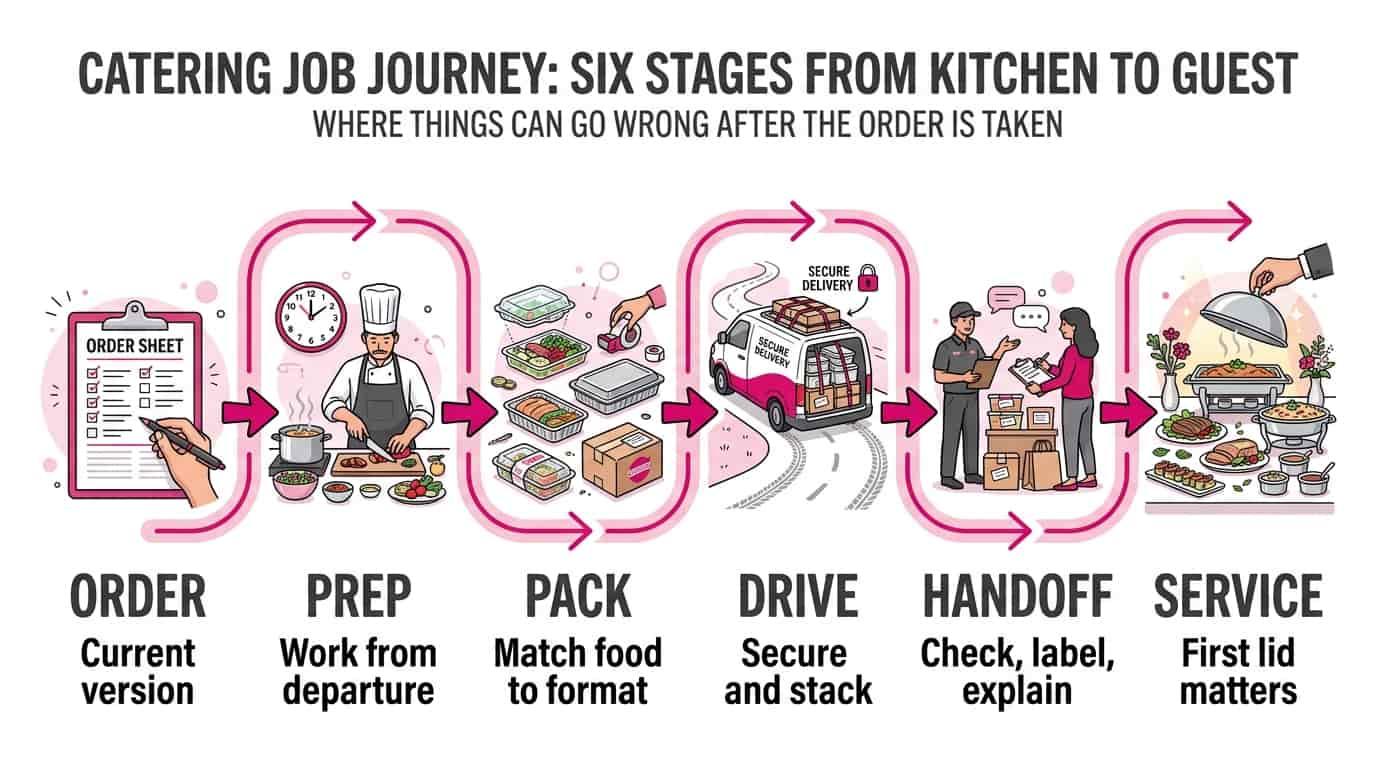
TL;DR: The common catering mistakes to avoid are rarely menu mistakes. They happen after the food is cooked, in the six stages between your kitchen and the guest: the order, the prep clock, the pack, the drive, the handoff and the service. This guide names the mistake living in each stage and points you to the fix. Start by auditing your last three jobs.
The common catering mistakes to avoid are almost never the ones on the list you have already read.
You know that list. Confirm dietary needs. Nail the headcount. Book early. All true, all written a hundred times, and none of it explains why a job you priced right and cooked right still lost you the client.
Here is what does. The mistakes that cost real money happen after the food is finished. A restaurant chef owns the plate until someone eats it. A caterer hands the food to a vehicle, then to a room, then often to staff who do not work for them. Every bit of control has to be built in before it leaves, and the places operators forget to build it in are remarkably consistent.
At Plastic Container City we supply thousands of food professionals across the U.S., and the same failures come back to us in the same order. What follows is the diagnostic version. If you are still pricing your first jobs, start with pricing a catering job instead.
What are common catering mistakes to avoid?
Direct Answer: The expensive ones happen after cooking, across six stages: the order, the prep clock, the pack, the drive, the handoff and the service itself.
Think of a catering job as a chain rather than a menu. Each link has one characteristic failure, and each failure has a different owner. Find yours before you read the rest.
| Stage | The mistake that lives here | Where the detail sits |
|---|---|---|
| The order | Packing from a version the client already changed | Caterer challenges guide |
| The prep clock | Cooking to service time instead of departure time | Caterer challenges guide |
| The pack | Wrong container for the dish, wet packed against dry | Covered below |
| The drive | Nothing secured, stacked in whatever order it was carried | Covered below |
| The handoff | No labels, no count check, nobody named as recipient | Caterer challenges guide |
| The service | Food that survived the trip and still looks wrong | Covered below |
Three of those are packing and transport problems, which is exactly why they get skipped. They feel like logistics rather than cooking, so they end up owned by nobody.
How far in advance should you make a catering order?
Direct Answer: Work back from departure rather than service, and lock the count against your own contract deadline instead of an industry rule that does not exist.
Two mistakes hide in this question, and they compound.
The first is the guest count. Every number a client gives you is provisional until it is contractual, and the gap between those two states is where the money leaks out. No national standard sets a final guarantee deadline, which makes the only date with teeth the one printed in your agreement, along with what a late change costs. Then the version problem: a banquet event order is a detailed catering event record, and its legal weight depends on your contract terms and the law that applies. Freeze the kitchen copy at your cutoff and keep a dated change log, because a count argument is almost always an argument about which sheet was on the bench.
The second is the clock. A restaurant kitchen works back from pickup. A catering kitchen works back from the moment the last box goes in the car, and cooled food runs its own timetable inside that window. Both are covered properly in the challenges caterers face, which is where the temperature detail lives.
What are the most common catering packing mistakes?
Direct Answer: Packing wet against dry, choosing a container by what is on the shelf, and filling to the brim with no allowance for movement.
This is the stage nobody rehearses, and it is where a correct job turns into a complaint.
Wet packed against dry is the big one. Dressing, sauce and anything releasing steam will find whatever you put next to it. Leaves travel undressed. Sauce travels alone. Anything crisp gets its own space or stops being crisp.
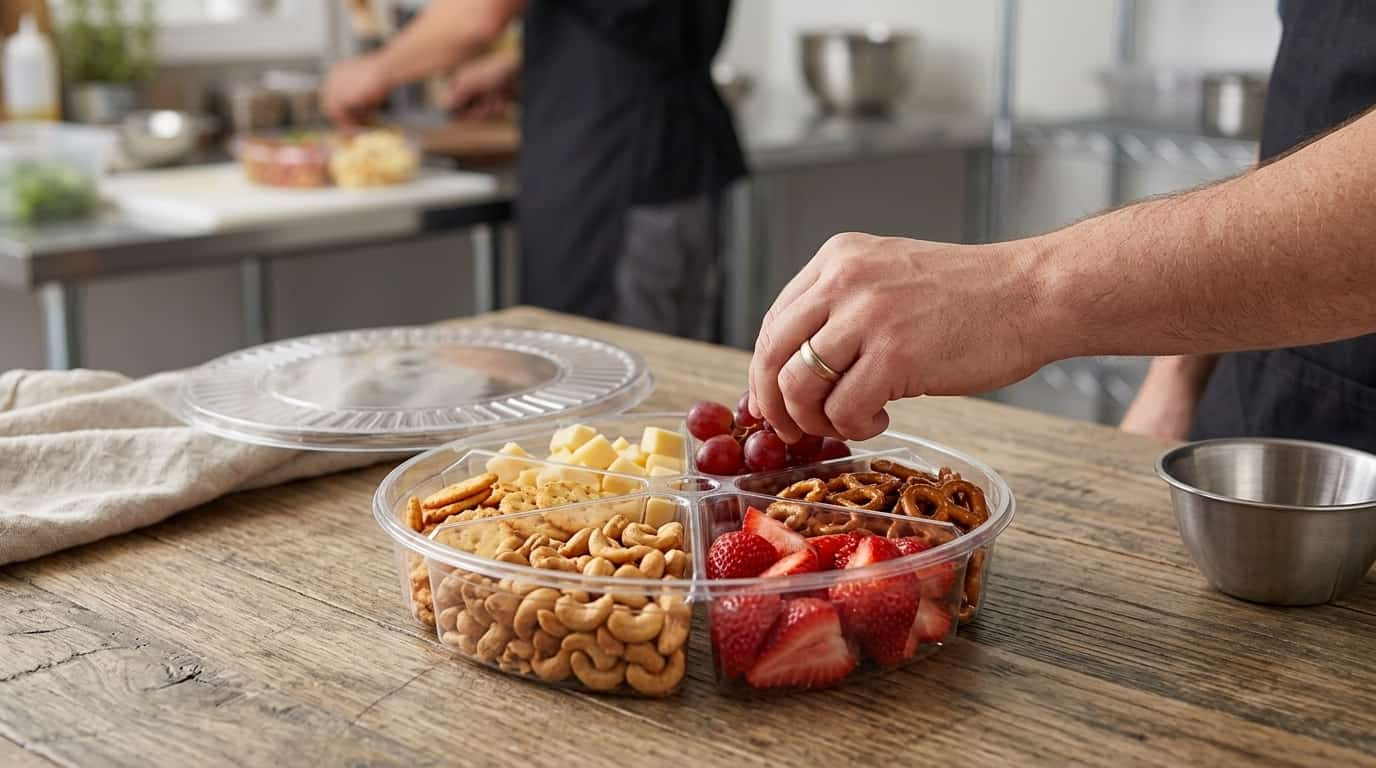
The wrong container for the dish means a format chosen for what was in stock rather than what the food needed. Compartments are not a luxury here, they are the separation. Our 12 inch round catering tray is a single compartment cold format, which makes it right for sandwiches, grazing and desserts and wrong for anything needing wet and dry kept apart. If the client intends to reheat, the format has to be documented for it, because the FDA cautions that some plastic containers can melt from the heat of the food. Format fit questions are answered on the take-out range, which is where that tray sits.
Filling to the brim ignores that food moves. Leave headspace, or the lid does the plating for you. The mechanics of spills, steam and crushing are covered in our delivery packaging guide.
How do caterers transport food without damaging it?
Direct Answer: Secure every container, stack heavy and flat at the bottom, and give one named person responsibility for temperature from dispatch to arrival.
A vehicle is not a shelf. It brakes, corners and goes over speed bumps, and food packed for a stationary kitchen behaves differently in all three.
Three habits separate operators who arrive clean from operators who arrive apologizing. Secure the load so nothing slides, using crates, non-slip matting or the floor rather than a seat. Stack with a plan, heaviest and flattest at the base, nothing stacked on a domed lid, and load in reverse order of service so the first thing out is the first thing needed. Give temperature an owner, because the failure mode here is assuming the food stayed in range rather than checking. The CDC's 2025 review of outbreak contributing factors lists prolonged time outside temperature control among the problems that keep recurring during preparation or service.
Which temperature rule binds you depends on the code your jurisdiction adopted, and that is a whole article of its own.
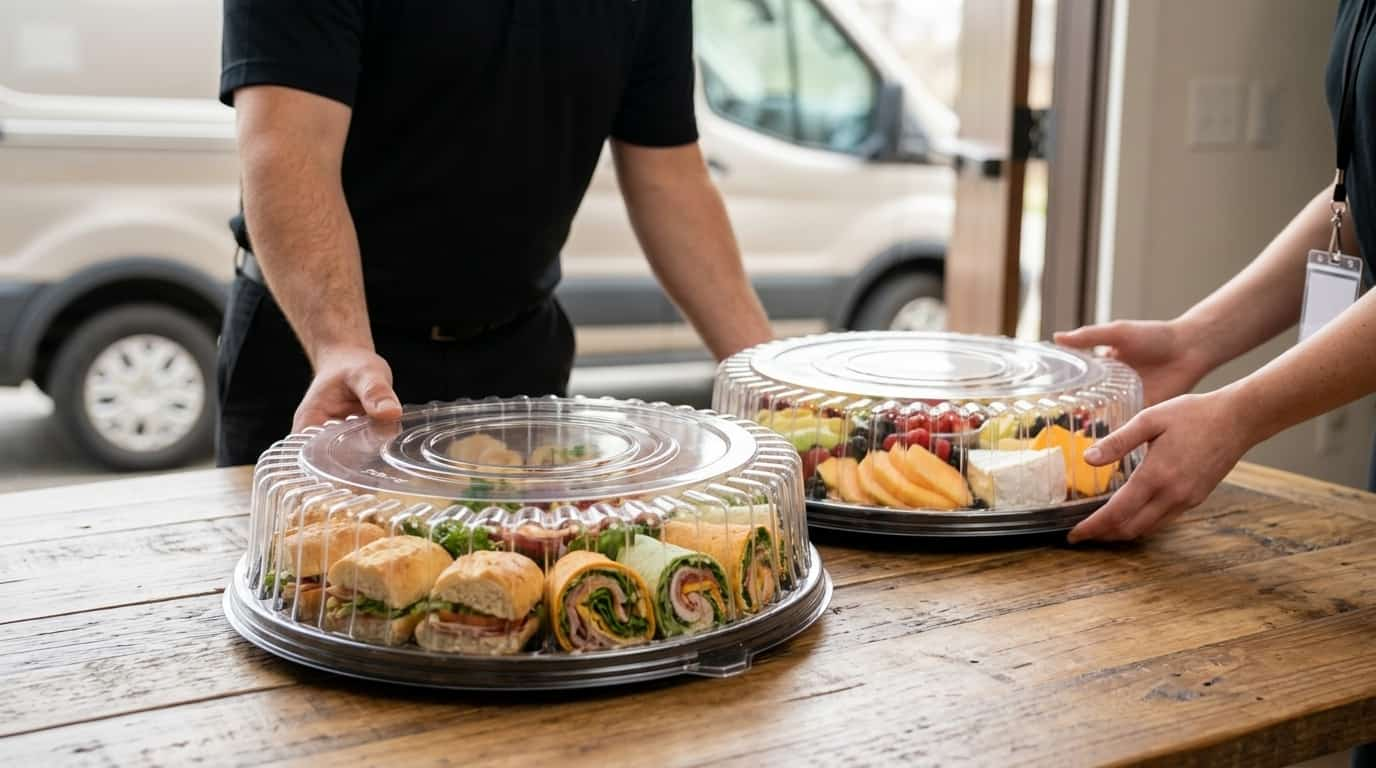
At handoff, check the count against the current order, label anything the receiving party needs to identify, and leave setup instructions before you go.
How do caterers make the food look appealing?
Direct Answer: Appeal is built at the pack, not at the venue. Fill levels, headspace and the order things get opened decide what the guest sees first.
Food that is safe, on time and correct can still read as cheap, and the guest judges the lid before they judge the cooking.
Density does most of the work. A container filled to a consistent line looks deliberate, while one filled by eye looks like whatever was left. Give height something to lean on rather than letting it slump. Keep the item that photographs well at the front, because somebody will take a picture before anyone eats. Then open in the right order at the venue, since the first lid off sets the tone for the whole table. None of it saves a dish that was never going to travel, which is a menu decision rather than a plating one, and what makes a good catering menu walks the four tests a dish has to pass before it earns a slot.
Which style of catering supplies only the food for an event?
Direct Answer: Drop-off catering usually means food is delivered without ongoing service. The scope should state whether setup, staffing or cleanup is included.
There is no official classification of catering styles in the U.S., whatever the listicles claim. What matters is what you signed up to deliver.
In everyday use, drop-off usually means food is delivered packed and ready, while full-service can stretch to setup, serving and cleanup. The mistake is not picking the wrong one, it is leaving it unwritten and finding out at the venue that the client expected serving utensils, a staffed table and someone to clear it. Put the scope in the quote in plain words: what arrives, who serves it, who clears it, and what time you leave.
What are common red flags with catering companies?
Direct Answer: Late arrival, running short mid service, no labels on allergen meals, and food that arrives correct but nobody can say what it is.
Clients rarely complain about seasoning. They complain about what made them look bad in front of their own guests, and every one of those is operational.
Running short is the one operators cause themselves, and it is an inventory failure wearing a packaging costume. Nobody budgets for the Saturday two jobs overlap and both counts came in optimistic. Buy in case quantities that match your real usage rather than topping up a shelf by eye, and keep the format list short while you are at it, since every extra type is another line to count and another way to run short.
How do you audit your last three catering jobs?
Direct Answer: Walk each job through the six stages and mark where it slipped. Three jobs is enough to show a pattern rather than a bad day.
Take an hour and be honest. For each of your last three events:
- The order. Did the kitchen pack from the current version, or one nobody reissued?
- The prep clock. Was cooling a scheduled task, or something you hoped would fit?
- The pack. Did anything wet travel touching anything dry? Was a container chosen because it was on the shelf?
- The drive. Did anything move, tip or crush? Was the load stacked to a plan or to whatever fitted?
- The handoff. Was there a count check, a label and a named person who accepted it?
- The service. Did the first lid off look like the food you meant to send?
One slip is a bad day. The same slip three times is a process you never wrote down. Fix the earliest stage that failed, because everything downstream inherits the problem. There is more operator material in the Plastic Container City blog. Catering clients rebook on reliability rather than on cooking alone, which is why the common catering mistakes to avoid are worth catching in your own records before a client catches them for you.
Frequently asked questions
What is the difference between catering and buffet?
Direct Answer: Catering is the overall service arrangement; a buffet is one way of serving food, where guests help themselves from a shared setup.
The commitment underneath is the same either way: a set menu, for a set count, at a set time, somewhere you do not own. You can cater without a buffet, and choosing one changes your packing rather than your obligations.
What is included in a basic catering package?
Direct Answer: There is no universal basic catering package. Your written scope should state what is delivered, set up, served and cleared.
Serving utensils, setup, staff, replenishment, cleanup and equipment return are each a separate line. Assume nothing is included by default, and neither will your client.
What is the difference between food packaging and food packing?
Direct Answer: Packaging is the container itself. Packing is the process of choosing, filling, separating and loading it for transport and handoff.
Which dish goes in which format, what travels apart, how full each one gets and in what order it loads: all packing. Operators tend to buy good packaging and then pack it badly, and the guest cannot tell the two failures apart. Most of the common catering mistakes to avoid live on the packing side of that line.