
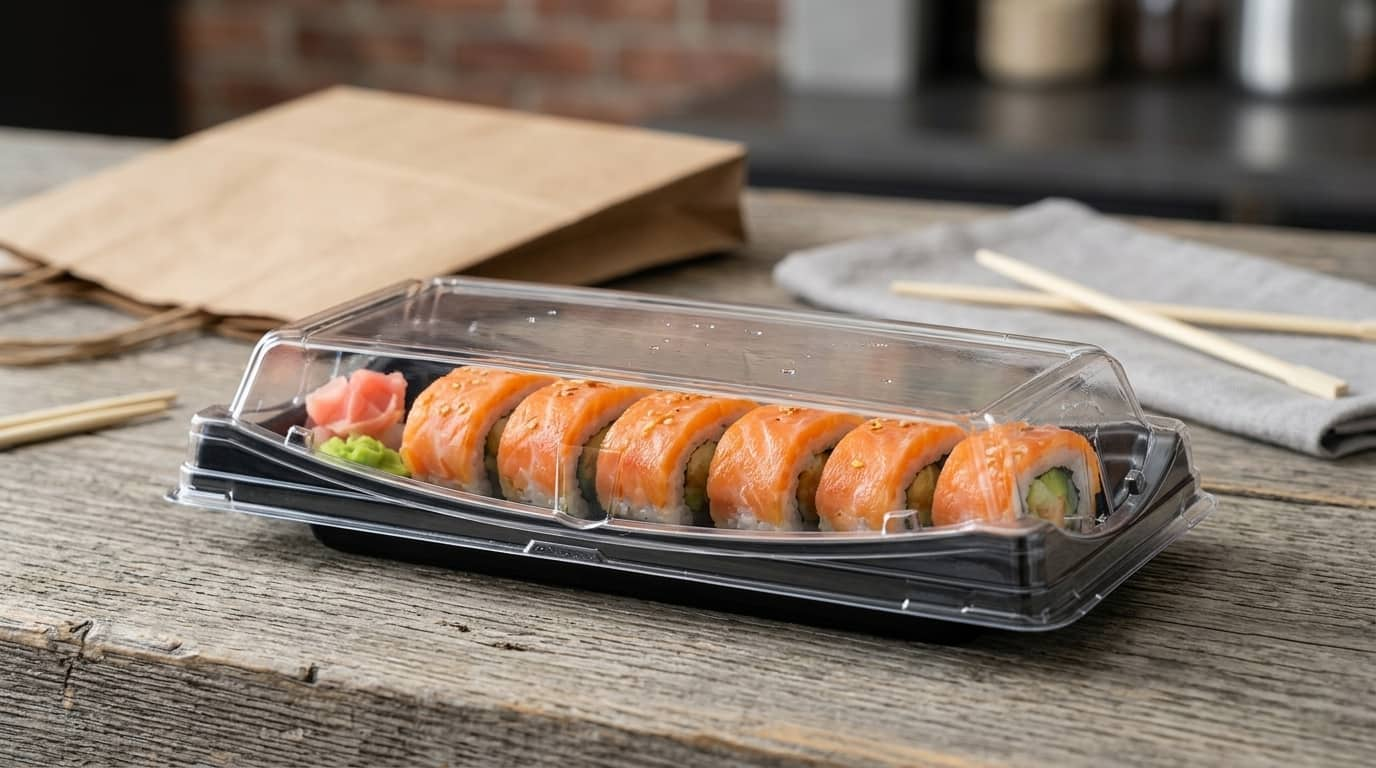
TL;DR: Sushi packaging for restaurants comes down to five decisions: material, size and shape, base style, sauce separation and case quantity. Work them in that order and the rest is paperwork. This guide covers each at overview level, flags the claims you should never assume, and points you to the deep dives. Test one finished order before you commit to a case.
Sushi packaging for restaurants fails in small, expensive ways. A lid that will not seat because the garnish sits a quarter inch too high. A case of 600 trays that turned out to be the wrong footprint. A tray that looked sharp in the cold case and reached the customer with the rolls slumped sideways. None of that is a kitchen problem. It is a sourcing problem, and it almost always starts the same way: buying on price or looks before checking fit, material and case size against real order volume.
At Plastic Container City we supply restaurants, ghost kitchens, grocery sushi counters, commissary kitchens and catering teams across the U.S., and the same five questions come up in the same order every time. This guide takes all five at overview level: what a material name actually tells you, how size and shape follow the order type, what a base color does and does not do, how sauce gets handled, and how case quantity ties back to volume.
How Do You Choose Sushi Packaging for Restaurants?
Direct Answer: Check material, tray size and shape, base style, sauce setup and case quantity on the exact SKU before placing a bulk order.
Each decision narrows the next. Material sets what you can honestly claim about fridge, freezer and microwave use. Size and shape set the footprint. Case quantity is the only one you cannot walk back cheaply.
- Material: decides which handling claims you can make
- Size and shape: decides whether the finished order fits
- Base style: decides how the tray reads on a shelf or table
- Sauce separation: decides whether the rolls arrive clean
- Case quantity: decides how long a mistake sits in your walk-in
What Material Should a Sushi Container Be?
Direct Answer: PCC sushi containers use PET or OPS/PS, depending on the SKU. Check the finished container's label before making heat, cold or reuse claims.
This trips up more buyers than anything else on the page. A recycling number does not confirm food-contact, freezer or microwave suitability on its own. FDA authorizations for substances that contact food apply to the substance, the intended use, the food type and the temperature, so a finished tray's status rides on its own paperwork.
| Material | What the material name tells you | What the exact SKU must confirm |
|---|---|---|
| PET | A clear thermoplastic widely used in food packaging | Microwave, hot-fill, freezer or reuse performance from the letters PET alone |
| OPS and PS | Polystyrene that can be made clear, used in food packaging under 21 CFR 177.1640 | Freezing, impact or heat performance, on the exact product page |
| Bagasse and molded fiber | Molded sugarcane fiber | Construction, coatings, certifications and accepted disposal setting |
| Kraft and paperboard | Paper-based board used for food packaging | Construction, coatings, certifications and any end-of-life claim |
Across our own sushi container line, material is not uniform. Six of Plastic Container City's seven rectangular sushi container sizes are listed as OPS/PS with a black base and clear dome, while the #30 rectangular container is clear PET. All three round party trays are listed as OPS/PS with a black base and clear dome. Several PCC sushi containers are listed as freezer-safe. Check the exact product page for refrigerator and freezer guidance before ordering.
One more thing worth reading properly before you switch suppliers on the strength of a headline. Virginia's rule applies to expanded polystyrene foam food-service containers, and the Virginia DEQ confirms the statewide phase expanded on July 1, 2026. Clear rigid OPS sushi trays are not expanded foam, but operators should still check the rules that apply in their location.
What Size and Shape of Sushi Tray Do You Need?
Direct Answer: Use rectangular trays for individual or small orders and round trays for shared platters. Confirm fit with one finished arrangement.
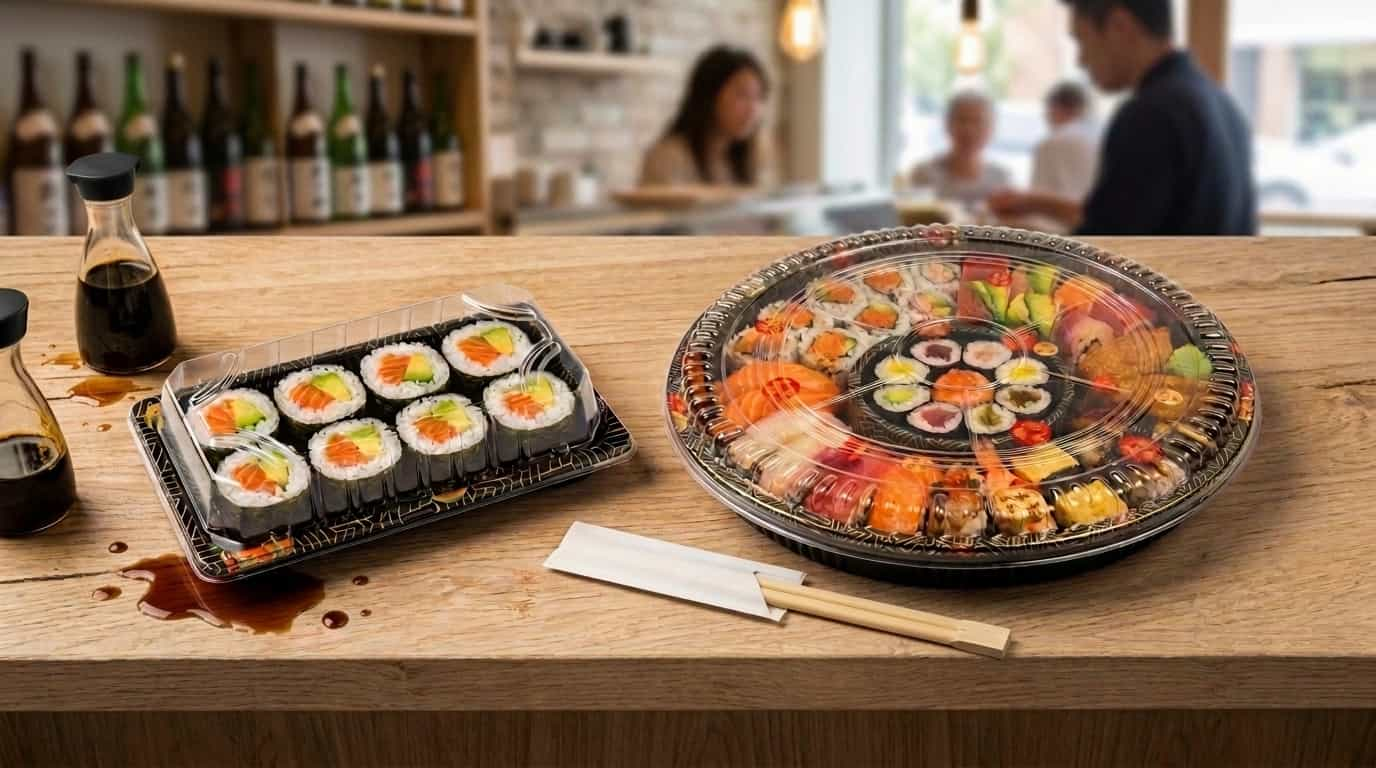
There is no single sushi tray size for every order. Use the listed dimensions as a starting point, then test the finished arrangement. Our rectangular line runs seven sizes, from the #.6 at 6.58 by 3.62 inches up to the #40 at 7.48 by 7.48 inches, plus three round party trays at 11.42, 13.75 and 15 inches across. The reliable method is a fit test: pack one finished order at your normal cut count, close the lid, and check that garnish and sauce cups clear. Our Sushi Tray Size & Case Quantity Guide for Restaurants has the dimension by dimension table and the reorder timing behind it.
Does the Base Color of a Sushi Tray Matter?
Direct Answer: Base color is a presentation choice, not a freshness claim. PCC offers black, blue and wooden-pattern bases with clear lids.
A 2025 plate-color study found that color effects depended on the food and setting, but it did not test sushi trays. Treat base color as an operator choice. Photograph the same arrangement on each base you can get hold of, under your own lighting, and pick the one that reads best in your cold case. The clear lid is doing most of the work either way, because it lets the tray double as its own display.
How Should Sauce Be Packed with a Sushi Order?
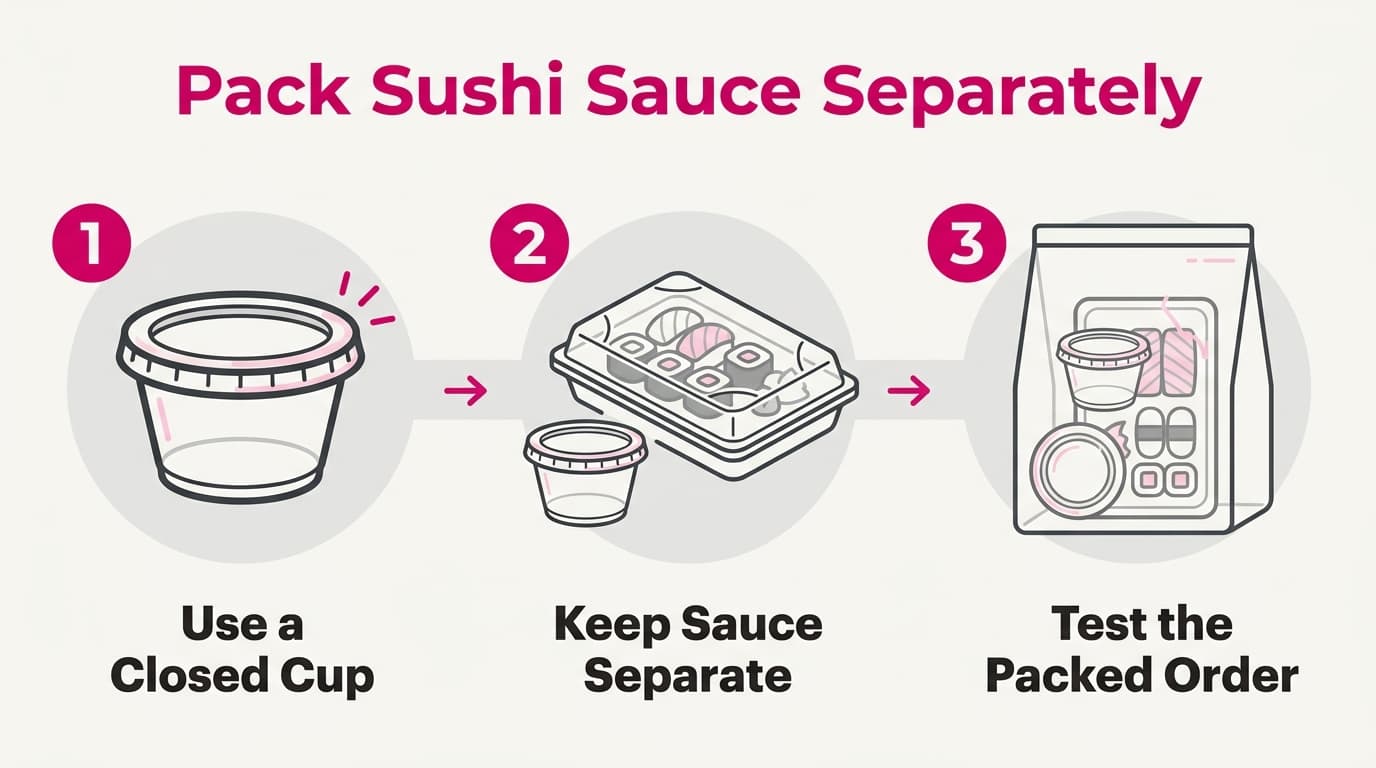
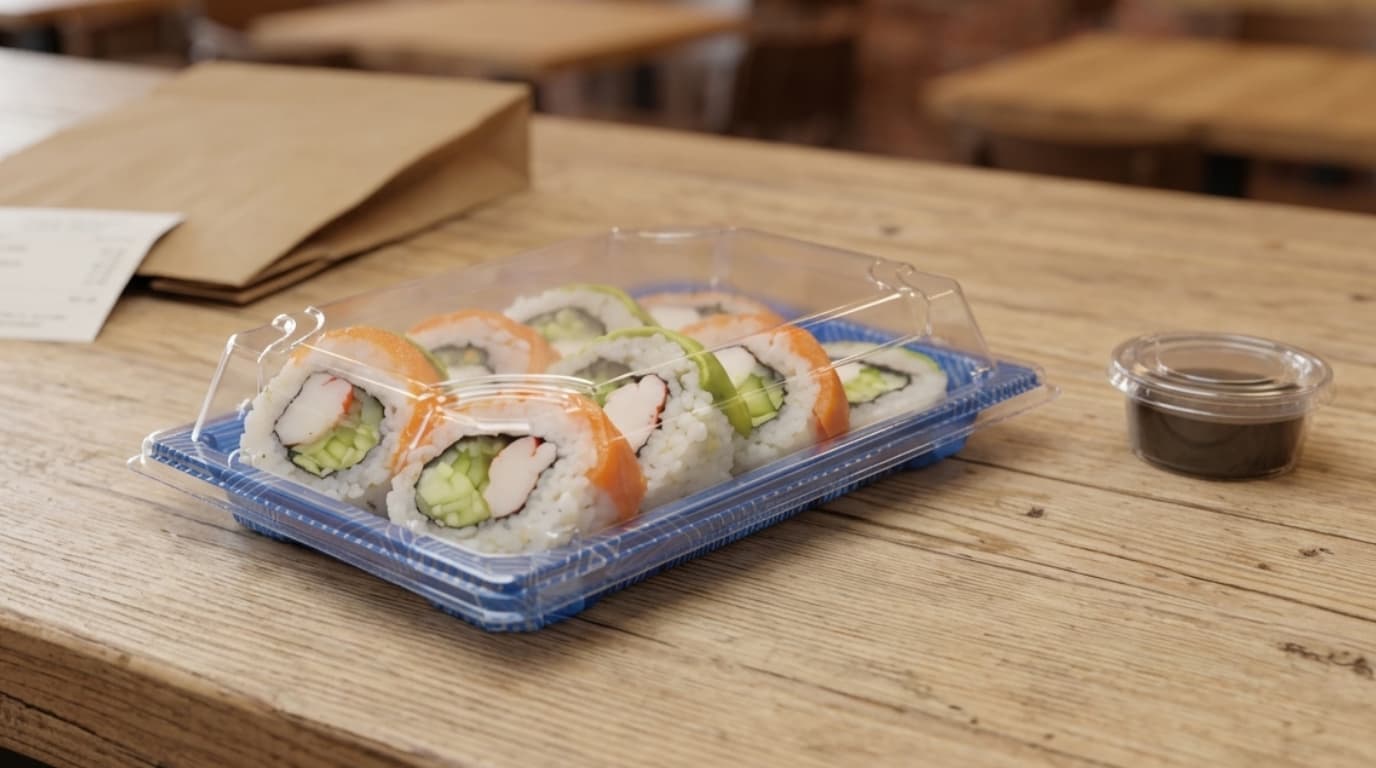
Direct Answer: Pack sauce separately. Plastic Container City offers 2 oz and 4 oz portion cups, and the cup must clear the lid when the tray is closed.
Soy sauce travelling loose against rice is the fastest way to turn a good order into a refund. The operational catch is clearance: a cup that fits the base may still stop the lid from seating, which is why sauce belongs inside the fit test rather than after it.
How Many Sushi Trays Come in a Case?
Direct Answer: PCC sushi case sizes range from 100 to 600 units. Confirm the exact SKU's count, then match it to forecast use and stock on hand.
That spread changes the math more than unit price does. A 600 count case of a slow moving size can sit for months, while a 100 count case of party trays can disappear over one catering weekend. Once a fit test confirms the container, the calculation is plain: forecast use, subtract stock on hand, divide by case size, round up.
What Should You Check Before Sushi Goes Out for Delivery?
Direct Answer: Check closure, stackability and the microwave label. Keep temperature-controlled sushi at 41°F or below unless an approved time-control plan applies.
Delivery is where listed features get mistaken for guarantees. A snap-locking lid is a feature. Leak-proof is a promise, and no supplier should make it without testing behind it. The temperature figure comes from the FDA Food Code, which is a model code, so local adoption decides what applies to you. On reheating, USDA guidance says to use only containers labeled for microwave use. If the sushi container is not labeled microwave-safe, do not microwave it. Our Sushi Takeout Container for Delivery guide covers the full checklist and the route test behind it.
Five decisions, one order, and a single habit underneath all of them: pack one finished order and close the lid before you buy 600 of anything. Suppliers can give you dimensions, case counts and listed features. Only your own line can tell you whether the garnish clears, the sauce cup seats, and the tray still looks worth the price at handoff. For more packaging guidance for restaurants and caterers, visit the Plastic Container City blog. Handled in that order, sushi packaging for restaurants stops being a gamble and becomes a repeatable order.
Frequently Asked Questions
What plastics should be avoided in food storage?
Direct Answer: The question is framed the wrong way round. Food-contact status is set by the finished article's authorized use, not by its recycling number.
What packing materials should a restaurant consider?
Direct Answer: For sushi, consider matched trays and lids, portion cups and insulated carriers. Check the documented use of any sushi packaging for restaurants.