
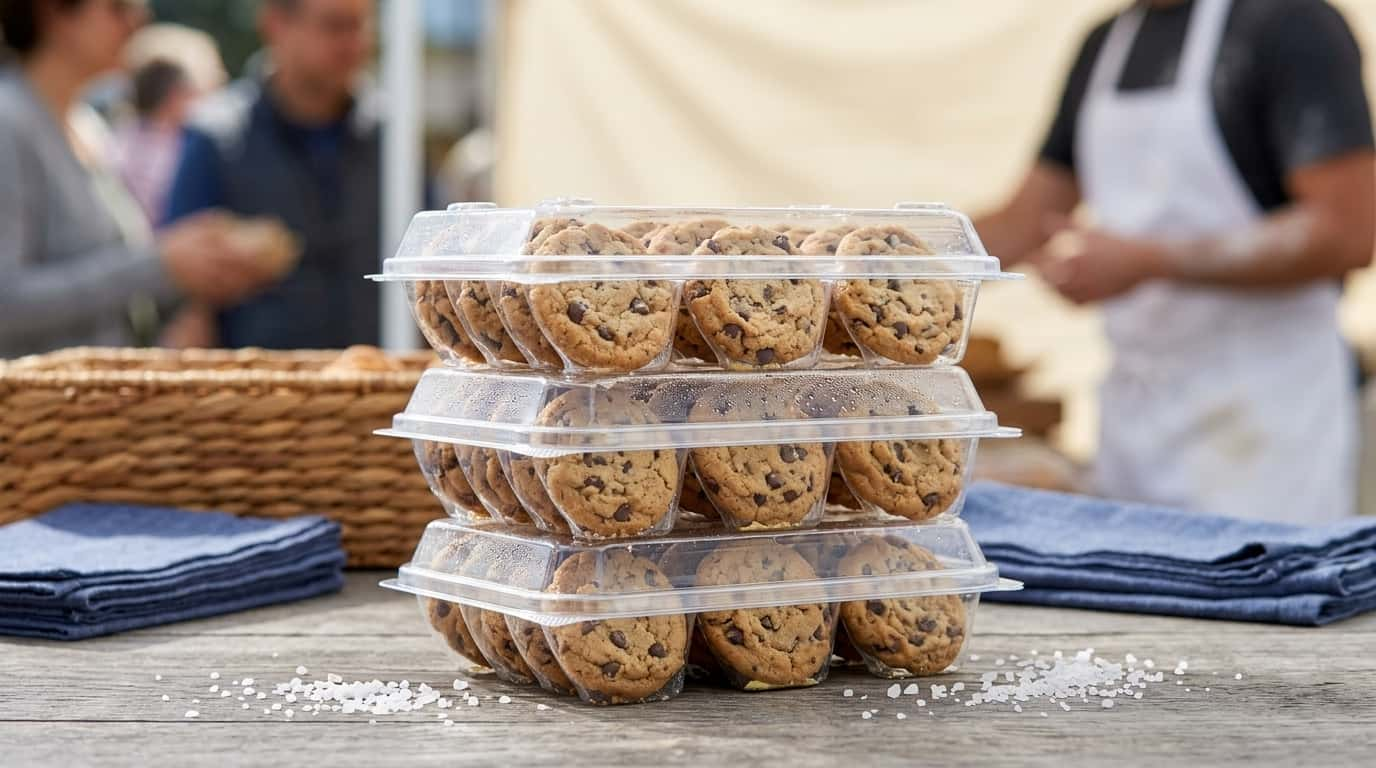
Bakery packaging farmers market strategy is a fundamentally different engineering problem than packaging for a climate-controlled retail display case. Summer sun pushes surface temperatures above 120°F. Transport bounces product across parking lots before the market even opens. And customers are evaluating your booth from 3 stalls away before they ever take a step toward you. The packaging choices that look great inside a bakery case can warp, collapse, or simply go unnoticed in an outdoor market environment.
The stakes are real: 56% of U.S. adults use single-use foodservice packaging weekly, and farmers market customers are among the most packaging-aware shoppers anywhere. They notice when your clamshell is warped, when your label is peeling in the heat, or when your booth looks thrown together next to the vendor beside you with a cohesive, polished display.
At Plastic Container City, we supply packaging to bakery operators ranging from single-market cottage food sellers to multi-location wholesale accounts. The questions we hear from outdoor market vendors are consistently different from those we hear from retail bakeries, and the packaging answers are different too.
The pain points at markets are specific: packaging that collapses under direct sun, product that arrives at the booth dented or crushed from transit, health inspectors flagging your labels as non-compliant, and displays that simply do not convert from a distance. This guide addresses all of them: material by material, label requirement by label requirement, state by state.
Can Your Packaging Survive an Outdoor Market Day?
Not all clear plastic looks the same, but the differences in heat performance are dramatic. Understanding which material you are actually buying, and what it does when temperatures climb, is the single most important packaging decision for outdoor market operators.
- PET (polyethylene terephthalate): The most reliable choice for outdoor markets. PET has a high heat deflection point and holds its shape in direct summer sun. It is widely used for bakery clamshells and is the correct default for any warm-weather outdoor event. PET is also widely recycled, giving it an environmental advantage over alternatives.
- OPS (oriented polystyrene): Cheaper than PET and commonly used for bakery packaging, but OPS has a lower heat deflection point. In sustained direct sun, OPS clamshells can warp, which distorts the product inside and signals poor quality to shoppers. For summer markets, PET is the better choice even at a slightly higher per-unit cost.
- PLA (compostable plastic): Marketed as the eco-friendly option, but PLA softens at 85 to 90°F, which is below the surface temperature of packaging sitting in direct summer sunlight. A PLA clamshell at an outdoor July market is likely to lose its shape before the first customer picks it up. PLA works well for indoor or shaded environments and for cool-weather markets, but it is the wrong material for a sun-exposed summer booth.
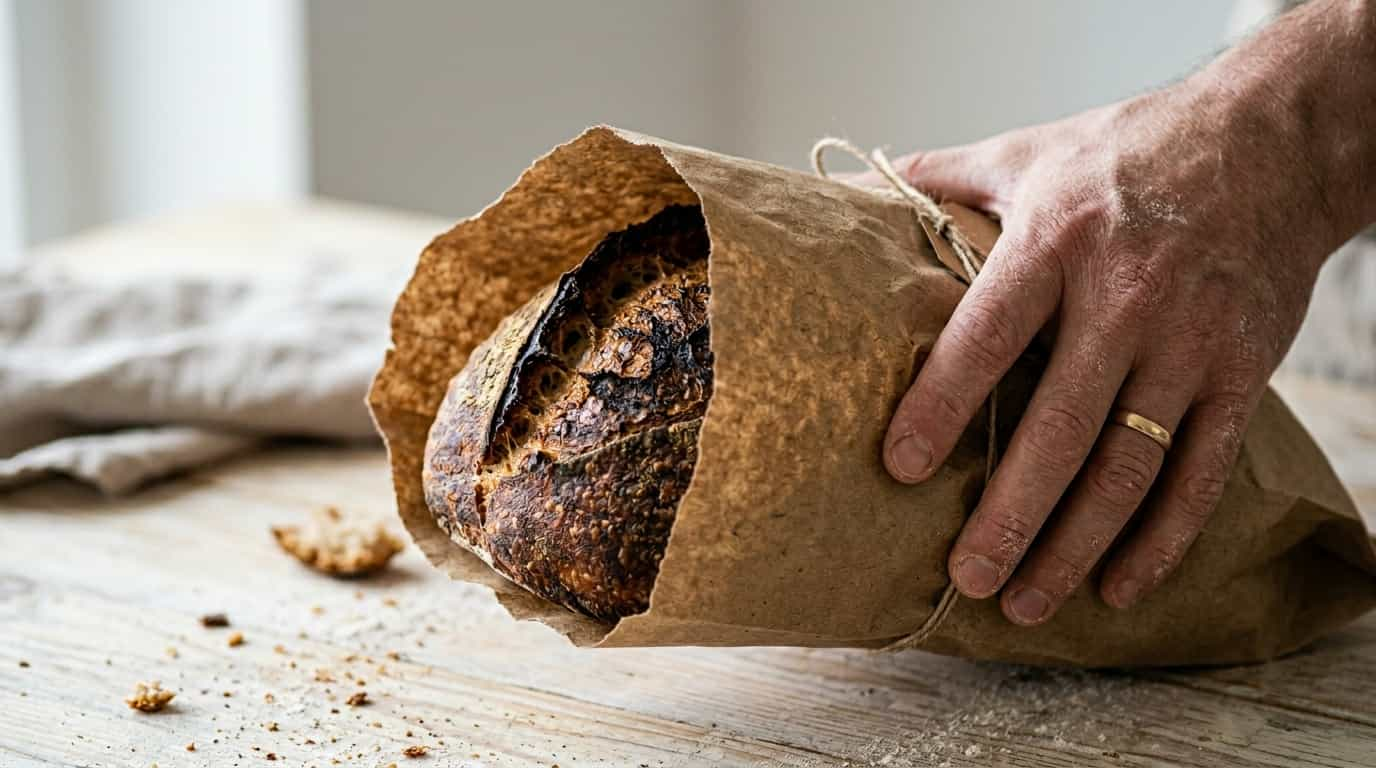
- Kraft paper and paperboard: Completely heat-stable at any temperature a market environment will reach. The correct choice for dry items including scones, biscotti, artisan breads, cookies, and brownies. Kraft bags and paperboard boxes perform as well in August heat as they do in October cool, and they carry a strong artisan quality signal with market shoppers.
The practical rule: if you are running a warm-weather outdoor market, PET and kraft are your two default materials. OPS is a backup option in cooler months. PLA belongs indoors.
Transport and Booth Setup: What Arrives Intact?
Transport is when packaging does its hardest work. The distance from your home kitchen to the market booth involves road vibration, stacking pressure, and the occasional hard stop that sends product sliding. Packaging that cannot survive the drive will not survive the market.
- Stackable rectangular or square clamshells: These pack efficiently in flat transport bins and distribute weight evenly when stacked. Tapered or irregular-shaped containers create unstable stacks that shift and collapse in transit. Rectangular geometry is not an aesthetic preference; it is a structural one.
- Hinged lids that click and hold: A lid that requires pressure to open will stay closed under vibration. Loose-fitting lids pop open in transit, exposing product to contamination and causing presentation damage. Test your packaging by filling it, closing it, and shaking it before committing to a large order.
- Flat base construction: Containers with a flat, stable base do not tip on uneven market tables or on the floor of a vehicle. Many markets have surfaces that are far from level, and a container that wobbles is a container that falls.
- Rigid walls that resist compression: When containers are stacked under product weight in transit, thin walls flex and can crack or distort. Look for wall thickness specifications when ordering; thicker walls cost marginally more but eliminate a real source of product loss.
One-handed operation matters at the market itself. Customers pick up, examine, and put down packaging within a few seconds. A container that requires two hands to hold safely creates friction, and customers who have to juggle the item simply put it back down. Easy-open, single-hand-holdable formats are the practical market standard. Design for the customer who is also holding a coffee, a bag, and a child's hand.
Visibility from 6 Feet Away: Making Your Booth Work Harder
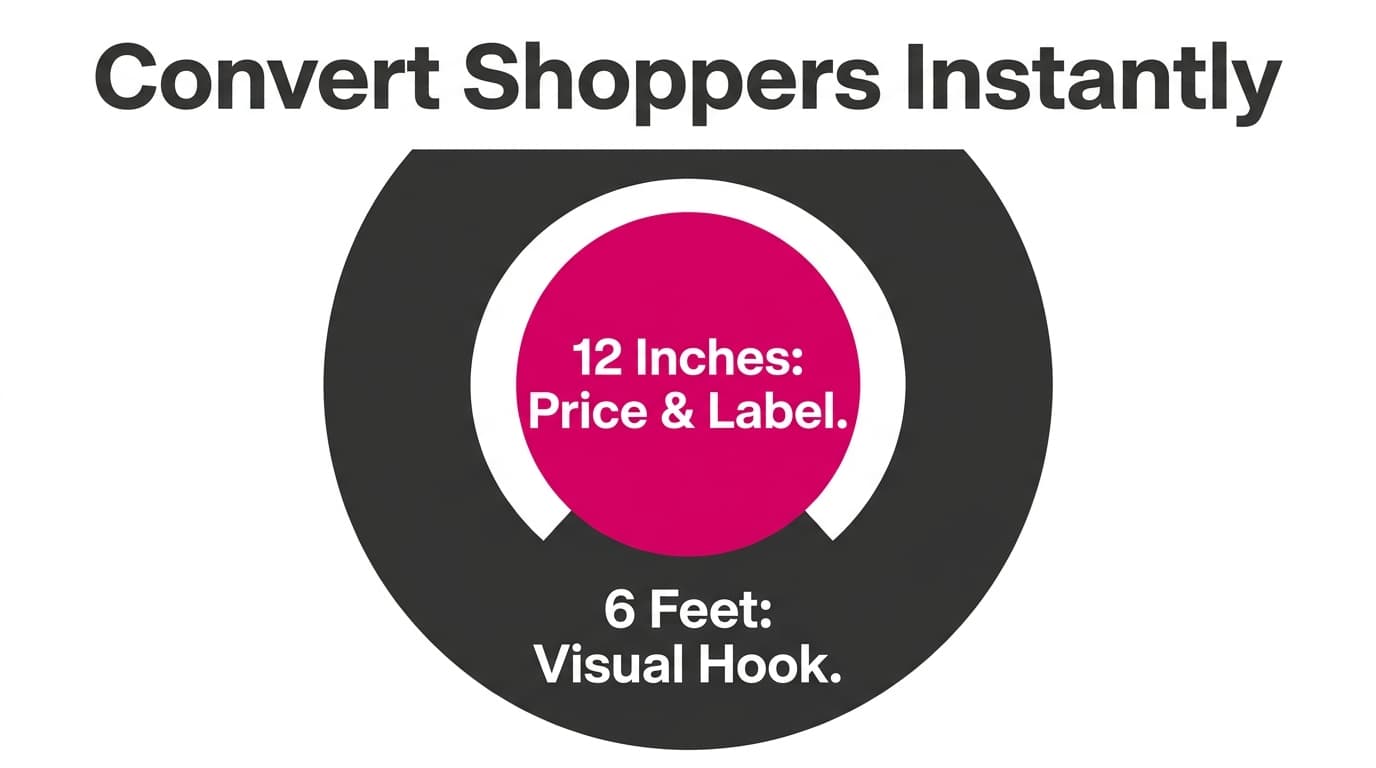
Farmers market purchasing happens in two distinct decision stages, and most small bakeries only design for the second one.
- Approach decision (6 feet): The customer sees your booth from a distance and decides whether to walk over. At this stage they are reading color, overall visual consistency, signage, and format. They are not reading your label. If your booth does not signal "worth approaching" at 6 feet, the label text is irrelevant.
- Purchase decision (12 inches): Once they are at the table, they read the label, check the price, look at ingredients, and make the final call. This is where label quality, ingredient transparency, and price clarity matter.
Practical adjustments for both distances:
- Product name in minimum 14-point font on the front face of the label, or on a printed shelf card propped in front of each product group
- Price visible without picking up the item; use a tent card positioned in front of the product is more reliable than a sticker on the base that faces away from the customer
- Consistent packaging format across all products: matching clamshell sizes, a uniform label template, and consistent color palette signal a professional, curated operation versus a collection of mismatched containers
- Clear containers outperform decorated opaque packaging for impulse conversion at the approach distance; the product itself is the most powerful visual, and clear packaging lets it show
- High-contrast labels with dark text on a light background are readable at 6 feet; script fonts layered over patterned backgrounds are not readable at any distance that matters for the approach decision
Eco packaging materials also function as approach-distance signals. Kraft bags and unbleached paperboard boxes read as artisan quality before the customer is close enough to read a single word. Shoppers at farmers markets have strong associations between natural packaging materials and craft food quality, a perception benefit worth considering when choosing between clear PET and kraft for eligible products. For more on reducing bakery packaging waste while maintaining that artisan signal, the material tradeoffs are worth understanding before your next order.
What Label Text Is Legally Required at a Farmers Market?
Labels are what health inspectors check first. A beautifully packaged product with an incomplete label is a violation at most markets, and many market managers require proof of label compliance as part of vendor applications. 58% of U.S. shoppers read food labels before purchasing, according to Acosta Group data from February 2026, which means your label is doing real sales work beyond just meeting legal minimums. Getting it right on both dimensions matters.
State cottage food laws vary widely in their required disclaimer language, type size, and what additional information must appear on the label. The table below covers five states with recent statutory updates:
| State | Required Disclaimer Language | Key Requirements | Recent Change |
|---|---|---|---|
| Florida | "Made in a cottage food operation that is not subject to Florida's food safety regulations." | 10-point type minimum; allergens and net weight required | 2025 Florida statute |
| California | County-specific: "Made in a Home Kitchen. Not inspected by [County] Dept of Health." | Allergens, net weight, producer name and address required | California 2025 guidance |
| Washington | Permit number and home-kitchen statement required on label | Non-potentially hazardous foods only; direct sales only | April 2026 Washington guidance |
| Illinois | Illinois home-kitchen disclaimer required | Common name, ingredients in order, allergens, net weight | Dec. 2025 Illinois guide |
| Georgia | No disclaimer required (licensing removed July 1, 2025 under HB 398) | Ingredients in descending order; federal allergen labeling required; retail sales now permitted | HB 398 opened retail sales channel |
Across all states, the nine FDA major allergens must be declared: milk, eggs, fish, shellfish, tree nuts, peanuts, wheat, soybeans, and sesame. These must appear clearly on every label regardless of state-specific disclaimer requirements. Missing allergen declarations are the most serious label violation at any market inspection.
For packaging requirements that go beyond labeling, specifically when tamper-evident features are needed at a self-service market booth, see Tamper Evident Packaging Bakery: Rules vs. Realities . Operators who are still working through the licensing process for their state can also reference this home bakery licensing guide for an overview of how cottage food registration varies by state.
Eco Packaging at Markets: What Works and What Fails?
Farmers market customers are among the most sustainability-conscious shoppers in any retail channel. Eco packaging that reads as intentional adds to artisan quality perception and can credibly support higher price points. But eco credentials mean nothing if the packaging fails physically before the end of the market day.
What these terms actually mean in a packaging context:
- Compostable: Breaks down in a certified industrial composting environment within a defined time period. Not heat-stable outdoors. PLA-based compostable clamshells lose structural integrity at 85 to 90°F. There is also no guarantee that the market location has compost collection infrastructure, which means "compostable" packaging may end up in landfill regardless of the label.
- Biodegradable: No standardized U.S. regulatory definition. A package labeled "biodegradable" may break down in 2 years or in 200 years depending on material composition and disposal conditions. Without third-party certification, the term carries no meaningful environmental guarantee.
- Recyclable: Requires that a local recycling facility actually accepts the material. Clear PET is accepted at most curbside programs in the U.S. OPS is not accepted at most curbside programs and is functionally non-recyclable for most customers despite what packaging may imply.
Practical guide for outdoor market operators:
- Kraft paper bags: Heat-stable at any outdoor temperature, biodegradable in real-world conditions, and carry a strong artisan quality signal for breads, scones, biscotti, cookies, and other dry items. The default eco choice for farmers markets.
- Unbleached paperboard boxes: Good structural option for whole baked goods in moderate to warm temperatures. Works well for cupcakes, muffins, and small pastry assortments in shaded or mild conditions.
- PLA clamshells: Save these for indoor pop-ups, shaded cool-weather markets, or winter events where ambient temperatures stay well below 85°F. Avoid using them at warm-weather outdoor markets where structural failure is a real possibility.
The practical eco hierarchy for summer markets: kraft paper first, unbleached paperboard second, clear PET when product visibility is essential. PLA and OPS are situational at best and unsuitable at worst for hot outdoor conditions.
Keeping Product Fresh Through a 6-Hour Market Day
Without access to refrigeration, packaging is the primary freshness tool at a farmers market booth. The decisions you make before you leave the home kitchen determine how your product looks and tastes 5 hours later.
- Pre-package everything before leaving: Never package product at the booth. Beyond being required by most state health codes for cottage food operators, packaging at the booth creates contamination risk from outdoor air, insects, and cross-contact with cash handling. Everything should be sealed before it leaves your kitchen.
- Dry items (cookies, scones, unfrosted bread, biscotti): Sealed clamshells or kraft bags keep out humidity and wind-borne contamination without any refrigeration. Dry baked goods are stable for the full length of a typical 4 to 6 hour market day when properly sealed.
- Items requiring refrigeration (cream-filled pastries, cream-cheese-frosted items): Transport in insulated containers with ice packs and sell early in the market. USDA and CDC guidance establishes a 2-hour window in the temperature danger zone (41°F to 135°F), cut to 1 hour when ambient temperature exceeds 90°F. Plan your quantities accordingly and remove unsold perishable items from display before the window closes.
- Pre-display stock rotation: Keep backup product in a sealed cooler or insulated bag out of direct sunlight. Rotate to the display table in small batches rather than setting out full inventory at once. This keeps backup product fresher longer and maintains an organized, fully-stocked display appearance throughout the market.
For display decisions specific to which of your products actually require refrigeration versus which are safe at ambient temperatures, see Refrigerated vs Dry Bakery Display Case: The 2026 Rule,
Building a Market Packaging Strategy That Works
The vendors who consistently sell out at farmers markets are not necessarily the ones with the best product. They are the ones whose booth does the most work from a distance, whose packaging survives the environment, and whose labels are never a liability. Each of those outcomes comes from deliberate packaging decisions made before market day.
Start with material selection based on your actual market conditions: season, shade availability, product type. Build your label template to satisfy your state's cottage food requirements before you sell a single item. Design your display for the 6-foot customer first, the 12-inch customer second. And pack for transport before you think about presentation; product that arrives intact is the prerequisite for everything else.
For operators running pop-ups and small retail spaces alongside their market program, the same principles apply with some scaling. Consistent packaging across all your channels builds brand recognition over time. A customer who bought a kraft-bagged scone from your market booth should recognize your packaging immediately when they encounter your product at a small retail partner. That recognition is built through packaging consistency, not product alone.
For the full grab-and-go container and display system behind your bakery operation, the grab-and-go bakery packaging guide covers the decisions that determine how every product in your range gets from your kitchen to your customer.
More guidance on packaging decisions for bakery operators across all formats is available at the Plastic Container City blog. Whether you are scaling from a single farmers market to multiple channels or refining a setup that is already working, the right packaging choices for your specific products and conditions are the foundation of sustainable bakery packaging for farmers markets.
Frequently Asked Questions
Will cookies stay fresh in cellophane?
Cellophane bags work for cookies that are already fully cooled and dry. They provide a basic moisture barrier for short-term display, typically 1 to 2 days for most drop cookies. Heat-sealed cellophane outperforms twist-tied bags for freshness. For a 6-hour market day, cellophane is adequate for dry, unfrosted cookies. Avoid cellophane for soft or high-moisture cookies, which go stale faster without a tighter seal.
How to display bakery items?
Use tiered risers to create height variation and prevent a flat, hard-to-scan table. Group products by type with consistent packaging. Place price and product name signs at standing-customer eye level rather than flat on the table. Clear containers let the product sell itself. Keep display quantities manageable and replenish from a covered backup supply; a sparse, tidy display outperforms an overstuffed one for most market customers.
How to present pastries attractively?
Clear clamshells or windowed boxes let the pastry's appearance do the work. Nest pastries in parchment or tissue to prevent sliding and keep presentation neat. For frosted items, ensure the lid has enough clearance to not smear the top. Consistent spacing inside the container, not overcrowded, signals care and quality. A simple kraft label with clean typography completes the presentation without competing with the product visually.
What is the difference between compostable and biodegradable packaging?
Compostable packaging meets a defined standard: it breaks down within a specific timeframe in a certified industrial composting facility. Biodegradable has no standardized U.S. regulatory definition. Any material technically biodegrades eventually, so the term without certification is not a meaningful environmental claim. For farmers market use, compostable PLA is heat-sensitive and often unsuitable outdoors. Kraft paper is the better practical choice for genuine environmental performance at markets.
Do I need to pre-package my baked goods before a farmers market?
Yes, in virtually every state. Most cottage food laws require that products are packaged in the licensed home kitchen, not at the point of sale. Packaging at the booth also creates contamination risk from outdoor conditions. Pre-packaging ensures label compliance, reduces handling at the booth, and protects product integrity during transport. Confirm your specific state's requirements, but pre-packaging in the kitchen before departure is both the legal and practical standard.