
The refrigerated vs. dry bakery display case question comes up early for any food professional setting up a display counter, and the answer is determined by what is inside the product, not what the product is called. "Cupcakes" is not a display temperature. "Cupcakes with cream cheese frosting" is refrigerated.
Getting this wrong is expensive either way. Under-refrigerating cream-filled or dairy-frosted items is a food safety risk that can result in foodborne illness, product recalls, and lost operating licenses. Over-refrigerating plain baked goods like croissants or artisan bread accelerates staling and turns a premium product into a dense, gummy disappointment before the end of the display day.
At Plastic Container City, we supply packaging to food professionals across the U.S. The display-type decision is one of the first questions that determines which packaging format a product needs, and we see the downstream consequences of getting it wrong regularly.
This article covers the frosting and filling decision guide, what the wrong display choice costs product quality, how packaging specs change for refrigerated cases, mixed-product management, and event handling without a case.
Refrigerated or Dry Display: What Actually Decides It?
The framework is straightforward once you strip away the product name. If a product's formulation includes cream, custard, uncooked eggs, cream cheese, whipped cream, or cut fruit, it belongs in a refrigerated display case held at 41°F or below. If the formulation is baked through with no dairy-fresh or egg-fresh component remaining after baking, it belongs in dry ambient storage at room temperature. The product name is irrelevant. The formula is everything.
A chocolate eclair filled with custard is refrigerated. A chocolate eclair shell with no filling is dry ambient. Same outer product, opposite display requirement. The distinction is not about caution or preference. It is a food safety classification based on the USDA and FDA definition of Temperature Control for Safety (TCS) foods.
| Product Type | Display | Temperature Rule |
|---|---|---|
| Cream-filled and custard pastries | Refrigerated | 41°F or below |
| Savory pastries with meat or dairy | Refrigerated | 41°F or below |
| Croissants and laminated pastries (unfilled) | Dry ambient | Room temperature |
| Muffins and soft cookies (unfrosted) | Dry ambient | Room temperature |
| Frosted cakes (formula-dependent) | See frosting guide below | — |
| Cheesecakes | Refrigerated | 41°F or below |
The Frosting and Filling Guide: What Forces Refrigeration?
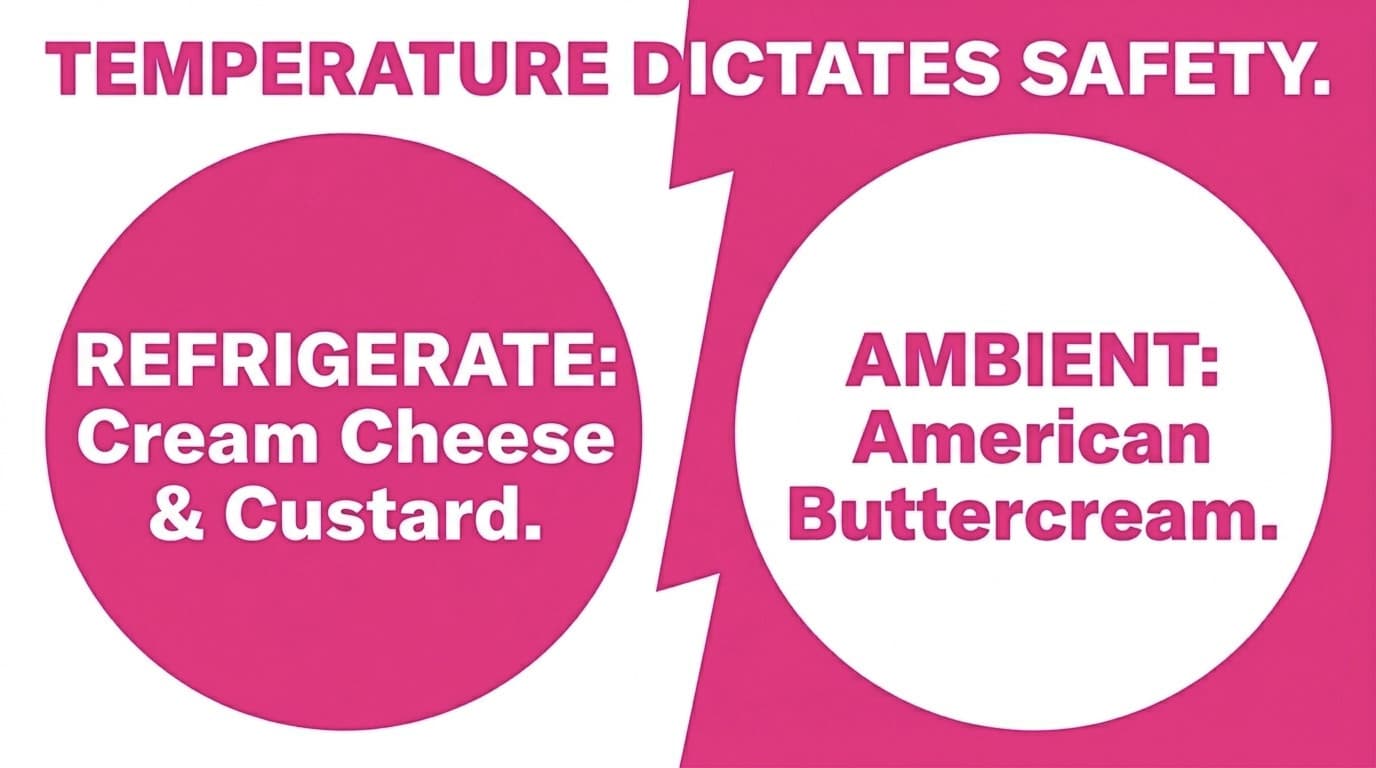
This is the single most-searched question in bakery display compliance and the least clearly answered anywhere online. The answer comes entirely from formula, not product name. A cake frosted with American buttercream can sit on a dry ambient shelf. The exact same cake frosted with cream cheese frosting must be in a cold case at 41°F or below. The cake did not change. The frosting formula did.
The table below covers the most common frosting and filling types in commercial and cottage bakery production. Use the display type column as your classification rule, not the product label.
| Frosting / Filling Type | Display Type | Temperature | Notes |
|---|---|---|---|
| American buttercream (powdered sugar + butter) | Dry ambient | Room temp | Low-moisture, high-sugar; stable without refrigeration |
| Swiss meringue buttercream (SMBC) | Refrigerated | 41°F or below | Made with raw egg whites |
| Italian meringue buttercream (IMBC) | Refrigerated | 41°F or below | Egg-containing; classified as high-risk |
| German buttercream (pastry cream base) | Refrigerated | 41°F or below | Contains egg yolks and milk |
| Cream cheese frosting | Refrigerated | 41°F or below | Iowa State Extension research confirms cream cheese frosting as a TCS food requiring cold holding |
| Whipped cream | Refrigerated | 41°F or below | Unstable at room temperature beyond 2 hours |
| Uncooked dairy frosting (validated formula) | Dry ambient IF formula meets threshold | Room temp | University of Minnesota Extension: only when sugar concentration exceeds 65° Brix AND water activity is at or below 0.85 |
| Custard / pastry cream filling | Refrigerated | 41°F or below | High-risk category |
| Dark chocolate ganache (cream-free recipe) | Dry ambient for short display | Room temp (24 to 48 hours) | Cream-based ganache = refrigerated |
The Minnesota threshold deserves emphasis. The University of Minnesota Extension guideline permits dry ambient display for certain uncooked dairy frostings only when sugar concentration exceeds 65° Brix and water activity is at or below 0.85. Most home-recipe buttercreams do not meet both criteria. Standard American buttercream made with 1 cup of butter to 3 to 4 cups of powdered sugar can approach or clear this threshold. A recipe that adds milk, heavy cream, or reduced the sugar ratio may not. When there is any doubt, refrigerate.
What Refrigerating Dry Bakery Items Actually Costs You
This is the display mistake that looks like food safety caution but is actually product destruction. Operators who refrigerate everything to be "safe" are not being safe with dry bakery items. They are accelerating a staling process that makes a premium product unsellable faster than dry ambient storage would.
Artisan bread stays soft and springy for two days at room temperature but becomes dense and crumbly after 24 hours in a cold case. Croissants lose their laminated, flaky texture and become leathery. Plain cookies, which should have a slight crisp edge, become soft and gummy from moisture migration inside the cold packaging.
The science of texture loss from cold storage is covered in depth in How Packaging Affects Freshness and Perceived Quality in Bakery Products. For this article's scope: cold temperatures accelerate starch recrystallization in dry starch-based bakery items. Once starches retrograde in a cold environment, the texture change is not reversible by bringing the product back to room temperature. Packaging can slow moisture loss but cannot stop retrogradation once it begins in a cold case.
Practical rule: if the product has no cream, egg, or dairy-fresh component, it goes on the dry ambient shelf. Refrigerating it is not a safer choice. It is an accelerated quality failure.
What Changes About Packaging in a Refrigerated Display Case?
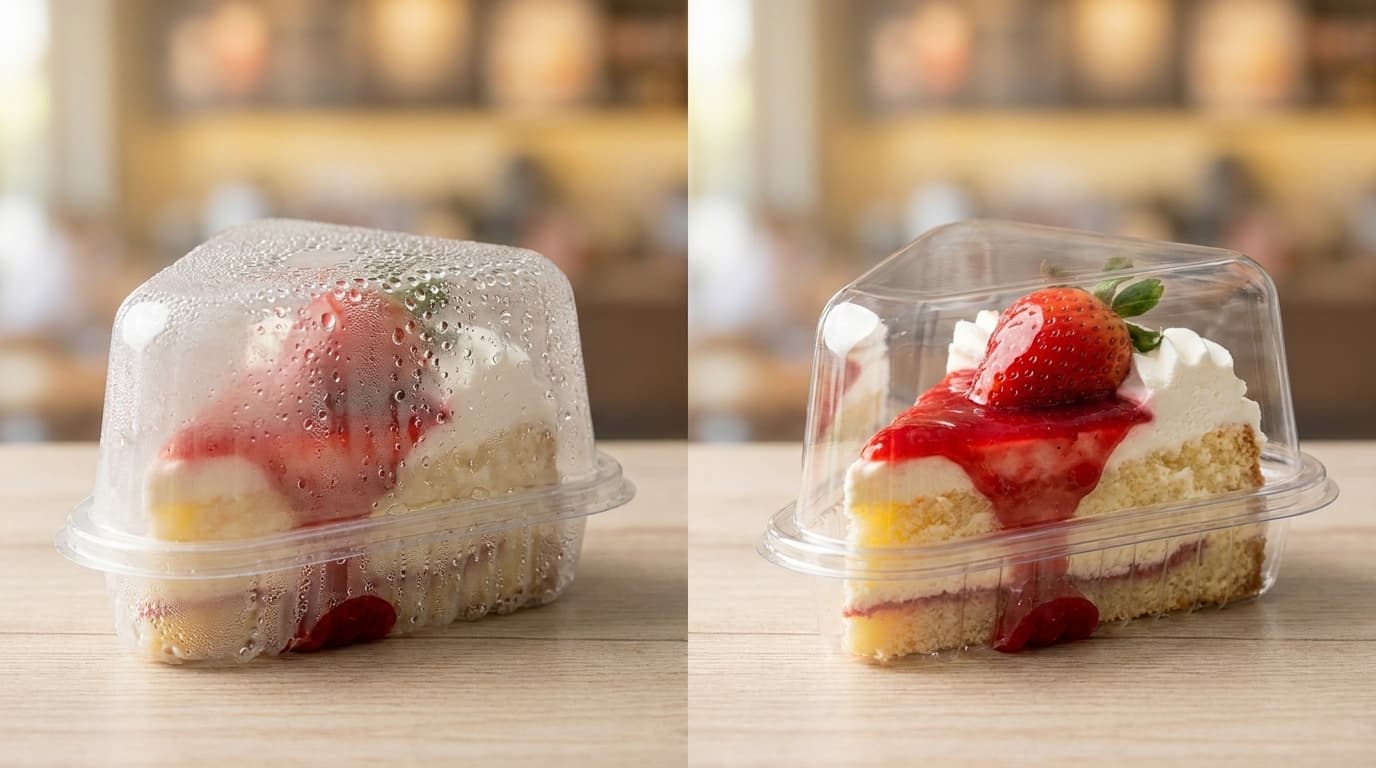
A product moved from a warm kitchen to a cold display case behaves differently inside its packaging than the same product sitting on a dry ambient shelf. Temperature differential causes condensation, which is both a freshness issue and a visual failure. A clear container with fogged or droplet-covered lids signals staleness to every customer who passes by, regardless of whether the product inside is fresh.
Anti-fog PET lids solve this directly. The release of anti-fog BOPET lidding film designed for cold-chain display demonstrates that the food packaging industry now treats condensation prevention as a standard specification for refrigerated bakery presentation, not an optional upgrade. The film prevents condensation droplets from forming on clear lids in cold-chain display environments. For refrigerated bakery, anti-fog PET lids are the practical standard for any product where visual presentation drives purchase.
Label adhesives are a less obvious but equally real issue. Standard pressure-sensitive adhesive labels can curl or detach at sustained temperatures of 34 to 40°F. Cold-temperature adhesives are formulated to maintain their bond at sustained refrigerated temperatures without edge peeling, which matters for compliance labeling as much as it does for brand presentation.
Case environment also matters. The Federal Industries dual-zone bakery case maintains an average refrigerated temperature of 38 to 40°F using a low-velocity fan system that also preserves higher ambient humidity within the case. This humidity detail is not cosmetic. Bakery products placed in low-humidity cold storage dry out faster, which means the packaging must do more work to protect moisture content at the same shelf life. A well-humidified case reduces the drying burden on packaging.
For a complete reference on which container formats work across refrigerated and dry product types, see the bakery packaging format guide on the Plastic Container City blog.
Running Both Cold and Dry at One Location
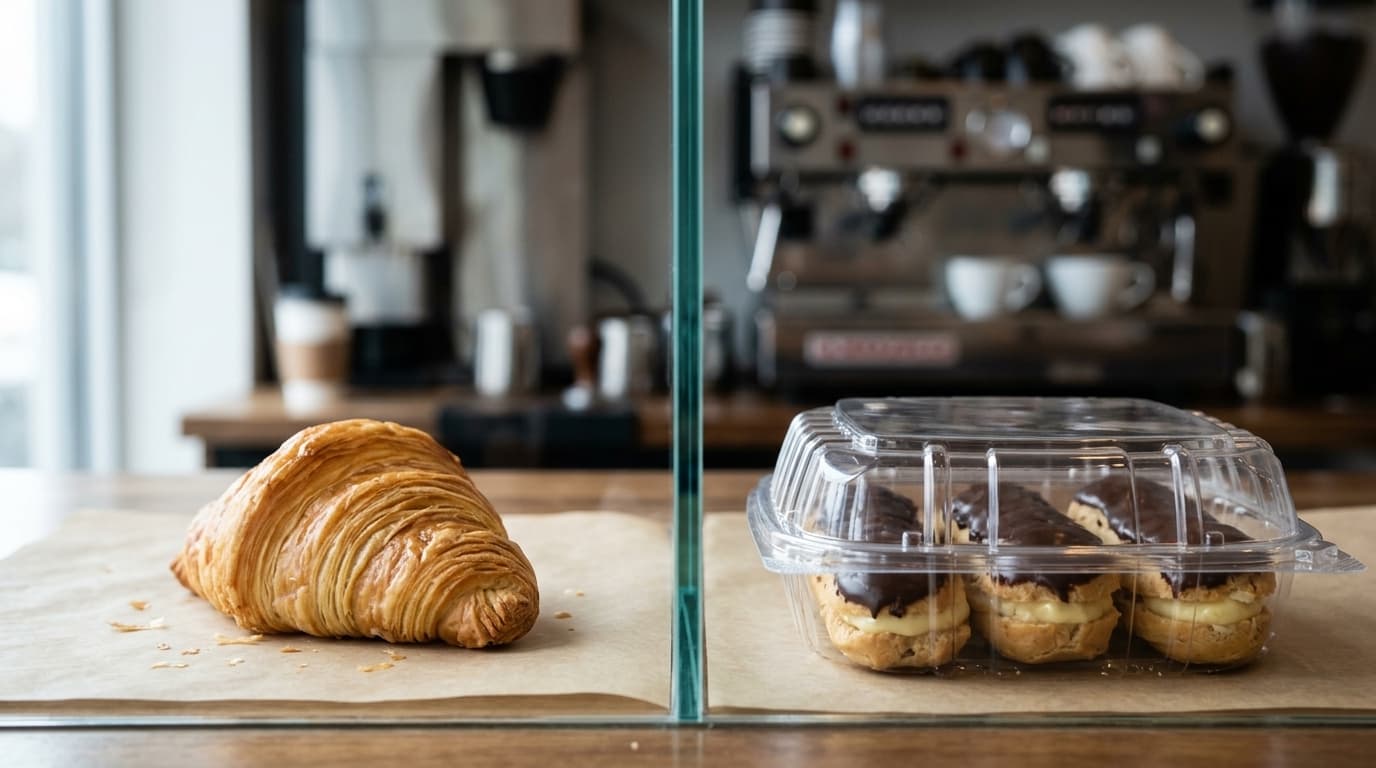
Most retail bakeries sell both dry and refrigerated items at the same counter. A croissant and a cream-filled eclair are natural companions on the same menu. Running everything in one temperature zone compromises either food safety or product quality for one of the two categories. There is no middle-ground temperature that works for both.
The cleanest solution at scale is a dual-zone case. Federal Industries manufactures a Federal Industries dual-zone bakery case with refrigerated and non-refrigerated sides in a single curved-glass unit. This eliminates the physical separation problem and presents both product categories under consistent lighting and glass quality. The capital investment is real and should be planned as a line-item decision.
For operators who are not ready for a dual-zone case, the practical split setup works:
- A refrigerated countertop display unit for all TCS products: cream-filled, dairy-frosted, custard-based items held at 41°F or below
- A dry ambient display adjacent to the refrigerated unit for all non-hazardous items: plain croissants, unfrosted muffins, artisan bread, American buttercream-frosted items
- Visually distinct packaging across the two zones, using consistent color-coding or a clear visual system, so customers can identify which items are refrigerated without asking staff every time
For self-service grab-and-go setups that span both display zones, see When Do You Need Tamper-Evident Packaging for Grab-and-Go Bakery Items? for the packaging requirements that apply when customers are handling product directly.
Events and Pop-Ups Without a Display Case
When a display case is not practical due to power access limitations, transport cost, or setup space constraints, packaging must do the work the case would normally do. This is one of the highest-risk situations in food service because the environmental controls are removed and replaced by operator judgment and monitoring discipline.
Current USDA and CDC food safety guidance is clear: perishable items must be held at 41°F or below. Any perishable item left in the temperature danger zone (41°F to 135°F) for more than 2 hours must be discarded. When ambient temperature exceeds 90°F, that window drops to 1 hour. This is not a guideline that can be stretched based on how the product looks.
Practical options for maintaining temperature at events include:
- Insulated transport containers with ice packs: product temperature must be monitored throughout the event with a probe thermometer, not assumed based on packing time
- Insulated display boxes with clear lids: these provide some temperature control while maintaining customer visibility of the product; they are a middle ground between full refrigeration and ambient display
- Front-loading TCS items in your sell plan: position cream-filled and dairy-frosted items for early sale so they move quickly; shift display to dry items for the back half of the event when temperature control becomes harder to guarantee
The harder answer is this: if you cannot maintain 41°F for cream-filled or dairy-frosted items throughout the full duration of the event, do not bring them. Dry items carry no temperature risk and sell well at events without any refrigeration challenge. A table of artisan loaves, plain croissants, unfrosted cookies, and American buttercream-frosted items can be a strong event lineup with zero cold-chain management required.
The Right Display Type Protects Your Product and Your Business
The display temperature decision is a formula question, not a category question. Every product in your case has a formulation answer, and that answer tells you exactly where it belongs. Cream, custard, raw egg, and cream cheese belong at 41°F or below. Fully baked, dairy-fresh-free products belong at room temperature. Getting the classification right protects your customers from food safety risk and your product from unnecessary quality degradation.
Packaging follows display type. Cold cases need anti-fog PET, cold-rated adhesives, and containers that hold up in sustained humidity. Dry ambient cases need packaging that controls moisture loss without trapping it. Both setups require clear presentation, consistent labeling, and containers that communicate freshness at a glance.
For the full grab-and-go container and display framework, the grab-and-go bakery packaging guide covers the complete product-to-display decisions your operation depends on, from container selection to refrigerated display specs.
At Plastic Container City, we work with bakeries across the country on packaging decisions that start exactly here. For more on packaging formats, freshness, and display-specific specs, visit the Plastic Container City blog. The right container choice for your display starts with correctly classifying your products under the refrigerated vs. dry bakery display case framework covered in this guide.
Frequently Asked Questions
How to preserve baked goods for display?
Match display temperature to product formula. Dry items stay freshest in dry ambient display with moisture-controlling packaging. TCS items require cold holding at 41°F or below in sealed anti-fog containers. Avoid refrigerating dry items: cold accelerates staling in plain baked goods. Use packaging that limits air exchange and prevents moisture loss for the relevant display environment.
How to display fresh baked goods?
Dry items go in dry ambient display with packaging that controls moisture loss without sealing in excess humidity. TCS products go in a refrigerated case at 41°F or below in anti-fog PET containers. Use color-coded or visually distinct packaging across both zones so customers can identify which items require cold handling. Label all packaged items with production date and ingredients.
How long can cake be on display?
It depends entirely on frosting formula. American buttercream-frosted cakes can display at room temperature for 2 to 3 days when properly packaged. Cream cheese, SMBC, or custard-frosted cakes must stay in a refrigerated case at 41°F or below and should be sold within 2 to 4 days. Any cut cake surface exposed to air should be sold the same day regardless of frosting type.
Do frosted cupcakes need to be refrigerated in a display case?
It depends on the frosting formula, not the cupcake. Cupcakes frosted with American buttercream are dry-display safe at room temperature. Cupcakes frosted with cream cheese frosting, Swiss meringue buttercream, German buttercream, whipped cream, or any custard-based frosting must be refrigerated at 41°F or below. Confirm your frosting formula before choosing a display temperature for any frosted item.
What is the 2 2 2 rule for food?
The phrase "2 2 2 rule" is sometimes used informally to describe food safety time limits, but the official standard is the 2-hour rule: perishable foods must not remain in the temperature danger zone (41°F to 135°F) for more than 2 hours total. Above 90°F ambient temperature, that limit drops to 1 hour. Food held beyond these limits must be discarded, not returned to refrigeration and re-displayed.