

Tamper evident packaging for bakery items is one of those topics where everyone has an opinion and almost nobody has a clear answer. Ask three operators and you will get three different answers, usually ranging from "absolutely required" to "no one ever mentioned it." The truth sits somewhere more specific, and knowing exactly where it sits is the difference between passing an inspection and failing one.
The most important thing to understand up front: the requirement is not product-based. It is channel-based. A sealed cookie sitting in your own bakery display case operates under entirely different rules than the same cookie packaged for a coffee shop account, or boxed up and shipped to a customer two states away. Nearly 75% of U.S. restaurant traffic now happens off-premises, according to the National Restaurant Association's April 2025 data. For bakery operators, that means what is inside the package, and how visibly secure it looks, has become front-line merchandising, not back-room compliance.
Here is the breakdown you actually need: when it is required, when it is best practice, what the terms mean, what the states say, and which container choices keep you protected.
Do You Actually Need Tamper-Evident Packaging for Bakery?
If you sell directly to customers who are standing in front of you, the law in most U.S. states focuses on whether your product is prepackaged and properly labeled, not whether it carries a formal tamper-evident feature. A review of current 2025 to 2026 cottage food regulations across California, Florida, Illinois, New York, Washington, and several other key states found that the operative language is consistently "prepackaged," "packaged in the home kitchen," or "packaged in a manner that prevents contamination." The exact phrase "tamper-evident" rarely appears as a hard statutory requirement for direct-to-consumer cottage food sales.
That does not mean you can skip it. It means the legal baseline for direct sales is sealing and labeling. Tamper-evident features sit above that baseline, serving as the standard that wholesale buyers expect, that product liability insurers look for, and that builds immediate consumer trust at the point of purchase.
For home bakery operators working through cottage food licensing, starting a home bakery the right way covers licensing requirements in detail. Once you move into wholesale or online sales, this article is the compliance layer that sits on top of that foundation.
Three Scenarios That Change the Rules
Scenario 1: Self-Service Retail Display
A self-service display is any setup where the customer selects the product without a staff member handing it over directly. This covers open bakery cases, café self-serve baskets, unattended market tables, hotel grab-and-go stations, and breakroom displays. At these points, local health codes treat your packaging as the only protective barrier between the public and the product.
In practice, health inspectors at self-service locations look at whether the product is wrapped or prepackaged, and whether the package shows visible signs of prior opening. The regulatory language is usually "wrapped" or "packaged," not "tamper-evident." A well-sealed hinged clamshell that shows obvious signs if forced open typically satisfies this inspection standard. For farmers market booth setups with self-service elements, bakery packaging for farmers markets and pop-ups covers the vendor-specific rules in full.
Scenario 2: Wholesale to a Third-Party Retailer
When a coffee shop, specialty grocer, hotel gift shop, or corporate cafe buys from you wholesale, the dynamic shifts entirely. Your packaging is now being evaluated by a buyer, their employees, their health inspector, and eventually their customers, none of whom were present when you made the product. Wholesale buyers increasingly require tamper-evident packaging as a condition of purchase, regardless of state cottage food law. Your sealed container is your documented proof that the product arrived intact. Without that proof, any complaint about the product's condition after delivery becomes your problem to defend.
Scenario 3: Shipped and Online Orders
For e-commerce bakery sales shipped direct to the consumer, the Food Safety Modernization Act (FSMA) provides the federal framework. The product must arrive in a condition that clearly shows it was not opened in transit. This makes tamper-evident closures the practical baseline for anything sold through an online channel, whether you are shipping a dozen cookies across town or a gift box across the country. A container that can be re-closed without visible evidence of opening does not meet this standard.

Tamper-Evident, Tamper-Resistant, or Tamper-Indicating?
These three terms get used interchangeably by operators, buyers, and inspectors alike. They are not the same thing, and the distinction matters when you are choosing containers, writing product specs for a wholesale account, or filing an insurance claim.
- Tamper-evident packaging includes a visible feature that makes it obvious to the consumer that the package was previously opened. A snap tab on a clamshell that breaks when the lid is lifted is tamper-evident. A sticker seal across a lid seam that shows tearing is tamper-evident. The consumer can see it without tools or testing.
- Tamper-resistant packaging is designed to make unauthorized opening much harder. Child-resistant prescription bottles are the most recognizable example. For bakery, this is rarely the relevant standard.
- Tamper-indicating packaging leaves a permanent, visible record of a breach after it happens. A "VOID" adhesive label that leaves a ghost message when peeled off is tamper-indicating. These are common in pharmaceutical and high-value product contexts.
For grab-and-go bakery, tamper-evident is what you need. The goal is not to prevent tampering physically. It is to give the consumer and the buyer visible confidence that the product was untouched from the moment you sealed it.
What State Rules Actually Require
The table below summarizes the current 2025 to 2026 packaging language for key cottage food states. Note the column "Packaging Term Used" carefully. It tells you what the state actually requires, not what operators assume it requires.
| State | Direct Sales Allowed | Wholesale Allowed | Packaging Term Used | Key Note |
|---|---|---|---|---|
| California | Yes (Class A & B) | Class B only | Prepackaged | Non-potentially hazardous items only; 2025 guidance confirmed |
| Florida | Yes | No | Prepackaged with affixed label | 2025 Florida statute requires exact 10-point disclaimer on label |
| Texas | Yes | No (cottage path) | Must prevent contamination | SB 541 (Sept. 1, 2025): TCS baked goods now allowed with registration, "prepared on" date, and safe-handling statement |
| New York | Yes | No | Packaged in home kitchen | Point-of-sale packaging not permitted; allergen labeling law takes effect Nov. 12, 2026 |
| Washington | Yes | No (cottage permit) | Labeled with permit number and home-kitchen statement | April 2026 guidance confirmed; online and wholesale sales require Food Processor's License |
| Georgia | Yes | Yes (as of July 1, 2025) | Ingredients in descending order; allergen labeling | HB 398 removed state cottage-food licensing requirement and opened retail sales |
| Illinois | Yes | Limited | Prepackaged in home kitchen | Dec. 2025 labeling guide: common name, allergens, and net weight required on label |
The pattern is clear across all seven states: no state in this set uses "tamper-evident" as the statutory baseline for cottage food direct sales. The operative standards are about prepackaging, labeling, and contamination prevention. Once product moves into wholesale or online channels, that gap closes fast because buyer requirements and federal frameworks fill it.
Which Containers Already Qualify?
At Plastic Container City, we work with thousands of food professionals across the U.S., and one of the most consistent observations from our team is that operators buy add-on tamper solutions when their existing containers already have built-in snap features that satisfy the standard. Before you invest in anything new, check what you are already using. With 58% of U.S. shoppers now regularly reading food labels according to a Feb. 2026 Acosta Group survey, visible security features are being noticed and evaluated at the shelf level.
| Container Type | Tamper-Evident Without Modification? | Estimated Cost Per Unit | Best For |
|---|---|---|---|
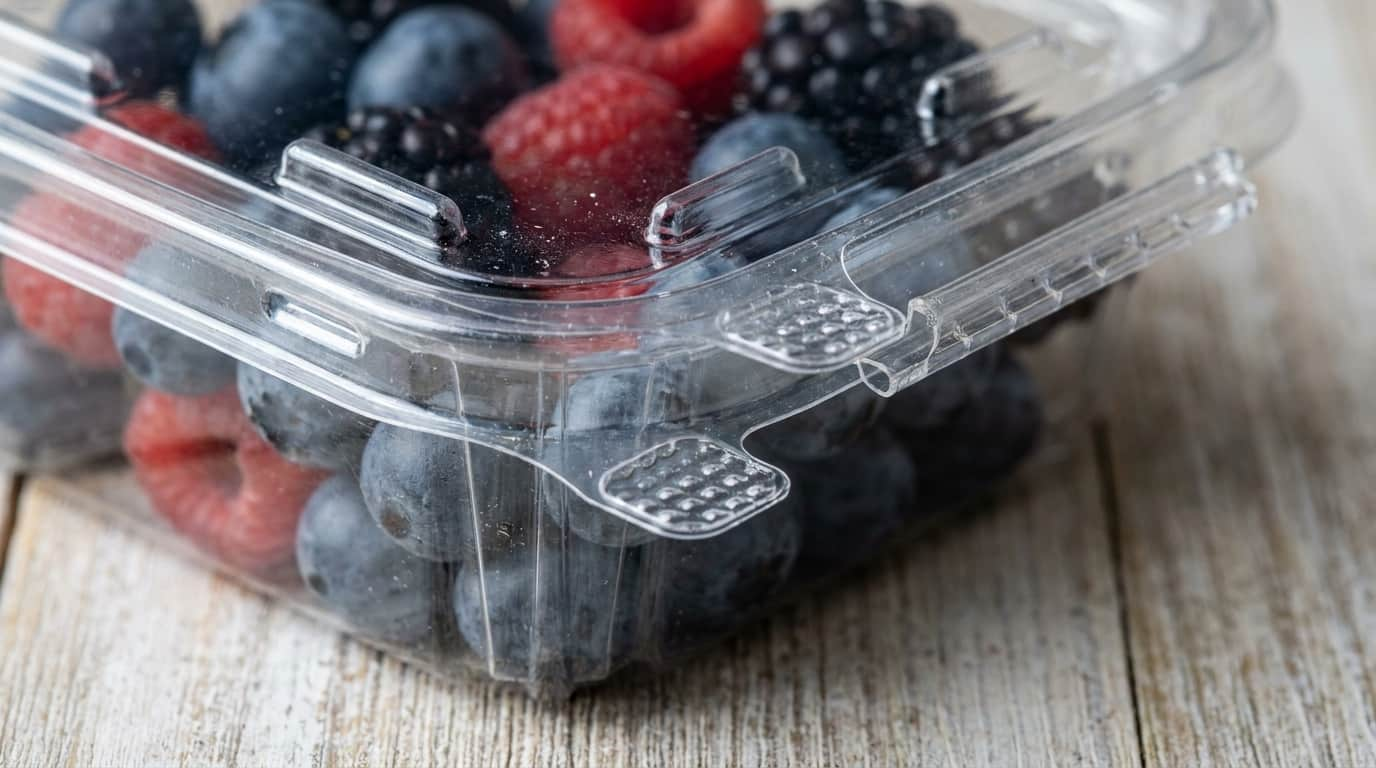
| Hinged PET clamshell with snap tab | Yes (snap shows forced opening) | $0.10 to $0.25 | Cookies, muffins, brownies, pastries |
| Sealed deli container with ring-pull lid | Yes (pull ring confirms seal integrity) | $0.08 to $0.20 | Cake slices, individual portions, cream-filled items requiring refrigeration |
| Shrink band over any container lid | Yes (breaks cleanly on opening) | $0.01 to $0.05 per band | Any capped container; easy retrofit for existing packaging |
| Adhesive tamper seal or sticker | Yes (shows tearing or void when peeled) | $0.01 to $0.03 per label | Boxes, bags, and clamshells without built-in snap features |
| Heat-shrink overwrap | Yes (full coverage, breaks cleanly) | $0.03 to $0.10 | Gift packs, bundled items, wholesale presentation |
| Standard kraft paper bag with twist closure | No | N/A | Dry items at attended counters only; not suitable for self-service displays |
The real cost question is not "how much does tamper-evident packaging cost?" It is "how much does a product tampering complaint cost compared to a shrink band at two cents?" View the full range of tamper-evident containers at Plastic Container City designed for high-volume bakeries. For a broader look at must-have food packaging solutions for bakeries, that guide covers format matching across a full product range.
The Liability Case for Getting This Right
If a customer contacts you claiming the product was tampered with and your packaging shows no evidence of prior opening, you have a documented defense. That is what tamper-evident packaging actually buys you. Without it, a complaint about product condition becomes a credibility contest with no physical evidence on your side.
Product liability insurance policies assess whether the packaging met the standard of care expected for that product type and sales channel. A sealed, intact tamper-evident container shifts the burden of proof. An unsealed or easily re-closeable container does not. Some insurers treat documented packaging standards, including the specific container type and seal method used, as part of their risk assessment for food businesses.
The FDA's 2025 Salmonella investigation linked to recalled Sweet Cream mini pastries is a useful reminder that filled and cream-based bakery products sit in a higher-risk category. A food safety incident involving a product with no tamper-evident seal, regardless of whether tampering was the actual cause, creates a compliance gap that is hard to defend. Building tamper-evident packaging into your standard operating procedure is the kind of operational decision that looks unimportant until it suddenly is not.
The financial reality of poor packaging decisions is covered in detail in the guide on how bad bakery packaging costs you. The numbers make the case more clearly than any compliance argument.
Conclusion
Tamper evident packaging for bakery is not a one-size-fits-all legal mandate, and understanding that nuance matters for your budget, your compliance posture, and your liability protection. Know your sales channel first. Direct cottage food sales require clean prepackaging and proper labeling as the legal baseline. Wholesale accounts and shipped orders raise that bar to tamper-evident as a practical requirement, not just a suggestion. A shrink band costs a cent. A credible response to a tampering complaint costs considerably more.
For the full container-to-display framework your operation depends on, the grab-and-go bakery packaging guide covers the decisions that determine how tamper evident packaging bakery standards fit into your overall packaging system.
If your product leaves your hands, it deserves a package that tells the next person who picks it up exactly what kind of operation you run. Choose the right container to ensure your tamper evident packaging bakery standards are reflected in your policy coverage. For more bakery insights, packaging guidance, and food-industry perspective, visit the Plastic Container City blog.
Frequently Asked Questions
What is legally required on packaging for grab-and-go bakery items?
Under FDA jurisdiction, prepackaged retail bakery items in the U.S. must carry the product name, ingredient list in descending order by weight, net weight or count, business name and address, and a declaration of all nine major food allergens. State cottage food laws typically require additional disclaimers and, in some states, a permit number. Tamper-evident features are not named in most state cottage food statutes but are required by most wholesale buyers and shipping standards as a condition of sale.
Does tamper-evident packaging apply to home bakers selling at a farmers market?
For most farmers market cottage food sellers operating their own attended booth, state law focuses on prepackaged and properly labeled product rather than a specific tamper-evident standard. If the booth is unattended or products are placed in a self-service arrangement, the expectation rises because your packaging is functioning as the only barrier between the public and your product. For a full breakdown of market-specific packaging rules, see Bakery Packaging for Farmers Markets, Pop-Ups, and Small Retail Spaces.
What is the simplest tamper-evident option for a small bakery on a budget?
Adhesive tamper seals and shrink bands are the lowest-cost entry point, with costs ranging from $0.01 to $0.05 per unit. A sticker placed across the lid seam of an existing clamshell or box is sufficient for most self-service and wholesale applications. For shipped orders, a combination of a sealed container plus an outer shrink band provides visible integrity at both the container and package level. No specialized equipment is required for either option.
Is a sticker across the lid seam enough to qualify as tamper-evident?
For most self-service display and wholesale applications, yes. An adhesive label placed across a lid seam that shows visible tearing or a "void" message when removed meets the practical standard for tamper-evident packaging. The label must be positioned so that the container cannot be opened without breaking or visibly disturbing the seal. For high-risk products, specifically cream-filled and protein-containing items that also require refrigeration, a sticker seal combined with a ring-pull lid or snap-tab container provides stronger protection. For display decisions tied to those product types, see Refrigerated vs. Dry Display: Which Bakery Setup Is Right for Your Products?
Does tamper-evident packaging affect product liability insurance for bakeries?
Documented packaging standards, including the container type and seal method used for each product, are part of how product liability underwriters assess risk for food businesses. A consistent, recorded tamper-evident packaging protocol gives you evidence that the product was sealed properly at the point of dispatch. Without that documentation, a claim about product condition after delivery has no physical baseline to reference. Check directly with your insurer about whether your current packaging standards are reflected in your policy coverage.