

TL;DR: Knowing how to package bakery desserts to sell comes down to one habit: match the container to the product, not the price sheet. Cake slices, cookies, pies, and macarons each need different things from height, stability, visibility, and selling channel. Get those four factors right and you protect the product, support cleaner handoffs, and stop buying container types you do not need. This guide frames the decision, then points you to the full detail for each.
Knowing how to package bakery desserts to sell is the difference between a slice that reaches the customer with its frosting intact and one that shows up smudged against a lid. Most operators pick containers by price per unit. It feels responsible. It is also how you end up with cookies with too much room in a deep box, a macaron shell losing its bite, and a display case that looks like four different bakeries packed it.
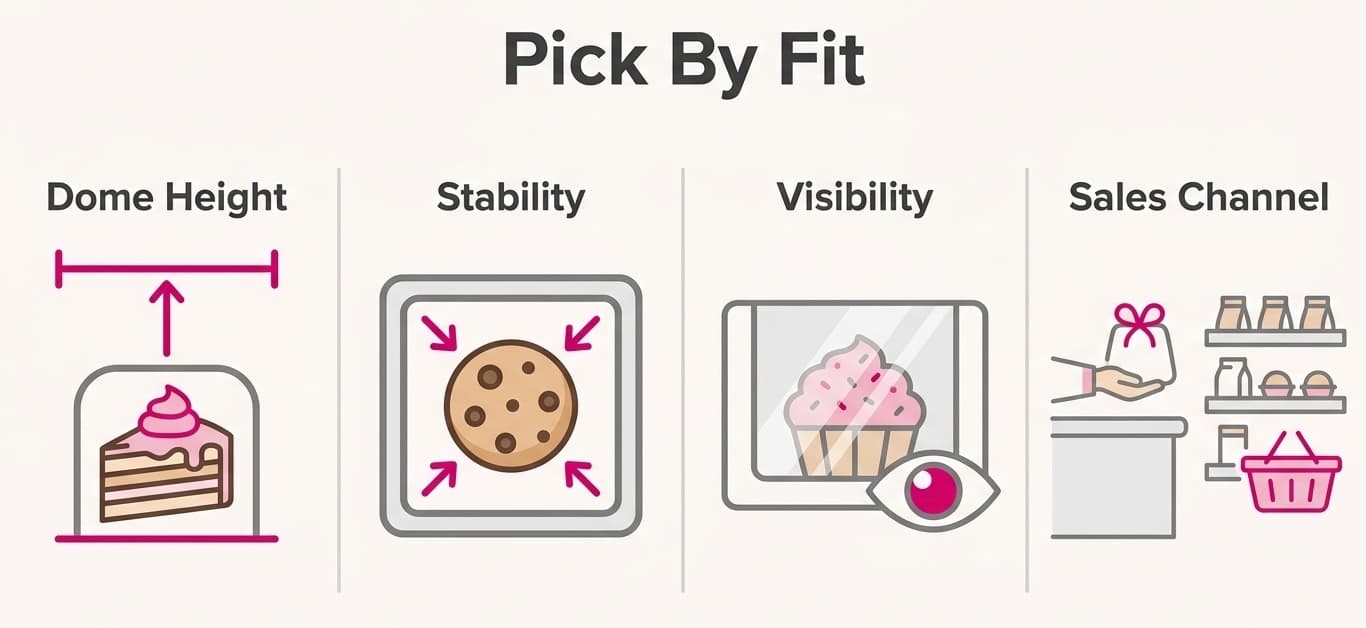
Here is the smarter way to think about it. Every single-serve dessert you sell, the slice, the cookie, the pie, the macaron, answers the same four questions: how tall is it, will it move, can the customer see it, and how is it leaving your counter? Different desserts weigh those questions differently. A frosted slice lives or dies by dome height. A macaron cares most about a tight seal. Buying by price alone is one of the quiet ways bad bakery packaging costs you in damage and lost sales. This pillar walks the decision for all four, then hands you off to the full guide for each.
How do you package bakery desserts to sell?
The short answer: package each dessert by product fit, then check dome height, stability, visibility, and sales channel.
Those four factors do the heavy lifting for any single-serve dessert, and the order they fall in changes by product. Run an item through all four and the right container usually picks itself. Skip them and you are guessing on price alone. For a wider view of what your counter actually needs, the 6-format packaging checklist pairs well with this guide.
| Decision factor | What it controls | The question to ask |
|---|---|---|
| Dome height | Headroom for frosting, toppings, and fillings | Does the lid clear the tallest point without touching? |
| Product stability | Whether the item slides or tips in transit | Does the footprint hold the product in place? |
| Display visibility | Whether buyers can see it at point of sale | Can a customer see the product clearly through the lid? |
| Selling channel | Display case, pickup, or grab-and-go handling | How does it leave the counter, and who handles it? |
Why does container format matter differently for each dessert?
Dessert types stress different needs: slices need dome clearance, macarons need seal control, and pies need topping room.
The four factors stay the same, but the priority order flips by product. That is why one container almost never serves your whole case well. There is one rule that applies to all of them, though. Food on display should be protected from contamination by packaging, a food guard, a display case, or another effective method, according to the FDA Food Code. Clear, secure packaging handles that job and lets customers see the product at the same time, which is its own kind of selling.

How do you package cake slices to sell?
Lead with dome height. Use lid clearance and a close-fitting base to help limit movement during pickup and handoff.
A cake slice is the fussiest single-serve dessert to pack because the part that sells it, the frosting and the layers, is also the part that smudges first. Too little headroom and the lid drags across the top. Too much base can give the slice room to move in transit and risk the face you worked to build. Clear sides and a clear lid keep those layers visible, which does real work in a display case.
The full breakdown, including how to choose dome height for a tall slice and how to reduce movement from counter to car, lives in How to Package Cake Slices to Sell.
How do you keep cookies fresh for display and orders?
Control moisture and air. Match the pack to the selling window, from same-day display to pickup, gift order, or grab-and-go.
University of Minnesota Extension lists baked goods as a broad cottage-food category with a two to three week shelf life when stored properly, and recommends airtight containers to hold freshness. Treat that as broad context, not a promise for every cookie. The practical point is that the container should fit the window. Cellophane and wrap may work for same-day display or gift presentation when the holding window is short. A rigid, tighter-sealing pack can make more sense when you are holding cookies for pickup or sending them out, and snug spacing keeps them from crowding and breaking.
For the channel-by-channel container picks and how to arrange cookies so they sell, see How to Keep Cookies Fresh for Bakery Display and Orders.
How do you package pie slices and mini pies to sell?
Fit the pie to the filling. Use dome height for toppings, then check state rules for fruit, cream, custard, and egg fillings.
Pie has two packing jobs. The first is fit: a shallow dome suits a flush slice, while a tall meringue or a piled topping needs a deeper one so nothing flattens against the lid. The second is rules. California includes fruit pies in its approved cottage-food list and leaves cream and custard fillings out of that category, so filling type can affect storage and selling rules under some state cottage-food programs. For grab-and-go cases, tamper-evident packaging is worth knowing too, because it can help customers see whether a package has already been opened.
Mini pies, half-pie servings, transport without a box, and when foil is the right call are all covered in How to Package Pie Slices and Mini Pies to Sell.
Do macarons need to be stored in an airtight container?
Use a sealed container for holding. The shell needs humidity protection, while the filling decides storage and cottage-food status.
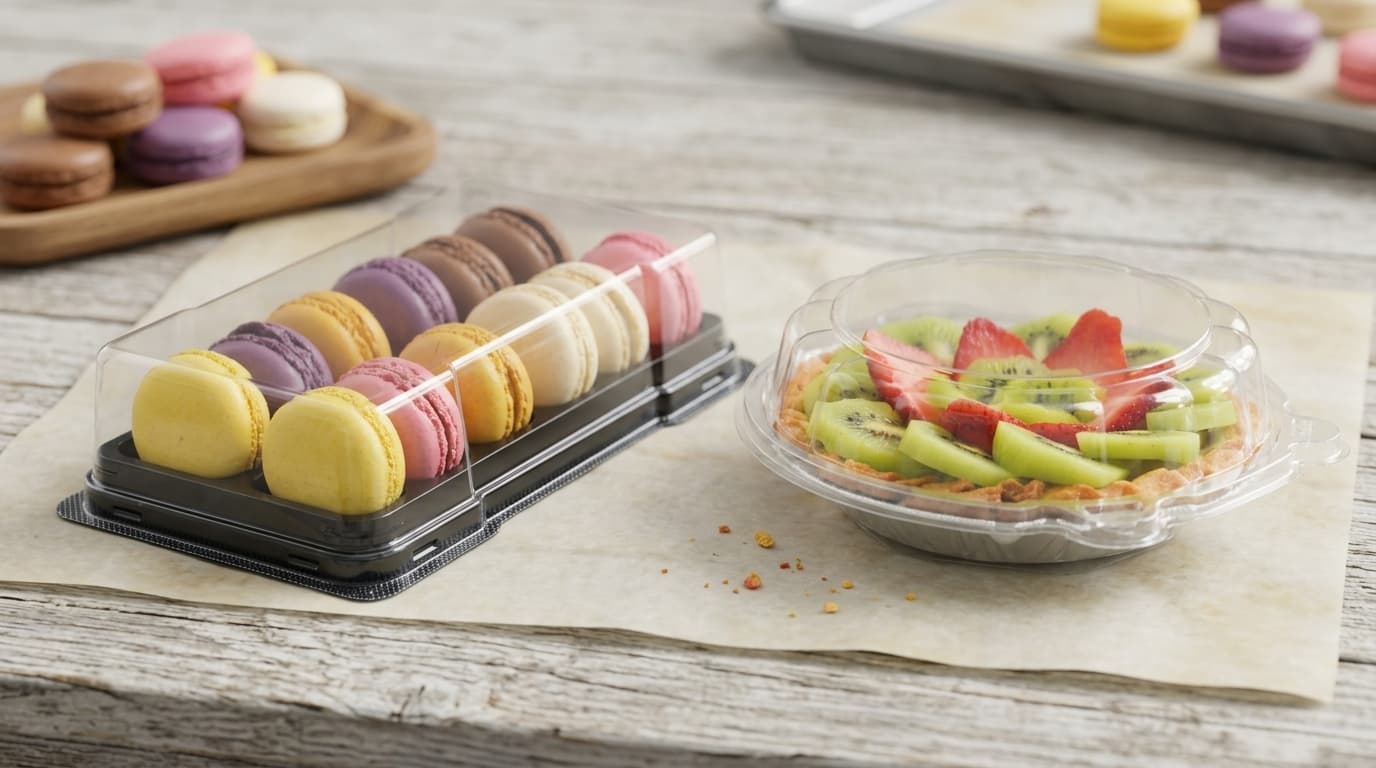
Macarons are the most delicate item on this list, and humidity is the enemy. Moisture can affect shell texture, so a sealed container earns its place when you are holding macarons for sale. The storage rule then hangs on the filling. Utah guidance, for example, treats macaron fillings such as non-TCS fillings like frosting, caramel, or chocolate differently from fillings that need refrigeration for safety. Do not assume every macaron is shelf-stable, and do not assume they all need the fridge. Check the filling and your state rule.
Shelf life, same-day display, and whether to use clear wholesale containers or custom printed boxes are all in How to Package Macarons to Sell.
Should you standardize containers across products?
Standardize only where fit overlaps. Shared formats can simplify reorders, but every dessert still needs the right height and footprint.
At Plastic Container City, we work with thousands of food professionals across the U.S., and the pattern is consistent: bakeries carry more container types than they need. When a footprint and dome that fit a cake slice also handle a mini pie, you can run one line for both. That means:
- Fewer SKUs to store, count, and reorder
- Faster packing when the rush hits, because staff reach for one format
- Easier bulk buying and cleaner reorder planning
The catch is honesty about fit. Standardize where a product genuinely fits the shared container, not where you are forcing it. A macaron does not belong in a deep slice dome just to trim a SKU. Once you know which formats overlap, working out case quantities for each one keeps reorders simple and your packing station stocked.
What should bakery operators take away?
Packaging bakery desserts to sell is not about hunting for one magic container. It is about asking the same four questions, height, stability, visibility, and channel, for every product, then buying to fit. Do that and each dessert has a better chance of arriving clean, holding its shape, and looking ready to sell. For more bakery insights, news, and food-industry tips, visit the Plastic Container City blog. Get the four factors right and you will know how to package bakery desserts to sell without guessing, and without overbuying.
Frequently Asked Questions
How do you display slices of cake?
Display slices upright or angled so the layers and frosting face the customer, in a clear container that shows the product without smudging the finish.
What are good cookie containers?
Good cookie containers hold cookies snug so they do not crowd or break, with clear lids for display and a tighter seal for pickup or shipping.
How do you package a mini pie?
Package a mini pie in a container that supports the base and clears the top crust or topping, with a secure lid for transport.
Does humidity affect macarons?
Yes. Moisture can affect macaron shell texture, so a sealed container helps protect quality during holding and display.
How do you package baked goods for sale?
Package baked goods by matching the container to the product's height, stability, and sales channel. Use clear, food-safe packaging.