
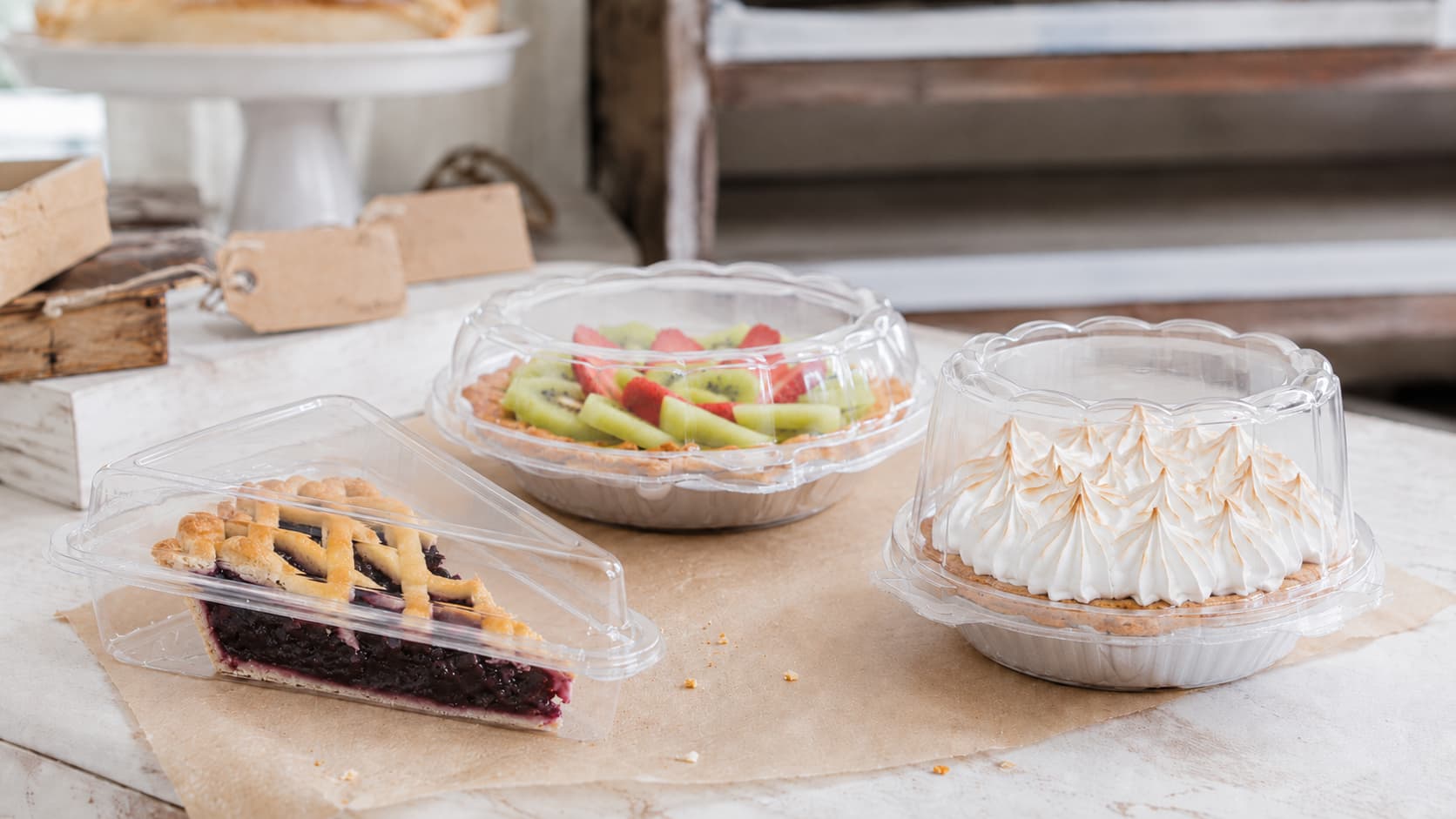
TL;DR: Learning how to package pie slices to sell, alongside mini pies, comes down to three decisions: dome height, selling format, and base fit. Get all three right and your product arrives intact, looks professional, and looks ready to buy in a self-serve case or farmers market display.
Pie slice packaging has a sizing problem, and it shows up the same way every time. A shallow container where the filling presses against the lid. A foil pan wrapped in cling film that gives customers no visibility and no confidence in what's inside. A round container that's almost right for a mini pie but not quite, so the pie sits off-center and shifts during transport.
The operators getting it right are not doing anything complicated. They've matched the dome to the filling height, picked a container format that suits how the product is sold, and for retail display, they've added a tamper-evident option that gives customers a clear visual cue before pickup.
This guide covers individual pie slice containers, mini pie containers, tamper-evident options for grab-and-go display, and the filling-type considerations that affect how you store and present what's inside. Whole-pie containers and preorder logistics are out of scope here. For single-serve dessert packaging across all formats, see How to Package Bakery Desserts to Sell.
How Do You Package Pie Slices to Sell?
Direct Answer: Use a clear rigid container matched to filling height. Choose tamper-evident wedge packs for self-serve pie slice display.
A well-packaged pie slice does two things at once. It protects the product from filling to crust without the lid making contact with the top. And it shows the product. A crystal-clear container lets the customer see the color of the fruit, the height of the meringue, the glaze on the surface. That visual helps the product sell before the customer reads the label.
Foil and cling film serve a real purpose during baking and for short holding. They are weaker for customer-facing display. They're not transparent, they wrinkle, and they read as improvised rather than professional. Clear rigid packaging changes the picture entirely.
Three variables to nail before choosing a container:
- Filling height: determines whether you need a shallow or deep dome
- Container shape: wedge for slices, round for mini pies, rectangular for half-pie servings
- Selling format: retail grab-and-go display, staffed counter pickup, or farmers market table
What Is the Difference Between a Shallow Dome and a Deep Dome Pie Container?
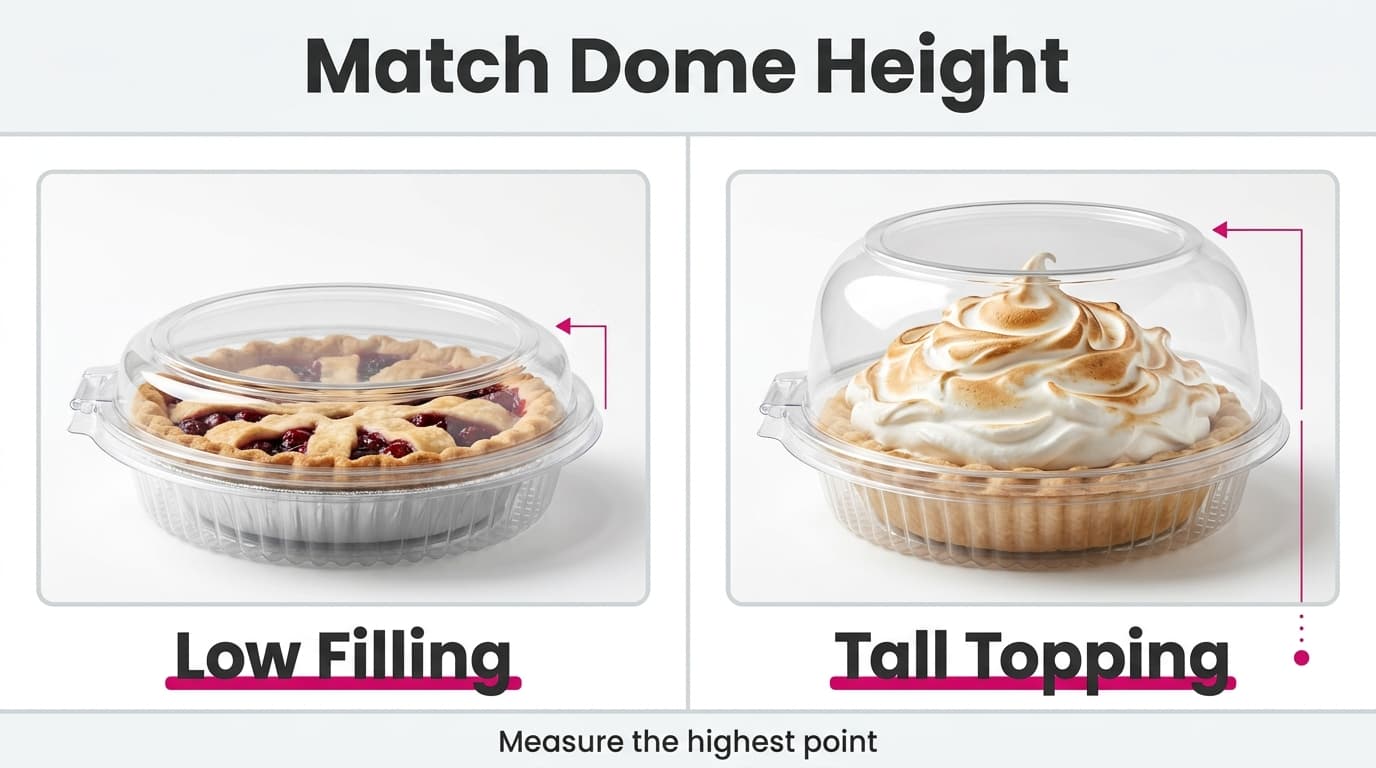
Direct Answer: Shallow domes fit low fillings. Deep domes protect taller toppings, meringue, and peaked finishes from touching the lid.
PCC's 6" round pie containers show this difference clearly. The 6" Pie Container - Crystal Clear Heavyweight Plastic has an external height of 2 inches. The 6" Crystal Clear Pie Containers with Deep Dome Heavyweight Plastic reaches 3.5 inches. Both have the same 4.25-inch bottom compartment diameter. Same bottom compartment diameter, different clearance above the filling.
The standard height works for a fruit pie with a flat or modestly rounded surface. The filling sits cleanly inside, the lid closes without touching the top, and the product looks exactly as it did when it came out of the oven. The deep dome is designed for taller toppings and higher-fill pies. That means tall meringue, peaked whipped cream, or any filling that rises well above the crust line and would press against a standard-height lid.
The mistake is buying standard containers for everything and finding out the filling is touching the lid only after the product is packed. The fix is simple: measure your filled pie at its highest point, then pick the container with enough clearance to keep the lid off the product. More clearance than you need adds unnecessary air space; less clearance distorts whatever is sitting on top.
| 6" Standard | 6" Deep Dome | |
|---|---|---|
| Total height | 2 inches | 3.5 inches |
| Bottom compartment diameter | 4.25 inches | 4.25 inches |
| Best for | Low-profile fruit pies, flat fills | Tall toppings, meringue, peaked fills |
| Material | PET, crystal clear, BPA-free, recyclable PET #1 | PET, crystal clear, BPA-free, recyclable PET #1 |
| Pack count | 200/case | 200/case |
| Fridge/freezer safe | Yes | Yes |
Both are hinged, snap-shut, and stackable. The dome is the only decision. For the equivalent dome-height framework applied to cake slices, How to Package Cake Slices to Sell Without Damage covers that in full.
What Is a Tamper-Evident Pie Slice Container?
Direct Answer: A tamper-evident container shows visible signs if opened, making it useful for self-serve pie slice displays.
The federal definition, drawn from 21 CFR 211.132, describes tamper-evident packaging as having "one or more indicators or barriers to entry that, if breached or missing, can reasonably be expected to provide visible evidence to consumers that tampering has occurred." That regulation is written for OTC drug products, not bakery foods. But the definition gives the clearest starting point for understanding what the term actually means.
For bakery operators, the practical question is simpler: when a customer picks up a pie slice from a self-serve case or retail display, can they see that the package hasn't been opened before them? A tamper-evident container answers that visually at the package level.
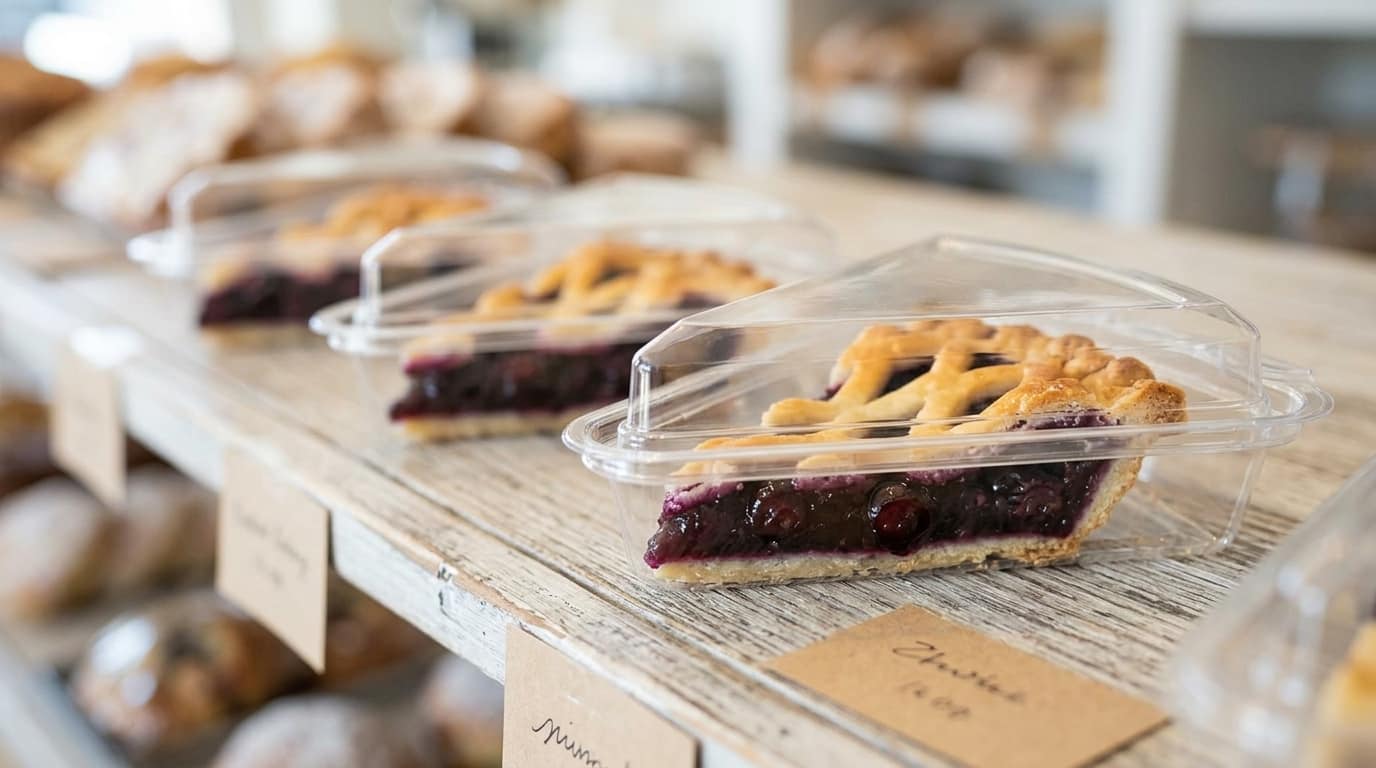
For this use case, PCC offers a triangular PET pie and cake slice container. It is designed for pie slices and measures 5 inches long by 3.75 inches wide by 2 inches tall. The container is hinged, snap-shut, BPA-free, recyclable PET No. 1, fridge and freezer safe, stackable, and available in 100-pack or 200-case formats.
The wedge shape works for both pie slices and cake slices, which means operators running both through a grab-and-go case can standardize on one format for both products.
Tamper-evident packaging is not a blanket requirement for all bakery grab-and-go items across the U.S. Local rules can still vary. Once your product is in a self-serve case, a retail location you don't staff directly, or a pickup order that travels without you watching it, the visible assurance becomes a practical argument for clear packaging. The customer can see whether the package appears unopened before pickup.
How Do You Package a Mini Pie?
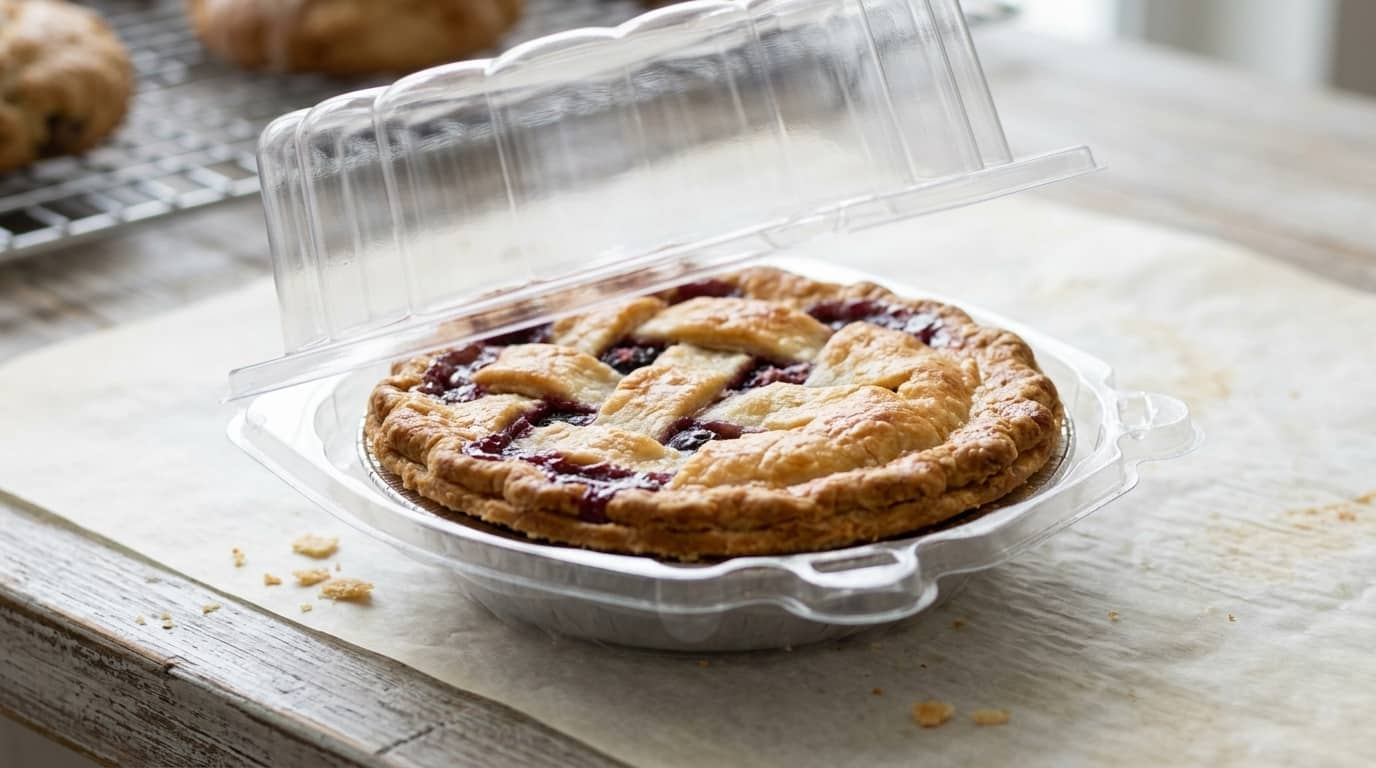
Direct Answer: Match the container base to the finished mini pie diameter. Use a round hinged container, not a wedge slice pack.
Mini pie packaging often comes down to diameter. Operators reach for whatever pie container is already on the shelf and find the pie either sits loose with space around the base, or doesn't fit cleanly at all. The key measurement is the bottom compartment diameter, not the outer container size.
PCC's 6" round pie containers (both the standard and deep dome versions) have a bottom compartment diameter of 4.25 inches. Whether that fits your mini pie depends entirely on your pan size. Baked pie dimensions can also vary based on pan brand, dough thickness, and fill level, so measure your actual finished pie rather than the pan alone.
The dome decision applies here the same way it does for slices. A flat-topped fruit mini pie fits the standard 2-inch height. A mini pie with a peaked topping, tall filling, or a decorative crust edge that rises above the base needs the 3.5-inch deep dome to clear without the lid pressing down.
Before ordering a full case: fill a test pie, let it cool completely, then close the container. If the lid seats cleanly and nothing is touching, you have the right match. Test with a smaller pack first when trying a new pan size or filling style.
What About Half-Pie Servings?
A half of a 10" pie is a different product from a mini pie, and it needs a different container. PCC's Half a 10" Pie Container is built for exactly this format. It's a rectangular hinged PET container: 10.75 inches long, 6 inches wide, 2.25 inches tall, with a 3.75-inch bottom compartment diameter and what PCC describes as a "tamper-proof seal built-in." BPA-free, recyclable PET #1, fridge and freezer safe, stackable, and available in 200-count cases.
It is a larger serving format than a mini pie or single wedge slice, and the rectangular shape is a better fit for a half-pie format than a wedge or round mini-pie pack.
How Do You Transport Pie Without a Box?
Direct Answer: Use a rigid hinged container with a seated snap-shut lid, then carry closed units in a flat-bottom bag or tray.
This question comes up most for farmers market operators and customers carrying pickup orders by hand. The difference between a rigid PET container and a foil pan wrapped in cling film is the difference between a pie that arrives looking like it was packed to sell and one that clearly wasn't.
A rigid base keeps the crust from compressing. A snap-shut closure that seats cleanly doesn't pop open when the bag tilts. A stackable design means multiple containers can travel together without one sliding on top of another. Use containers where the product page confirms a rigid base, seated closure, and stackable format.
For customers taking a sealed slice, the container can reduce the need for a separate box in many pickup handoffs. For larger volumes or event handoffs, placing closed containers in a flat-bottom bag or on a tray keeps them upright for the duration of the carry.
Does Filling Type Change How You Package and Display a Pie?
Direct Answer: Yes. Filling type affects storage and display; fruit, cream, custard, and egg-based pies can be treated differently under local rules.
If you're selling pies under a cottage food permit, filling type is one of the first things your state will weigh in on. California's approved cottage food list includes fruit pies and excludes cream, custard, or meat fillings from the baked goods category. Utah's cottage food guidance limits pies to fruit pies and excludes custard, cream, and egg-based fillings entirely. Both of these are state-level rules, not national requirements, but they reflect a pattern worth knowing: the filling changes the product's storage and regulatory category.
For display, this affects the practical setup. A sealed clear container may work for some fruit pie slices, but holding temperature depends on the filling and local rules. A cream or custard filling may require refrigerated display depending on your local food safety rules. The FDA Food Code says food on display should be protected from contamination through packaging, food guards, display cases, or another effective method. A sealed clear container can be one way to protect food on display, but holding temperature and sale rules still depend on the filling and local authority.
If you're not sure what applies to your product and your state, check with your local health department rather than assuming. Packaging cannot substitute for compliance with the storage rules that apply to your filling type.
When Is Foil the Right Call?
Direct Answer: Foil works for baking or short holding. Use clear rigid containers when pie slices need visibility for display or grab-and-go.
Foil pans have a legitimate role in a bakery kitchen. They're economical, they handle heat, and a foil pan wrapped in cling film is a workable option for a phone order where a regular customer is picking up in an hour.
That same setup struggles the moment it goes into a display case or lands on a farmers market table. Customers buying on impulse need to see the product. Cling film distorts, wrinkles, and obscures the filling. Foil hides most of the product. That can make impulse display harder.
The moment your pie slice is packaged for display, self-serve, or any setup where the packaging is doing the presentation work without you standing next to it, a clear rigid container becomes the stronger format. The customer sees the crust color, the filling depth, the height of whatever is on top. The container protects the product. The presentation helps the product look ready to buy.
For cookies and macarons in the same case, see How to Keep Cookies Fresh for Bakery Display and Orders.
Frequently Asked Questions
How do you store pie slices?
Packaging can limit exposure to air, light, moisture, and contamination, which affect baked-goods quality over time. University of Minnesota Extension notes that even sealed packaging can allow moisture to penetrate over time, so crust texture still depends on storage time, filling type, and holding conditions. Check local rules for any filling that may require refrigeration.
How long do mini pies last in the fridge?
There is no single-source shelf-life figure that covers all mini pie types in sealed containers. Actual shelf life depends on your filling, how the product was cooled before sealing, how well the container closure is seated, and refrigeration temperature. Use your own product testing, cooling process, and local food-safety guidance. Do not state shelf-life claims to customers without testing your own product and checking any applicable local cottage food rules.
How do you package pies to sell?
This guide covers individual pie slices and mini pies. Whole-pie packaging (6", 9", or 10" formats) is a different scope and requires different container dimensions. If you are selling individual servings cut from a whole pie, the slice and mini pie formats in this guide cover the main options.
What is the difference between tamper-proof and tamper-evident?
Tamper-proof implies the package cannot be opened without being destroyed entirely. Tamper-evident means the package shows visible signs if it has been opened. In bakery packaging, tamper-evident is usually the more accurate term because it describes a visible opening cue, not an impossible-to-open package. If a named PCC product uses different wording on the product page, keep the product-page wording when naming that container.
If you are deciding how to package pie slices to sell at scale, browse PCC's full range of pie containers.