
TL;DR: A good wholesale packaging minimum order quantity is one that matches what you would buy anyway, rather than treating a supplier's minimum as a recommended quantity. The high minimums you see online often come from custom packaging runs. Stocked disposables run on a separate rulebook, and the minimum shifts by SKU. Check the pack size before you assume you need a full case, then size your first order from real usage.
Wholesale packaging minimum order quantity is the number that scares people out of wholesale before they even get a quote. You search it, land on a custom box supplier, and the page gives you a huge custom-run minimum. For a bakery running forty orders a week, that number does not compute. So you close the tab and keep paying retail.
Here is the part that page never mentions. That minimum belongs to custom printed packaging, built to your logo on a press that needs setup work first. Stocked disposables, the plain clear containers most food businesses actually reach for, run on a different rulebook, and the minimum moves depending on the item.
At Plastic Container City, we work with thousands of food professionals across the U.S., and the question we hear most from new wholesale buyers is not "what's your price." It's "how many do I have to buy." This piece answers that honestly: what MOQ actually means, why the custom number and the stocked number live nowhere near each other, and how to land on an order size that fits your kitchen rather than a custom production schedule.
So What Actually Makes a Good MOQ?
Direct Answer: A good MOQ matches expected usage, storage, and available cash. If the minimum forces excess stock, it is too high for that order.
That sounds obvious until you remember most of what ranks for this question was written for someone pricing a custom printed case, not someone restocking clear cupcake domes. An MOQ is not a recommendation. It is the supplier's stated floor for that order. Microsoft Business Central, for example, treats minimum order quantity as an order modifier that raises an order to the stated minimum during planning. It says nothing about whether that floor suits you. That part depends on what you sell, how fast you sell it, and where the extra boxes go in the meantime.
What Is the Wholesale Packaging Minimum Order Quantity?
Direct Answer: MOQ is the smallest quantity a supplier requires for an order. It is a supplier-set floor, not the buyer's ideal purchase quantity.
Every supplier sets this differently, and the number is not tied to what makes sense for your business. It is tied to what makes sense for theirs, which is why the same three letters can mean two very different things depending on who you are buying from. The next section is where that difference actually plays out.
Why Do Custom and Stocked Packaging MOQs Differ?
Direct Answer: Custom and stocked packaging follow different buying models. Stocked item minimums vary by supplier and SKU, with no universal benchmark.
The Foodservice Packaging Institute draws this line clearly in its own sourcing guidance for buyers. It points operators toward a manufacturer when they need "customized packaging" bought in "high volumes," and toward a distributor or retail source when their "needs will be met by stock packaging" at lower volumes. That is not marketing language. It is a structural difference in how the two products are sourced. A distributor selling stocked disposables and a manufacturer running a custom print job are simply different businesses with different rules.
Custom packaging exists because you asked for it, and that costs something before a single unit ships. The Flexographic Technical Association describes how traditional print runs carry plate and make-ready costs, the setup work a press needs before it starts producing, while digital printing "eliminates the need for plates, reduces make-ready time." For custom printed packaging, those setup and make-ready costs are one reason larger production runs can make more economic sense. Stocked packaging skips that step. It was already made before you called, so the entry point can sit far lower.
Here is what that actually looks like across our own catalog, not a hypothetical:
| Container | Smaller pack | Case option |
|---|---|---|
| Stackable cupcake container, deep dome | 50 | 300 (800 also available) |
| 12 mini cupcake container, deep dome | 20 | 160 |
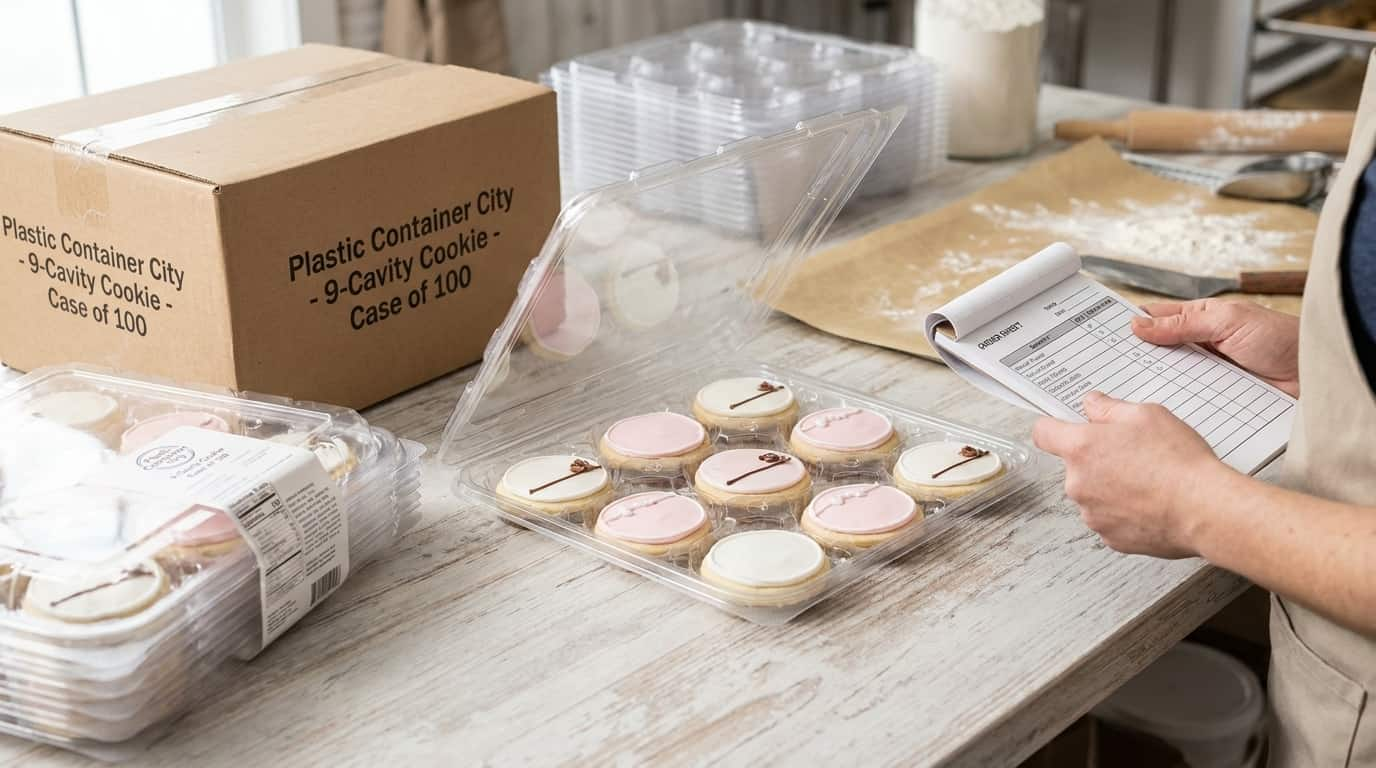
| 9 cavity cookie container, 3" | 25 | 75 |
| 5" square medium cookie container | 50 | 400 |
| Tamper evident pie and cake slice container | 100 | 200 |
You can browse the full range across our bakery containers. Those examples show why it pays to check the available pack sizes before assuming a full case is your only option.
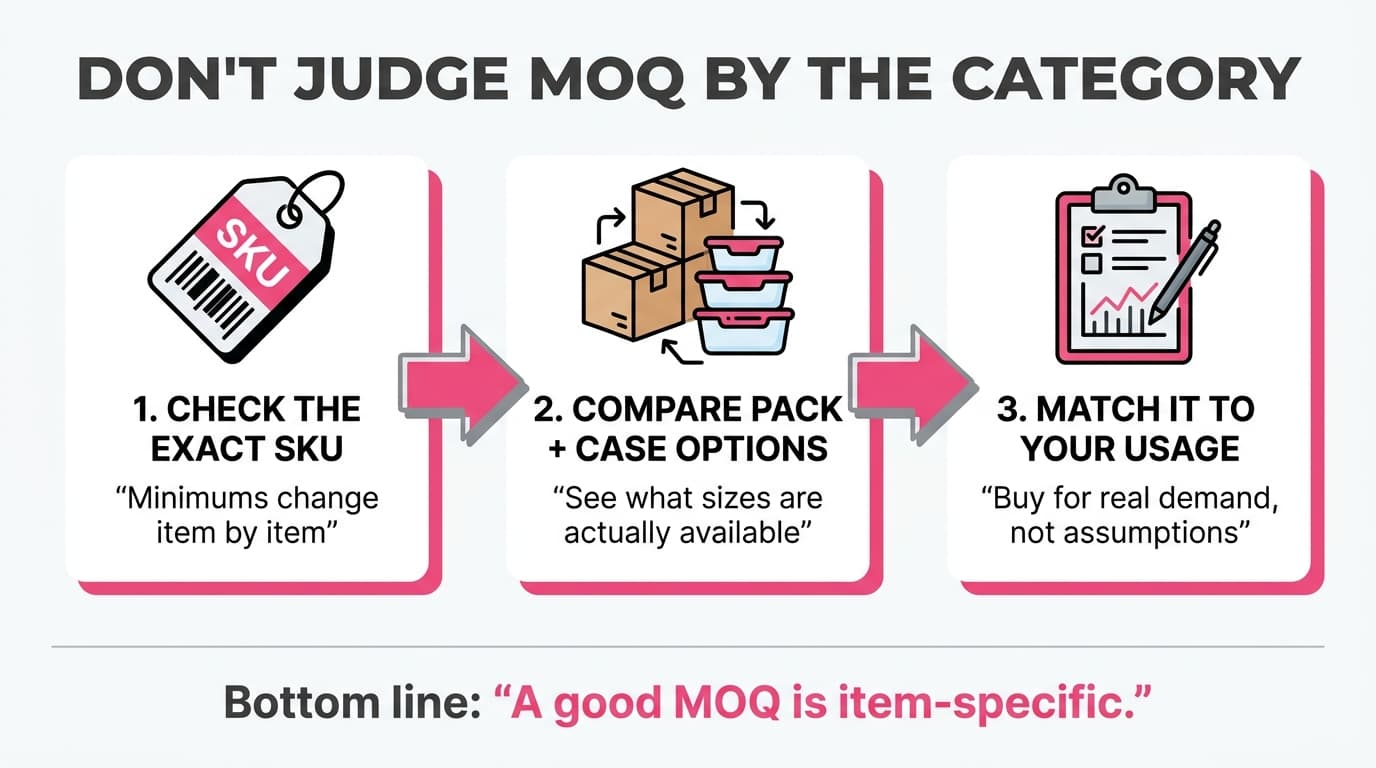
But do not read this as "every stocked item ships in a small pack." It does not. Several cookie and cake containers in our catalog come in both smaller packs and larger cases, while others start at a full case with no smaller option at all. The minimum is set item by item, not category by category, so check the exact SKU rather than assume one container's pack size applies to the next.
What Is EOQ and MOQ?
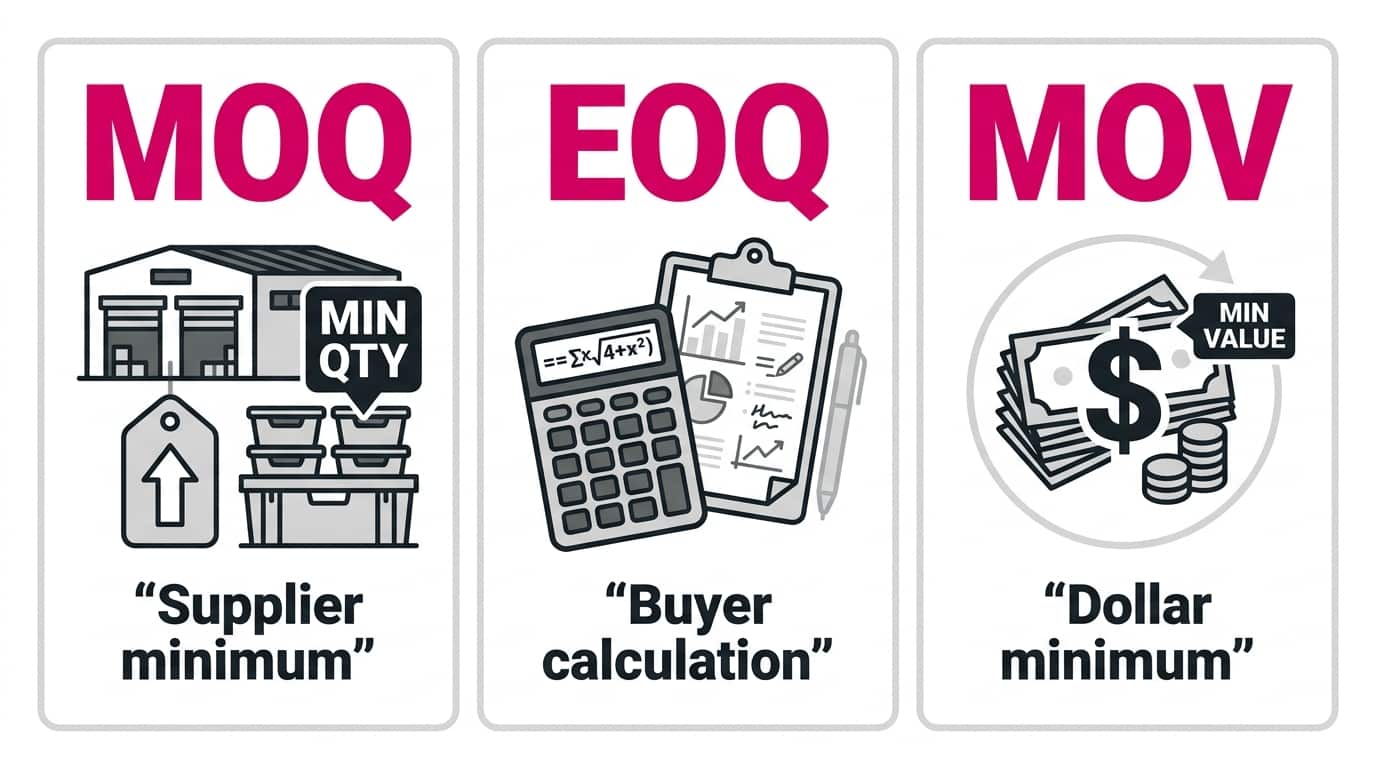
Direct Answer: MOQ is a supplier-set minimum. EOQ is a buyer-side calculation that balances ordering costs with the cost of holding inventory.
| Term | Set by | Meaning |
|---|---|---|
| MOQ | Supplier | Minimum unit quantity |
| EOQ | Buyer | Calculated order quantity |
| MOV | Supplier | Minimum order value |
The Chartered Institute of Procurement and Supply describes EOQ as a method for finding the order quantity that keeps costs lowest, balancing what it costs to place an order against what it costs to hold stock. That is a calculation you run using your own sales pace, not a rule your supplier hands you. Minimum order value, or MOV, is different again. SAP's own documentation lists minimum order value and minimum order quantity as separate fields, a monetary threshold rather than a unit threshold. Only EOQ is actually about what makes sense for your business. The other two are about what makes sense for the supplier.
How Do You Calculate Your Real Order Size?
Direct Answer: Start with actual packaging usage, then compare that need with available pack sizes and the supplier's minimum for the item before ordering.
This is where most of the guesswork disappears once you look at your own numbers instead of a stranger's benchmark. Pull your last few weeks of packaging use for the item in question. A bakery moving sixty cupcakes a week in stackable domes needs a very different order than one moving six hundred. Round that usage up for a busy stretch, then check it against the pack and case sizes actually available for that SKU.
If the smaller pack covers a few weeks of normal use, that may be your entry point, with less cash committed to stock you have not used yet. If only the full case is available and it is more than you would use, ask the supplier directly whether a smaller quantity exists rather than assuming the case size on the page is the floor. We walk through the actual math, case counts included, in how to calculate bakery packaging case quantities.
Can You Negotiate a Lower MOQ?
Direct Answer: An MOQ may be negotiable, but no industry rule says when or by how much. Ask what options apply to the exact item you want.
There is no standard formula for this. Whether a minimum can move depends on the supplier, the item, and the order terms. Ask directly whether another pack size or quantity option exists for the item you want, and whether it flexes for a first order or a repeat one.
What Are the Downsides of Buying to a Minimum?
Direct Answer: Buying only to meet a minimum can tie up cash, use storage space, and leave unused stock exposed to damage or obsolescence.
None of that means buying to a minimum is a bad move. Buying past what you need is the risk, not the minimum itself. Every unit sitting in a storeroom is money out of your bank account, space you could use for ingredients, and a bet that you sell through it before your needs change. A minimum that matches your real usage reduces the risk of carrying excess stock. That is the reason to run the math above before you commit to a number.
Where Does Your First Order Go From Here?
Direct Answer: Once the first order is placed, the next question is when to reorder. That belongs to reorder point planning, not first order sizing.
Everything above gets you to a first order that fits your business rather than a custom production schedule. What happens after that, when to reorder and how much buffer stock to hold, is its own topic with its own math. We cover that in How to Set Reorder Points for Takeout Containers. And if you have not settled on a supplier yet, start with How to Choose a Wholesale Food Packaging Supplier.
A good MOQ was never a number you could look up. It is the number that matches your own usage, checked against a minimum set item by item rather than industry-wide. Check the exact SKU, not the category, and custom-run minimums stop being the whole story. For more on sizing packaging and running the numbers on your own operation, the Plastic Container City blog has you covered.
Frequently asked questions
What is considered a low MOQ?
There is no fixed threshold that makes an MOQ officially low. What counts as low depends on your own usage. A 50 unit minimum is low for a bakery moving hundreds of containers a week and high for a home based seller filling a dozen orders. That comparison is a better test of your wholesale packaging minimum order quantity than a generic "low MOQ" label.