

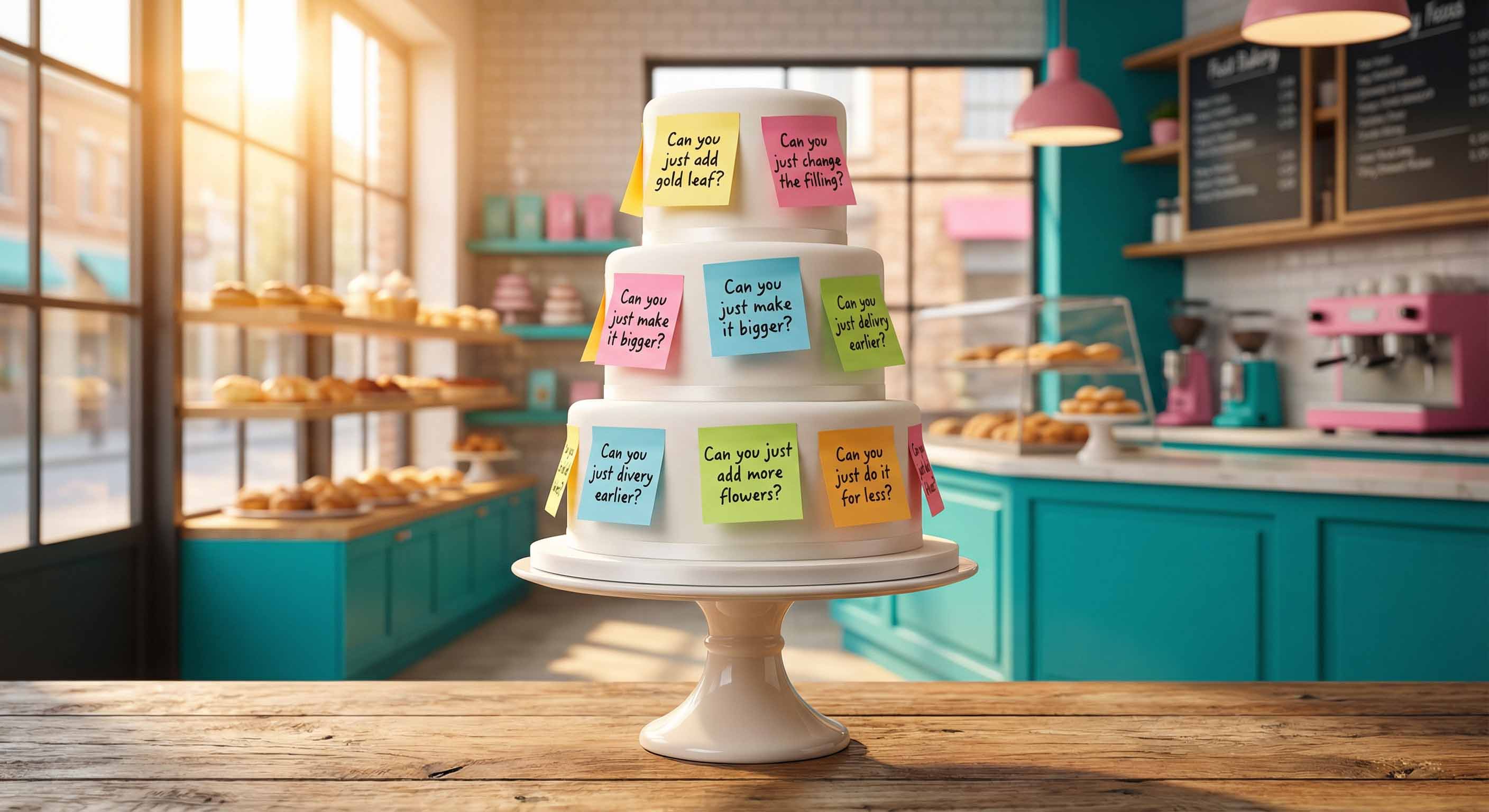
How are bakery customization costs quietly eating 10% of your profit without you even noticing? You don't have a "bad staff" problem. You have a "Can you just..." problem. Your team isn't pocketing cash. They're saying yes to tiny changes that add up to thousands in lost labor, wasted materials, and missed production capacity every month.
You're not imagining it. Customers are more demanding than ever. Over 30% of them now walk in the door expecting a "bespoke" experience for a "standard" price. You want to give it to them, but you shouldn't have to go broke to be nice.
Every ingredient swap, message change, or last-second pickup adjustment costs you minutes. Those minutes compound into hours. By month's end, you're left wondering why your numbers don't match the effort your team put in.
The real problem? Micro-customizations live in a gray zone between your standard menu and formal custom orders. Too small to trigger your custom cake pricing system. Too costly to give away free. And because nobody tracks them, you can't measure what they're really costing.
What Micro-Customization Actually Means
Micro-customizations are the informal, on-the-spot modifications customers request outside your established custom order process. A customer ordering from your display case asks if you can make it dairy free. Someone picking up cupcakes wants three boxes instead of two, split by flavor. A wedding client texts at 9 p.m. asking to change tomorrow's ribbon color.
Your custom order system has guardrails: pricing calculators, lead time requirements, signed agreements. Micro-customizations have none of that. They happen in real time at the register or over text, and your staff defaults to "yes" to keep things moving.pricing calculators, lead time requirements, and signed agreements. Micro-customizations have none of that. They happen in real time at the register or over text, and your staff defaults to "yes" to keep things moving.

The Four Ways Customization Drains Your Margin
1. Added Labor Minutes Per Request
Each modification adds direct labor time. Swapping regular flour for almond flour means pulling a different bin, measuring separately, cleaning tools between batches to avoid cross contact. Changing a cake message after piping requires scraping, re-icing, and re-piping. Splitting an order into custom packaging adds several minutes of boxing and labeling.
Accommodating last-minute delivery or pickup time changes means reconfiguring your route schedule, calling other customers to adjust their slots, and spending coordination time that never gets billed. A simple "Can I pick up at 2pm instead of 10am?" costs 5 to 10 minutes of phone tag and schedule shuffling.
At a median baker wage of $17.09 per hour, every five untracked minutes costs $1.42 in labor. Run that 20 times weekly and you're down $1,478 annually per recurring request type. Most bakeries handle dozens daily.
2. Interruptions Kill Production Flow
Production bakeries run on sequencing. You're scaling recipes, managing oven rotations, coordinating decorating schedules. When someone pulls a team member off task to handle a modification, you lose more than just the direct minutes spent on the change.
Every time a decorator is pulled away, it doesn't just cost a few minutes. It breaks their rhythm. In a high-stakes kitchen, that rhythm is what prevents typos on cakes and keeps oven timers from being ignored. When that flow breaks, mistakes happen. And in 2025, kitchen waste is already eating 5.6% of your sales. You can't afford to add more chaos to the mix.
In a bakery, interruptions mean restarting a count, double checking which batch you were on, or losing rhythm in a decorating sequence. Even brief disruptions compound throughout a production shift. A decorator interrupted three times before lunch has lost over an hour of focused work.
3. Rush Changes Create Expensive Mistakes
When a customer asks to add a name to cookies 15 minutes before pickup, your decorator works under pressure without the usual quality checks. Typos happen. Smudges happen. Now you're either sending out subpar work or redoing it on the spot, eating both the time and materials.
Dietary modifications carry bigger risks. Cross contact with allergens, mislabeled items, or using the wrong substitution can trigger serious health consequences and liability. That's why professional custom orders include detailed intake forms and clear communication protocols. Micro-customizations skip all of that, leaving you exposed.
4. Missed Capacity Means Lost Revenue
Every minute spent on an unpriced modification is time you can't use for planned, profitable work. Your decorator redoing a cake message isn't finishing the wedding order due tomorrow. Your morning baker handling a special flour request is running behind on the croissant batch that sells out by 10 a.m.
At Plastic Container City, we work with bakeries across the U.S. and see this pattern constantly: operations that feel perpetually behind despite working long hours. The culprit? Invisible labor that never gets scheduled, priced, or accounted for in capacity planning. When you're constantly reacting to unplanned requests, streamlining your core offerings becomes that much harder.
| Margin Leak Type | Typical Time Cost | Annual Impact (20x/week) |
|---|---|---|
| Ingredient swap (per item) | 5 to 8 minutes | $1,478 to $2,365 |
| Message or design change | 10 to 15 minutes | $2,956 to $4,434 |
| Packaging reconfiguration | 3 to 5 minutes | $887 to $1,478 |
| Rush timeline accommodation | 15 to 30 minutes | $4,434 to $8,868 |
How to Actually Cost These Modification
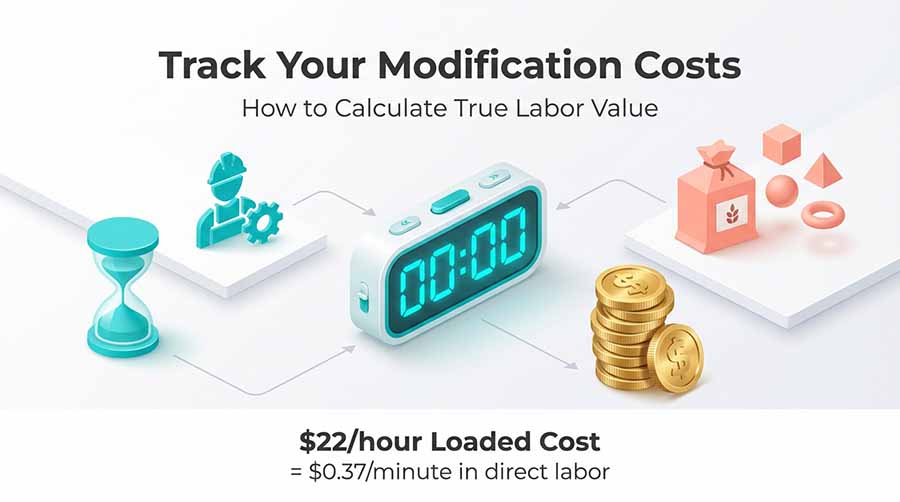
1. Calculate your true labor cost per minute. Take your hourly wage and add 20 to 30% for payroll taxes and benefits. Divide that by 60 minutes. A baker earning $17 per hour actually costs you about $22 per hour once you factor in the full burden. That is $0.37 per minute.
2. Track modifications for two weeks. Keep a notebook at the front counter and in production. Every time someone handles a special request, jot down the request type and estimate the time spent. You don't need precision. Rough numbers will reveal patterns fast.
One bakery owner we work with tracked for 10 days and discovered she was handling 47 unpriced modifications weekly. At an average of 8 minutes each, that was over 6 hours of unpaid labor per week. Just documenting it showed her exactly where $8,500 annually was disappearing.
3. Build a modification fee schedule. Once you know your most common requests and their typical time requirements, create simple pricing. Ingredient swaps: $3 to $8 depending on complexity. Message changes after order placement: $5 to $12. Packaging reconfigurations: $4 to $7. Rush fees: 25 to 50% upcharge. Think of these as mini pricing tiers, similar to how effective bakery pricing structures work for your main menu.
These aren't arbitrary. A 10 minute modification at $22 per hour loaded labor cost is $3.67 in direct expense. Pricing it at $8 covers the labor, the context switching loss, and leaves a buffer for complexity.
Once You Have the Data, Graduate From the Notebook
After two weeks of tracking, you've proven the problem exists and you know what it costs. Now you can automate the fix. Modern POS systems like Toast and Square let you program modifier buttons with your fee schedule. A customer requests almond flour? One button press adds the $8 fee automatically. No mental math. No forgotten charges. Just consistent profit recovery.
You don't need this on Day 1. Start with the notebook. But once you've built your pricing structure and trained your team, technology makes it stick. The best systems track modification frequency, so you can see which requests are happening most often and adjust your policies accordingly. Some bakeries discover that one or two modifications account for 60% of their unpaid labor. That's the kind of insight that lets you make smart menu changes instead of just working harder.
A Change Control System That Works
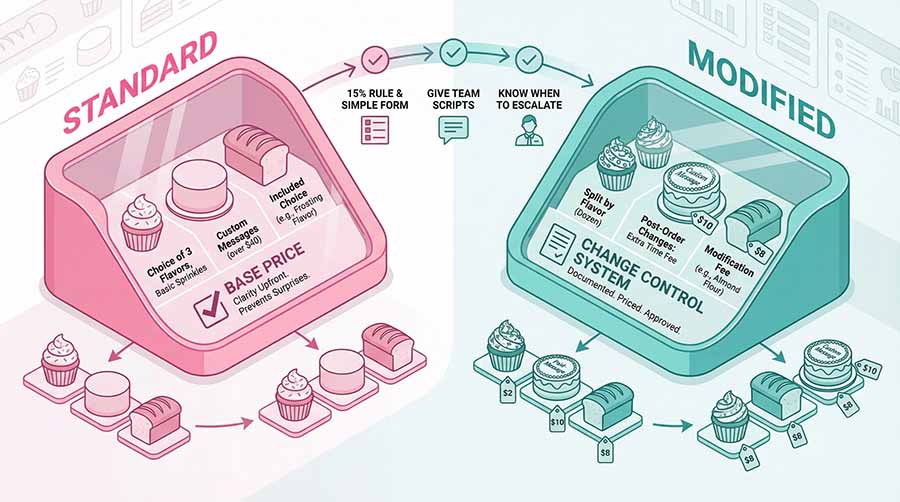
Professional project managers live by this rule: every change is either included, priced, or declined, and always documented. Your bakery needs the same discipline.
Define What's Included in Your Base Price
Customers need to know what comes standard. If your cupcakes include a choice of three frosting flavors and basic sprinkles, say so clearly on your menu and website. If custom messages are free on cakes over $40, make that explicit. Clarity upfront prevents surprises later.
The tighter your boundaries, the easier it is for staff to recognize when something crosses into modification territory. "Can you split this dozen into three boxes sorted by flavor?" is a modification. "Can I get chocolate frosting instead of vanilla?" is an included choice if both are standard options.
The 15% Rule: If You're Drowning in Requests, Your Menu Might Be the Problem
Here's something the smartest operators figured out: reducing your menu by 15 to 20% doesn't just lower ingredient costs, it dramatically cuts the mental load on your staff. When you're juggling 40 SKUs, every customization request feels overwhelming because you're already maxed out.
Cut your slow movers. The items that sell three units a week but require separate ingredient ordering, special prep time, or unique packaging. Those "nice to have" products create the conditions where customization requests become chaos. With a tighter menu, your team has the bandwidth to handle paid modifications professionally instead of rushing through them and making mistakes.
One cafe bakery we supply went from 35 daily offerings to 28. Their modification fee revenue actually increased because staff could finally execute the changes well enough that customers kept ordering them. Less menu complexity means more capacity for profitable customization. It's counterintuitive, but it works.
Create a Simple Modification Form
It doesn't need to be complicated. A half sheet checklist works fine. Customer name, original order, requested change, time estimate, price quoted, customer acknowledgment. Keep a stack at the register and another in the back.
The act of writing it down does three things. It forces your team to pause and assess whether the change is actually quick or more involved than it seems. It creates documented proof when a customer claims at checkout: "Nobody told me there'd be a charge for that." You have their signature confirming the fee was quoted and agreed to upfront. And it generates data you can use to refine your pricing and identify patterns.
Give Your Team Scripts
Most staff say yes because they don't know they have other choices. Give them language that acknowledges the request, explains the cost, and offers alternatives.
"I can absolutely swap that to almond flour. Because it requires separate prep to avoid cross contact, there's an $8 modification fee. Or if you'd like, we have almond flour items on our regular menu already priced to include that."
"I can redo the message, no problem. We charge $10 for post-order changes to cover the extra decorating time. Would you like me to proceed, or would you prefer to keep the original?"
Notice the phrasing: you're not asking permission. You're stating policy clearly and giving the customer a choice. Most accept the fee. Some decline and stick with the original. Either outcome beats doing unpaid work.
Know When to Escalate
Complex modifications involving allergen risk, significant production changes, or unclear feasibility need management review. Train your team to recognize these situations and bring in someone with authority to assess and quote.
"That's a bigger change than I can approve at the register. Let me grab my manager and we'll figure out exactly what's involved and get you a quote."
Answering the Pushback You'll Get
"Isn't This Nickel and Diming?"
Only if you do it inconsistently or spring it on customers. When your pricing is transparent, your policies are posted, and you apply them uniformly, customers understand they're paying for real work. Actually, research shows that 67% of adults accept price increases when they know it covers the higher cost of doing business. Your customers aren't looking for the cheapest option. They're looking for fair value and honest pricing.
The alternative? Hiding the cost in higher base prices for everyone. That punishes the 80% who order standard items to subsidize the 20% who request modifications.
"My Competitors Don't Charge"
They're recovering that cost somewhere: higher menu prices, lower quality ingredients, or burned out staff who quit. You're not competing on who gives away the most free labor. You're competing on quality, reliability, and still being here in five years.
"My Staff Can't Handle Hard Conversations"
Then train them. Role play scenarios during a slow afternoon. Let them practice scripts until they feel natural. Emphasize that explaining policy isn't confrontation, it's clarity.
Give them permission to defer to management when uncertain. And back them up when customers push back. If you let a customer steamroll your staff into free modifications, you've taught your team that policies don't matter.
"Some Changes Really Are Tiny"
Build a threshold. Changes under two minutes and no additional material cost? Include them. Beyond that? Priced modification. The key is consistency. If you waive fees randomly based on how much you like the customer, nobody knows what the rules are.
"Tracking Sounds Like Work"
It's harder to keep losing money without knowing why. A notebook and two weeks give you enough data to see the problem clearly. One wholesale bakery we supply started tracking and discovered that "quick packaging changes" were consuming 12 hours weekly. That's $13,700 annually in labor they weren't pricing.
Because we supply food businesses (from bakeries to caterers across the country), we see what separates operations that scale from ones that stay stuck. The difference is always in the details: tracking labor, pricing accurately, treating every service as work that deserves compensation.

Don't Let Invisible Labor Drain Your Bakery
"Isn't This Nickel and Dimin
Customer expectations escalate when unpriced modifications become routine. The person who got a free swap last month assumes it's permanent policy. Your team feels the chaos without seeing revenue to justify it, and quality slips when you're perpetually reacting instead of executing a plan. Eventually, you're known as the bakery that "does everything custom" while your margins prove otherwise.
Your staff aren't stealing. They're trying to keep customers happy without the tools to do it sustainably. The bakeries that thrive long term aren't giving away the most free labor. They're the ones that measure what modifications actually cost, communicate pricing transparently, train their teams to handle requests professionally, and charge accordingly for every minute of bakery customization costs. For more insights on bakery profit optimization and cost control strategies, visit the Plastic Container City blog.
FAQ
What is a good profit margin for a bakery?
Healthy bakery profit margins typically range from 5 to 15% net, with specialty and wholesale operations at the lower end and retail focused bakeries at the higher end. Controlling labor costs, especially hidden labor from untracked modifications, is critical to staying in that range.
How to calculate bakery cost?
Calculate total cost per item by adding direct ingredients, packaging, allocated labor (hourly wage plus benefits divided by units produced), and a portion of overhead (rent, utilities, equipment). Add modification costs as line items when they occur rather than spreading them invisibly across all products.
Why do small bakeries fail?
mall bakeries often fail due to poor cost control, underpricing products, and not accounting for all labor expenses. Untracked customization requests create invisible labor costs that erode margins without owners realizing where the money is going.
How to respectfully decline an order?
Be direct and courteous: "I appreciate you thinking of us, but we're not able to take on that request within your timeline" or "That modification is outside what we can accommodate safely given our current kitchen setup." Offer an alternative if possible, but don't commit to work you can't do well or price appropriately.
What are two common causes of scope creep?
Scope creep in bakery orders happens when modifications are added informally without documentation or pricing adjustments, and when staff lack clear authority to say no or offer paid alternatives. Both stem from unclear policies and inconsistent enforcement.
