

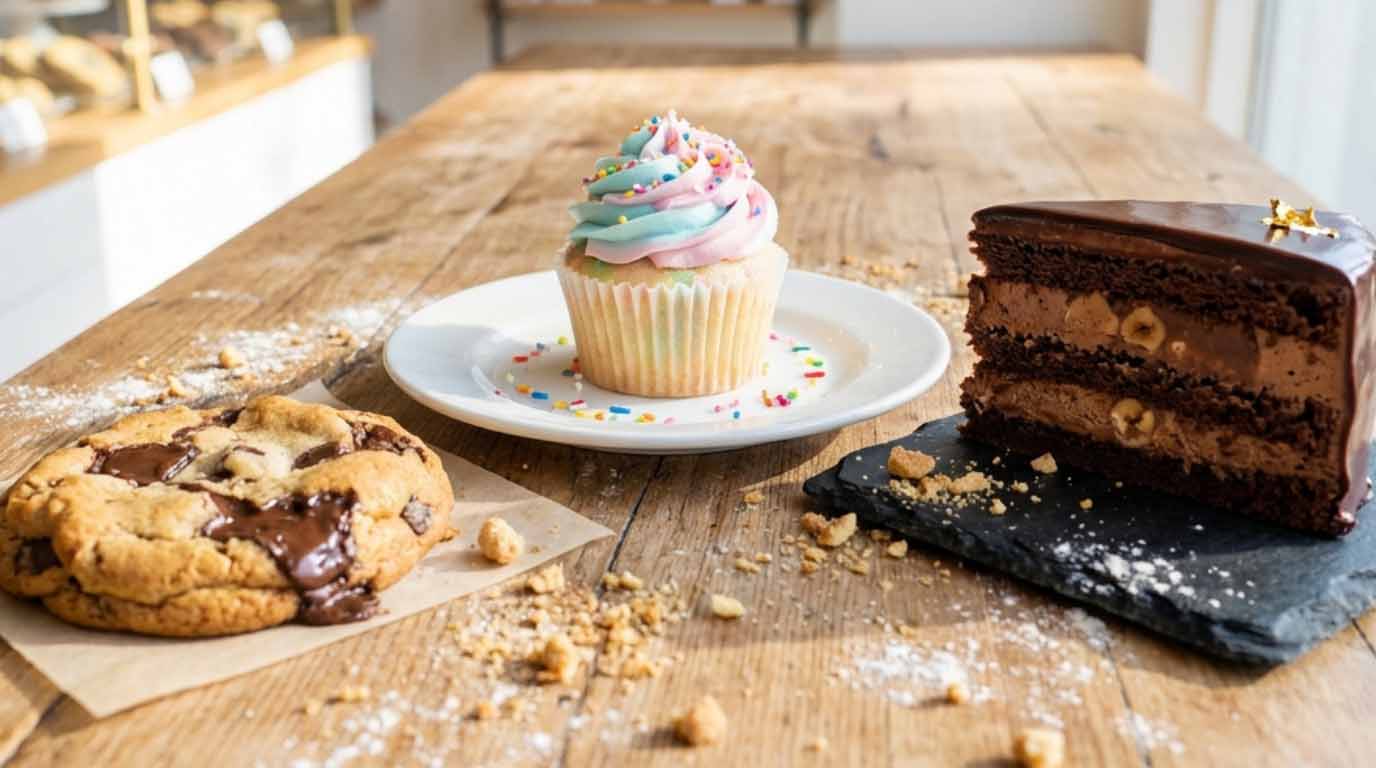
Bakery pricing 2026 comes down to one question: how do you raise prices without watching customers walk away? The bakeries losing customers right now are the ones marking up everything by 10% and hoping nobody notices. The ones growing their margins while keeping traffic steady understand that different products deserve different strategies.
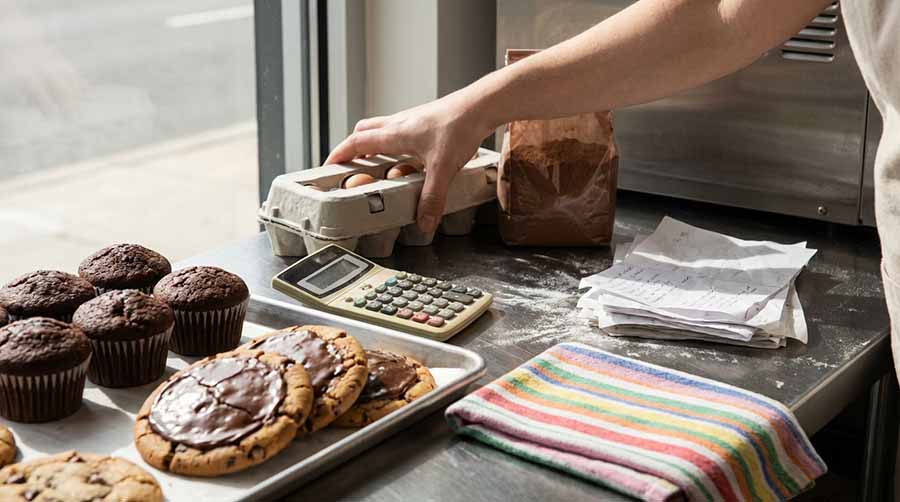
Build a three tier pricing system where entry items stay accessible, core products earn healthy margins, and signature items justify top dollar.
This isn't theory. At Plastic Container City, we work with thousands of food professionals across the U.S. The operators thriving in 2026 aren't competing on price. They're using packaging, presentation, and smart positioning to turn $4 products into $8 experiences customers choose willingly.
Why 2026 Pricing Demands a New Playbook
The U.S. specialty bakery market is expanding from $6.27 billion in 2024 to $9.02 billion by 2032 at 4.65% annually, while premium confectionery jumps from $31.6 billion to $68.1 billion at 10.4% compound growth. Customers are spending more on treats they value.
The competitive pressure? Home baking is surging. Sales of baking products are up 1% while bakery sales dropped 2%, with over 800,000 baking cookbooks sold in the past year. Customers baking at home aren't your enemy. They're proof that standard bakery offerings aren't special enough to justify the purchase.
Meanwhile, ingredient costs keep climbing. Cocoa hit $10.75 per kilogram in January 2025 before moderating to $6,683 per metric ton. Avian flu wiped out 41.6 million hens, spiking egg costs. Paper packaging jumped.
You can't absorb everything and survive. The solution: tiered pricing where entry items stay accessible, core products earn healthy margins, and elevated offerings justify top dollar through better ingredients and presentation that home bakers can't replicate.
The Three Tier Pricing System
Tier 1: Entry Products That Drive Traffic
Your base tier exists to get people through the door without losing money. Simple items with tight portion control and efficient packaging. A basic cupcake, standard cookie, coffee cake slice.
Price these at 67% to 100% markup over total cost for 40% to 50% margins. If your mini cupcake costs $1.50 all in, sell it for $2.50 to $3.00. Use simple clamshells or basic boxes. Batch production only. This serves price conscious customers and builds volume, but never lose money here.
Tier 2: Core Best Sellers With Healthy Margins
Your middle tier runs the business. Proven sellers that move steadily. Calculate true cost (ingredients, realistic labor, packaging, overhead allocation) then apply 140% to 185% markup for 58% to 65% gross margins.
A decorated cupcake costing $2.10 to produce sells for $5 to $6. Smart bundling works here: Single cupcake at $5.50, or four for $20. You move volume, customers feel value, per unit costs drop slightly.
Example Tier 2 Pricing:
| Product | True Cost | Retail Price | Margin |
|---|---|---|---|
| Decorated Cupcake | $2.10 | $5.50 | 62% |
| Layer Cake Slice | $3.25 | $7.50 | 57% |
| 4-Pack Cupcakes | $8.00 | $20.00 | 60% |
Tier 3: Premium Signatures That Command Top Dollar
This is where profit lives. Limited, special items positioned as worth the price. Specialty flavors, custom designs, seasonal exclusives. Price at 200% to 300% markup without hesitation.
The key is justification. A $12 slice needs to look, taste, and feel like $12. Better chocolate, signature fillings, clear dome containers, branded labels, storytelling. House made caramel, Madagascar vanilla, Belgian couverture. Customers at this level want to know why. One emerging premium angle: high protein desserts for health conscious customers command premium prices because they deliver indulgence in smaller, purposeful portions.
Typical scenario: A home baker introduced a signature chocolate cake with imported cocoa, salted caramel filling, and custom black box presentation. Her cost was $18 per cake. She priced it at $65. Within eight weeks, this single product represented 30% of her total revenue while accounting for just 15% of orders. That top tier positioning delivered triple the profit per unit compared to her standard cakes. (If you're running a home bakery, this premium focus strategy is even more critical since you can't compete on volume.)
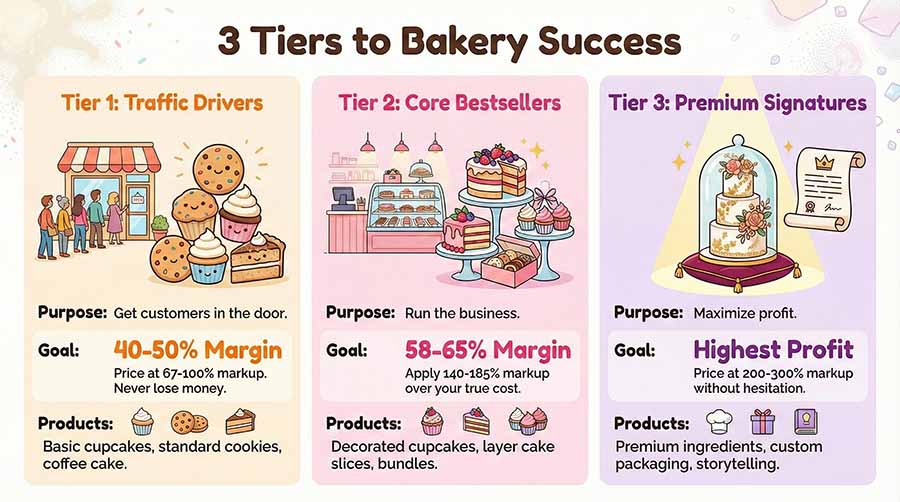
How Packaging Justifies Higher Prices
Packaging isn't an afterthought. It communicates value before the first bite. The container is part of what customers buy at elevated price points.
Entry products: Basic but clean. Simple clamshells, kraft boxes. Keep costs under 8% to 10% of retail. A $2.50 cookie carries $0.20 to $0.25 in packaging.
Core products: Windowed boxes that showcase product, sturdy clamshells that prevent damage, simple branded stickers. Budget 10% to 12% of retail. Your $5.50 cupcake can support $0.55 to $0.65 in packaging.
Signature items: Clear domes that frame products like art. Black or white boxes with custom printing. Tissue paper, ribbon, branded inserts. Spend 12% to 15% of retail. A $12 slice in a $1.50 premium container feels luxurious. In cheap plastic, it feels overpriced.
Because we supply packaging nationwide, we see this daily: better containers erase price objections.
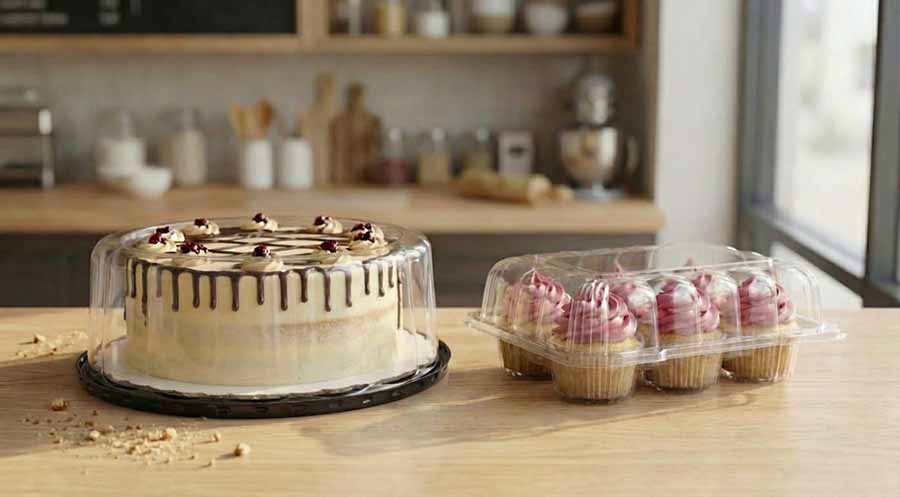
The Math: Moving From Entry to Core Pricing
Here's a standard cupcake evolving from Tier 1 to Tier 2:
Tier 1 Version:
- •Ingredients: $0.85
- •Labor: $0.30
- •Packaging: $0.15
- •Overhead: $0.20
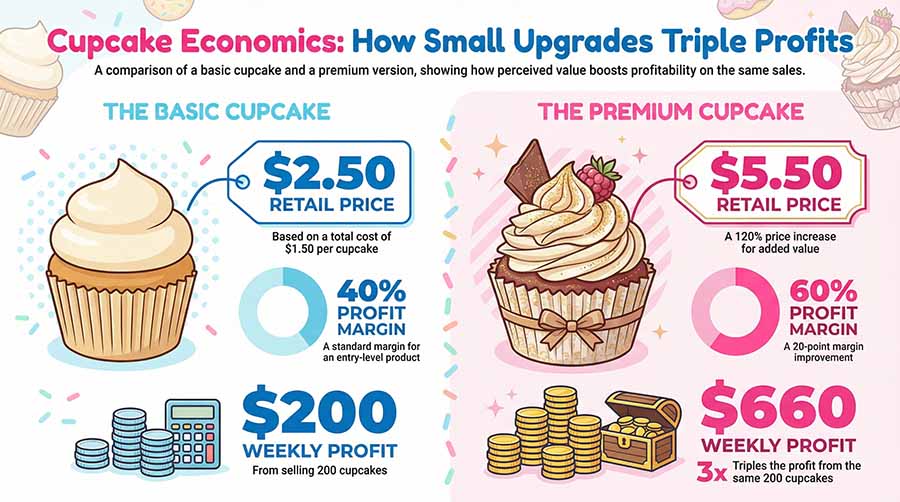
- •Total cost: $1.50
- •Retail: $2.50
- •Margin: 40%
Tier 2 Version:
- •Ingredients: $1.10 (better butter, real vanilla, custom liner)
- •Labor: $0.45 (individual decoration)
- •Packaging: $0.40 (windowed box)
- •Overhead: $0.25
- •Total cost: $2.20
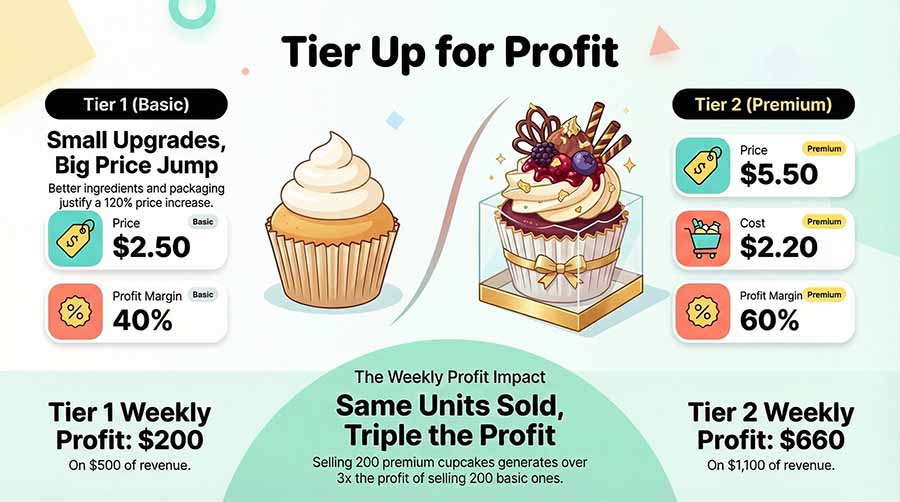
- •Retail: $5.50
- •Margin: 60%
Price went up 120%. Margin improved 20 points. Customer perceives $3 of additional value through better taste, presentation, and packaging.
Scale this across 200 cupcakes weekly:
- •Tier 1: $500 revenue, $200 gross profit
- •Tier 2: $1,100 revenue, $660 gross profit
Same units. Triple the profit.
Rolling Out Your Tiered System
Don't reprice everything overnight. Customers tolerate change when they understand it. Start by identifying 2 to 3 products per tier. Introduce signature offerings as limited editions. Existing customers keep buying their regulars at stable prices while curious customers try new premium items.
Communicate value clearly, not just price changes. Don't announce "chocolate cake now $65 instead of $45." Show the upgrade: Valrhona chocolate, house made ganache, better packaging. Customers accept higher prices when they see what changed.
For core products, bundle strategically. Single cupcakes at $5.50 or 4 for $20. Bundles feel like deals, softening price increases while boosting order value.
Keep entry tier stable as long as possible. Price conscious customers need an anchor. When costs force adjustments, change the product slightly rather than price. Customers forgive smaller cupcakes more readily than price jumps on go to items.
Avoid These Pricing Traps
Inconsistent gaps between tiers: If your basic cupcake is $5 and premium is $5.50, customers see no reason to buy basic and you've left money on the table with premium. Price gaps should be 30% to 40% minimum.
Under investing in high end offerings: A $10 slice needs to look like $10. Cheap packaging or pedestrian flavors at elevated prices trains customers not to trust your top tier products.
Too many SKUs: Three pricing tiers doesn't mean twenty products per tier. Five to seven items per tier is plenty. More spreads labor, inventory, and packaging too thin.
Managing Cost Fluctuations With Tiered Pricing
A three tier system gives flexibility when ingredient costs swing. When cocoa spikes, hold entry level prices by reducing portion size or switching to cocoa powder blends. Core products absorb small increases customers barely notice. Top tier margins must stay protected. Customers paying $75 for a cake won't balk at $80 if quality stays high.
Your signature item margins fund business growth and cushion cost shocks. If you let those top tier margins erode, you lose the buffer keeping your business resilient.
The Bottom Line
The premium confectionery market growing at 10.4% annually signals customer appetite for special treats. Stop competing on price. Compete on value at every tier. Build your ladder, support it with packaging that justifies each level, and protect margins while serving customers who want different experiences. That's how smart operators master bakery pricing 2026.
For more bakery insights, pricing strategies, and food industry trends, visit the Plastic Container City blog.
FAQ
What is the best pricing strategy for a bakery?
A three tier system that serves different customer needs: affordable entry items that drive traffic, core products at healthy 60% margins, and signature items at 200% to 300% markup. This lets you raise prices on high end products without losing price conscious customers who stick with entry tier.
How to calculate labor cost for a bakery?
Track total labor hours per week, multiply by hourly wages, then divide by total revenue to get labor cost percentage. Target 25% to 30% of revenue for labor in most bakery operations. Factor individual product labor time into cost calculations: if decorating a cupcake takes 3 minutes and your baker makes $18/hour, that's $0.90 in labor cost per cupcake.
What is a good profit margin for a bakery?
Target 60% to 65% gross on core products, which translates to 5% to 8% net after expenses. Top tier items should hit 65% to 70% gross. Entry products run at 40% to 50% gross margins to stay competitive while covering costs and driving traffic.
How do bakeries price their cakes?
Most use cost plus pricing: calculate ingredient, labor, and packaging costs, then multiply by 2.5 to 3.5 depending on complexity. A cake costing $25 to produce typically sells for $65 to $90. Custom cakes can command 3.5x to 4x multipliers when design work and specialty ingredients justify the price. For a complete custom cake pricing system, we've built a five stage approach that factors in design complexity, consultation time, and ingredient upgrades.
What is the most profitable bakery item to sell?
Items with high perceived value relative to actual cost deliver the best margins. Specialty cupcakes at $7 to $9, premium brownies, decorated cookies with custom designs, and signature cakes with unique flavors justify premium pricing through better ingredients, skilled labor, and elevated presentation customers can see and taste.
