

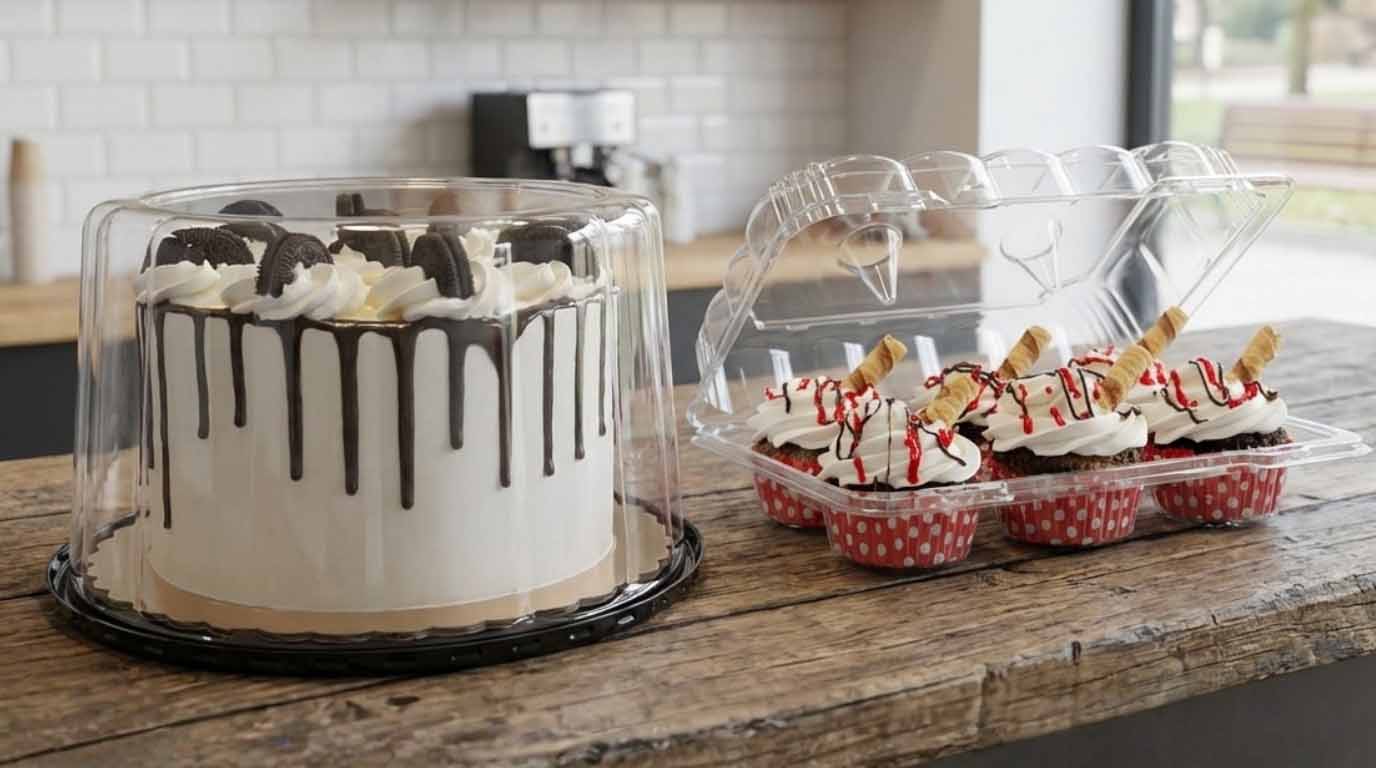
TL;DR: Knowing how to package cupcakes for sale, alongside cakes and cookies, is the difference between a product that arrives perfectly and one that lands crushed. This guide gives you exact container sizes, dome clearance specs by frosting style, material comparisons, and a count-format guide by sales channel. Get these four things right, and your packaging works as hard as your baking does. Start with the sizing tables below.
Learning how to package cupcakes for sale without destroying the frosting in transit is one of those lessons most bakers collect the hard way. The same goes for cakes that arrive crushed and cookies that go soft before the customer gets home. The container you choose is not an afterthought. It is your product's first and last impression.
At Plastic Container City, we work with thousands of food professionals across the U.S., from home bakers launching cottage food operations to high-volume commercial kitchens filling catering orders every weekend. The packaging questions we hear most often come down to four things: size, fit, material, and channel. Get those four right, and everything else falls into place.
This guide covers the practical decisions: which container fits which cake, how to choose dome height for cupcakes, which cookie format holds freshness best, and what "food-safe" actually means when you are buying containers in bulk.
What Size Cake Container Do I Actually Need?
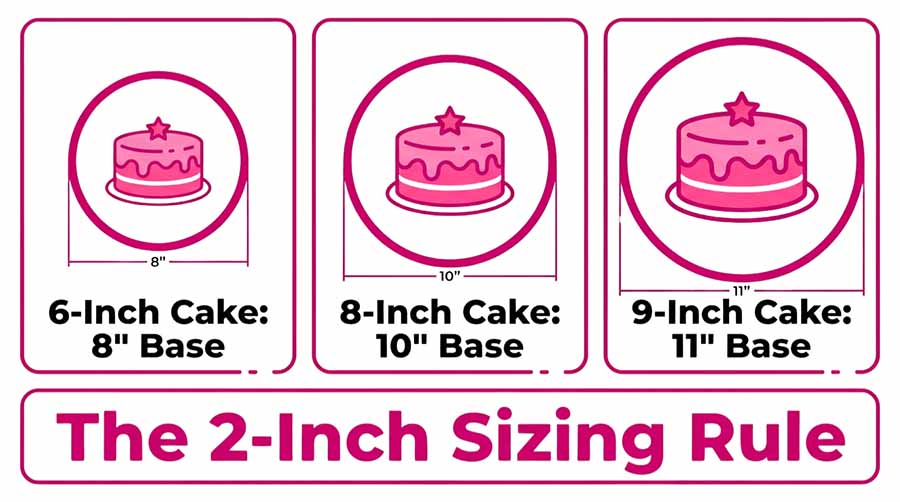
Direct Answer: Choose a container base 2 inches wider than your cake diameter. A 6-inch cake needs an 8-inch base; an 8-inch cake needs a 10-inch base. Dome height should match your tallest decoration, not the cake itself.
The sizing principle here is easy once you know it, but ordering the wrong base costs you product, trust, and repeat business. The table below is drawn from Pactiv Evergreen's verified bakery cake container size guide.
| Cake Diameter | Minimum Base Diameter | Dome Height Options Available |
|---|---|---|
| 6 inches | 8 inches | 3" smooth-wall, 4" fluted |
| 7 inches | 9 inches | 3" fluted, 4" swirl, 4.5" smooth-wall, 5" fluted |
| 8 inches | 10 inches | 3.3" smooth-wall, 3.5" swirl, 4" swirl, 5" smooth-wall |
| 9 inches | 11 inches | 3.5" fluted, 5" smooth-wall |
Single-Layer vs. Double-Layer Cake Height
The base diameter stays constant for a given cake width. What changes is dome clearance. A single-layer 8-inch cake with smooth buttercream fits a 3.3-inch dome. Add a second layer and tall piped rosettes, and you need 5 inches of clearance at minimum. Measure your tallest decoration before ordering, not the cake itself.
Dome vs. Flat Lid: When to Use Each
Clear plastic domes are the standard for retail display. Consumers buy with their eyes first, and visibility provides freshness cues like texture, color, and decoration that drive purchase decisions. Flat lids make more sense when you are stacking containers for cold storage or transit and vertical height clearance is limited.
Display vs. Delivery: Two Different Problems
A display container is built for visibility. A delivery container needs structural integrity above all else. For off-premises orders, the National Restaurant Association's packaging checklist calls for robustness in transit, securely held contents, leak resistance, and tamper evidence. A beautiful dome that pops open mid-delivery is not a packaging win, no matter how clear the plastic is.
Cake Slice Containers: A Separate Problem
Whole cakes are only part of the picture. If you sell slices, those need their own formats. Display Pack's 2026 catalog lists a single slice container at 6.08 x 3.95 x 3.34 inches and a hinged single slice format at 5.91 x 4.04 x 2.53 inches. For pie-style triangular cuts, wedge formats are also available from the same catalog.
What About Sheet Cakes?
Sheet cakes follow a different sizing logic entirely. Pactiv's PET container range lists three sheet formats: 1/8 sheet, 1/4 sheet, and 1/2 sheet, each available as a base alone or paired with a 5-inch RoseDome lid. For catering and high-volume production, the 1/2 sheet with a 5-inch dome is the standard pairing. A 13-inch base with a 5.75-inch RoseDome is also listed for larger round or specialty formats where no specific cake diameter is cited. If you are running sheet cake volume, these three container sizes should cover the full range of standard baking pans.
How Do You Package Cupcakes for Sale Without Crushing the Frosting?
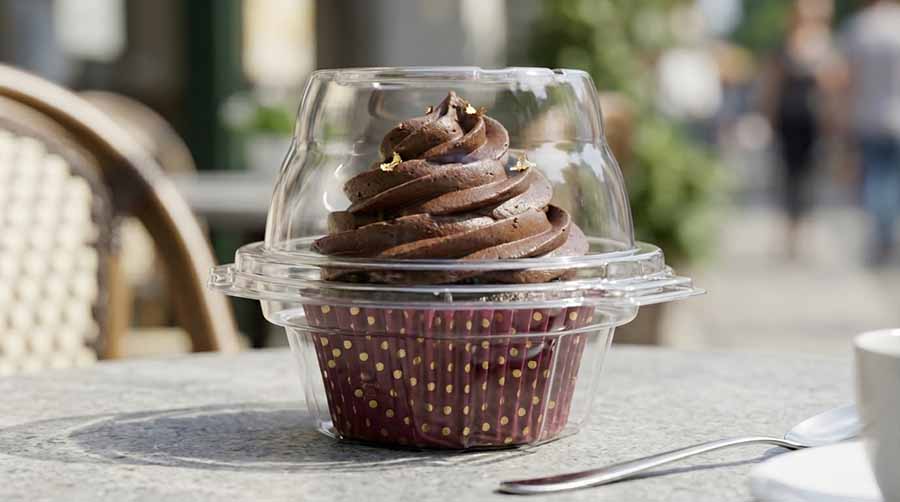
Direct Answer: Match dome height to frosting style. Flat or smooth frosting needs 3.0 to 3.4 inches of clearance. Swirled needs 3.4 to 3.8 inches. Tall piped or stacked styles need 4 inches or more.
The number one cupcake packaging fail is ordering a container without first measuring the clearance. Pactiv's cupcake container documentation is clear on this: a deep dome hinged lid is specifically designed to help cupcakes "keep their finished look throughout the transport process." Individual cavity separation matters just as much. It lets you lift cupcakes out cleanly without denting the frosting of the ones next to it.
Dome Clearance Guide by Frosting Style
| Frosting Style | Recommended Dome Clearance |
|---|---|
| Flat or smooth finish | 3.0 to 3.4 inches |
| Swirled or rosette | 3.4 to 3.8 inches |
| Tall piped or stacked decoration | 4.0 inches and above |
Count Format by Sales Channel
Not every occasion calls for a 12-pack. Match count format to context:
- Single retail display: 1-count jumbo clamshell (5.15 x 5.13 x 3.19 inches per Display Pack's 2026 catalog)
- Café or market counter: 4-count (7.64 x 7.64 x 3.62 inches) or 6-count (9.25 x 6.40 x 3.43 inches)
- Catering or wholesale: 12-count (12.12 x 9.30 x 3.46 inches) or 24-count (17.87 x 12.20 x 3.40 inches)
The Condensation Problem
When a warm cupcake goes into a sealed container, condensation forms on the inside of the dome and drips straight back down onto the frosting. Avoiding this is the simplest quality-control step in the entire packing process. Cool cupcakes completely before sealing. The same principle applies to refrigerated storage: placing a cake or cupcake in an unsealed container in the fridge draws moisture out of the product and into the surrounding air. An airtight PET container prevents that moisture loss, which is the direct answer to whether refrigerating cake dries it out. It does — but only when the packaging is wrong. On the upside of the equation: once you have the right container and the right temperature, a full-perimeter sealed PET clamshell is reported by Supermarket Perimeter to double the shelf life of cupcakes compared to loosely lidded alternatives. That is a meaningful number when you are weighing packaging cost against product waste.
Clamshell vs. Cardboard Box: An Honest Comparison
PET clamshells win on visibility. PET is crystal clear and shatterproof, which makes it the natural call for impulse-buy settings where the product does the selling. Cardboard boxes win when the goal is brand presentation or premium gifting. For bake sales and farmers markets, clear plastic beats a closed box every time. For wedding favors or custom orders, a windowed cardboard box with your logo earns the price premium.
Once the container is right, safe transit is the next variable. See how to safely transport your baked goods for practical delivery guidance from our team.
How Do You Package Cookies for Sale to Keep Them Fresh?
Direct Answer: For maximum moisture retention, use a heat-sealed flexible pouch — trade testing shows pouches outperform clamshells on freshness. Soft cookies need airtight sealing; hard cookies suit a PET clamshell or window box. Never pack warm.
Material Comparison: Cellophane vs. PET Clamshell vs. Window Box
| Format | Freshness | Visual Appeal | Best Use Case |
|---|---|---|---|
| Cellophane (heat-sealed) | Good | Medium | Individual retail, bake sales |
| PET clamshell | Good | High | Multi-count retail, café counter display |
| Window box | Moderate | High | Gift sets, premium retail |
| Flexible pouch (resealable zipper) | Best | Medium | Shipped orders, multi-count retail |
Trade testing reported by Supermarket Perimeter shows that flexible pouches outperform clamshells on moisture and texture retention, available in single-serve and 12 to 18-count formats with resealable zippers and high-visibility windows. As for cellophane specifically: yes, cookies will stay fresh in cellophane, but only when it is properly heat-sealed. An open-twist or loosely folded cellophane wrap loses its moisture barrier within hours. The seal is what does the work, not the material alone.
Soft Cookies vs. Hard Cookies: Different Needs
Soft cookies need moisture locked in. An airtight PET clamshell or heat-sealed pouch is the right call. Hard cookies (snaps, biscotti, shortbread) are less sensitive to moisture loss but highly sensitive to humidity getting in. Both formats go stale fast if exposed to condensation, which is why the next point matters.
Individual Retail vs. Multi-Count
For premium gifting or resale, individually wrapped cookies with a heat seal add perceived value and measurably extend freshness. For counter display or catering service, a multi-count format is more practical. Display Pack's 2026 catalog lists a 10-count slanted hinged clamshell at 8.00 x 7.00 x 2.53 inches, a clean and accessible format for a retail bakery counter.
Heat-Sealing: Do You Need the Equipment?
A proper heat seal gives cellophane and flexible pouches a truly airtight close. Entry-level impulse sealers handle small-batch production without much investment. If you are not ready for a sealer, resealable bags are a step up from twist ties, though neither matches a proper seal for shelf life or presentation on a retail shelf.
The Warm Cookie Mistake
Never pack warm cookies. The steam softens texture, causes condensation on container walls, and makes cookies stick together or to the packaging. Always cool to room temperature before sealing, regardless of the container format you are using.
Which Bakery Packaging Is Best for Delivery vs. Retail?
Direct Answer: Display cases need visibility. Delivery needs structural integrity. Farmers markets need lightweight portability. Catering needs bulk count formats that stack and travel without shifting. One container rarely covers all four.
Context changes everything. The right container for a bakery display case is rarely the right one for a catering order or a shipped box. Here is how channel changes the decision:
| Sales Channel | Cakes | Cupcakes | Cookies |
|---|---|---|---|
| Bakery display | Clear PET dome, sized to decoration height | Clear clamshell, 4 or 6-count | PET clamshell or window box |
| Delivery or shipping | Tamper-evident dome, secured base | Deep dome hinged with cavity separation | Heat-sealed flexible pouch |
| Farmers market | Clear dome, lightweight and portable | 4 or 6-count hinged clamshell | Individual cellophane, 6 to 10-count box |
| Catering | Quarter or half-sheet cake formats | 12-count or 24-count hinged | 12 to 18-count sealed flexible pouch |
What Does "Food-Safe Packaging" Actually Mean?
Direct Answer: Food-safe packaging must meet FDA authorization standards for food contact substances. For bakery use, look for food-grade PET or PP containers produced in compliance with 21 CFR 174.5.
The term "food-safe" is not a marketing phrase. The FDA regulates food packaging through food contact substance authorizations, and manufacturers must ensure their products follow the specifications and limits in those authorizations. The regulatory baseline is 21 CFR 174.5, which limits indirect food additives in food-contact articles to the amount reasonably required for the article's technical function in the packaging itself.
PET vs. PP: Which Material Do You Need?
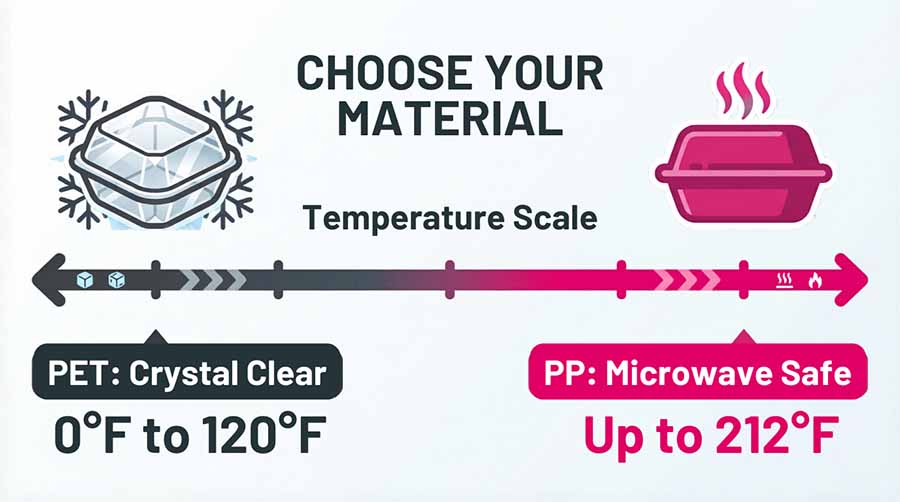
- PET (polyethylene terephthalate): Crystal clear, shatterproof. Temperature ranges vary across supplier spec sheets: Pactiv Evergreen lists PET at ‑20°F to 150°F, while Display Pack's material guide shows 0°F to 120°F. Use the more conservative range (0°F to 120°F) when in doubt. Best for display cases and refrigerated product.
- PP (polypropylene): Durable, crack-resistant, microwave-safe, temperature range up to 212°F. Better for any container a customer might put in a microwave or that holds hot-to-warm product.
For standard bakery display and refrigerated storage, PET is the industry standard. For any packaging that may see heat post-purchase, PP is the smarter material call. Our Bakery Packaging Laws 2026 guide covers labeling requirements, allergen disclosures, and what legally needs to appear on your containers for commercial resale.
How Many Container Formats Do You Actually Need?
Fewer than you think. Most small-to-mid-size bakeries can cover every sales context with five or six formats:
- A round cake container in two dome heights: one for single-layer cakes, one for double-layer or tall-decorated cakes
- A cupcake clamshell in 6-count for counters and markets, and 12-count for catering
- A PET cookie clamshell in a 10-count format for retail counter display
- A flexible pouch or heat-sealed cellophane option for individual retail, gifting, or shipped orders
Standardizing your range keeps ordering simple, reduces storage overhead, and makes per-unit cost easier to manage. At Plastic Container City, we regularly see bakers over-order variety and under-order volume. Locking in four to six formats and buying in quantity is where the real cost savings are. You can browse our full cupcake and cake container range here.
If you are still unsure whether your current setup is working for or against you, read why bad bakery packaging costs you more than most bakers realize.
The Bottom Line
Good packaging does not save a mediocre product. But poor packaging absolutely kills a great one. Nail the container size, match the dome height to the decoration, pick the material that protects what you made, and think about where the product is going before you seal it up.
The bakery professionals who get this right are not spending more. They are spending smarter. For more bakery insights, food industry tips, and practical guides from our team, visit the Plastic Container City blog.
Knowing how to package cupcakes for sale, along with cakes and cookies, is the detail that separates a one-time buyer from a loyal, repeat customer who trusts your product will arrive exactly as you made it.
FAQs
How to package cupcakes to sell?
Use a food-grade PET clamshell with individual cavities and a dome tall enough to clear your frosting style. Go single-count for retail display, 4 to 6-count for café or market, and 12 to 24-count for catering. Always cool cupcakes completely before sealing the container.
How do you package cupcakes for a bake sale?
A 4 or 6-count clear PET clamshell with a dome lid is the most practical bake sale format. It keeps cupcakes visible, protected, and easy for customers to carry. Make sure the dome clears your frosting by at least half an inch. Do not seal while warm.
How to pack cookies for selling?
Match format to the customer journey. Individual retail: heat-sealed cellophane or a single-count clamshell. Counter display: a 6 to 10-count PET clamshell. Shipped orders: a heat-sealed flexible pouch with a resealable zipper. Cool completely before packing every time.
What is the best packaging to keep baked goods fresh?
Airtight PET containers and heat-sealed flexible pouches perform best for freshness. Flexible pouches with resealable zippers outperform clamshells for moisture and texture retention. Cardboard boxes need a moisture barrier for anything with a glaze, cream filling, or frosting.
What legally needs to be on food packaging for sale?
For commercial resale in the U.S., standard requirements include an ingredient list, allergen disclosures, net weight, and your business name and address. Cottage food laws add state-specific restrictions on top of federal baseline rules. Always check your state's food labeling requirements before going to market.
