

TL;DR: The cake size guide servings question trips up bakers at every level because the pan size, the finished cake size, and the right box size are three different numbers. This guide gives you a clear serving chart for rounds, sheets, and tiers, the 2-inch wider rule for boxes, box height by layer count, and direct answers to the most common refrigeration questions. Get these numbers right before you order boxes or accept an event brief.
The cake size guide servings question sounds straightforward until a client calls to say the lid touched the frosting, or 20 guests showed up and the 8-inch round ran out at guest 14. Both problems have the same root cause: the wrong size decisions were made at the start, before a single layer was baked or a single box was ordered.
At Plastic Container City, we field these sizing questions constantly from bakers who are confident in the kitchen but less confident at the spec sheet stage. This guide exists to remove the guesswork from both sides of the equation: how many people your cake feeds, and which cake container or box it needs to travel in safely. While many use cardboard, a rigid PET container offers the visibility and seal that modern bakeries require.
Does Pan Size Equal Finished Cake Size?
Direct Answer: No. An 8-inch pan frosts to 9 inches. Always measure the finished, decorated cake, as frosting adds extra diameter and height.
This single distinction is responsible for the majority of sizing errors in cake packaging. A baker orders a 10-inch box for a 10-inch pan, fits in the box, closes the lid, and finds the frosting has smeared against the inner wall during the drive. The box was the same size as the pan, not the finished cake.
Measure your decorated cake, not your pan. Do it with every new recipe, with every new frosting style, and especially with any cake that has side decoration or a textured finish. The extra five minutes saves a ruined order.
What Size Cake Box or Container Do I Need?
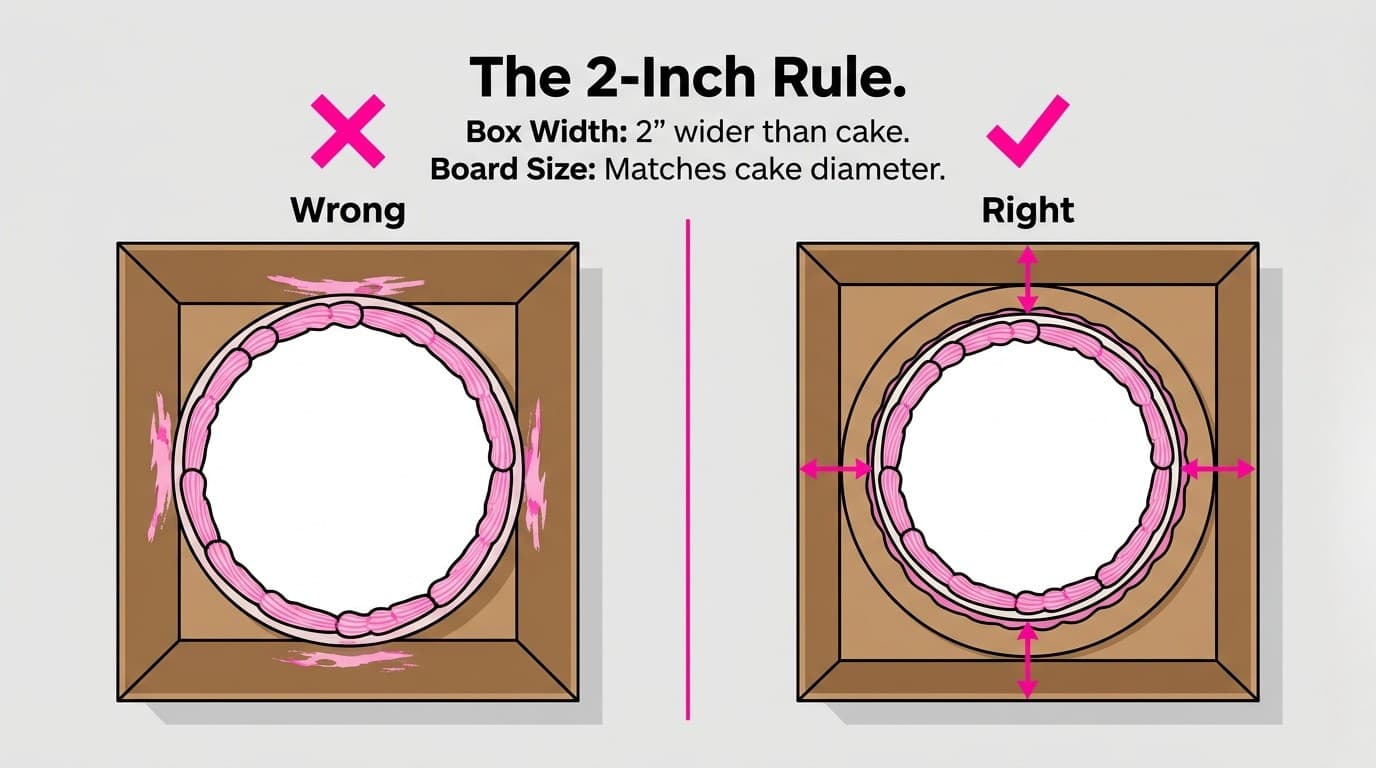
Direct Answer: Choose a box 2 inches wider than your finished frosted cake. An 8-inch pan frosts to 9 inches, so a 10-inch box is the correct choice.
This is the 2-inch wider rule, and it applies across every round cake size. The extra inch on each side gives the frosting clearance, prevents the cake from shifting during transport, and leaves enough room for a cake board to sit flat without the corners catching the box walls.
| Pan Size | Frosted Cake Size (approx.) | Correct Box Width | Cake Board Size |
|---|---|---|---|
| 6 inch | 6.5 to 7 inches | 8 inch box | 6 inch board |
| 8 inch | 8.5 to 9 inches | 10 inch box | 8 inch board |
| 9 inch | 9.5 to 10 inches | 11 or 12 inch box | 9 inch board |
| 10 inch | 10.5 to 11 inches | 12 inch box | 10 inch board |
| 12 inch | 12.5 to 13 inches | 14 inch box | 12 inch board |
Will a 10 Inch Cake Board Fit in a 10 Inch Cake Box?
Direct Answer: No. A 10-inch cake board requires a 12-inch box. The box must be 2 inches larger than the board to prevent walls from damaging the frosting.
This is one of the most common confusion points in our bakery packaging conversations. The rule to remember: board size matches cake size; box size is 2 inches larger than the board. The board slides into the box with clearance on all sides, the cake sits centered, and the lid closes without the box walls pressing into the frosting.
Cake Size Guide: Servings by Pan Size
Direct Answer: An 8-inch round yields 12–16 party servings (1.5" wide) or 20–24 wedding servings (1" wide). Portions vary by event type and cut depth.
Serving count depends on how the cake is cut, the event type, and whether accompaniments are served. The chart below uses standard industry cutting guides for 4-inch tall two-layer cakes.
| Pan Size | Party Servings | Wedding Servings | Correct Box |
|---|---|---|---|
| 6 inch round | 8 to 10 | 12 to 14 | 8 inch box |
| 8 inch round | 12 to 16 | 20 to 24 | 10 inch box |
| 9 inch round | 16 to 20 | 24 to 30 | 11 to 12 inch box |
| 10 inch round | 20 to 25 | 30 to 38 | 12 inch box |
| 12 inch round | 30 to 40 | 50 to 56 | 14 inch box |
A 10-inch round is comfortably enough for 20 guests at a birthday party. For a wedding with 20 guests at the dinner table, a 6-inch or 8-inch tier handles that count. Wedding cakes are cut smaller because guests typically eat cake after a full meal and often have other desserts available.
Sheet Cake Sizes and the Right Box: Quarter, Half, and Full
Sheet cakes cause more box-size confusion than any other format, largely because home bakers and professionals use the terms "quarter sheet" and "half sheet" inconsistently. Here is what the standard sizes actually are, and which box fits each.
| Sheet Type | Pan Dimensions | Party Servings | Box Size Needed |
|---|---|---|---|
| Quarter sheet | 9 x 13 inches | 20 to 24 | 10 x 14 inch box |
| Half sheet | 12 x 18 inches | 40 to 54 | 14 x 20 inch box |
| Full sheet | 18 x 26 inches | 80 to 108 | 20 x 28 inch box |
Note: A 9x13 pan and a quarter sheet are not always interchangeable terms at a commercial scale. Quarter sheet in commercial baking often refers to a 9x13 half-size sheet pan, but verify your pan dimensions before ordering boxes. The 2-inch wider rule still applies on all sides.
How Tall Does Your Cake Container Need to Be?
Direct Answer: Height depends on layers: 4" for single; 6" for double; 8" for triple. For tall toppers or flowers, use 10–12" containers for safe clearance.
Bakers who measure box height against the cake layers rather than the total decorated height are the ones calling us after a delivery with crushed fondant flowers and a dented topper. The rule is simple: measure from the cake board to the tip of the tallest element, add a half inch for clearance, and that is your minimum box height. For a full overview of container formats that handle every height requirement, see the guide to must-have food packaging solutions for your bakery.
Window Box vs. Solid Box: When to Use Each
- Window box: Best for display, retail counter sales, gifting, and any situation where the customer sees the cake before buying. The clear window adds visual appeal and perceived value. Clear PET windows are FDA-authorized for direct food contact under 21 CFR §177.1630.
- Solid box: Best for delivery, stacking multiple boxes, transport across distances, and any order where the structural strength of the box matters more than visibility. Solid boxes stack more reliably than window boxes.
While PET is BPA-free, research shows recycled PET can contain trace contaminants. For maximum purity, many professionals prefer virgin PET #1 windows when food is in direct contact with the packaging surface.
Transporting Tiered Cakes: Box Strategy by Tier
Tiered cakes should not travel assembled unless they are a small two-tier on a short trip with a skilled driver. For any tiered cake moving more than a few miles, transport tiers separately in individual boxes, then assemble on site.
- Each tier sits on its own cake board. Board size matches the tier; box is 2 inches wider.
- Box height per tier: add 1 inch above the top of each tier's cake for clearance during transit. This is especially critical for the bottom tier, which bears the weight of any assembled stacking hardware.
- Dowels and support boards for internal structure stay in place during transport. Remove only the decorative topper before boxing if it is at risk of toppling during movement.
- Stack tiers in the vehicle with the largest tier on the vehicle floor, never on top of another box.
A tiered cake that arrives in four separate boxes and is assembled in five minutes on site beats a fully assembled cake that shifts during a 45-minute drive every single time. For more on protecting baked goods in transit, the guide to safely transporting baked goods covers the broader logistics.
Should You Put a Bakery Cake in the Fridge?
Direct Answer: Perishable frostings (cream cheese, whipped cream) must be refrigerated. Standard buttercream and fondant can sit out for 2–3 days if sealed.
Refrigerating a cake when it does not need it is the most common cause of dried-out cake texture. Here is why: cold temperatures accelerate starch retrogradation, the process by which the starch molecules in baked goods reorganize into a firmer, drier crystal structure. The result is a cake that feels stale faster than one kept at room temperature.
Wrapping Inside the Box: Which Method Works
- Plastic wrap directly on the cake: Works for undecorated cake layers stored before frosting. Not practical for a fully frosted, decorated cake.
- Plastic wrap loosely tented over the box top: Traps cold air moisture and causes condensation on the frosting. Avoid.
- Airtight sealed box at room temperature: Best option for most standard buttercream and fondant cakes. The closed box creates a stable micro-environment that slows moisture loss.
- Refrigerating in a sealed box: If you must refrigerate (cream cheese, SMBC, whipped cream frostings), keep the cake in a closed box and bring it back to room temperature for 30 to 45 minutes before serving. This prevents condensation from forming on the decoration as it warms up.
The 4-Day Cake Rule: Is It Real?
The “4-day cake rule” appears across bakery forums as a general guideline that frosted cakes remain at their best quality for up to 4 days when stored correctly. It is not a food safety regulation. It is a quality threshold based on texture and taste degradation over time. If you sell cakes commercially, the labeling and packaging rules that do apply are covered in the guide to bakery packaging laws in 2026.
For most standard buttercream cakes stored in a sealed box at room temperature (below 70°F), 3 to 4 days is a reasonable quality window. Beyond that, the texture deteriorates and the frosting may begin to crust or separate. Cakes with perishable fillings (fresh fruit, pastry cream, mousse) have a shorter window and must be refrigerated per FDA safe food storage guidance, which then brings the starch retrogradation concern back into play.
Can you make a cake 3 days in advance? Yes, with conditions. An undecorated cake layer can be wrapped and refrigerated or frozen for days before finishing. A fully decorated cake made 3 days ahead should be sealed in a box, stored at room temperature away from heat, and assessed for freshness before delivery. The container choice matters here. A well-sealed, airtight container that reduces air exchange extends that window meaningfully.
Three Numbers That Prevent Most Cake Packaging Mistakes
Finished cake width (not pan size). Box width 2 inches wider than that. Box height matching total decorated height with a half inch clearance. Get those three numbers right and the box choice becomes straightforward.
The serving count question follows from the same discipline. Know your event type (party or wedding portions), know your pan size, and use the chart above. An 8-inch round does not feed 20 guests at a birthday party. A 10-inch round does. That calculation done before a client deposits is far less painful than the one done with an under-catered room full of people at dessert time.
For a complete overview of packaging cakes, cupcakes, and cookies for sale, see the guide to how to package cupcakes for sale. For more on this cake size guide, servings by event type, and packaging across all bakery products, visit the Plastic Container City blog.
Frequently Asked Questions
What size cake will feed 20 people?
Direct Answer: A 10-inch round two-layer cake feeds 20 to 25 guests at party-size portions. For a wedding with 20 guests, an 8-inch round is sufficient, as wedding servings are cut smaller. A 9x13 quarter sheet cake also covers 20 to 24 party servings.
What size cake box for a 9x13 cake?
Direct Answer: A 9x13 cake (quarter sheet) needs a 10x14 inch box to allow 1 inch of clearance on each side. If your 9x13 cake has tall frosting or decoration, also check the box height against the total decorated height before ordering.
Does refrigerating cake dry it out?
Direct Answer: Yes, if the cake is left uncovered or stored incorrectly. Cold air accelerates starch retrogradation, which makes the cake texture firmer and drier. To minimize this, store the cake in a closed, sealed box in the fridge, and bring it to room temperature for 30 to 45 minutes before serving.
Is a 1/4 sheet cake the same as 9x13?
Direct Answer: In home baking contexts, yes, a 9x13 pan is commonly called a quarter sheet. In commercial baking, a quarter sheet pan often refers to a 9x13 half-size sheet pan. The two align, but always verify the exact dimensions of your pan against the box specifications rather than relying on terminology alone.
How long will a bakery cake stay fresh?
Direct Answer: Most standard buttercream-frosted cakes stored in a sealed box at room temperature stay at best quality for 3 to 4 days. Cakes with cream cheese frosting, whipped cream, or fresh fruit fillings are perishable and should be refrigerated, with a quality window of 2 to 3 days. Fondant-covered cakes are best consumed within 2 to 3 days and should not be refrigerated unless the filling requires it.
