

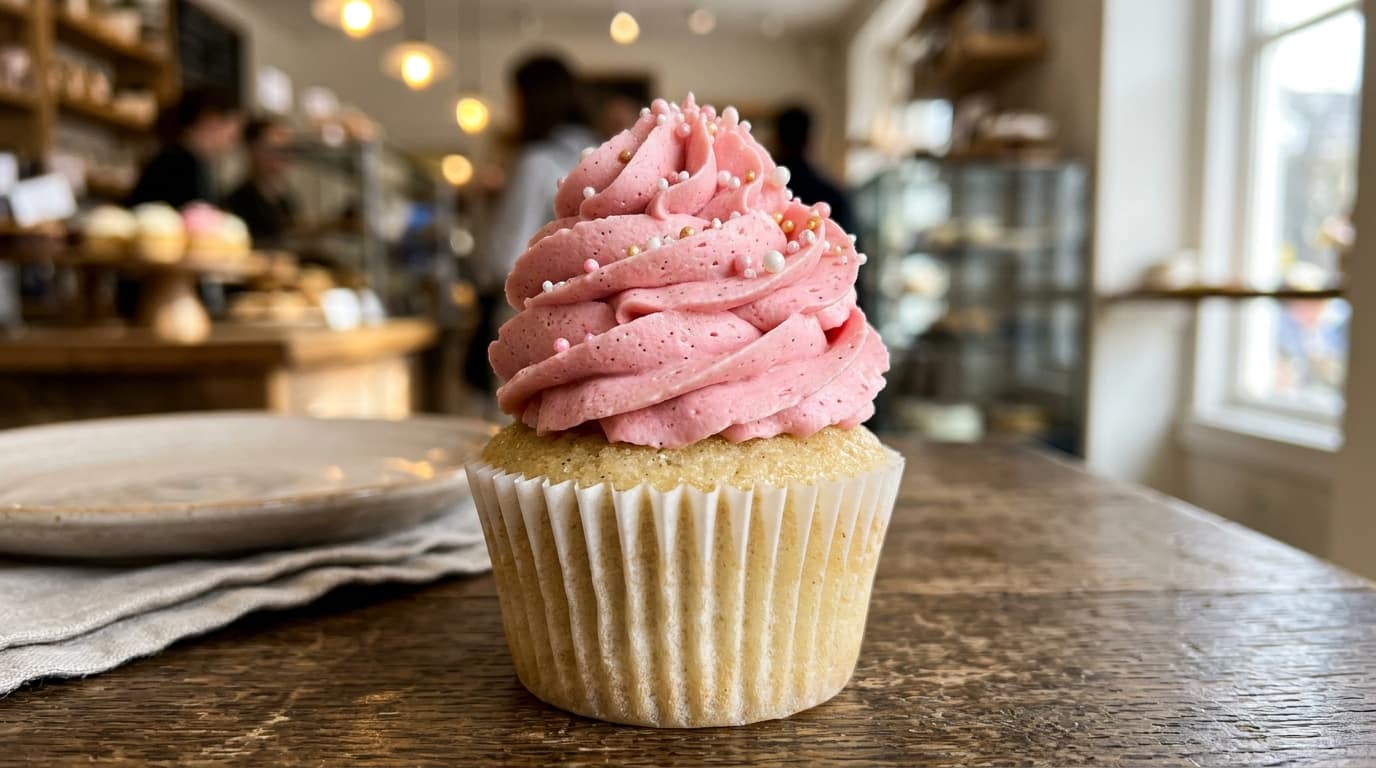
TL;DR: Cupcake container dome height is the number one cause of crushed frosting and wasted orders. This guide covers how to measure your decorated cupcake correctly, which dome height your frosting style actually needs, how to decode supplier labeling confusion, and how to match your count to your selling channel. Get these three things right and the packaging starts working for you, not against you.
Cupcake container dome height is the number one cause of crushed frosting and ruined orders, and it is entirely avoidable. You spent an hour piping perfect rosettes, reached for a lid, and heard a crunch. That crunch is the sound of dome clearance math going wrong. It costs real money in damaged goods, replacement orders, and customer refunds.
Since we supply thousands of food professionals across the U.S. at Plastic Container City, we see dome clearance math go wrong every day. That crunch you hear is the sound of lost profit.
How Do You Measure a Cupcake Before Ordering a Container?
Direct Answer: Measure the base diameter, widest top frosting point, and total height including toppers. Dome clearance must exceed total height by at least 1/4 inch.
Most buyers skip this step entirely and order by feel or guesswork. That is the root cause of the majority of returns and damaged orders we hear about. Three measurements, taken before you order, prevent every one of those problems.
The Three Measurements That Matter
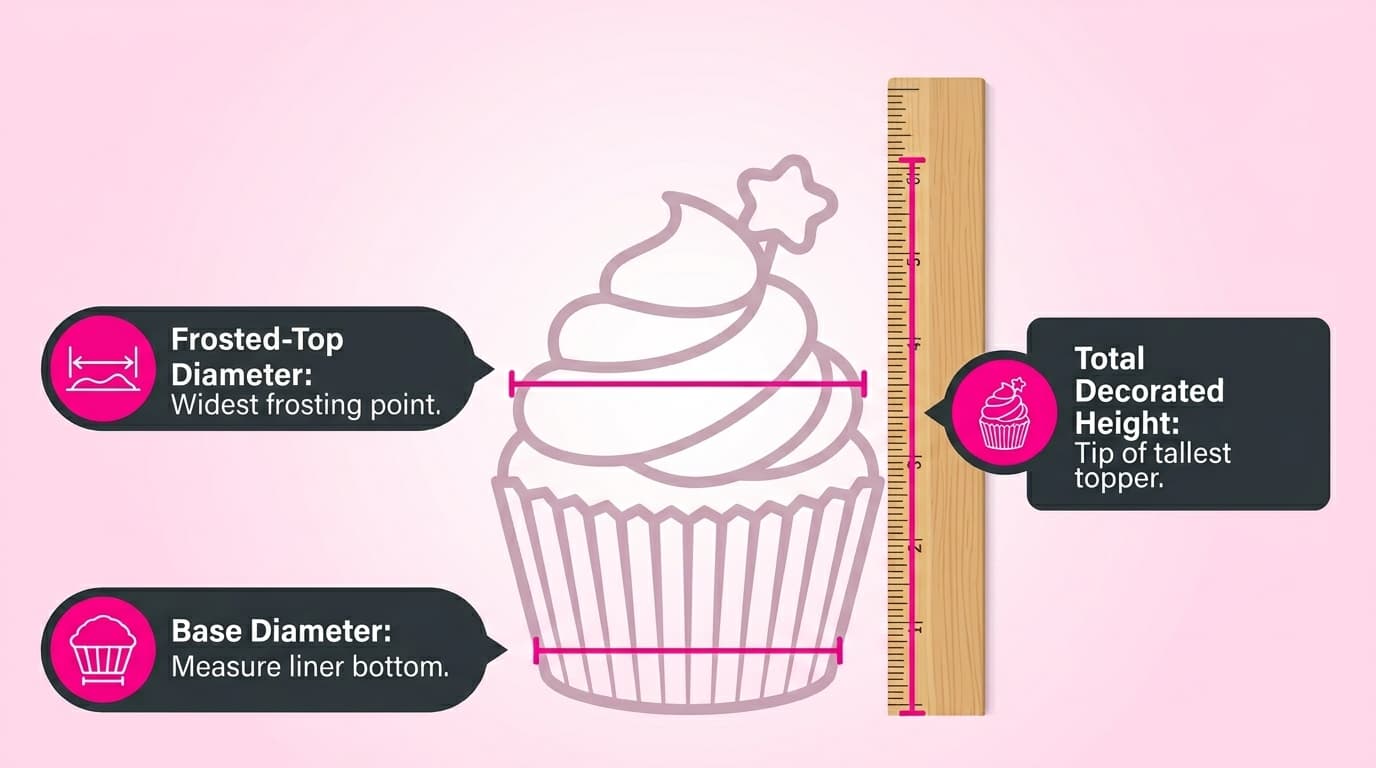
- Base diameter: Measure across the bottom of the cupcake paper or liner. Standard cupcakes sit at roughly 2 to 2.5 inches. Jumbo cupcakes run wider, closer to 2.75 to 3 inches.
- Frosted-top diameter: Measure the widest point of the piped frosting, not the paper. A swirled buttercream can spread to 3 inches or more across the top.
- Total decorated height: Measure from the bottom of the paper to the tip of the tallest element, whether that is a frosting peak, fondant figure, or sugar flower. This is the number your dome must clear.
Write those numbers down before you open a supplier catalog. A container that clears the frosting top by at least a quarter inch is the minimum. A half inch of clearance is better for transport.
Cupcake Container Dome Height: Which Level Do You Need?
Direct Answer: Low dome (1.5") fits glazes; standard (2.5") fits swirls; high/deep dome (3–3.5") handles rosettes, tall decorations, and fondant toppers.
Dome height is the clearance from the insert tray surface to the inside of the lid. It is the one spec that bakers get wrong more than any other. Here is how it maps to the most common frosting styles.
| Frosting Style | Approximate Height | Dome Level Needed | Dome Clearance | Best Decoration Type |
|---|---|---|---|---|
| Flat glaze or light spread | Up to 1 inch | Low dome | ~1.5 inches | Naked cakes, minimalist glazes |
| Standard buttercream swirl | 1.5 to 2 inches | Standard dome | ~2.5 inches | Piped swirls, star borders, simple rosettes |
| Tall rosette or layered swirl | 2 to 2.5 inches | High dome | ~3 inches | Stacked rosettes, piped bouquets, ruffle borders |
| Fondant topper or stacked decoration | 2.5 inches or more | Deep dome | 3 to 3.5 inches | Sculpted figures, sugar flowers, fondant sculptures |
Always measure your actual decorated cupcake, not an estimate. Frosting height varies by baker, by tip size, and by how heavily your hand applies pressure. Your measurement beats any chart.
Deep Dome vs. High Dome Lid: Is There an Actual Difference?
Direct Answer: There is no industry standard difference. Both describe tall lids (3–3.5"). Always ignore the label and verify the clearance spec in inches.
This is one of the most common points of confusion when shopping for how to choose cupcake containers. One supplier calls their tallest lid a "deep dome." Another calls the exact same height a "high dome lid." A third might say "jumbo dome." None of these are standardized industry terms.
The fix is simple: look at the dome clearance dimension in the product specifications, listed in inches. That number tells you everything the label does not. A lid with 3.1 inches of interior clearance is the same lid regardless of what the marketing copy calls it.
Which Lid Type Is Right for Your Setup?
Direct Answer: Hinged clamshells are best for retail; snap-on lids suit grab-and-go; insert trays with separate lids are best for catering and stacking.
Dome height is one decision. Lid mechanism is another. There are three main formats, and each has a different use case, a different protection level, and a different packing speed.
| Lid Type | Best For | Protection Level | Packing Speed |
|---|---|---|---|
| Hinged clamshell | Retail, gifting, market stalls | High | Fast, one-motion close |
| Snap-on dome lid | Display counters, grab-and-go | Medium-High | Moderate, two-piece assembly |
| Insert tray with separate dome lid | Catering, bulk orders, events | High when sealed | Slower, but allows stacking |
For market stalls and walk-up retail, hinged clamshells are the fastest option. For event catering where you are packing 50 or more units at a time, an insert tray system with a separate lid gives you better stacking control and more flexibility with dome height selection.
Cavity Width: The Measurement Most Buyers Miss
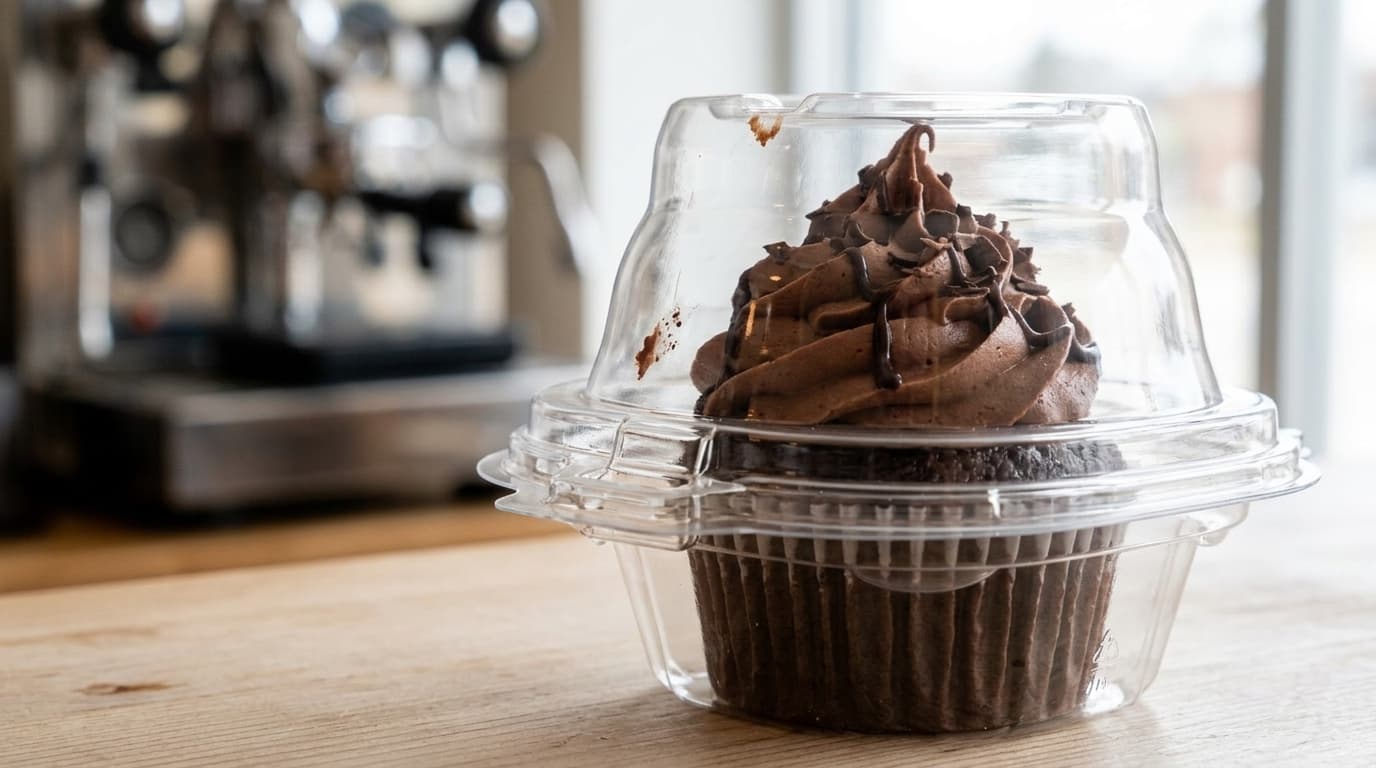
Getting dome height right and then ordering the wrong cavity width still ends in disaster. The cavity is the individual cup-shaped well that holds each cupcake in the insert tray. Its opening diameter must be close to your cupcake base diameter.
Too wide, and the cupcake tips inside the container. A tipped cupcake means frosting pressed against the dome wall. You open the lid and find a smeared mess instead of a clean rosette.
The sweet spot is a cavity opening that grips the cupcake liner snugly without squeezing the paper. A quarter inch of clearance on each side is the practical working tolerance. Check this dimension against your liner size, not just your cake size. A jumbo liner in a standard cavity will buckle and force the cupcake sideways before you ever close the lid. The cavity width check takes thirty seconds. Skipping it is how a batch that took two hours ends up unmarketable. For more on what packaging errors cost real bakery businesses, the real cost of bad bakery packaging covers the financial case.
Cupcake Box Count Guide: Matching Count to Your Selling Channel
Direct Answer: Match count to channel: 1-packs for gifting/markets; 4–6 counts for retail shelves; 12–24 counts for catering and bulk event orders.
Ordering the wrong count for your volume creates waste on both ends. Too many per pack and you are using event-size packaging for individual retail sales, which looks odd and costs more per unit. Too few per pack and you are running five trips to the car with one cupcake at a time.
| Count Format | Best Selling Channel | Notes |
|---|---|---|
| 1-pack (individual) | Gifting, farmers markets, grab-and-go | Highest per-unit cost; premium presentation |
| 4-count | Retail shelves, small gifting sets | Good balance of display and value |
| 6-count | Retail, local delivery, small events | The most common retail format |
| 12-count | Catering, birthday orders, event pick-up | Reduces pack-out time dramatically |
| 24-count | High-volume catering, wholesale delivery | Lowest per-unit container cost |
If you sell at farmers markets and also take catering gigs, you will likely need two count formats. Stock both rather than compromising on one. The cost difference is minimal compared to the presentation and packing efficiency gains. For more on packaging as a sales tool, the real cost of bad bakery packaging is worth reading before you place your next container order.
Material Choice: Why Clarity and Seal Matter for Cupcakes
Direct Answer: For cupcakes, PET (#1) is the preferred material because it offers 360-degree clarity for high-end decorations and creates a snap-tight seal that extends shelf life by 48 hours compared to cardboard.
When you are selling intricate rosettes and toppers, the material isn't just about safety—it is your display case. PET (polyethylene terephthalate) is crystal clear and shatterproof, making it the industry standard for retail cupcakes. It is FDA-approved for direct food contact and provides a moisture barrier that keeps the sponge soft.
Polypropylene (PP) is another food-safe option often used for insert trays. While slightly less clear than PET, it is highly durable. If your cupcakes are going from a cold fridge to a warm delivery van, PET and PP are superior to cardboard as they will not absorb moisture from the air or go "soggy" in high humidity.
For a technical breakdown of food-safe material codes and FDA compliance, see our comprehensive guide to bakery packaging materials.
Cottage Food Compliance: Prepackaging and Fit
For cottage food operators in major markets like California, Texas, and Florida, the container is more than just protection—it is a legal requirement for prepackaging. Most state regulations mandate that cupcakes be sold in a closed container with a label affixed before the point of sale.
Using a hinged PET clamshell is the most efficient way to meet these "prepackaged" definitions while ensuring your label stays flat and readable on the smooth lid surface. If your container is too small and the lid bulges, your required state disclosure may become obscured or peel off, leading to a compliance risk during inspection.
Specific labeling requirements (such as the 12-point font rule in California) vary by state. For a full breakdown of the rules in your area, see our guide to bakery packaging types and compliance.
The Right Container Is a Business Decision, Not a Packaging Decision
Three measurements. A dome height matched to your frosting. A count matched to your selling channel. That is the whole system. It sounds obvious spelled out like this, and yet the wrong container is the single most common complaint we hear from bakers who contact us after a bad delivery experience.
Cupcake container dome height is not a detail. It is the difference between a perfect product arriving intact and a beautiful hour of piping work ending up on the inside of a lid. Get the measurement right before you order, and everything else follows.
For a full breakdown of packaging across cakes, cookies, and cupcakes, see the complete guide to how to package cupcakes for sale. For more bakery packaging insights from the team at Plastic Container City, visit the Plastic Container City blog, where cupcake container dome height, cake box sizing, and packaging compliance are topics we return to regularly.
Frequently Asked Questions
How long will cupcakes stay fresh in an airtight container?
Direct Answer: Cupcakes stored in an airtight PET container at room temperature stay fresh for 2 to 3 days. Cardboard boxes, which absorb moisture from the baked goods, typically extend freshness to 1 to 2 days. Frosted cupcakes with perishable toppings like cream cheese or whipped cream should be refrigerated and consumed within 24 hours. For protecting freshness during delivery, see the guide to safely transporting baked goods.
How do you package cupcakes for a bake sale?
Direct Answer: For a bake sale, use a clear cupcake container with a dome lid that protects the frosting and lets customers see the product easily. Single packs work well for individual sales, while 4 count and 6 count containers are a good fit for multi-buy purchases.
How to pack 100 cupcakes?
Direct Answer: To pack 100 cupcakes, use larger multi-count containers that allow stable stacking and faster pack-out. Measure the finished cupcake height first and choose a lid that clears the tallest decoration without touching the frosting.
How long do cupcakes last in a cardboard box?
Direct Answer: Cupcakes in a cardboard box typically stay at best quality for 1 to 2 days at room temperature. Cardboard absorbs moisture from the frosting and cake, which shortens freshness compared to an airtight PET container. For same-day pick-up orders, cardboard performs well. For anything sold with more than a day's lead time, clear PET is the better choice.
How far in advance can you make cupcakes for a party?
Direct Answer: Unfrosted cupcakes can be baked up to 2 days in advance and stored in an airtight container. Frosted cupcakes are best made no more than 1 day ahead if using standard buttercream, and stored in an airtight PET container at room temperature. Avoid refrigerating frosted cupcakes unless the frosting contains perishable dairy, as cold air can dry out the cake and cause condensation on the frosting when brought back to room temperature.
