

Ever wonder how to start a bakery subscription box so every item in your display case is paid for before you even preheat the oven? That's the promise behind the recurring model, and it's the reason small bakers are ditching the "bake it and hope" approach. You bake six dozen muffins on a Tuesday, sell four dozen, and donate the rest. The math never works in your favor. A subscription box flips that equation: every item is pre-sold, waste drops close to zero, and your revenue stops being a guessing game.
This guide walks you through the pricing formula, the packaging decisions, the operational guardrails, and the retention tactics that separate a subscription side hustle from a real, repeatable profit channel. No fluff, no theory. Just the playbook.
What Is the Predictable Profit Formula for a Bakery Box?
The formula is straightforward:
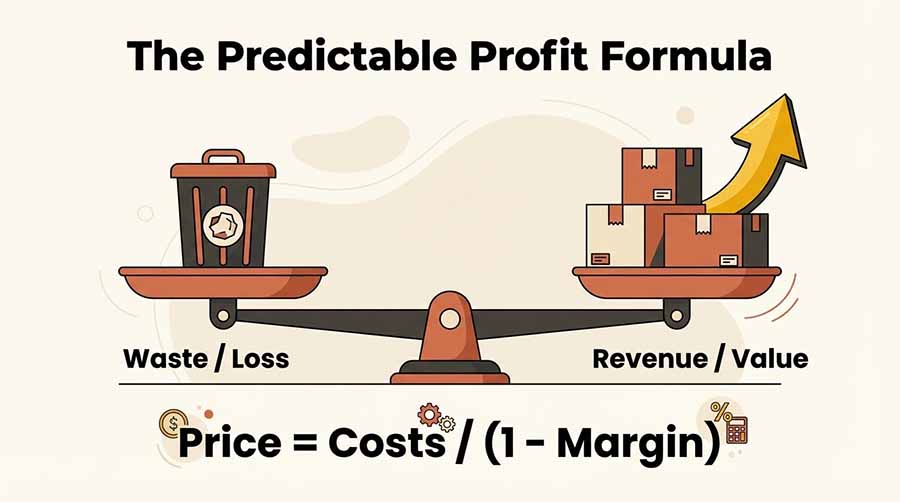
Box Price = (Ingredients + Labor + Packaging + Overhead) ÷ (1 − Desired Margin)
Say your total cost per box is $18 and you want a 45% gross margin. That's $18 ÷ (1 − 0.45) = $32.73. Round up to $33 or $35 and you have your price point.
Why 45%? Because current pricing guidance for meal subscriptions benchmarks successful services at a 40 to 50% gross margin after direct costs. The old "55 to 65%" figure floats around the internet, but recent public filings from operators like Goodfood show actual gross margins sitting in the low 40s. Price for real margins, not fantasy ones.
Why Pre-Sold Boxes Kill Waste
The biggest hidden profit boost isn't the price you charge. It's the product you stop throwing away.
When every box is spoken for before production day, you buy only what you need. A 2025 NCBI review found that pre-portioned food models reduce household food waste by roughly 38% compared to grocery-sourced equivalents. The same principle applies in your kitchen: no leftover inventory, no stale product heading to the donation bin on Wednesday morning.
At Plastic Container City, we work with thousands of food professionals across the U.S., and one pattern is consistent: bakeries that move to any kind of pre-order or subscription model almost always report tighter purchasing and less waste. The subscription box is just the most structured version of that shift.
How Do You Set Operational Boundaries That Prevent Burnout?
Three rules will save your operation before it starts:
The "No Customization" Rule
Your box is Baker's Choice. Period. You pick what goes in. Subscribers get what you bake. The moment you allow "Can I swap the lemon bars for brownies?" you have created a custom order program, not a subscription. Custom swaps erode margins and eat production time. If you want a deeper look at why this matters, our piece on stopping customization costs from eating your profits breaks down the numbers.
The Founding 20 Cap
Do not launch to the public. Launch to 20 subscribers. This "Founding 20" approach lets you test your workflow, identify bottlenecks in batching and assembly, and get honest feedback before you scale. Once those 20 boxes ship smoothly for two or three cycles, open another 10 spots. Then another 10. Controlled growth beats viral chaos every time.
Pickup and Delivery Windows
Set a single pickup day (say, Saturday from 10am to 1pm) and stick to it. Or better yet, set it on a traditionally slow day. By funneling your prep into a specific window, you transform "Slow Tuesdays" into a high-efficiency production day with zero idle labor. Late pickups are the silent profit killer that nobody talks about. Your policy should be clear upfront: boxes not collected within the window get donated or forfeited. No exceptions, no holding product in a fridge for three days. This protects product quality and your time.
For delivery, keep the radius tight. Local pickup and short-distance delivery let you use simpler, more breathable packaging since transit times are short and vibration damage is minimal. National shipping is a different game entirely, one with higher costs and more risk.
What Packaging Keeps a Subscription Box Fresh and Professional?
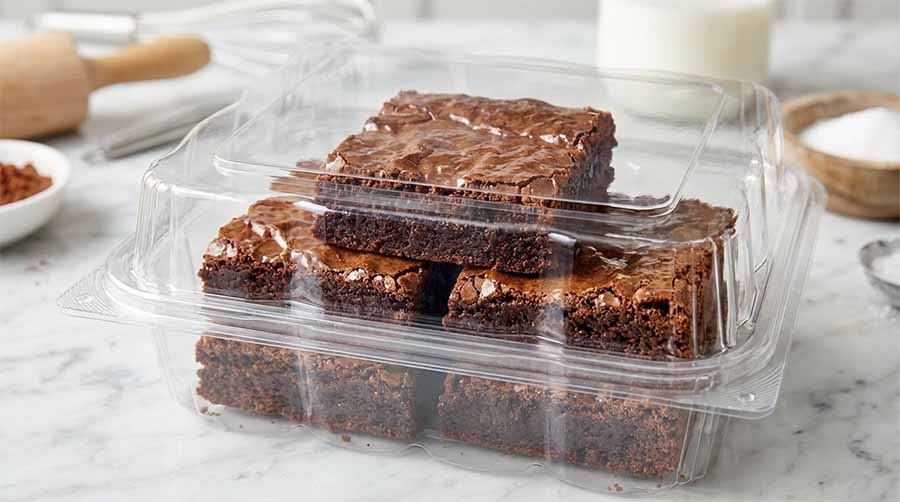
Packaging does two jobs in a subscription: it keeps the product fresh and it replaces the in-person experience your subscriber doesn't get. When someone opens a box and sees their pastries through a crystal-clear container with a sealed lid, that's your storefront window.
Freshness and Moisture Control
Baked goods have a short quality window. Staling accelerates when moisture migrates from the crumb to the crust, and packaging choice either helps or hurts that process. Food-grade PET offers a strong moisture barrier that keeps cookies crisp and soft items soft. Plain unlined cardboard? It absorbs moisture and leads to soggy results, particularly with anything that has a glaze or cream filling.
One note worth knowing: breathable kraft bags can actually outperform fully sealed plastic for artisan breads and preservative-free items sold within a day or two, because they let just enough moisture escape to prevent surface condensation. The right container depends on what's inside.
Tamper Evidence and Stacking
Tamper-evident PET containers produce a visible indicator if opened, which builds confidence for subscribers receiving boxes at a pickup point or via delivery. Beyond visibility, PET's high strength-to-weight ratio allows for vertical stacking during assembly and local delivery, preventing the "smashed cupcake" scenario that kills retention before it starts.
For fragile items like cupcakes, use containers with built-in inserts or rigid domes. If you are shipping nationally (rather than doing local pickup), you will also need cushioning and void fill to handle the 3 to 4% average package damage rate that US parcel carriers currently experience.
How Should You Price and Bill Your Bakery Subscription?
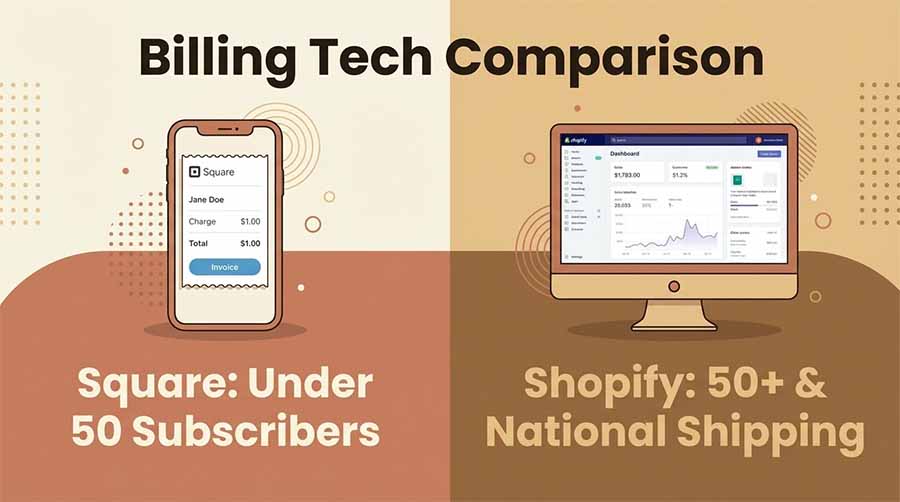
For a micro-bakery running 20 to 50 subscriptions, a simple recurring invoice through Square works perfectly. There's no monthly software fee. You pay 2.8% plus $0.30 per online invoice payment. Set it to auto-charge on a fixed billing date, and your revenue hits the account like clockwork.
Once you grow past 50 subscribers or start offering skip/pause options and tiered boxes, platform tools like Shopify paired with a subscription app (Loop, Recharge) start making sense. These give you anchor billing dates tied to your production calendar, automated churn management, and self-service portals that let subscribers pause instead of cancel. One Shopify case study showed a 36% cancellation-save rate after adding subscription-specific tools.
| Feature | Simple Tech (Square) | Platform Tech (Shopify + App) |
|---|---|---|
| Best for | Under 50 subscribers | 50+ subscribers or national shipping |
| Monthly software cost | $0 | $39+/mo (Shopify) plus app fees |
| Transaction fees | 2.8% + $0.30 | 2.9% + $0.30 (varies) |
| Skip/pause options | Manual | Automated self-service |
| Anchor billing dates | Basic scheduling | Tied to production calendar |
| Churn management | None | Cancel-save flows, dunning |
The key insight: don't overspend on tech before you have the subscribers to justify it. A spreadsheet and a Square recurring invoice will get you through the first 20 boxes without any friction.
What Legal Rules Apply to Bakery Subscription Boxes?
That said, the details matter. Several states expanded cottage food rules in 2025. Texas raised its sales cap to $150,000, Nevada jumped to $100,000, and North Dakota now allows online ordering and out-of-state shipping for cottage food producers. Vermont nearly tripled its annual limit to $30,000.
The critical points for subscription operators:
- Product type matters most. Regulations focus on whether your items are "non-potentially hazardous" (shelf-stable) versus requiring temperature control. Cookies, breads, and brownies typically qualify. Cream-filled pastries and cheesecakes often do not.
- Shipping across state lines is still rare. Only a handful of states (notably North Dakota) permit interstate cottage food shipping. If you are operating under a cottage food license, your subscription is almost certainly limited to in-state, direct-to-consumer sales.
- Sales caps are your ceiling. A subscription generating $500/month across 25 subscribers hits $6,000/year. That's fine in most states, but if your box takes off, you may outgrow cottage food limits quickly. Know your state's threshold.
For a full breakdown of cottage food requirements and managing local permits, our cottage food guide covers what you need to get started legally.
How Do You Keep Subscribers From Canceling?
The data on food subscription churn is sobering. A 2025 CNET survey found that 46% of non-subscribers avoid meal kits because they don't want another recurring bill. Among those who do subscribe, cost and "subscription fatigue" are the top cancellation drivers across the industry.
Your defense against this has two parts:
The "Amuse-Bouche" Strategy
Include one small, unexpected item in every box. A single macaron. A two-pack of seasonal shortbread. A mini jar of house-made jam. This costs you almost nothing to produce but gives the subscriber something to look forward to, something that feels like a bonus rather than part of the transaction. It also doubles as market research: if everyone raves about the lavender shortbread, you've found your next featured item.
Position the Box as a Gift, Not a Bill
The language you use in your marketing, your packaging insert, and your billing emails should frame the box as a recurring treat. "Your box is ready" beats "Your invoice has been processed." Small shifts in language move the subscriber's mental model from "expense" to "reward." Consider offering gift subscriptions (3-month or 6-month prepaid) as well. These bring in new subscribers through someone else's wallet and give you revenue upfront.
For more ideas on building lasting customer relationships, check out our guide on creating a bakery loyalty program.
What Does a Launch Checklist Look Like?
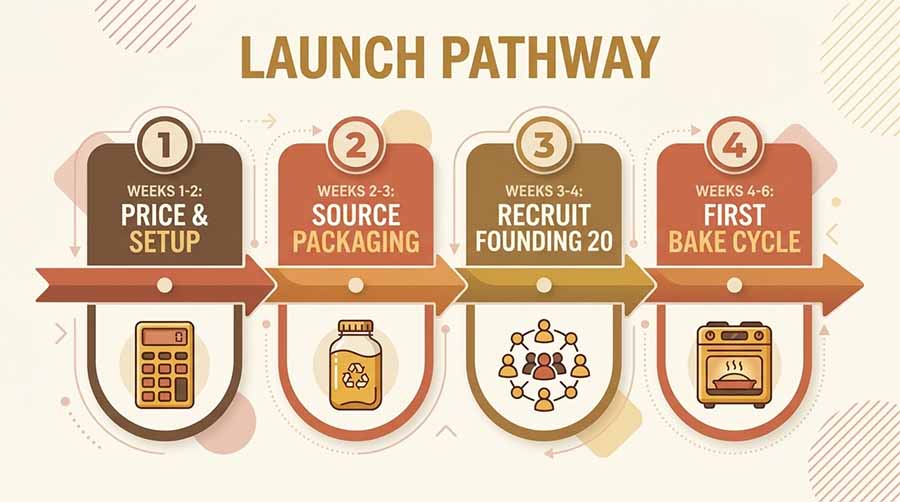
Weeks 1 to 2: Run the pricing formula on three different box sizes. Pick one. Set your billing date and production day. Choose your billing tool.
Weeks 2 to 3: Source packaging. Order tamper-evident clamshells, inserts for fragile items, and branded labels or stickers. Test pack a full box to check fit, stacking, and visual appeal.
Weeks 3 to 4: Recruit your Founding 20. Use your email list, social media, and word of mouth. Offer a first-month "founding member" rate if you want early traction, but keep the discount modest (10 to 15%, not 50%).
Weeks 4 to 6: Run your first production cycle. Bake, assemble, deliver or set up pickup. Collect feedback. Fix what broke. Run cycle two.
The goal isn't perfection on day one. It's getting 20 boxes out the door, learning what works, and tightening the process before you tell anyone else about it. For more on growing without a brick-and-mortar location, see our guide on scaling your bakery without a storefront.
Frequently Asked Questions
How much does it cost to start a subscription box business?
What is a good profit margin for a subscription box?
What is the churn rate for subscription boxes?
Why do small bakeries fail?
How does a subscription box work?
For more bakery insights, industry news, and food-business tips, visit the Plastic Container City blog.
