

Can you scale a bakery without a storefront? Yes. Four paths work: shared commercial kitchens, production-only leases, co-packers, or wholesale partnerships. Each trades different levels of control, capital, and risk.
Most bakers equate "real business" with "storefront." That's ego, not economics. Retail leases demand $4,000+ monthly before you bake a single item. Buildouts run $50k minimum. You don't need that to scale: you need production capacity, legal compliance, and margins that survive contact with reality.
Are You Actually Ready to Scale?
The clearest signal you need to scale: You're turning away business weekly.
Refusing orders because of capacity constraints means you've outgrown home. Period. Other signals: running out of prep space, oven time, or freezer capacity faster than you can restock.
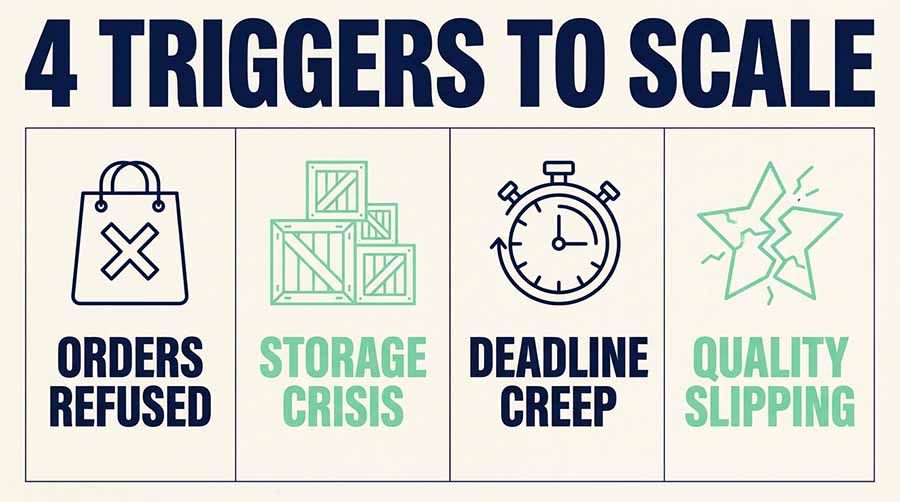
Quick Diagnostic: Four Triggers
You need to scale if:
- You refuse orders weekly because your schedule is maxed
- Your house looks like a commercial bakery, not a living space
- You cut off orders 48 hours early just to manage production
- Product quality slips because you're rushing
Two or more yes answers? You're ready. Still comfortable at home? Stay put and keep banking profits. For complementary growth strategies including digital channels and wholesale partnerships, see our guide on how to expand your bakery business.
Path 1: Shared Commercial Kitchens
Rent licensed kitchen space by the hour or month to produce at commercial scale. Over 50% of shared kitchen users are first-timers; the model works for beginners and established operations.
Most shared kitchens charge $20 to $29 per hour. That is where 42% of operators price. Budget $25/hour as your baseline. Rural facilities drop to $15. Urban markets during peak times? $75 to $120. Tack on dry storage ($20 to $50 monthly) and deposits ($250 to $500).
Best For
Custom cakes, testing new products, batch production for wholesale accounts, or seasonal volume spikes. Works when you need flexibility without long-term commitments. If custom cakes are your focus, make sure you're pricing them for actual profit before you rent kitchen time.
The Gotcha
Scheduling conflicts crush productivity. Shared kitchens get crowded mornings and weekends. Book consistent weekly slots months ahead or pay premium rates. Most facilities require you to remove everything after each session, which adds hours of hauling and setup time.
Hidden Costs
A four hour rental becomes six hours of your day once you factor in driving, unloading, setup, breakdown, cleaning, and loading out. Hidden labor costs turn what looks like a $25/hour rental into $40+ per hour of your actual time. If you're not pricing products to cover six hours of work, you're losing money on every batch.
Where most bakers blow it: They drop prices because "$30/hour sounds cheap." Then they realize they're working for $8/hour after factoring in setup, travel, and breakdown time. Don't underprice just because you're renting. Factor in every minute of unpaid time, or you'll lose money on every batch.
Path 2: Production-Only Lease
This is dedicated commercial kitchen space for pure production with no customer-facing areas. Lower rent than retail locations, but you're still signing a lease and investing in industrial equipment.
Real costs: Monthly rent ranges from $900 to $6,000 depending on location and square footage. Equipment investment runs $20,000 to $30,000 for industrial ovens, mixers, and cold storage.
Best For
High-volume wholesale operations making bread, cookies, or packaged goods. You need consistent daily production and distribution logistics.
The Reality
Lower rent doesn't mean lower risk. You need steady cash flow to cover monthly payments, utilities, equipment maintenance, and insurance. One slow quarter puts you underwater.

Path 3: Co-Packer or Contract Manufacturer
Hire a third party to manufacture and package your proprietary recipes at scale. This is outsourced production, not a facility you control.
Real costs: Co-packers require minimums like 10,000 lbs per formula and charge $1,000 R&D fees for development. Kitting and assembly run $0.40 to $0.60 per unit.
Who This Works For
Packaged cookies, granola bars, or shelf-stable baked goods with proven demand. You need capital to fund large inventory buys upfront and recipes worth protecting with NDAs.
What You're Trading
MOQs are the small brand killer. If you can't move 10,000 lbs of product within 90 days, co-packing isn't an option; it's a fantasy. And co-packing isn't "set it and forget it." It's a vendor relationship. Specs. Lead times. Quality checks. Contract negotiations. You're managing a supplier, not running a kitchen.
You lose control over production schedules, quality touches, recipe tweaks, and last-minute changes. Your co-packer runs their schedule, not yours.
Packaging and labeling requirements add cost and complexity. Co-packers require standardized packaging and labels meeting FDA requirements, including allergen declarations, nutrition facts, and barcode compliance. Budget $500 to $2,000 for compliant packaging design, label printing, and initial production runs. This isn't optional.

Path 4: Wholesale First Model
Sell bulk quantities to cafes, grocery stores, or restaurants instead of direct to consumers. You're trading individual orders for predictable accounts.
The margin reality: Wholesale margins shrink to 30% markup versus 45% for retail. You make less per unit but gain predictable orders and lower customer service labor.
Best For
Bakers who hate social media, individual order packaging, and direct customer service. You'd rather focus on production than retail theatrics.
The Cash Flow Trap
Payment terms will strain your cash flow. Many wholesale accounts pay net 30 or net 60. You front ingredient costs, labor, and packaging, then wait two months to get paid. Small operations with thin reserves don't survive this. You need working capital or you'll be out of cash before the first check clears.
What You Need
Exact cost calculations. Know your ingredient costs, labor time per unit, overhead allocation, and delivery expenses down to the penny. Wholesale pricing leaves zero room for guessing. If your menu has drifted into complexity, simplifying to fewer high-margin items makes cost tracking and wholesale pricing much easier.
Quick Comparison: Which Path Fits Your Bakery?
The Packaging Decision You Can't Ignore
At Plastic Container City, we supply thousands of bakeries across the U.S. The pattern is consistent: operators who scale without upgrading packaging lose money fast.
Proper packaging can boost sales 30% simply by ensuring products arrive intact. Damaged goods that can't be sold represent hidden expense cheap containers create. Whether you're delivering to wholesale accounts or shipping individual orders, packaging quality becomes your reputation.

Regulatory Reality Check
Cottage food laws vary wildly by state. Indiana caps annual home sales at $2,500. Vermont allows $6,500. Texas bans temperature-sensitive products entirely. What's legal in one state might be banned in yours.
Check your state's actual limits before you assume you can scale from home. Some states ban wholesale from home kitchens. Some allow shipping; others don't.
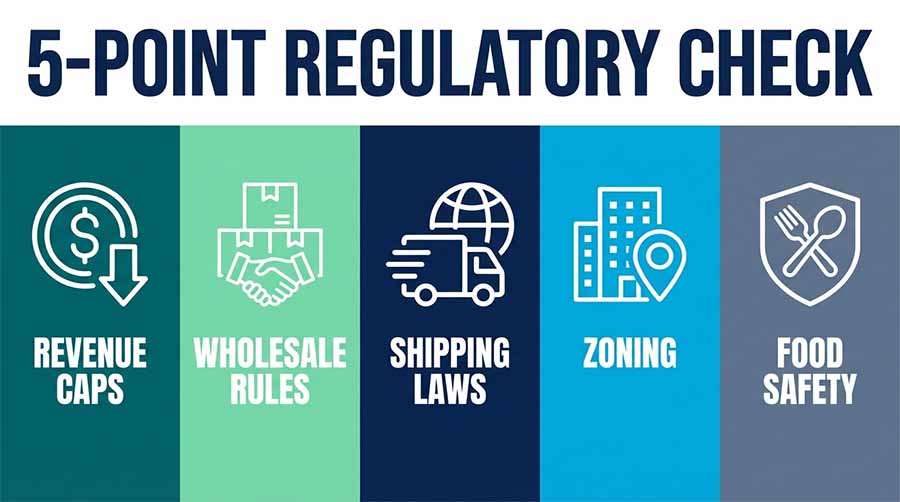
Verify These Five Things Before You Commit
- Revenue caps: Does your state limit annual cottage food sales?
- Wholesale restrictions: Can you legally sell to cafes or stores from home?
- Online sales: Are you allowed to ship across state lines?
- Zoning compliance: Does your residential area permit commercial food production?
- Food safety training: Do you need ServSafe certification to operate commercially?
Check official cottage food resources for your state. Don't trust Facebook groups or Reddit advice. One compliance mistake shuts down your business.
Your 30 Day Action Plan
Stop researching. Start testing.
Week 1: Run Your Real Numbers
- Calculate your true cost per unit for your top three items (ingredients, labor time at actual hourly rate, overhead allocation, packaging)
- Add 20% cushion for waste and mistakes
- Determine what each model would cost monthly (shared kitchen hours needed, lease payment, or wholesale margin hit)
Week 2: Tour Three Facilities
- Book tours at shared kitchens in your area
- Ask about scheduling conflicts during your preferred hours
- Check storage policies, equipment availability, and cleaning requirements
- Talk to current users about hidden costs and friction points
Week 3: Test One Path
- Book a single shared kitchen session or reach out to one wholesale account
- Track every minute spent: drive time, setup, production, breakdown, cleanup
- Document real costs: rental fees, storage, gas, packaging, unexpected charges
- Calculate actual cost per unit including hidden time
Week 4: Rebuild Your Pricing
- Adjust prices based on new time and facility costs
- Verify your cottage food compliance status
- Decide whether to commit or test another path
- Set a date to scale or deliberately decide to stay home

When a Storefront Actually Makes Sense
Sometimes retail space is the right move. Just make sure it's driven by business logic, not ego.
A storefront makes sense if:
- Your brand requires customer-facing service and community presence
- You make fresh daily baked goods that don't ship well
- You've maxed out wholesale and shared kitchen options and still have demand
- Your numbers prove you can cover rent, utilities, and staff while maintaining profit
Make the decision based on data, not ego. Test the alternatives first. If they can't deliver what you need, then explore retail. But don't default to a lease just because it feels like the "real" way to scale.
You can scale without a storefront. Pick the path that matches your product economics, test it properly, and adjust when the numbers tell you to.
For more bakery insights, growth strategies, and food industry intelligence, explore the Plastic Container City blog.
Frequently Asked Questions
How do I scale my bakery business?
Start with shared commercial kitchens to test volume before committing to leases. Track your real costs per unit, test production in a rented facility for at least one month, then choose between shared kitchens, production leases, co-packing, or wholesale based on your product type and capital available.
What mistakes do startup bakeries make?
The biggest mistake is underpricing products when moving to shared kitchens. Bakers see "$25/hour rental" and drop prices, forgetting to factor in drive time, setup, breakdown, and storage costs. Second mistake: signing leases before testing demand at wholesale or shared kitchen scale. Third: choosing co-packers without understanding MOQs and payment terms. Always test small before committing to fixed overhead.
Why do small bakeries fail?
Cash flow kills more bakeries than bad products. Net 30 or net 60 wholesale terms force you to front costs for two months before getting paid. Shared kitchen scheduling conflicts waste hours. Production leases create fixed overhead whether you sell or not. Most failures happen when bakers scale before testing real costs and proving they can maintain margins under new models.
What is the most profitable bakery item to sell?
Custom cakes deliver 60% to 70% margins when priced correctly because labor and skill create value customers can't replicate. Cookies and bars scale better for wholesale since they ship well and tolerate storage. The most profitable item for YOUR bakery depends on your production efficiency, pricing strategy, and distribution model. Items that require minimal labor per unit while commanding premium prices win.
How do I expand my bakery business?
Test demand first, commit to infrastructure second. Start with shared kitchens to prove you can handle volume without capacity constraints. Track real costs per unit including hidden time. If margins hold at scale, either move to production-only leases for more control or pursue wholesale partnerships for predictable revenue. Co-packing works only if you have capital for 10,000+ lb MOQs. Avoid storefronts until you've maxed out lower-risk options and your numbers prove rent won't kill margins.
