
TL;DR: Cookie packaging for bakery orders is a four-part decision: format, size, count, and bulk storage. Choose between cellophane and hinged clamshells based on your cookie type and how orders are handled. Match your container interior to your cookie dimensions before placing a case order. Get the count format right from the start and stage pre-filled orders with a system. This guide walks through all four decisions in sequence.
Cookie packaging for bakery orders is the decision that separates an operator filling a full pickup table cleanly from one who repacks orders because the container was wrong. The cookie is not the problem. The container format, the count, and the staging plan usually are.
At Plastic Container City, we work with thousands of food professionals across the U.S., from cottage food operators running weekend markets to bakeries managing preorder windows that run weeks ahead. The cookie packaging questions we hear most often come down to four decisions: whether to use cellophane or a rigid clamshell, what size container fits the right count, how to store pre-filled orders before pickup, and when ordering a bulk case makes more economic sense than a smaller pack.
This guide answers all four with the details that actually help when your orders are already booked.
Which Cookie Packaging for Bakery Orders Works Best?
Direct Answer: Choose by handling, not habit. Cellophane suits individual wraps. Rigid clamshells suit multi-cookie orders and pickup staging.
The format question is the one operators most often answer by default rather than by decision. Cellophane is the common starting point because it is inexpensive and familiar. Clamshells feel more substantial. Neither is universally better. The right answer depends on your cookie type, your order format, and what happens between packaging and the moment the customer picks up the order.
For general U.S. food-contact packaging context, the FDA food packaging and food-contact materials page is a neutral reference. For cookie orders, the practical decision still comes down to cookie type, closure method, storage time, and handling risk.
When cellophane works well: Cellophane can be a practical format for individually wrapped cookies, grab-and-go single units, or orders where the customer is buying one or two cookies. It is lightweight and familiar, but it should be judged by closure method, cookie type, storage time, and handling risk. Test your own cookie in the chosen bag before using it for volume orders.
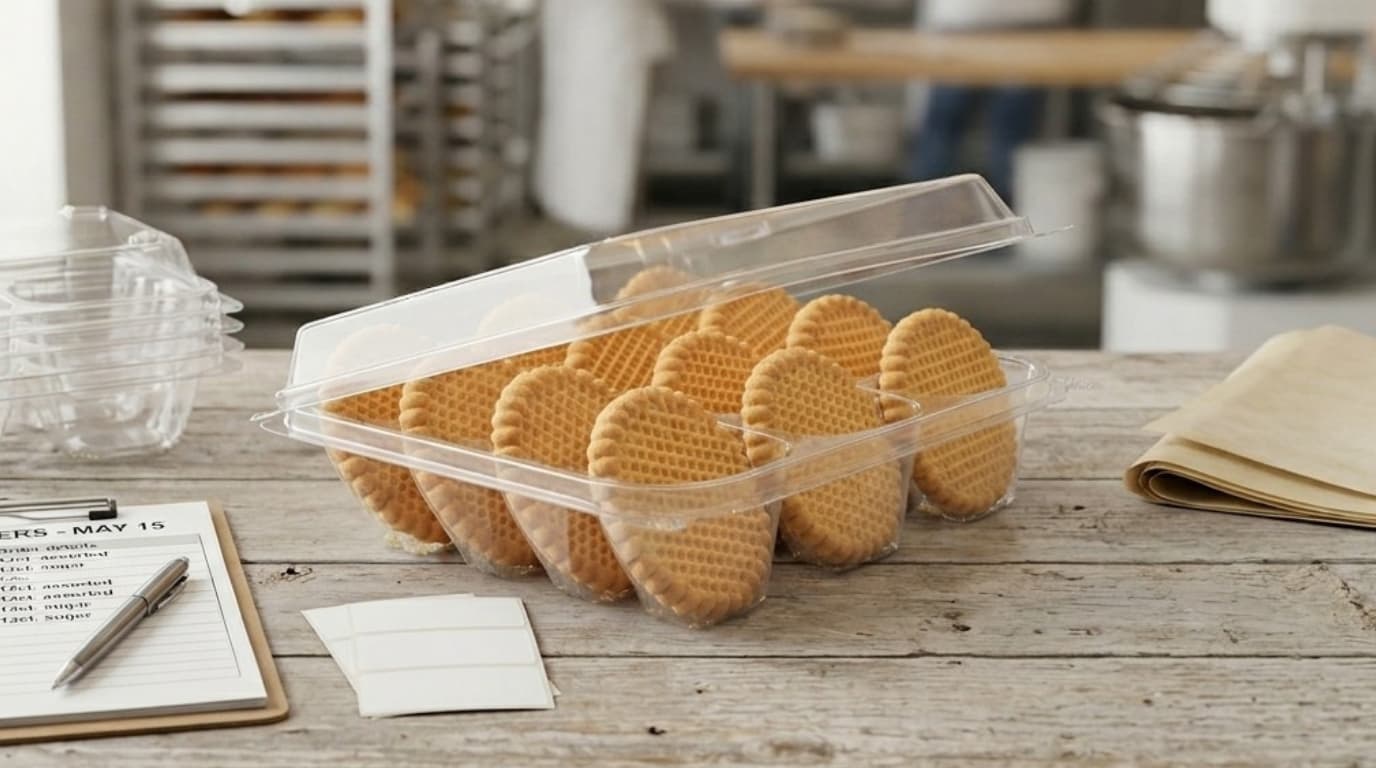
When a rigid hinged clamshell is the better call: Rigid hinged clamshells give multi-cookie orders more structure than a flexible bag. For bakery preorder fills where a dozen cookies need to travel from your kitchen to a customer's car without shifting, a rigid clamshell helps keep the arrangement intact. It stacks cleanly on a table during a pickup event. It presents as a finished product rather than a bagged item.
For volume orders of 6, 12, or more cookies, and for any situation where the filled container is stacked or handled multiple times before pickup, the rigid clamshell is the more reliable format.
Will Cookies Stay Fresh in Cellophane?
Direct Answer: Cellophane can work for short-term individual wrapping. For bulk orders, choose by cookie type, closure method, storage time, and handling risk.
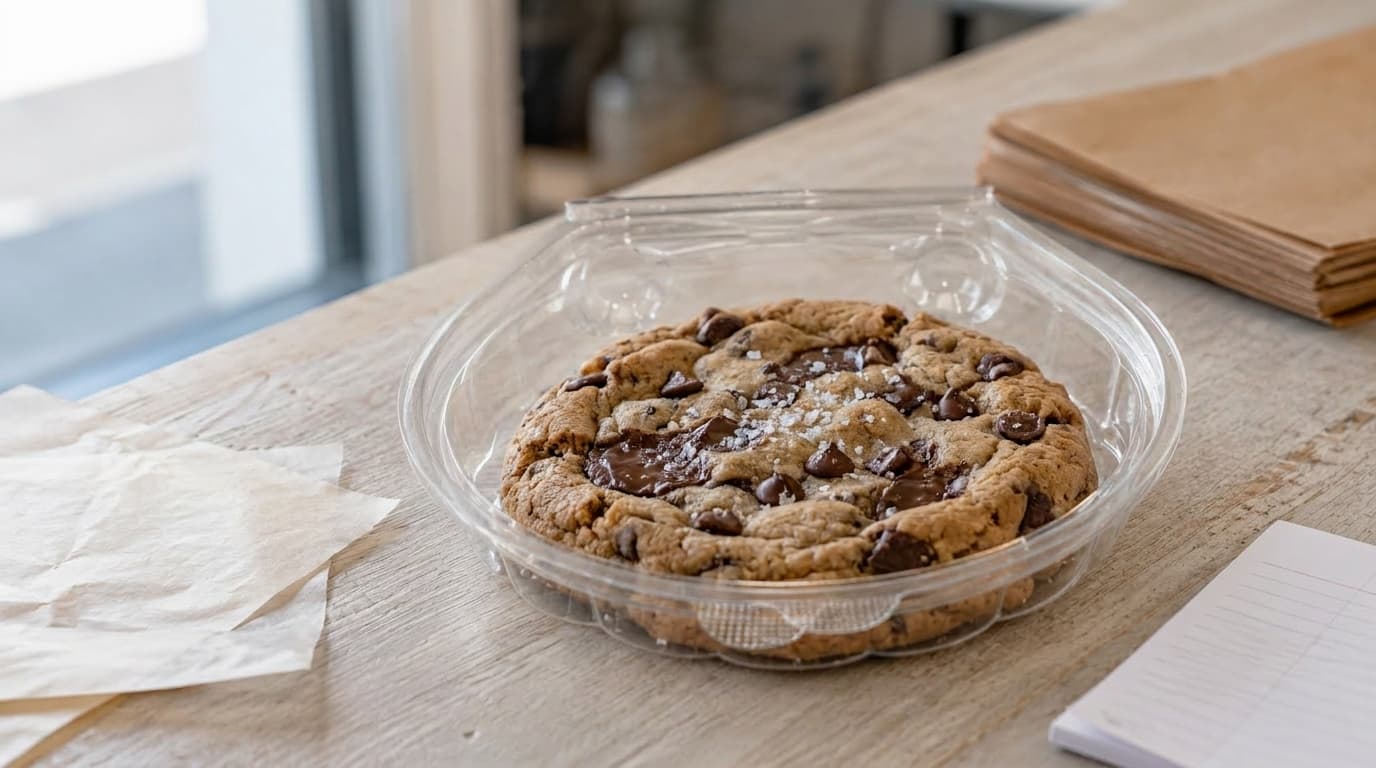
Cellophane looks like it seals, but its performance depends on how it is closed. A heat-sealed cellophane bag creates a tighter closure than one that is twisted and tied. For same-day pickup orders, a properly sealed cellophane bag can work when your own cookie test confirms the texture and finish still hold. For orders that need to sit overnight or carry coatings and delicate surface finishes, the softer seal and reduced structural protection mean the container choice needs more thought.
If your orders are picked up the same day they are filled, cellophane can work when your closure method and cookie type pass your own test. If they need to sit longer, the closure method and cookie type matter more than the bag material alone. For a deeper look at how packaging choices affect product quality between filling and pickup, see the Bakery Packaging Freshness guide on the Plastic Container City blog.
What Is the Downside of Cellophane Cookie Packaging?
Direct Answer: Cellophane has less structure than a rigid clamshell, so it is weaker for multi-cookie orders, stacked staging, and busy pickup tables.
For individual cookies, cellophane's flexibility is not a problem. For a dozen cookies packed together, that same flexibility becomes a handling risk. A filled cellophane bag does not hold its shape once placed on a surface. It does not stack cleanly like a rigid container, so cookies can shift during staging. At a high-volume pickup event where dozens of orders are staged on a table, bags that collapse slow the pickup process and undermine the presentation.
This is where the format choice becomes operational. If your order volume is high and your handoff time is short, a rigid container does the staging work a bag cannot. Switching from cellophane to a hinged clamshell is not about upgrading for appearance. It is about matching the container format to the actual conditions of your order pickup.
What Size Cookie Box Holds 12 Cookies?
Direct Answer: A 12-count cookie container must match your cookie diameter, height, and layout. Measure the inside fit before ordering a case.
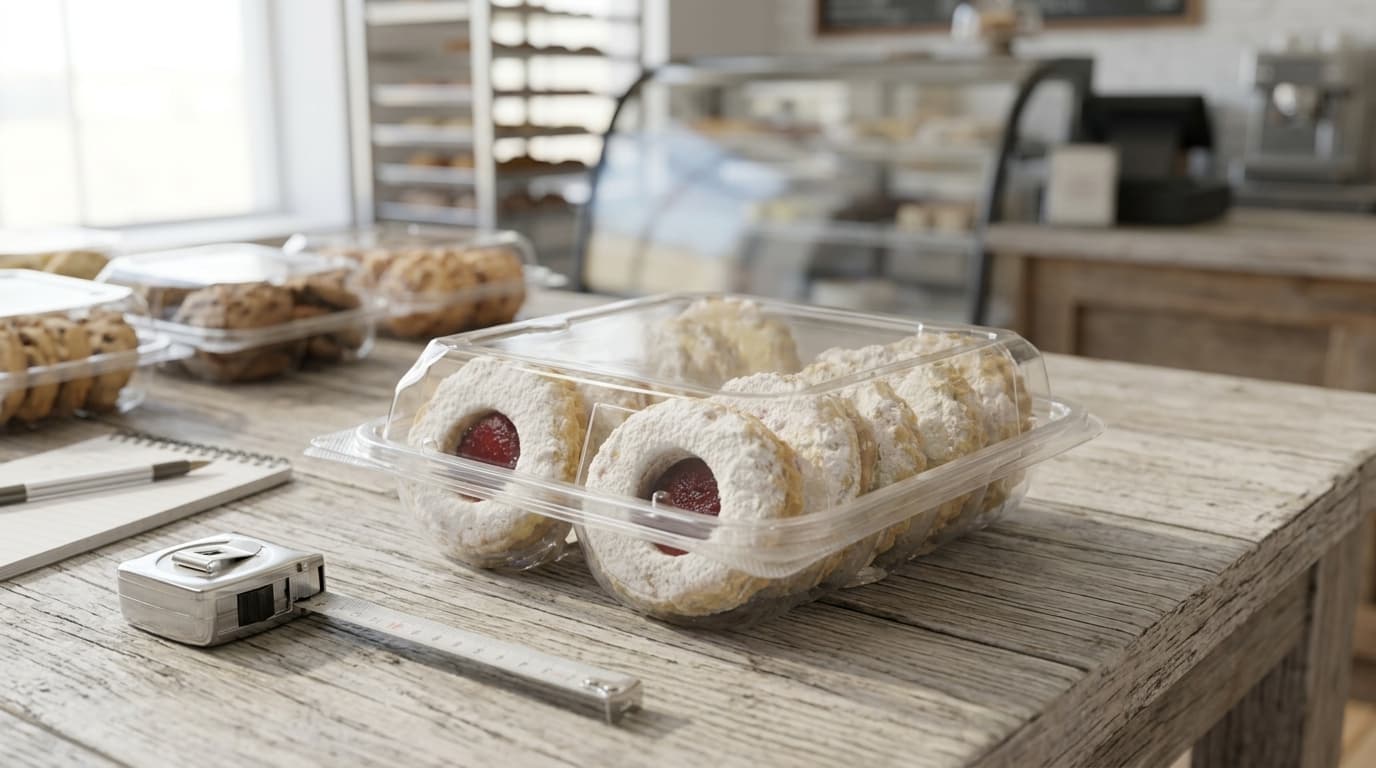
There is no universal 12-count box size because bakery cookies range from under 2 inches across for a mini format up to 4 inches for an oversized bakery-style cookie. The only measurement that matters is the interior dimension of the container checked against the diameter and height of that cookie. A container that works for a 2.5-inch drop cookie may not close cleanly on a 4-inch bakery-style cookie, even if both are described as holding a dozen.
| Cookie Type | Approximate Diameter | Before Ordering a Case |
|---|---|---|
| Mini or bite-size | 1.5 to 2 inches | Confirm the actual cavity layout and interior dimensions for your cookie and count |
| Standard drop cookie | 2.5 to 3 inches | Confirm the actual cavity layout and interior dimensions before ordering a case |
| Bakery-style oversized | 3.5 to 4 inches | Confirm interior dimensions against your actual cookie size; larger cookies need more interior width |
Before ordering a case, fill one test container with your actual cookies. If the lid closes without pressure and the cookies sit flat without touching the sides, the container interior fits your product. Plastic Container City carries relevant options including the 3 Dozen Cookie Container for larger-volume per-order counts and clear hinged clamshells for lower per-order counts. Check the interior dimensions on the product page against your measured cookie size before committing to a case.
How Should Bakeries Store Bulk Cookie Orders?
Direct Answer: Store pre-filled cookie containers by order, away from heat, and stack only as high as your filled test container allows.
Pre-filling dozens of cookie orders for a Saturday pickup sounds manageable until the staging reality arrives. The gap between having filled containers and having organized, accessible, correctly labeled orders is where most operators lose time, often on their busiest morning.
A few rules that hold consistently for volume staging:
- Test your stack height with a filled container before setting up staging. If lids flex, cookies press against the lid, or bottom containers show pressure, the stack is too high.
- Keep filled orders away from heat and temperature swings so cookie texture, label condition, and container fit stay consistent.
- Sort by order name or order number before the pickup window opens. Searching through identical containers while customers are waiting is a preventable problem.
- Keep your working stock of empty containers near the production area. Back stock stays in its case until needed.
For farmers market and pop-up sellers, the same logic applies in a smaller footprint. A tray or flat that holds pre-filled containers in a single organized layer is worth the extra minute of setup before the market opens.
When Should Bakeries Order Bulk Cookie Containers?
Direct Answer: Order a bulk case when projected volume, rush timing, storage space, and reorder speed all support the case quantity comfortably.
A full case can make sense when your order volume, storage space, and reorder schedule all point in the same direction. The question is whether your actual output and storage situation support the case quantity before you commit to it. It makes less sense when your volume sits well below the case count or your storage is already tight.
The formula in How to Calculate Bakery Packaging Case Quantities applies directly here: project your peak weekly units for cookie containers, multiply by the number of rush weeks you want to cover, add a 10 to 15 percent planning buffer when that matches your sales history and reorder speed, and match the result to the nearest case size your supplier carries. If the output sits comfortably within a full case, the bulk order makes sense. If it falls well below, a smaller pack avoids the storage pressure without cutting into your planning.
For the broader ordering window and seasonal planning picture, including when to place the order relative to your first pickup date, the full system is at How to Plan Your Bakery Packaging Before a Busy Season.
Get the format right and you stop repackaging. Get the size right and you stop reordering. Build the staging system once and your pickup window runs without the scramble. The operators who move through a busy season without a container gap made these decisions before the first order was booked, not after.
If you are also managing cake and pie preorders alongside cookie orders, the container sizing decisions are a different set of variables. The depth check for a meringue pie and the dome clearance for a layered cake each carry their own logic. The full checklist is at Cake and Pie Preorder Packaging Checklist. For more practical guidance on cookie packaging for bakery orders, visit the Plastic Container City blog.
Frequently Asked Questions
What size is a bakery-style cookie?
A standard bakery-style cookie is typically 3 to 4 inches in diameter, though sizes vary by recipe and portion weight. Mini cookies generally run 1.5 to 2 inches across. Always measure your actual cookie before selecting a container. The interior dimensions of the container determine the fit, not the external box size.
How do you pack cookies in cellophane?
Place the cookie flat inside the bag, press out excess air, and heat seal or tie the open end. For stacked cookies in a tube-style bag, layer with parchment between each cookie if the surface is delicate. Avoid overfilling. Pressure on the bag seam can cause it to open during handling, which is a problem no one catches until the order is already in the customer's hands.
How do you pack cookies for gifting?
For bakery gifting or branded pickup orders, choose a format that presents cleanly without extra assembly at the counter. A clear rigid clamshell pre-filled, closed, and labeled is faster to hand off than a bag that needs tying at pickup. For repeat gifting or branded pickup orders, the format needs to be consistent, easy to label, and quick to hand off. Keep it consistent and quick to hand off.
What is the perfect packaging for cookies?
The right container matches your cookie's dimensions, protects it through the handling it will actually face, and presents it the way your brand needs at the price your order volume supports. A clear rigid clamshell covers most B2B bakery order scenarios: it protects, it displays, and it stages cleanly. Cellophane is the better call for the individual-wrap use case. Neither is universally perfect for every format.
How to professionally package cookies?
Use containers that close cleanly, display the product without needing to be opened, and require no finishing work at the pickup window. A pre-filled, labeled, sealed container is the professional format. The label should include the product name, the count or weight, and any allergen or cottage food statement your state requires. For allergen-labeling context, the FDA food allergen labeling guidance explains requirements for declaring major food allergens on FDA-regulated foods. For home kitchens, check your state's cottage food labeling rules before your first order goes out; the National Agricultural Law Center cottage food law compilation shows that cottage food rules vary by state. Compliant labels are part of cookie packaging for bakery orders.