
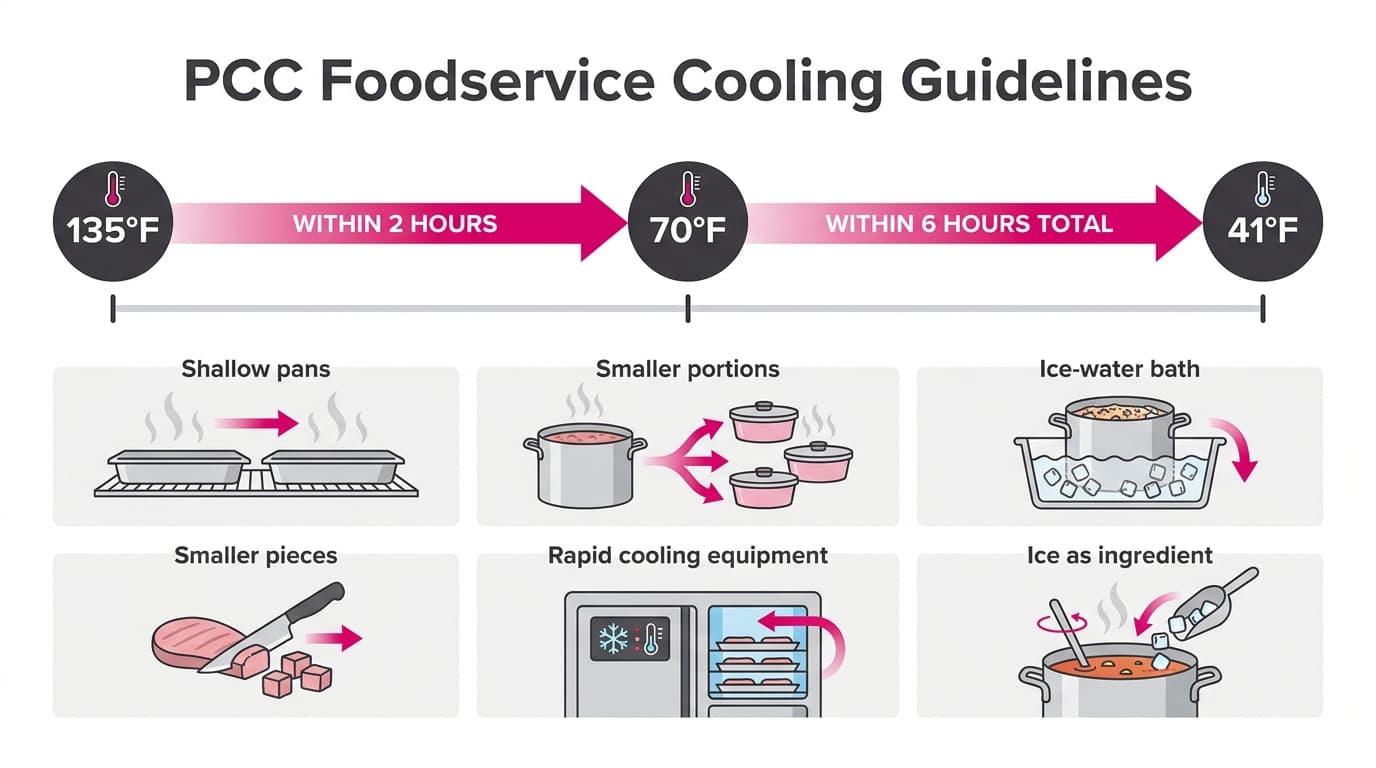
TL;DR: The safe methods to cool hot food quickly all work the same way: get cooked food from 135°F to 70°F within two hours, then to 41°F or lower within six hours total. Shallow pans, an ice water bath, smaller portions, and a blast chiller are among the approved ways to hit that window. Skip the "let it sit on the counter first" habit, and portion food into the right containers before it goes into the walk-in.
What are the safe methods to cool hot food quickly, and why does one stockpot of soup pass a health inspection while another fails on the same shift? The difference usually comes down to two numbers most kitchens have heard but few actually clock on a timer: 135°F to 70°F within two hours, then 41°F or lower within six hours total.
Home cooking advice says to just let food cool a bit before refrigerating. That works fine for a single dinner plate. It does not work for a 12 gallon stockpot of soup after a lunch rush, or a hotel pan of braised chicken left over from a catered event. Mass matters. A deep, covered pot traps heat at its center long after the surface feels cool to the touch, and that center is exactly where bacteria have the most time to multiply. This guide covers the two stage cooling rule, the methods that actually meet it, what to avoid, and how "portion it into smaller containers" turns into an actual container decision for your kitchen.
What Is the Correct Method for Cooling Hot Food?
Direct Answer: Cooked TCS food must cool from 135°F to 70°F within two hours, then reach 41°F or lower within six hours total, under the FDA Food Code's two stage cooling rule.
That two stage checkpoint, not a general sense of "cool enough," is what the FDA's Food Code cooling guidance sets out in section 3-501.14. TCS stands for time/temperature control for safety, the category that covers soups, stews, sauces, cooked rice, and most cooked proteins.
The Food Code is a model code, not one federal law that applies word for word in every state. Check your local regulatory authority for the exact version enforced in your kitchen. What holds steady almost everywhere is the underlying principle: food sitting in the temperature danger zone, generally 41°F to 135°F for foodservice, gives pathogens room to grow. The faster food moves through that range, the less risk it carries into service or storage.
What Is the 2-Hour/4-Hour Rule for Cooling Hot Food?
Direct Answer: The 2-hour/4-hour language usually points to Time as a Public Health Control, a separate system from the six hour cooling rule, where qualifying food is time marked and must be served or discarded within a set window.
This is where confusion tends to creep in, so it is worth separating the two. Cooling is Food Code §3-501.14: 135°F to 70°F in two hours, then 41°F or lower within six hours total.
Time as a Public Health Control, covered under §3-501.19, is a different tool. Under the standard four hour option, food generally starts at 41°F or lower, or 135°F or higher, gets time marked, and must be cooked, served, or discarded within four hours. A separate six hour option applies to qualifying cold food that starts at 41°F or lower and stays at or below 70°F for the period, with written procedures kept on hand for your regulatory authority. The National Restaurant Association confirms TPHC is a formal part of the 2022 Food Code, distinct from a general four hour grace period for any food sitting out. Do not treat the four hour TPHC window and the six hour cooling requirement as interchangeable. Mixing them up on a cooling log is an easy way to fail an inspection over paperwork rather than an actual food safety problem.
What Are the Safe Methods to Cool Hot Food Quickly?
Direct Answer: Divide food into shallow pans or smaller portions, use an ice water bath with stirring, cut large solid items into smaller pieces, or use a blast chiller. Each method works by increasing surface area or pulling heat away faster.
Every approved method uses the same principle: give heat more surface area to escape from, or draw it out faster with something colder.
Shallow pans and smaller portions cut the distance heat has to travel to reach the surface. Some health departments set a specific depth benchmark. Virginia public health guidance advises no more than about 2 inches when cooling, while Georgia's guidance allows up to 4 inches. The FDA Food Code sets no single national number, so pan depth is worth confirming with your local authority rather than assuming one figure applies everywhere.
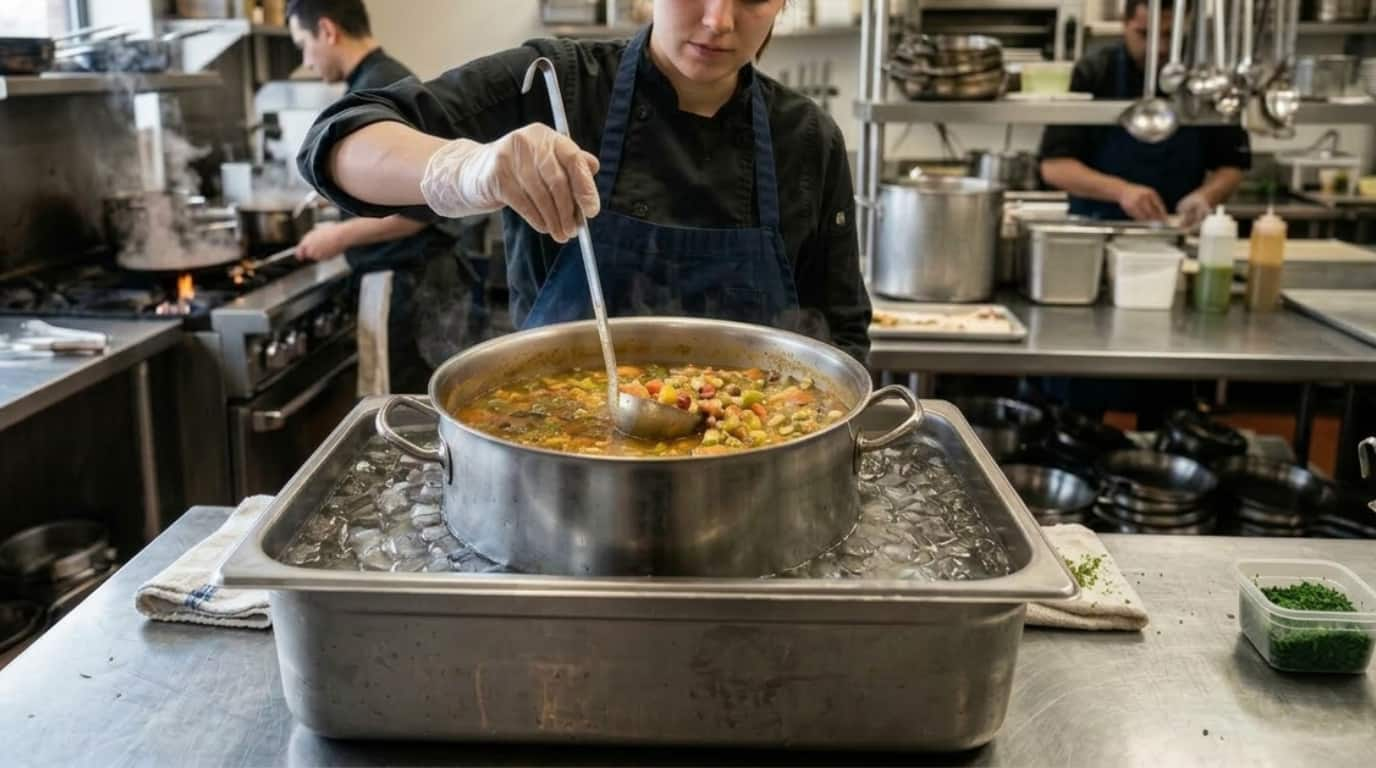
An ice water bath, stirred occasionally, pulls heat out through the sides and bottom of the container. Cutting large roasts or whole proteins into smaller pieces reduces the mass any single piece has to lose heat from. Adding ice directly as an ingredient, in a soup or stock, is another FDA recognized method. A blast chiller is one example of rapid cooling equipment used to help food meet the same cooling targets.
| Method | How It Works | Best For |
|---|---|---|
| Shallow pans or smaller portions | Increases surface area so heat escapes faster | Soups, sauces, braises, large batches |
| Ice water bath with stirring | Pulls heat out through the container walls | Stockpots, stews, liquid heavy batches |
| Cutting into smaller pieces | Reduces the mass any one piece must lose heat from | Roasts, whole proteins, dense solids |
| Blast chiller | Rapid-cooling equipment used to help food meet cooling targets | High volume kitchens, post-event batches |
| Adding ice as an ingredient | Dilutes and cools the food directly | Soups, stocks, thin sauces |
None of these methods require guesswork once you know which one fits the batch in front of you.
What Is Not a Recommended Method for Cooling Food Quickly?
Direct Answer: Covering food tightly, leaving it out to cool first, and cooling one large deep pot as a single mass all slow cooling past the safe window.
These are the three habits that quietly sink an otherwise careful kitchen.
- Covering hot food tightly. This traps steam and heat instead of letting either escape, working against every approved method above.
- Letting food "cool a bit" on a prep table first. This burns minutes you cannot get back inside the two hour window, and a busy shift makes it easy to lose track of exactly how many.
- Cooling one large, deep pot as a single mass. A large, deep container can make the six hour target harder to hit. The center of a deep pot can sit well above 41°F long after the edges have cooled, and a surface temperature check will not catch that.
None of these are dramatic mistakes. They are habits that cost time the clock does not give back.
What Happens If You Miss the Cooling Window?
Direct Answer: If food is still above 70°F after two hours or above 41°F after six hours, many health departments direct kitchens to reheat to 165°F for 15 seconds and restart cooling with a different method, or discard it.
Georgia's Department of Agriculture states that cooked food above 70°F at two hours or less into cooling, or above 41°F at six hours or less, can be reheated to 165°F for 15 seconds and cooled again using a different method. Past those time limits, the guidance is to discard it.
Corrective action steps vary by state, so treat this as one jurisdiction's example rather than a national script. The practical takeaway holds everywhere: follow your written food safety plan for what happens at each checkpoint, and do not guess when a log shows a batch ran over.
How Do You Portion Large Batches Into the Right Containers?
Direct Answer: Split hot food into containers shallow or small enough to cool within the checkpoint window, then confirm the container's actual measurements rather than assuming it meets a specific depth spec.
Portioning only works as a cooling method if the container you grab actually helps. A deep, narrow container defeats the purpose just as surely as one giant stockpot does.
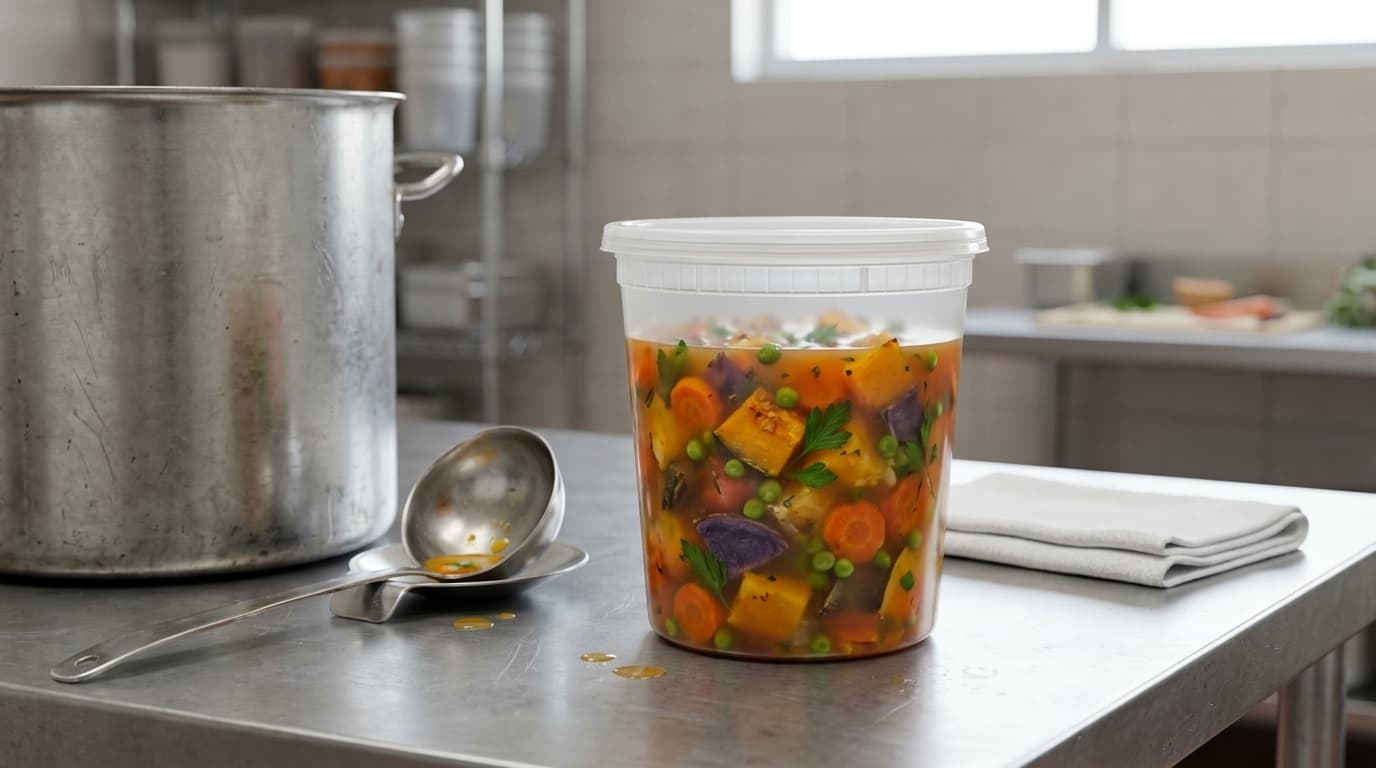
At Plastic Container City, we hear from caterers and commissary kitchens who need a fast way to portion a large batch right after service, without pulling out a ruler mid rush. Our 64 oz deli container measures 4 5/16 inches tall, and the 32 oz size measures 5 7/16 inches. Both sit in our take-out container range. Neither is a literal 2 inch shallow pan, so treat portioning into these as a faster cooling option through smaller volume, not a container built to meet a specific depth code. If your local health department requires a measured depth, confirm the exact figure against your own container before relying on it for compliance.
Where Should You Go From Here?
Direct Answer: Once cooling is handled, the next gaps are usually what goes wrong right after cooking and which containers to standardize on.
Cooling hot food correctly is one piece of a longer post-service routine. If your team is still working out what else tends to go wrong once the last plate leaves the kitchen, What Are Common Catering Mistakes to Avoid? covers the errors that show up most often after cooking, cooling included.
And once a cooling method is settled, the next practical question is usually which container to standardize on for service. How to Choose Takeout Containers for Your Restaurant walks through that decision.
For more food safety and packaging guidance for bakeries, restaurants, and catering teams, visit the Plastic Container City blog. Knowing how to cool hot food quickly and safely turns post-service cooling into a measured kitchen process instead of a guess.
Frequently Asked Questions
Can you put hot food into the fridge straight away?
Direct Answer: Yes. The FDA Food Code does not require food to cool on the counter first. Putting it directly into the refrigerator in shallow containers, arranged for airflow, is an accepted way to start the cooling clock.
The old habit of waiting for food to cool before refrigerating works against the checkpoints, not for them. Arrange containers loosely covered, or uncovered if protected from anything that could drip onto them, so cold air reaches the food from more than one side.
Why shouldn't you put hot food in the freezer?
Direct Answer: A freezer can be used to initiate rapid cooling in some jurisdictions. The food still has to meet the same cooling checkpoints, and large or deep containers can still cool too slowly.
Georgia's guidance, for example, lists the freezer as one rapid-cooling method. Whatever method you use, follow your local code and make sure cooked TCS food reaches 70°F within two hours and 41°F within six hours total.
What is the 2-2-4 rule for leftovers?
Direct Answer: The 2-2-4 rule is a memory aid: refrigerate within 2 hours, use containers about 2 inches deep, and eat leftovers within 4 days. It comes from university extension guidance, not the FDA Food Code.
It is a simple way to remember three habits: fridge within 2 hours, roughly 2 inch deep containers, leftovers used within 4 days. If you see the unrelated "2-2-2" shorthand mentioned elsewhere, that is a different rule with no connection to this one or to the §3-501.14 checkpoints above.
What is the ServSafe 4-hour rule for food safety?
Direct Answer: The four-hour rule generally refers to Time as a Public Health Control under FDA Food Code §3-501.19. It is separate from the six-hour cooling rule.
Under this option, qualifying food can be held without temperature control for a set period when the Food Code's starting conditions, time marking and disposal requirements are followed.
How long should soup cool before refrigerating?
Direct Answer: Soup should reach 70°F within two hours of leaving the heat, then 41°F or lower within six hours total, the same checkpoints that apply to any cooked TCS food.
A stockpot of soup is one of the slowest things in a kitchen to cool as a single mass, which makes it a strong candidate for the ice water bath or shallow pan methods above rather than a straight trip into the walk-in as is.