
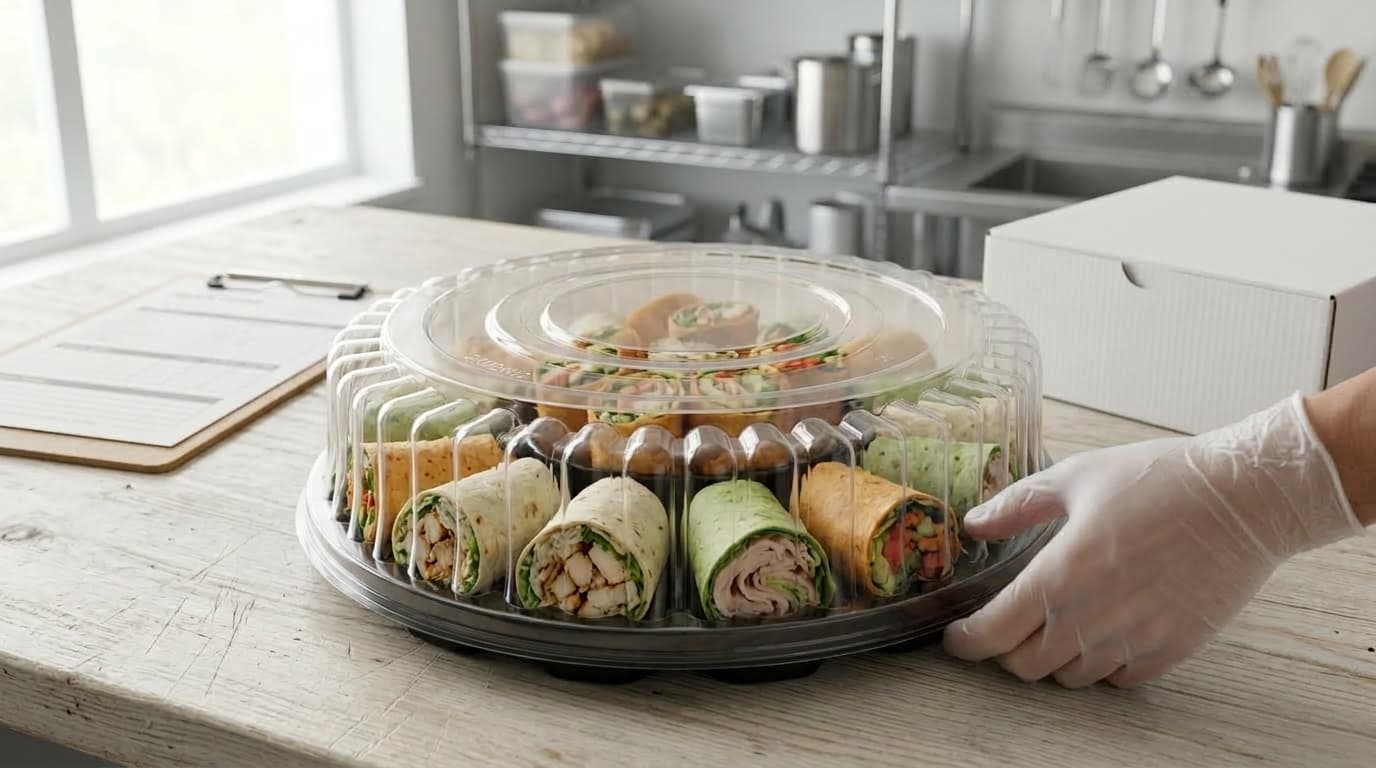
TL;DR: Calculating food quantities for catering starts with a real yield per item, not a universal per-person rule. Multiply that yield by your guest count, add a buffer based on your own job history, then size your tray and lid order to match. Skip the generic "one pound per person" math. It ignores how much a format actually holds.
How to calculate food quantities for catering is the question every operator asks the week before a big job, and most answer it the same way: a rough per-person number pulled from memory, then a hope that it holds. It usually doesn't. A guest count is not a food count, and a food count is not a tray count. Treating all three as one number is how a job runs short at guest ninety, or comes back from the venue half full and wasted.
The fix is not a bigger multiplier. It is a different starting point: the real yield of the dish in the format you are packing it in, which varies by menu item far more than any online calculator admits. Get that number right and the rest is arithmetic.
At Plastic Container City, we've packed orders for caterers and foodservice teams across the country for years, and the ones who stop guessing are the ones who stopped treating the food order and the packaging order as two separate decisions.
How to Calculate Food Quantities for Catering?
Direct Answer: Start from a documented yield per item and format, multiply by guest count, then add your own tested buffer before ordering food or packaging.
The method has four steps, and none of them needs a universal per-person rule:
- Get a real yield. Test the dish yourself in the tray or pan you will actually use, or pull the number from a menu source that states it. Never assume a size label (small, medium, large) means the same headcount across dishes.
- Multiply by guest count. Divide your guest count by that yield to get the number of trays or pans needed for that one item, then round up. A tray is never partially useful.
- Add a buffer you can defend. Not an industry percentage, one built from your own last few jobs (more on that below).
- Translate the total into a packaging order. The number of trays you need for food is the same number driving your tray and lid order, which is where most operators stop tracking and start guessing.
Run that sequence per dish, not once for the whole menu. A pasta salad and a fruit platter will never share a yield, even served from the same size tray.
Why Doesn't One "Food Per Person" Number Work for Catering?
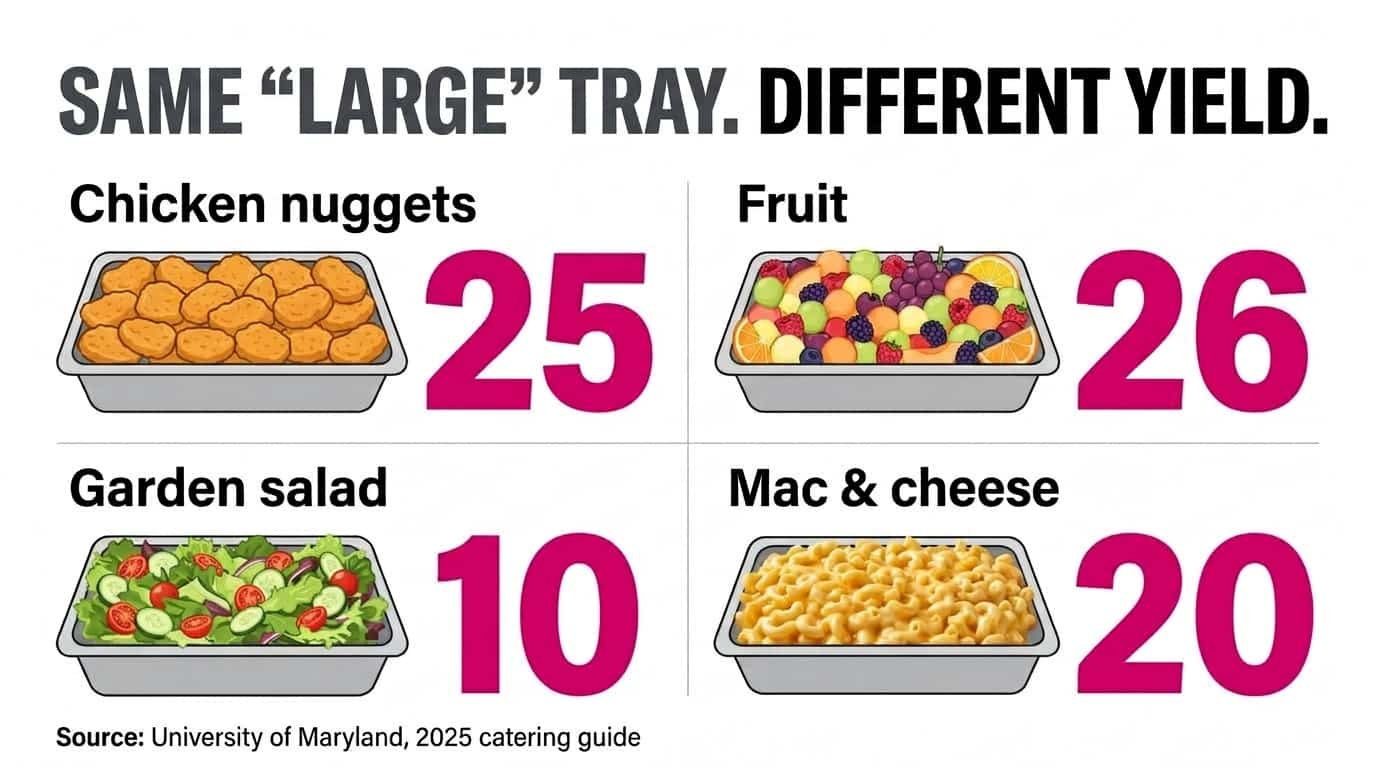
Direct Answer: No universal per-person number survives a real menu. One "large" tray serves 25 orders of nuggets, 26 of fruit, but only 10 of garden salad.
That comparison comes from the University of Maryland's own 2025 catering guide, where a "large" tray yields 25 servings of chicken nuggets, 26 of fruit, 10 of garden salad, and 20 of macaroni and cheese. Same label, same size tier, four different real numbers. A calculator that asks only "how many guests" and hands back one figure is guessing on your behalf. Those four yields make the point: the tray label alone does not tell you the serving count.
Individual serving weight tells the same story from a different angle. UMass Lowell's 2025-26 catering menu publishes item-level weights rather than one catering-wide rule: 3 oz for breakfast potatoes, 4 oz for scrambled eggs, 3.5 oz for garden salad, 4 oz for grilled lemon rosemary chicken, 5 oz for beef pot roast. The menu decides the number. The guest count only decides how many times you multiply it.
How Many Trays or Platters Do You Need, by Guest Count?
Direct Answer: There is no fixed answer. Guest count divided by one item's real yield, then rounded up, gives you the tray count for that dish.
Salisbury University's 2026-27 catering guide sizes its fresh cut-fruit bowls, and separately its Chicken Caesar Wrap platters, in the same three bands: 25, 50 and 75 servings, by tray size. Take that documented band and run the division against common guest counts, and the table below shows what the math looks like, not a rule you can skip the math with.
| Guest count | Trays needed at a 25-per-tray yield | Trays needed at a 50-per-tray yield |
|---|---|---|
| 20 | 1 | 1 |
| 25 | 1 | 1 |
| 40 | 2 | 1 |
| 50 | 2 | 1 |
| 60 | 3 | 2 |
| 100 | 4 | 2 |
Two things to notice. First, rounding always goes up, because a caterer does not sell three quarters of a tray. Second, the yield you plug in has to be your own, tested in your own format, for your own dish. Swap in a 10-per-tray yield, the number UMD's own garden salad actually pulled, and the same 100-guest job jumps from four trays to ten. The guest count barely moved the number. The dish did.
How Do You Build In a Buffer Without Over-Ordering?
Direct Answer: Skip borrowed buffer percentages. Track leftover and short-tray rates job to job, then base the buffer on your own records.
That's not a dodge. There simply isn't one industry number to hand you. Rosen Shingle Creek's 2025 banquet policy requires a final attendance guarantee 72 business hours out and says identical service is not assured beyond 5% over the guarantee for parties up to 500, or 3% for larger parties. That's a real number, but it's Rosen's own service tolerance for its own banquet operation, not evidence of a universal food buffer any caterer should copy.
Build your own version instead. After each job, note whether you ran short, ran even, or came back with full trays, and by how much. Over time, your own records will tell you more than a percentage borrowed from a blog ever could, because they reflect your menu, format and clients.
How Does Your Food Count Turn Into a Packaging Order?
Direct Answer: Count trays first, then check whether lids are included or sold separately before sizing the case quantity for the packaging order.
This is the step most quantity guides skip entirely, and it is where the arithmetic above actually pays off. Once you know a job needs four trays of one dish and two of another, that is not just a cooking plan, it is a packaging order. Your tray count is your lid count, but not automatically your case count: some formats sell the lid with the tray, some sell it separately, so check that before you order. For cold, single-compartment items like sandwiches, grazing boards and desserts, the take-out range covers the format. Anything that needs wet and dry kept apart needs a compartmentalized tray counted the same way, dish by dish, not guessed at checkout.
Buy in case quantities that match what the math above actually produced. A food count you calculated properly is wasted if the tray order underneath it is still a guess.
How Does Guest Count Math Change by Catering Style?
Direct Answer: There is no universal service-style multiplier. Use the same item-level yield method, then adjust it from your own job records.
Service style does not justify borrowing a fixed percentage. If your own records show that a dish consistently yields differently in one service format, build that experience into the number you use next time. The guest count still starts the calculation; the tested yield is what makes it useful. Which format you are running in the first place is a scope question, not a quantity one, and that scope is covered in the common catering mistakes guide.
Getting the quantity math right does not fix a menu that was never built for volume in the first place. What makes a good catering menu covers which dishes earn a place before you ever calculate how much of them to make.
Run the same four steps on every booked job, and calculating food quantities for catering stops being a guess you make once and hope holds. It becomes a number you can defend to a client, and an order you can defend to your supplier. There is more operator material in the Plastic Container City blog.
Frequently asked questions
How much food to cater for 60 guests?
Direct Answer: There's no single total. Run your own tested per-item yield against 60, the same division shown above, rather than trusting a generic calculator.
A generic calculator will hand you one number for 60 guests regardless of what you are serving. Use the method above instead: your dish's real yield, divided into 60, rounded up.
How to estimate how much food for a party?
Direct Answer: Estimate each dish from its documented or tested yield, apply that yield to the guest count, then round the tray quantity up.
Run the calculation separately for each menu item. One total for the whole menu hides the yield differences that actually decide how many trays you need.
How many full trays of food for 25 guests?
Direct Answer: It depends entirely on the dish's yield per tray. At a 25-per-tray yield that's one tray. At a 10-per-tray yield, it's three.
Check the table above for the pattern. The guest count stays fixed at 25. That's the whole trick to calculating food quantities for catering: the tray count moves with the dish, not the guest list.