
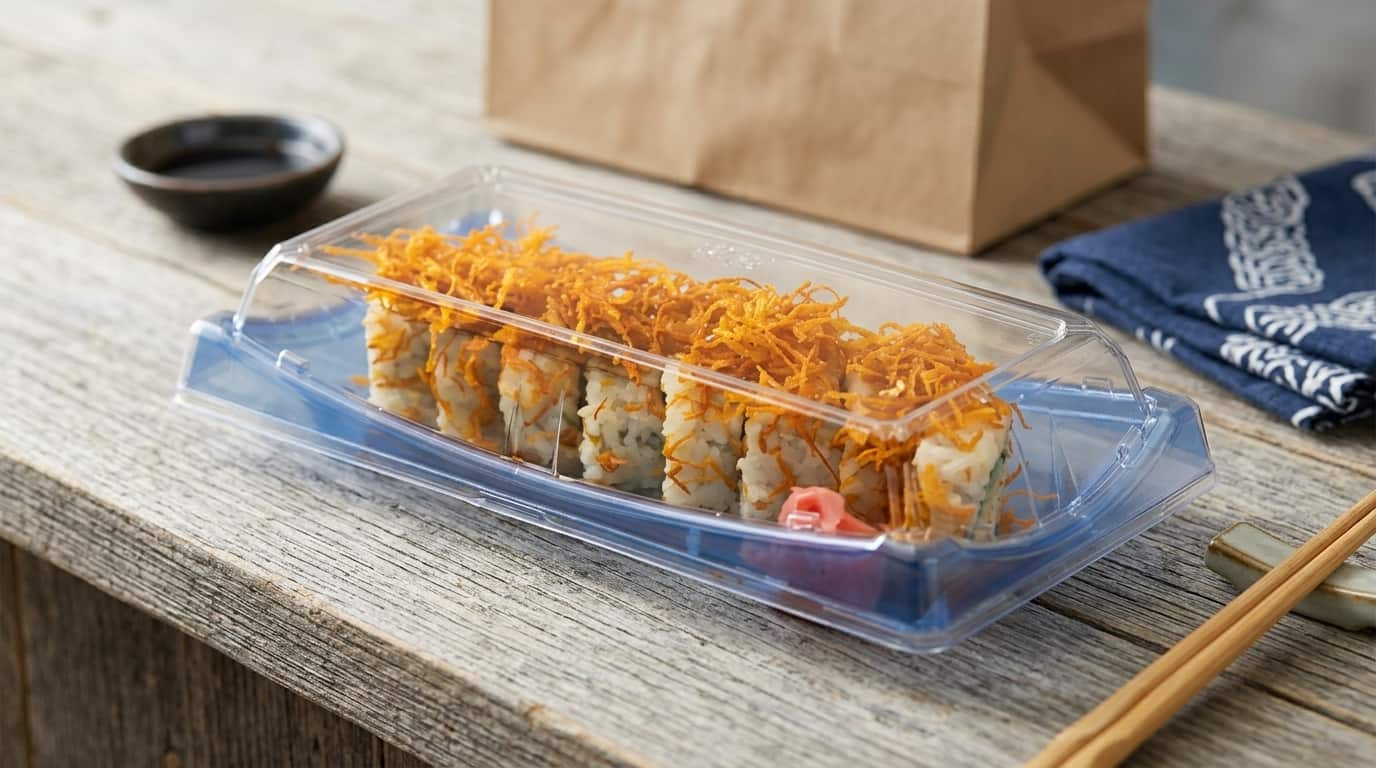
TL;DR: Choosing the right sushi takeout container for delivery comes down to checking the exact SKU's closure and listed stackability, confirming any microwave claim, and testing one packed order on your normal route. This guide walks through exactly what to check before you order a case, plus the food-safety basics that belong in the conversation.
Choosing a sushi takeout container for delivery starts with the exact SKU. Check the stated closure, whether stackability is listed, and how one finished order performs on your normal route.
The checks below cover product-page claims, packed-order testing, microwave labeling and cold holding without turning listed features into delivery guarantees.
If you're starting from scratch on sushi packaging generally, our Sushi Packaging Guide for Restaurants covers material, shape, and base style. This guide narrows in on one job: what matters once the box leaves your hands.
What Matters in a Sushi Takeout Container for Delivery?
Direct Answer: For delivery, check the exact SKU's closure, stackability and microwave labeling, then test one packed order on your normal route.
Delivery packaging gets judged at handoff, not at the pass. Check the finished order when you close the lid and again at handoff. The second check shows how the tray performed under the actual packing and route conditions. That gap is why the checklist for a delivery container looks different from the checklist for a dine-in tray. For dimension-by-dimension sizing and case quantities, see our Sushi Tray Size & Case Quantity Guide for Restaurants. This piece sticks to what holds up once the order is out the door.
Why Do Lid and Seal Security Matter for Sushi Delivery?
Direct Answer: Check the exact SKU for its stated lid and seal features. Do not treat snap-locking, spill protection or leak resistance as line-wide claims.
On Plastic Container City's sushi container and lid line, snap-locking lids and protection against odor contamination and spills are listed on certain SKUs, not as a blanket claim across every item in the category. That's a real concern when a sushi order shares a bag with garlic noodles or a leaking soup, but confirm it on the exact product page rather than assuming it carries over from one SKU to another. A listed closure feature is not the same as a leak-proof guarantee, and no supplier, ours included, should claim crush-resistance without testing behind it. If a sales page promises "leak-proof" with nothing to back it up, that's a question to ask, not a fact to assume.
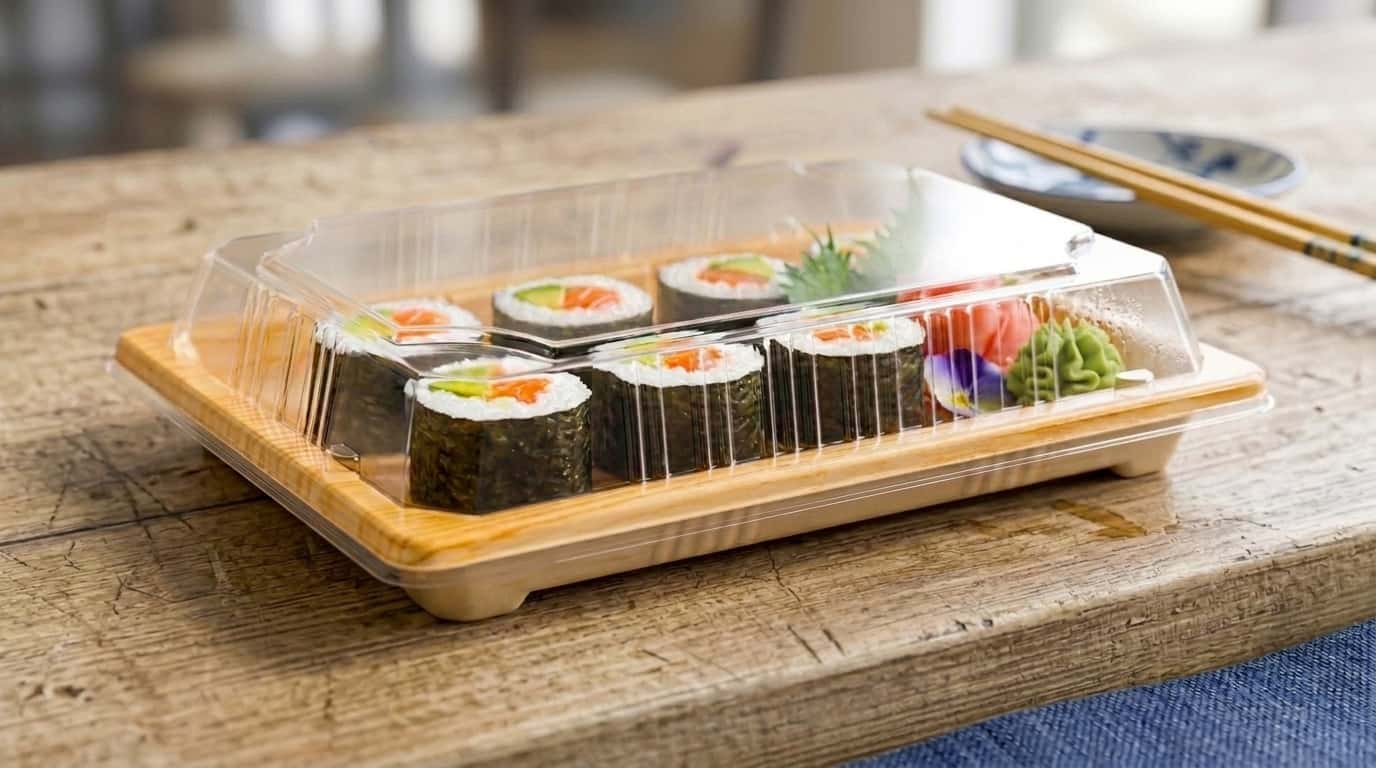
How Should Sushi Trays Stack for Delivery Bags?
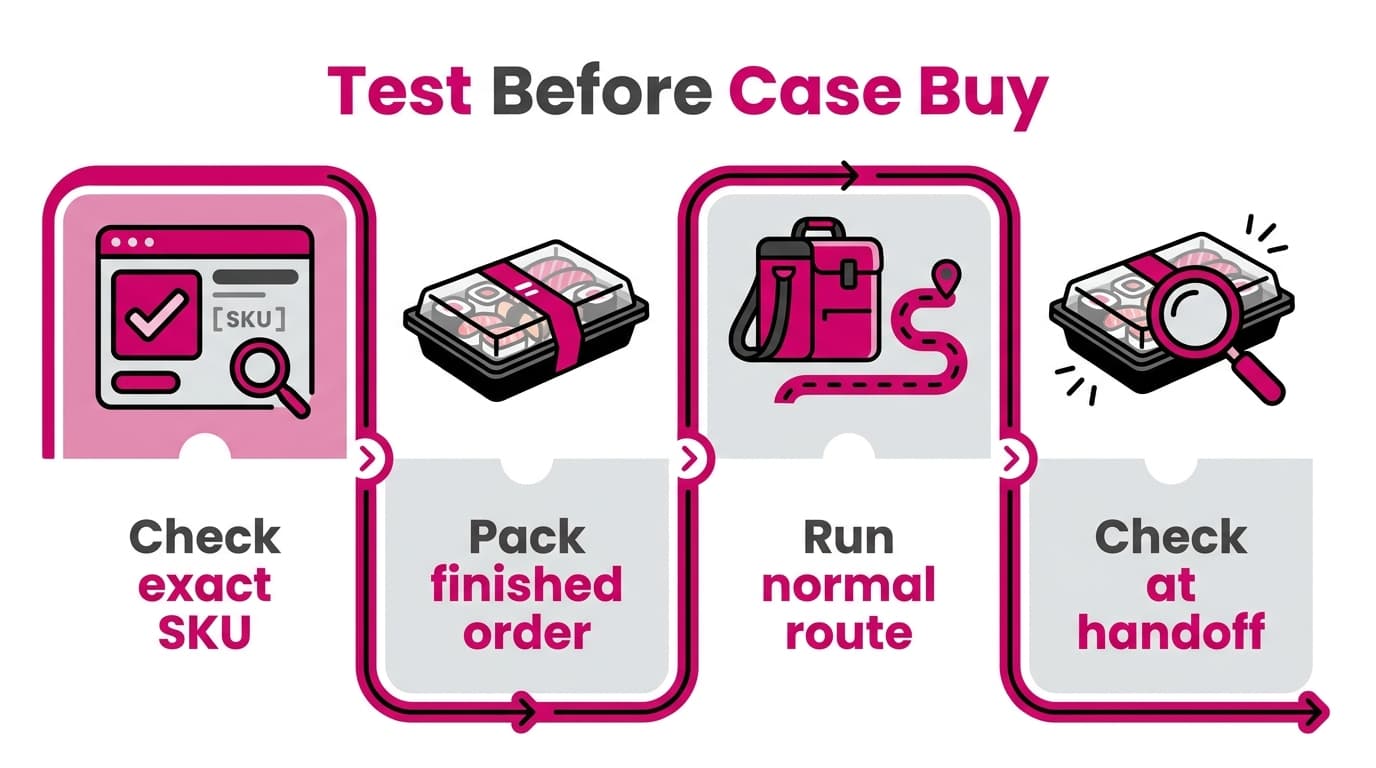
Direct Answer: A stackable listing does not prove packed-bag performance. Test one finished order on the normal delivery route before buying a case.
Check whether stackability is listed on the exact SKU's product page. Even when it is, a product listing cannot show how that tray will behave in your driver's bag or on your normal route. A useful check is simple: pack one finished order, close the lid, and run it through a normal delivery route before you commit to a case. Confirm closure, garnish clearance, and presentation at handoff. That test shows how the tray performs under your own packing and route conditions.
- Pack one full order the way your line normally would.
- Close the lid and check that it seats flush.
- Run it on the actual delivery route, not just across the kitchen.
- Check roll movement, garnish clearance, and presentation at handoff.
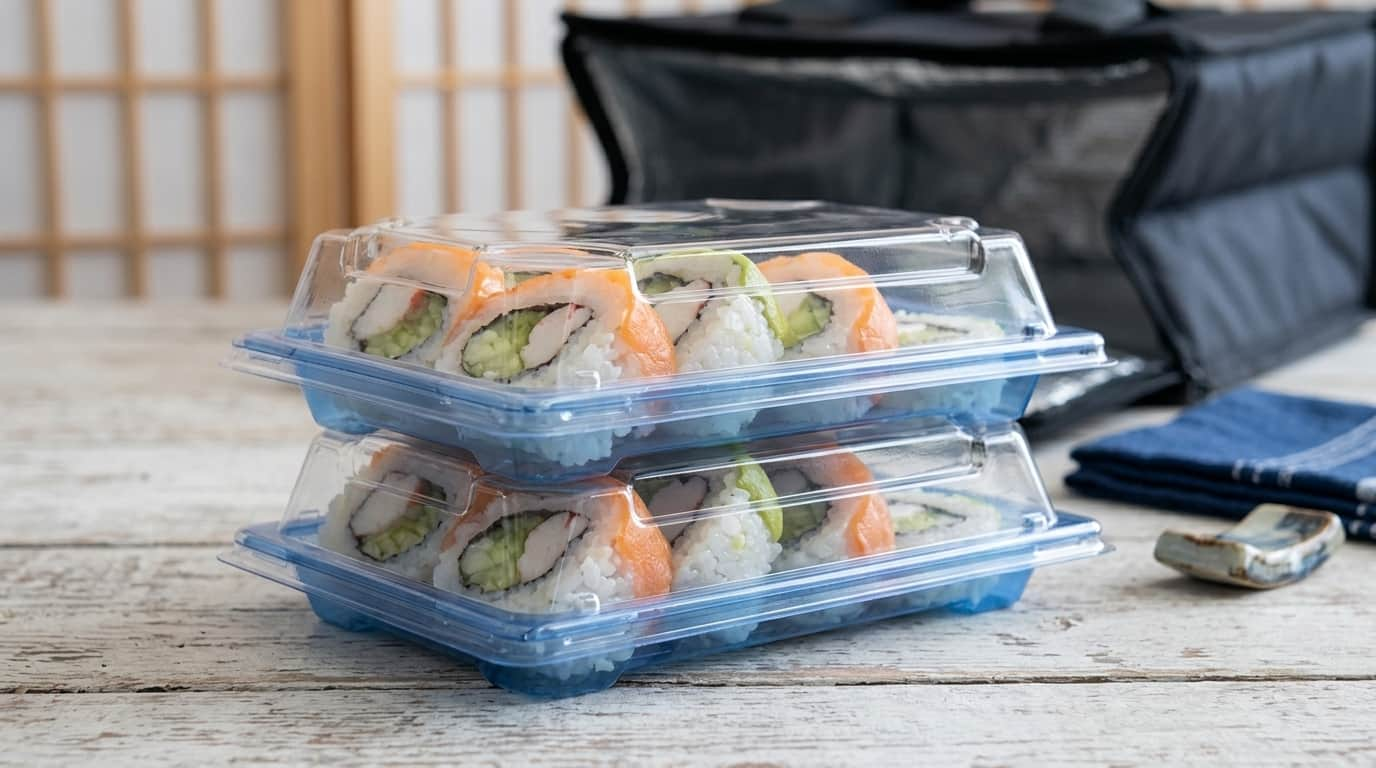
What Portion Cup Sizes Does PCC Offer?
Direct Answer: Plastic Container City offers 2 oz and 4 oz portion cups. Check the exact listing for lid style and seal details before ordering.
For more on matching cup size to order type, see our guide on portion cup sizes for restaurants.
Are Sushi Takeout Containers Microwave Safe?
Direct Answer: Do not microwave a sushi container unless the finished container is explicitly identified as microwave-safe by its manufacturer or supplier.
That's the standard set by USDA guidance on microwave-safe labeling, and it applies to sushi containers the same way it applies to any other takeout packaging. The absence of a microwave-safe label is not proof that a container is unsafe. It means microwave use has not been confirmed by the manufacturer or supplier, so do not assume it either way. Check the exact product listing before reheating anything in its original container.
What Temperature Should Delivery Sushi Maintain?
Direct Answer: Keep sushi that needs temperature control at 41°F or below unless your regulator permits a written time-control procedure.
That's the standard set by the FDA Food Code for time/temperature control for safety food. The Food Code is a model code, so local adoption controls what actually applies to your establishment, and some jurisdictions allow a written time-as-a-public-health-control procedure as an alternative to continuous cold holding. A sushi takeout container doesn't create that cold chain on its own. Insulated carriers and cooling media may support the process, but they do not prove that the required food temperature was maintained. Treat the container as one part of the system, and check your local health code and your own food-safety plan for the exact requirements that apply to you.
What Should a Sushi Delivery Checklist Include?
| What to Check | Why It Matters | What to Check Before Ordering |
|---|---|---|
| Snap-locking lid | A closure feature to check during the packed-order route test | Ask if the lid is snap-locking and confirmed on the product page |
| Odor and spill protection | Relevant when a sushi order shares a delivery bag with other food | Ask whether odor and spill protection is listed for the exact SKU |
| Stackable base | Relevant for packing multiple trays into one delivery bag | Confirm stackability is listed, then test it with a packed route run |
| Separate sauce portioning | Relevant for keeping sauce and rolls packed apart in transit | Ask about 2 oz / 4 oz portion cup availability |
| Microwave-safe labeling | Shows whether the manufacturer or supplier has confirmed microwave use | Check for an explicit microwave-safe label; don't assume either way if it's missing |
| Leak-proof or crush-resistant claims | A performance promise some suppliers advertise | Ask your supplier what testing backs the claim, if any |
How Long Can Sushi Takeout Sit Unrefrigerated?
Direct Answer: FDA consumer guidance says not to leave sushi unrefrigerated more than two hours, or one hour if it's above 90°F outside.
That timing comes directly from FDA guidance on serving fresh and frozen seafood safely. It is consumer-facing guidance rather than a commercial food-safety rule. For commercial handling, follow your establishment's food-safety plan and local health code.
Getting a sushi takeout container for delivery right isn't about chasing the fanciest tray on the page. Choose a sushi takeout container for delivery by matching the trip with features confirmed on the exact SKU, testing one packed order, and deciding whether it also needs separate sauce packaging. Treat any leak-proof or crush-resistant claim as a question worth asking your supplier, not a fact to assume off a product photo. Run the packed-route test before you commit to a case, and the right sushi takeout container for delivery becomes an easy call.