

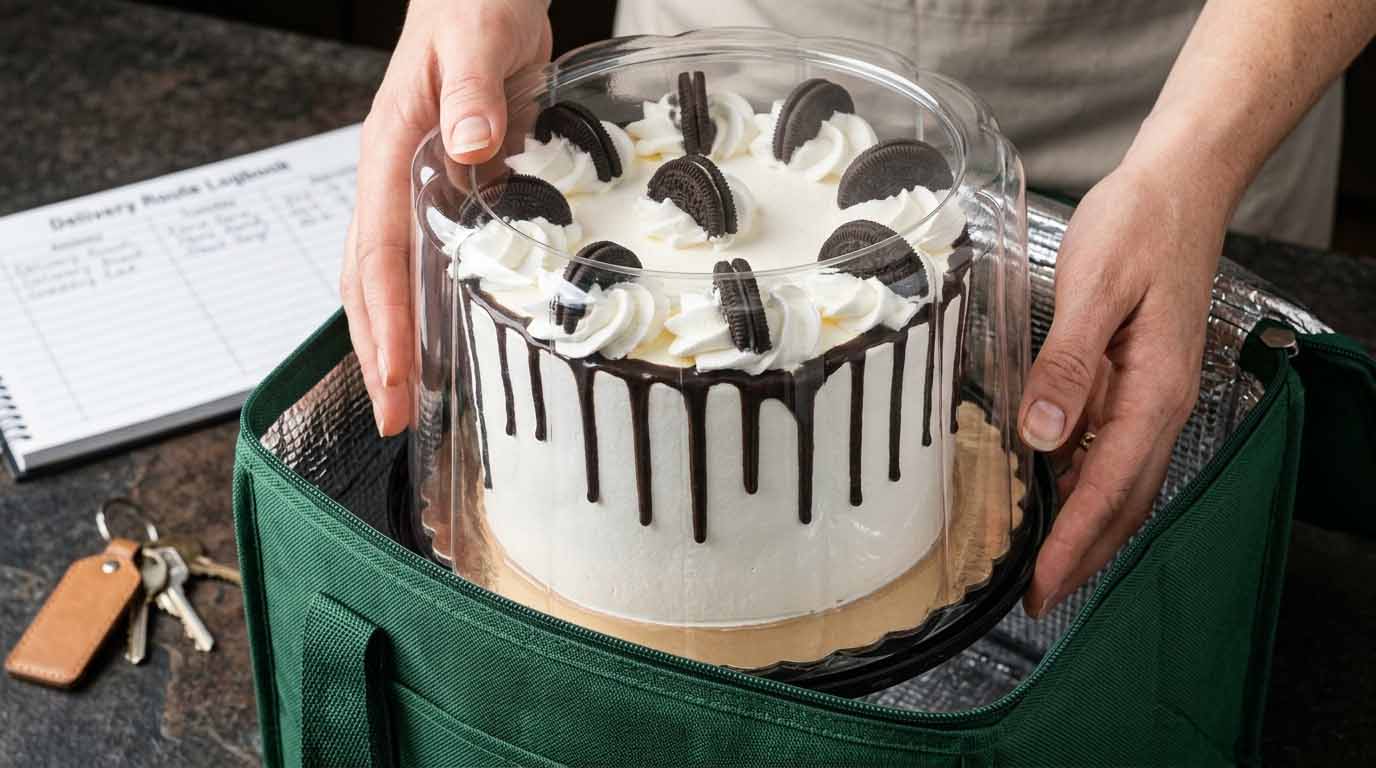
TL;DR: Your bakery delivery fee needs to cover gas, vehicle wear, your time, packaging, and a profit buffer, all calculated for a round trip. Most bakers undercharge because they use one-way mileage and forget packaging entirely. This post gives you the exact formula with real numbers, three pricing model options, a true-cost platform comparison for DoorDash and Uber Eats, and two ready-to-use scripts for communicating your fee with confidence.
Still guessing at your bakery delivery fee? That is the most expensive habit a baker can have.
Pricing delivery is not complicated once you know every cost involved. The problem is that most resources skip the hard parts: round-trip mileage, packaging, and the value of your time as a skilled professional. They hand you a vague "charge a dollar per mile" and leave you quietly absorbing the rest. This article gives you the real formula, with actual numbers, three fee models to choose from, and the math that makes delivery a profit center instead of a charity service.
At Plastic Container City, we supply packaging to food professionals across the U.S., from home bakers to event caterers, and the cost gap we see most often is not in ingredients or overhead. It is in delivery. Let us fix that.
What Goes Into a Bakery Delivery Fee?
Five cost components make up every delivery. Add them up, apply a 15 to 20 percent profit buffer, and you have your fee. Here is a worked example using a 10-mile delivery:
Round trip: 20 miles
| Cost Component | Calculation | Amount |
|---|---|---|
| Vehicle cost (compact SUV, AAA 2025) | 20 miles x 68.5¢/mile | $13.70 |
| Your time (45 min at $20/hr) | 0.75 hrs x $20 | $15.00 |
| Packaging (insulated bag + tamper-evident seal) | Per-order cost | $3.00 |
| Profit buffer (15%) | 15% of $31.70 | $4.76 |
| Total Delivery Fee | $36.46 |
Round that to $35 or $38 as a flat fee for deliveries under 12 miles. That is a defensible, margin-positive charge. The 2026 IRS standard mileage rate of 72.5 cents per mile is a reliable all-in vehicle cost benchmark for tax purposes. AAA's 2025 data breaks vehicle costs down by category, and a compact SUV clocks in at 68.5 cents per mile at 15,000 miles per year, which includes fuel, maintenance, and depreciation.
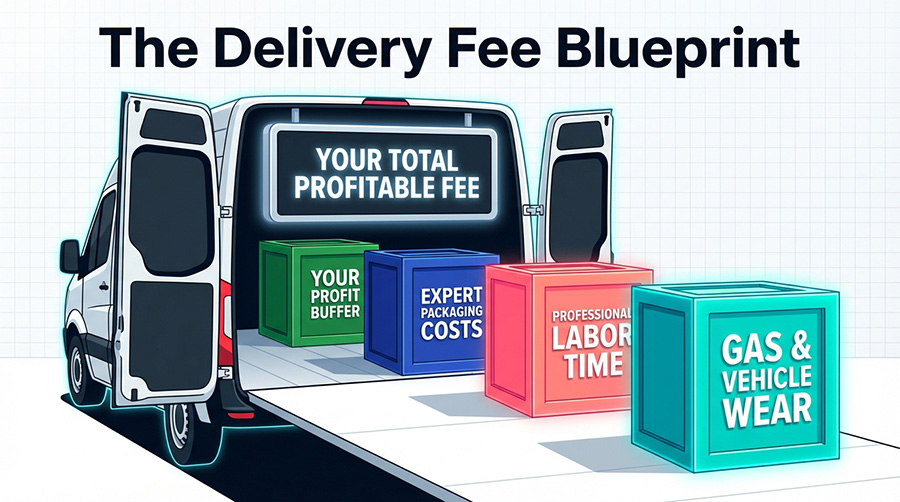
The Round-Trip Rule: The Number One Mistake Bakers Make
This one mistake costs bakers money on every single run. You calculate 10 miles to the customer, quote a $10 delivery fee, and then drive 10 miles home on your own dime. Over 50 deliveries a year, that is 500 uncompensated miles. At 68.5 cents per mile, you have silently given away $342.50.
Always double the mileage before you do any math. Every time, without exception. Write it on a sticky note above your order desk if you need to.
Which Delivery Fee Model Should You Use?
Flat Zone Fee
Set a flat rate per delivery zone. For example: $15 within 5 miles, $25 within 10 miles. Customers appreciate the predictability. Easy to post on a website or order form. Works best when your orders cluster in a consistent radius.
Per-Mile Rate
Charge $1.50 to $2.50 per round-trip mile. More transparent for long-distance orders and fairer when distances vary widely. It can surprise customers on larger orders, so it works better for caterers and food trucks than for retail-style bakeries.
Hybrid: Flat Rate Base Plus Per-Mile Charge
The model most experienced bakers land on. Charge a flat rate base fee of $15 for the first 8 miles, then $1.75 per additional mile beyond that. It protects your baseline margin on short runs while keeping long-distance fees fair and transparent.
What Is the Minimum Order That Makes Delivery Worth It?
Using the formula above, your delivery cost for a 10-mile round trip is roughly $36. If your product margin is 35 percent, the customer needs to spend at least $103 for their order alone to offset the cost of delivery. Add your delivery fee on top and you are protected.
If someone wants $40 in brownies delivered across town and you charge a $12 delivery fee, you are still behind. The math does not lie.
Practical recommendation: Set a minimum order value of $65 to $90 for any delivery. Adjust that figure based on your actual cost per run. Publish it clearly at checkout, not buried in the fine print.
Should You Offer Free Delivery?
Free delivery is never actually free. Someone pays for it. The question is whether your margin is wide enough and your order volumes high enough to absorb the cost without eroding your bottom line.
Here is the business case for taking it seriously: Baymard's research shows a 70.22 percent cart abandonment rate across online retail, with 39 percent of shoppers citing extra costs like delivery fees as the main reason they left. That is real friction. For a bakery doing a high volume of smaller local orders, absorbing the delivery cost above a spend threshold can make commercial sense.
For everyone else, the math usually does not work. Here is a quick decision framework:
| Scenario | Recommendation |
|---|---|
| Average order value above $150 | Free delivery can be viable, offered above a threshold |
| Average order value below $80 | Charge for delivery. The margin does not cover it. |
| Building a loyal local customer base | Consider free delivery above a minimum spend threshold |
| One-off or event orders | Always charge. These are your highest-cost deliveries. |
| Peak seasons (holidays, Valentine's Day) | Add a 10 to 20% seasonal surcharge. Demand supports it. |
The Break-Even Order Value
If your delivery cost is $36 and your product margin is 40 percent, the order value needs to reach $90 before you break even on a free-delivery offer. Set your free-delivery threshold at $95 or above to leave yourself room. Anything under that and you are paying to deliver.
Packaging Is a Cost Line, Not a Footnote
Insulated bags, tamper-evident containers, and reinforced cake boxes are real per-order expenses. They protect your product, represent your brand, and keep a $200 wedding cake looking like a $200 wedding cake at the door. Most bakers leave them out of the delivery formula entirely.
A quality insulated delivery bag runs $2 to $5 per use. A tamper-evident seal adds $0.50 to $1.50. A reinforced cake box can cost $3 or more. That is $5 to $9 added to every delivery before you turn the key.
We see this gap constantly at Plastic Container City. Bakers who price their products carefully are absorbing packaging costs the moment they add delivery to the equation. Name it as a line item in your formula and charge for it. For practical guidance on what packaging works best for delivery runs, the Bake, Pack, Deliver guide covers the options in detail. You might also want to see why bad bakery packaging costs you more than you think.
Your Business Type Changes the Numbers
One formula, five different cost structures. Here is a fast-scan guide for each business type:
Home baker: Your personal vehicle is doing the work. Use the IRS standard mileage rate (72.5 cents per mile for 2026) to protect yourself on tax deductions and as a clean vehicle cost proxy. Set a firm minimum order and a clear delivery radius before your first run.
Cottage food baker: Delivery rights vary by state. Some states allow direct delivery to customers; others require in-person sales only. A few restrict third-party platform use for cottage food entirely. Verify your state rules before quoting delivery to anyone.
Cafe or bakery storefront: You likely have a staff member available for local runs. Factor in their full hourly rate, not just the vehicle cost. The delivery window cuts into your in-store production time, which has its own value.
Food truck: Your delivery model is event-based and distances vary widely. A per-mile rate, not a flat fee, gives you better protection across different job sizes.
Caterer: High order values justify higher fees and the hybrid model. Build delivery and setup as separate named line items in every quote. Bundling them into a single figure makes it harder to justify either.
Self-Delivery vs. DoorDash vs. Uber Eats: What Do You Actually Keep?
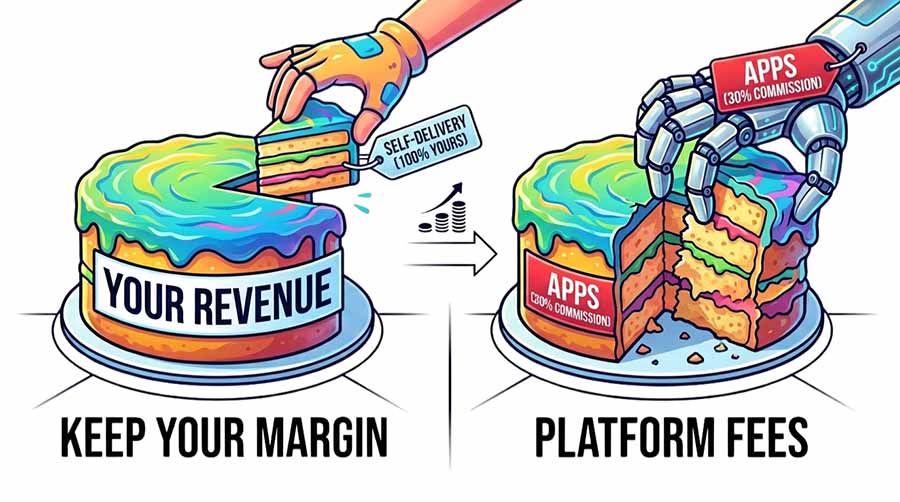
Commission structures updated in late 2025 and early 2026. Here is what both platforms currently charge marketplace sellers:
| Platform | Plan | Delivery Commission | You Keep (on $100 order) |
|---|---|---|---|
| DoorDash | Basic | 15% | $85 |
| DoorDash | Plus | 25% | $75 |
| DoorDash | Premier | 30% | $70 |
| Uber Eats | Lite | 20% | $80 |
| Uber Eats | Plus | 25% | $75 |
| Uber Eats | Premium | 30% | $70 |
| Self-Delivery | Your own fee model | 0% | $100 + your delivery fee |
DoorDash commission data: updated November 2025. Uber Eats marketplace fees effective March 11, 2026.
On a $100 order, the math nearly always favors self-delivery for an established local bakery. Platforms make sense when you need new customer discovery or cannot staff delivery yourself. The trade-off goes beyond commission rates: marketplace orders give you very limited customer contact information, while direct orders let you own the relationship, the email address, and the full order history.
Can Cottage Food Bakers Deliver?
Cottage food laws differ by state in ways that matter for delivery. Some states permit direct delivery to the customer's door. Others require all sales to happen in person, which means delivery as most people understand it is not available at all. A handful of states also restrict which products can be sold under cottage food rules, regardless of how they are delivered.
Do not guess. The Institute for Justice homemade food resource maintains state-by-state summaries, updated into late 2025. If you run a cottage food bakery, confirm your state rules before you promise delivery to anyone. The legal risk is real and not worth skipping a quick check.
How Do You Tell Customers About Your Delivery Fee?
Customers do not object to fees that are explained. They object to surprises. A clearly stated delivery policy, posted before checkout, converts better than a vague "delivery available" note that leaves the price invisible until the last screen.
Here are two scripts you can copy directly onto your website or order form:
"Delivery is available within a 15-mile radius of our bakery. Our delivery fee is $35 for orders up to $100, and $20 for orders over $100. A minimum order of $65 applies for all deliveries. This fee covers our round-trip travel, packaging, and the care taken to get your order to you safely and on time."
"For event and wedding deliveries, our delivery fee is calculated based on distance and order requirements. We confirm your fee in writing at the time of booking. This covers professional packaging, travel time, and safe setup on arrival. Fees start at $50 and are quoted individually for deliveries over 15 miles."
Use plain language. State the fee, explain what it covers, and include the minimum order. A customer who pushes back on a clearly published fee is usually a customer whose order was not going to be profitable anyway.
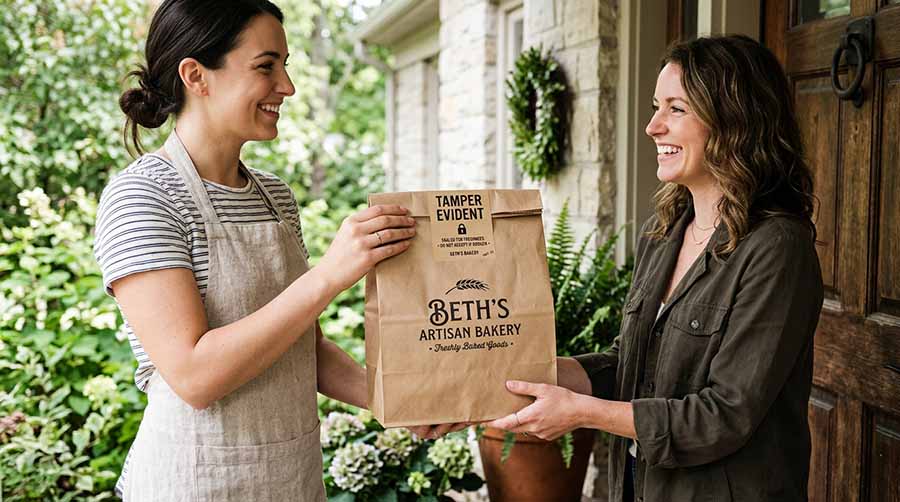
Price It Like the Professional You Are
Pricing your bakery delivery fee is not about what feels comfortable to charge. It is about knowing what every run actually costs you and building that into a fee that keeps your business running. Use the formula. Apply the round-trip rule on every single order. Choose the fee model that fits your business type, and if you use a delivery platform, go in with a clear picture of what you actually net per order.
Visit the Plastic Container City blog for more tools on mastering your bakery delivery fee, packaging costs, and overall profitability.
FAQs
What is a reasonable delivery fee?
A reasonable bakery delivery fee falls between $15 and $45 depending on distance, order size, and your real per-run cost. For a 10-mile round trip with packaging included, most small bakeries land between $28 and $40. Anything below $20 for a full delivery run should be questioned against your actual costs.
What is a good delivery rate per mile?
A per-mile rate of $1.50 to $2.50 per round-trip mile is a common range for bakery deliveries. The 2026 IRS mileage rate of 72.5 cents per mile is your vehicle cost baseline for tax deduction purposes, not your customer charge. Your charge to the customer needs to cover vehicle costs, your time, and a profit buffer on top.
How do I calculate a delivery charge?
Use this formula: (vehicle cost per mile x round-trip miles) + (hourly rate x delivery time in hours) + packaging cost + 15 to 20 percent profit buffer. That total is your minimum delivery charge. Round up to the nearest clean number for simplicity.
Should I offer free delivery?
Only if the math supports it. Calculate your break-even order value (delivery cost divided by your product margin). Offer free delivery only above that threshold. Below it, you pay to deliver, which is not a sustainable business decision for most small bakeries.
Can I write off delivery expenses as a bakery business?
Yes. The IRS allows bakery owners to deduct business vehicle expenses using the standard mileage method or the actual expense method. Keep a mileage log for every delivery run. Report on Schedule C using IRS Topic 510 guidance. Consult a tax professional for your specific circumstances.
