
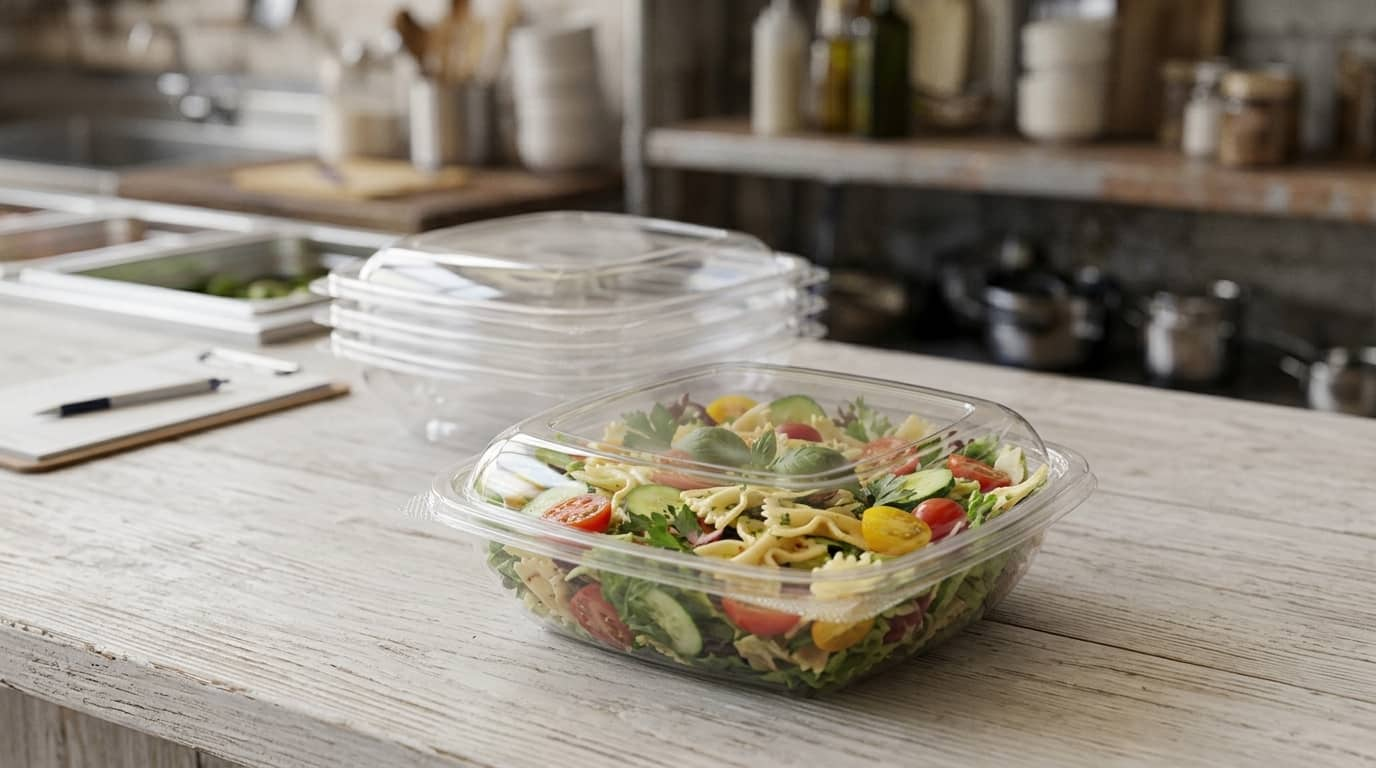
TL;DR: A reorder point is the stock level that tells you to place your next packaging order. Work it out as average daily usage across your replenishment lead time, plus safety stock. Then convert that raw number into whole cases, because cases are how most packaging is sold. Set one trigger per SKU, round it up, and revisit it before a known busy stretch.
Most operators learn how to set reorder points for takeout containers the hard way. It is Friday night, delivery tickets are stacking up, and the shelf where the 9 inch clamshells live is empty. Someone gets sent to a cash and carry to pay retail for whatever is on the shelf, or the kitchen packs a saucy entree in a container built for a salad.
The trigger you were using was "that shelf looks thin." That is not a trigger. It is a guess that happens to work most of the time.
A reorder point replaces the guess with a number. Stock drops to that number, you place the order. The math takes about two minutes per item once you know your usage.
Here is the part almost every article on this subject skips. The formula gives you a raw unit count. Nobody has a 550 button on the order form. Where a SKU ships by the case, you buy whole cases. At Plastic Container City, we work with thousands of food professionals across the U.S., and that gap between the calculated number and the case on the pallet is where most reorder points quietly stop being used.
What Is the Formula for Reorder Point in EOQ?
Direct Answer: Reorder point equals average daily usage times replenishment lead time, plus safety stock. EOQ answers how much to buy. This answers when.
Search results bundle the two together, which is why the question gets asked this way. They are not the same job. Economic order quantity is about order size. The reorder point is a trigger level sitting on your shelf.
The plain version for a food business: take how many containers you get through on a normal day, multiply by how long a replenishment actually takes, add a buffer for the days that are not normal. That total is the level at which you order, not the level at which you panic. Order size is its own question, and we cover the first order version of it in what makes a good MOQ for wholesale food packaging.
Which Lead Time Should Go Into the Formula?
Direct Answer: Use replenishment lead time: the full gap between placing the order and the containers sitting on your shelf, ready to use.
Lead time is where most reorder points go wrong, because operators time it from the truck rather than from the purchase order. The real clock covers order processing at the supplier, transit, receiving at your end, and getting the cases put away where staff can reach them.
Order Tuesday, supplier ships Thursday, pallet lands the following Wednesday: that is an eight day lead time, not six. Ask your supplier for the number on the item you actually buy, and record it for that item and that supplier rather than assuming one figure covers everything you order. If you have not settled on a supplier yet, that conversation belongs in How to Choose a Wholesale Food Packaging Supplier.
How Much Safety Stock Do Takeout Containers Need?
Direct Answer: Safety stock is the buffer that absorbs demand swings and late deliveries. The right amount depends on how much your volume moves.
The Association for Supply Chain Management is blunt about the shortcut version. It notes that some inventory managers use rules of thumb such as 10 to 20 percent of cycle stock, then says the decision should be more nuanced, because it depends on supply and demand variability and on your tolerance for stockouts. CIPS describes safety stock as extra inventory held as a buffer against unexpected demand or supply chain delays.
In kitchen terms: a lunch counter doing steady weekday covers needs a thinner buffer than a caterer whose week can double on one phone call. The steadier the SKU, the less buffer it needs. Set yours from your own demand and delivery variation rather than a fixed percentage or a fixed number of days.
How Do You Turn a Reorder Point Into Whole Cases?
Direct Answer: When a SKU is sold by the case, divide the reorder point by units per case and round up so the trigger matches a whole case count.
This is the step the ranking pages leave out, and it decides whether your number survives contact with a real order form. Microsoft's inventory planning documentation calls the mechanism an order multiple and gives the fix in one line: round up the order quantity to meet a specified order multiple. A case-packed container is a textbook order multiple. The case count is fixed, and it is not the same from one container to the next.
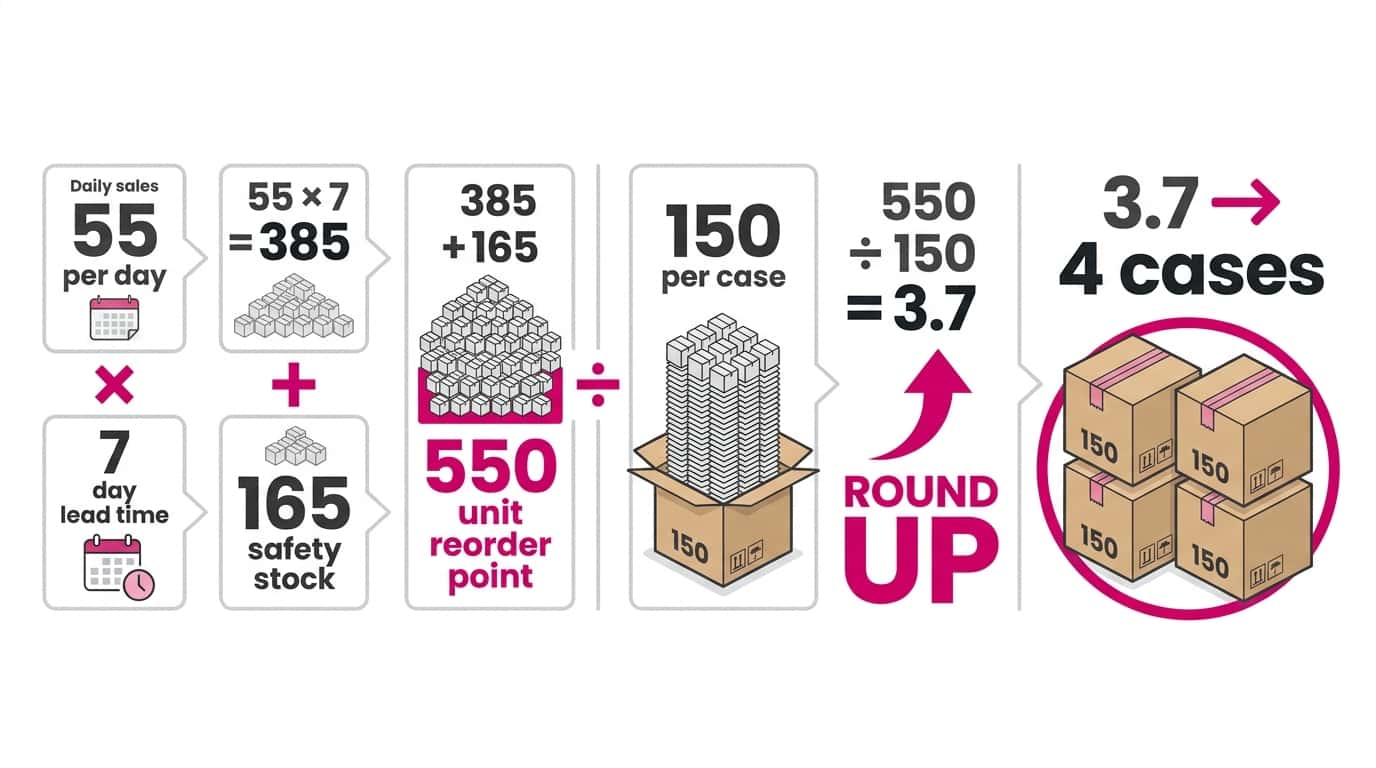
Here is a worked example. The usage, lead time and safety stock below are illustrative for the walkthrough. The case count is real.
| Step | Working | Result |
|---|---|---|
| Item | 9" White 3 Compartment Hinged Clamshell | 150 units per case |
| Average daily usage | Counted across a normal trading week | 55 per day |
| Replenishment lead time | Order to shelf | 7 days |
| Usage across lead time | 55 × 7 | 385 units |
| Safety stock | 3 days of cover | 165 units |
| Reorder point | 385 + 165 | 550 units |
| Reorder point in cases | 550 ÷ 150 | 3.7, so trigger at 4 unopened cases |
Round the trigger up. Three and a bit cases becomes four. Rounding down means the trigger fires after you are already short, which defeats the point of having one.
The reason this matters for packaging is that case counts vary widely across a takeout range. Here is a sample from our own takeout containers:
| Takeout container | Units per case |
|---|---|
| Small Clamshell Container | 500 |
| Large Clamshell Container | 200 |
| 9" White 3 Compartment Hinged Clamshell | 150 |
| 8 oz Deli Containers with Lids | 240 |
| 32 oz Wide Shallow Bowl with Hinged Lid | 150 |
| Recycled Take Out Containers 40 oz | 300 |
A trigger of 550 units is nearly four cases of one item and barely one case of another. Set the number in units, convert it once, then write the case figure on the shelf label, because that is what your team can actually see.
Do Lids and Bases Need Separate Reorder Points?
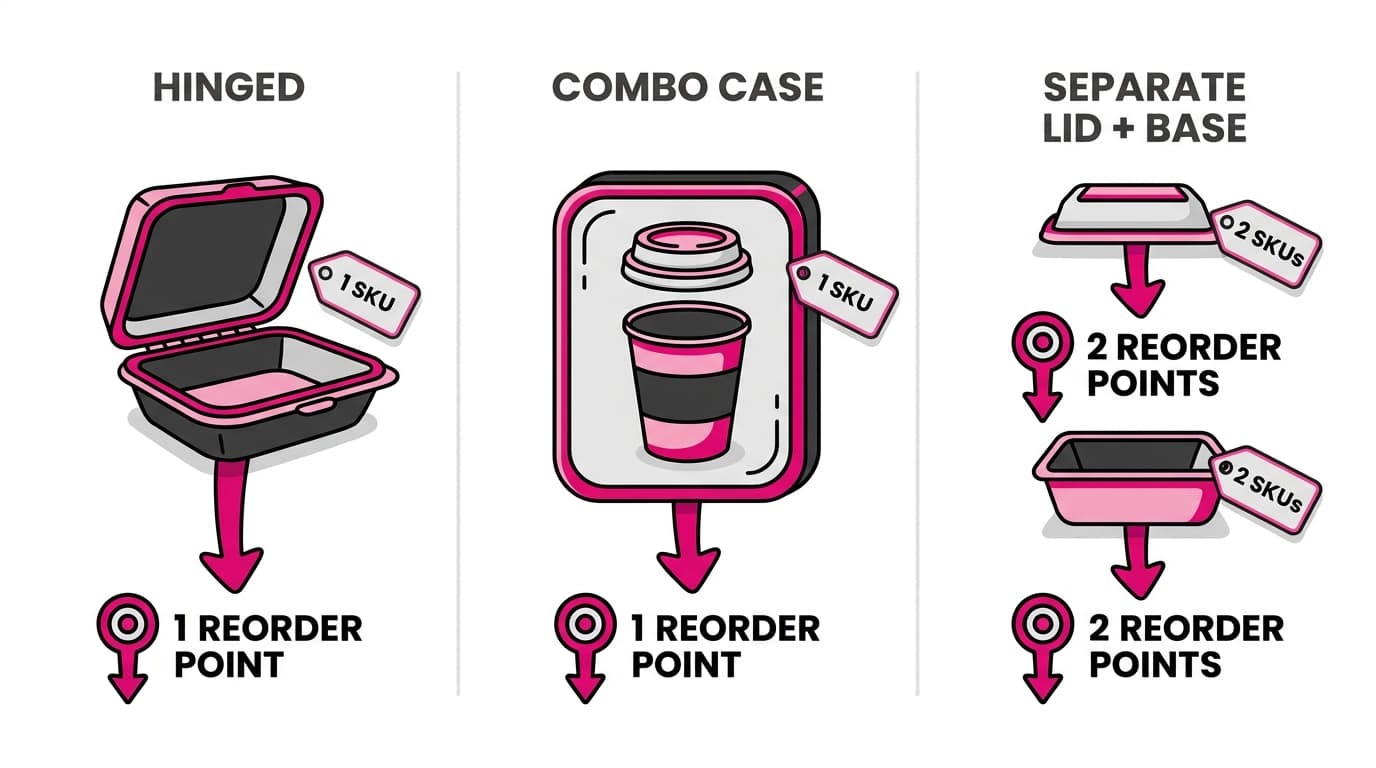
Direct Answer: Where lids and bases are sold as separate SKUs, each needs its own reorder point. Where they ship together in one case, one trigger covers both.
This comes down to how the item is sold, not how it is used. Three formats show up across a typical takeout order:
- Hinged containers. The lid is part of the base. One SKU, one reorder point.
- Combo cases. Cups and lids ship together in one case, so a single trigger covers the pair.
- Standalone lids. A sip through coffee cup lid sold at 1,000 per case is its own SKU with its own case count, and needs its own number.
Buy the two halves separately and they are two SKUs on the order form. Give each its own reorder point.
When Should You Revisit the Reorder Point?
Direct Answer: Revisit it when volume, menu or lead time changes, and before a season you already know is coming. A February trigger will not hold in December.
Predictable demand shifts belong in the forecast, not buried inside a bigger safety stock number all year round. That is the difference between a buffer and a bad habit. Carrying December's cushion through March ties up cash and shelf space in containers you did not need to be carrying then.
A practical cadence is a quick review when the menu changes and a deliberate one ahead of a known peak. If your busy stretch is already on the calendar, move the number before it arrives rather than after.
Where Do the On-Hand Counts Come From?
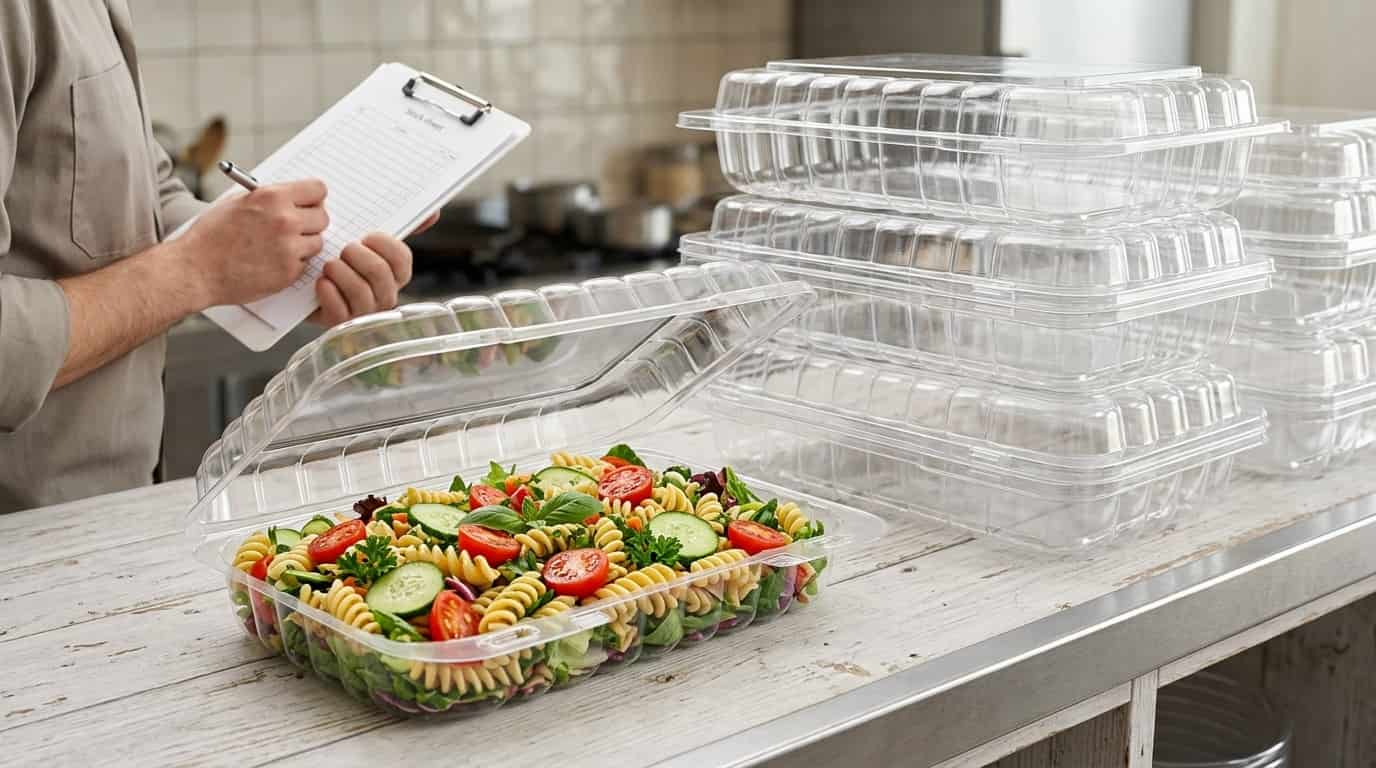
Direct Answer: The reorder point only works against a current on-hand count per SKU. How you count, how often and where is a separate system.
A trigger is useless if nobody knows what is actually on the shelf, or if half the stock is sitting in a back storeroom nobody counted. That side of the job, the counting routine that feeds these numbers, is covered in how to Track Packaging Inventory in a Restaurant.
Once the counts are reliable, the reorder point does what it was built to do. It turns a judgement call into a number anyone on your team can read off a shelf. For more on running the numbers on your own operation, the Plastic Container City blog is worth a look. Work out how to set reorder points for takeout containers item by item, in cases rather than loose units, and the Friday night scramble gets a lot rarer.
Frequently asked questions
What happens if the reorder point is too low?
Direct Answer: If the reorder point is too low, you order too late and raise stockout risk because replacement stock may arrive after inventory runs out.
The two usual causes are underestimating lead time and setting the buffer too thin for how much your volume actually swings. Both surface the same way: an emergency retail run, or packing in whatever is left on the shelf.
What is the difference between safety stock and reorder points?
Direct Answer: Safety stock is the buffer for demand or delivery variation. The reorder point includes that buffer and tells you when to place the order.
One is an ingredient, the other is the total. Move your safety stock and the reorder point moves with it, which is why the two get reviewed together rather than one at a time.
How do I calculate the reorder quantity?
Direct Answer: The reorder point tells you when to order, not how much. Reorder quantity is what you replenish, rounded to the supplier's order multiple.
They get confused because they land in the same moment, the one where you pick up the phone. Keep the two apart when you work out how to set reorder points for takeout containers: the reorder point answers when, and the reorder quantity answers how much.