
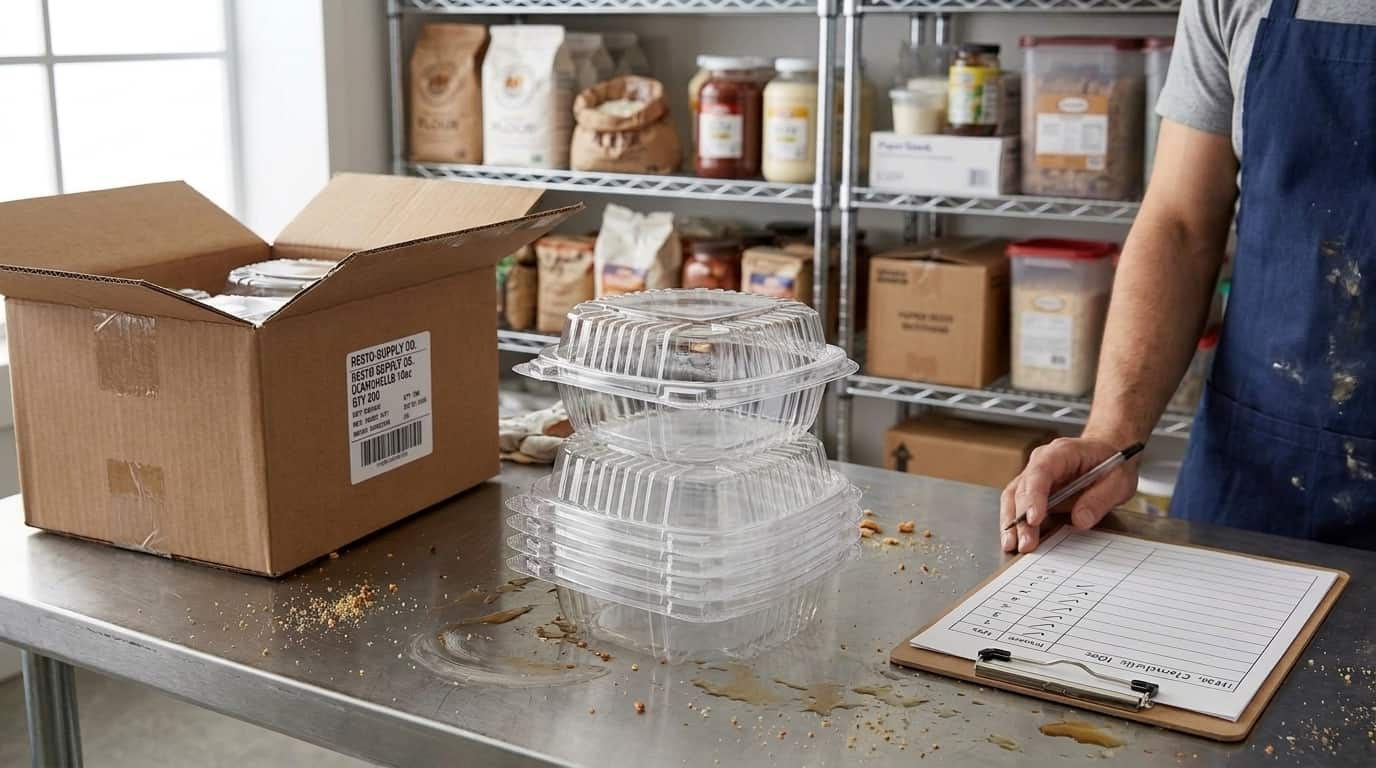
TL;DR: Restaurant packaging inventory management works best as its own count, separate from food. Track it by SKU, not as one paper goods line. Pick one unit, cases or eaches, and stick with it. Count on a set cadence, focus on the SKUs that carry the most volume, and cover every storage spot. Once the count is reliable, it feeds straight into your reorder points.
Restaurant packaging inventory management can end up as one line on a spreadsheet: paper goods, some dollar figure, done. That works for the accountant. It does nothing for the person who opens the stockroom on a Thursday and finds four 9 inch clamshells and a stack of napkins where a full case should be.
Food inventory gets the spreadsheet, the app, the weekly count. Packaging gets whatever attention is left over, because it does not spoil, so nobody treats it like it will run out. Then it runs out.
At Plastic Container City, we work with thousands of food professionals across the U.S., from bakeries with a grab and go case to caterers packing forty orders before noon, and packaging is almost always the part of their inventory nobody built a system for.
This is that system. Not a food inventory guide with packaging bolted onto the end of it. A way to count what you actually hold, SKU by SKU, so ordering stops being a guess and starts being a number you can act on.
Why Does Packaging Need Its Own Inventory Count?
Direct Answer: Packaging can end up tracked as one lump line instead of by SKU. That makes shortages harder to see until stock is already low.
Food inventory gets watched closely because a missed count shows up fast, in spoiled product or a failed check. Packaging can sit quietly wrong for weeks. A restaurant can run a tight kitchen and still run out of the one clamshell size a Friday order depends on, because nobody was counting containers with the same discipline as chicken or produce.
Restaurant365 includes packaging and paper goods among the non-food items that can be tracked in inventory, which only pays off if packaging is counted with the same care as everything else on it. A general "supplies" line defeats that. Packaging needs its own list, tracked SKU by SKU.
How Do You Keep Track of Inventory in a Restaurant?
Direct Answer: Build a SKU level list, pick one counting unit, set a cadence, and count every storage location. That combination is restaurant packaging inventory management. Nothing more complicated than that.
The system does not need software to start. It needs four decisions made once, then repeated the same way every time: what you are counting, what unit you are counting it in, how often, and where you are looking. Skip one of those and the numbers stop being usable, because a count that changes its own rules cannot be compared to last week's.
Everything below breaks those four decisions down in the order you will actually make them when you build your own list.
What Should Go on a Packaging Inventory List?
Direct Answer: List every packaging SKU you actually stock by name and size, not by category. "Clamshells" is not a line item. "9 inch 3 compartment hinged clamshell" is.
This is where informal packaging tracking usually falls apart before it starts. One line for "takeout containers" tells you nothing when three sizes are moving at three different speeds. Break the list down to the SKU, the same level of detail you would use placing a supplier order.
A practical starting list usually covers the takeout containers or clamshells you use most, lids sold as their own SKU, cups, bags, and anything tied to a single menu item. If you are still deciding which formats to carry in the first place, our guide to how to choose takeout containers for your restaurant walks through the formats most operations end up stocking. Once a format is settled, the SKU goes on the count list and stays there.
What Unit Should You Count Packaging In?
Direct Answer: Pick cases or individual units for each SKU and count in that unit every time. Switching between the two mid month makes the numbers impossible to compare.
Packaging is ordered by the case and used one piece at a time, and that gap is where counts quietly go wrong. Restaurant365's own documentation on units of measure works through this with a food example: ordering by the case while inventory tracks by the each, with the case size set as the conversion between the two so the relationship stays on the record instead of living in someone's memory. Case sizes vary widely from one container to the next, so working out that math for one order is worth doing properly.
| Unit | Works well for | Tradeoff |
|---|---|---|
| Whole cases | Fast counts on high volume SKUs stored unopened | Loses precision once a case is opened |
| Individual units | SKUs you open and draw down one at a time | Slower to count, easy to lose track partway through |
Whichever you pick, note it next to the SKU on the list itself, so whoever counts next does not have to guess.
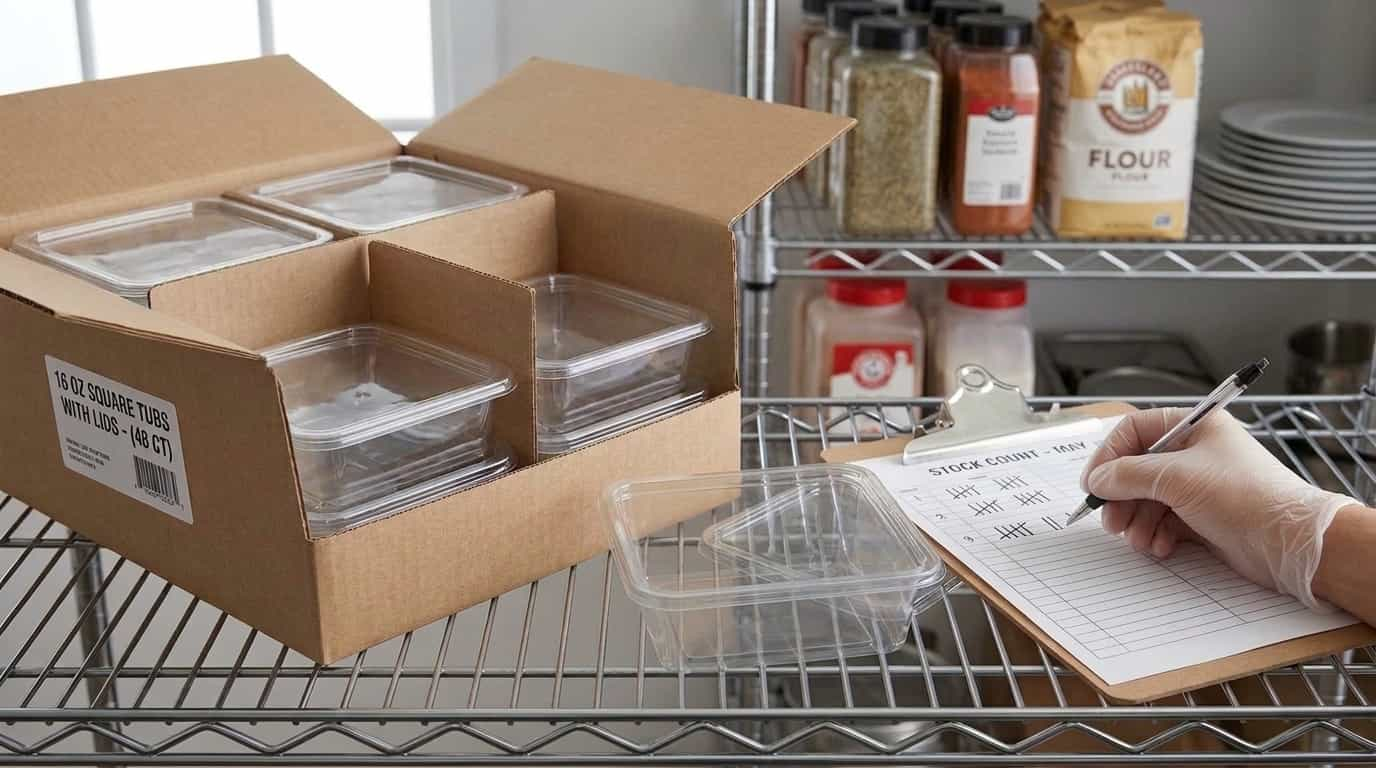
How Often Should You Count Packaging?
Direct Answer: There isn't one count frequency that fits every restaurant. Set a cadence that fits your volume and attach it to a routine you already run.
Packaging has no single count schedule that fits every restaurant. What matters more than the exact interval is whether the count happens on schedule, every time.
| Cadence | Works well for | Watch for |
|---|---|---|
| Weekly full count | Most single location operations | Takes real time once the list grows long |
| Spot counts between full counts | High volume or fast moving SKUs | Only useful if the full count still happens too |
| Monthly | Slow moving or low value SKUs | Too slow to catch a shortage before it hits |
The easiest way to make a cadence stick is to attach it to something that already happens on schedule: a delivery day, a weekly prep list, or a closing checklist, rather than inventing a new task nobody remembers to do.
What Is the 80/20 Rule in Inventory?
Direct Answer: The 80/20 rule is a way to focus attention, not a fixed packaging ratio. Count the SKUs that matter most to service more closely.
The 80/20 pattern comes from a wider inventory principle called ABC classification, where items are grouped by how much value or volume they actually contribute rather than treated as equally important. CIPS describes ABC classification as identifying which products generate the most value, not simply the most volume, so the highest priority items get the closest attention.
Do not force your own SKUs into an exact 80/20 split. Instead, look at what you reorder most often, your everyday clamshell or standard cup, and count those on a tighter cadence than a specialty container you restock twice a year. The principle matters more than the precise percentage.
What If Your Packaging Is Split Across Storage Areas?
Direct Answer: Count every storage location separately, then add them together. A single storeroom count will miss whatever is sitting behind the line or in a second stockroom.
Packaging rarely lives in one place. A shift's worth of clamshells might sit behind the pass, cases wait unopened in dry storage, and overflow gets pushed onto whatever shelf had room that week. Restaurant365's inventory documentation supports arranging storage locations within the count itself, so each area gets counted in the order it actually sits in the building, rather than trusting memory to cover every spot.
Give the count a location for every SKU, not just a total, and add the locations together for the real number. A count that only checks the obvious shelf can read lower than what you actually hold, and that gap can trigger an order you did not need.
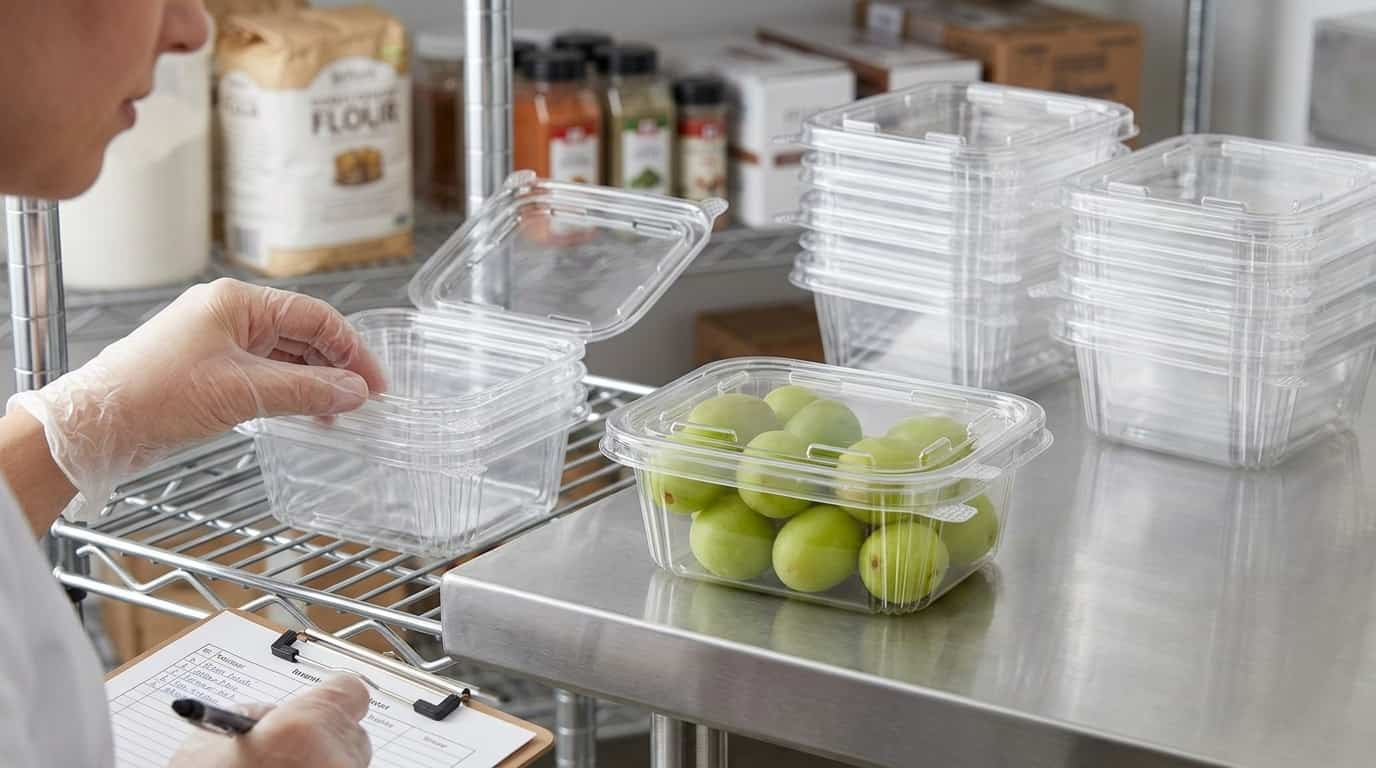
Restaurant Packaging Inventory Management: What Comes Next?
Direct Answer: Once your counts are accurate, they can feed into reorder points. The next step is deciding when that stock level should trigger an order.
Everything above gets you a number you can trust: a SKU level list, one consistent unit, a cadence that happens, and every storage location included. That number is the input, not the finish line. Turning that count into a trigger that tells you when to reorder is covered fully in how to set reorder points for takeout containers. If you have not settled on a supplier for the packaging on your list yet, that groundwork belongs in How to Choose a Wholesale Food Packaging Supplier.
A reliable count will not stop every Friday night scramble on its own. It gives you the one thing every reorder decision after it depends on: an honest answer to how much you actually have.
Frequently asked questions
How to make a simple inventory list?
Direct Answer: Four columns are enough to start: SKU name, counting unit, current count, and storage location. Add more detail only once the basic version gets used every week.
A spreadsheet or a printed sheet both work. The format matters less than whether someone actually fills it in on schedule.
Is there a free Excel template for restaurant inventory?
Direct Answer: A template can work, but packaging only needs a simple sheet with SKU, counting unit, on-hand count, storage location, and count date.
Building your own keeps it exactly to your SKUs and skips features you will not use. Keep restaurant packaging inventory management simple until the plain version stops being enough.