


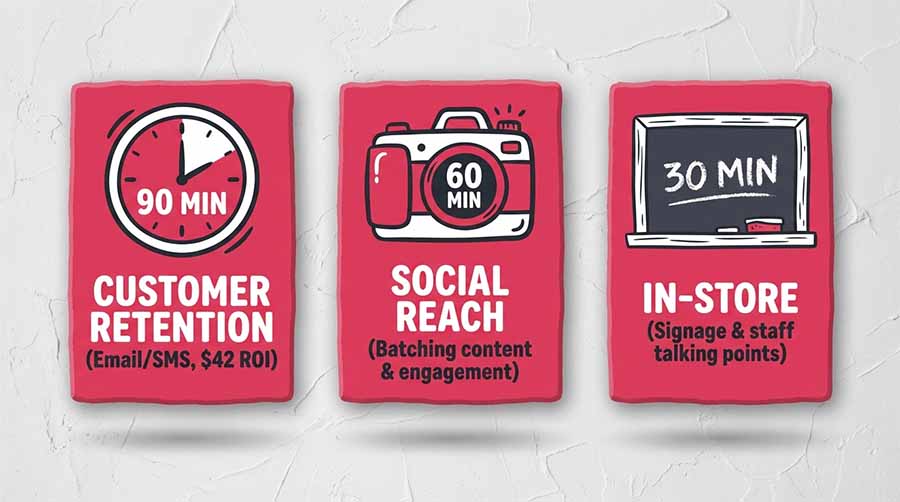
What if your entire bakery marketing plan took just three hours per week? Ninety minutes Tuesday for email and customer retention. Sixty minutes Thursday for social media. Thirty minutes Saturday morning for in-store activation. No daily posting pressure. No algorithm anxiety. Just focused work in the three channels that actually convert.
With restaurant turnover hitting 75% in early 2025, you don't have time to be a full-time influencer. Since 70% of first-time diners never return, your survival depends on a focused bakery marketing plan, not a viral video.
If you've ever asked "where do I even start with marketing," this is your answer. This is the schedule that works when you're running a bakery, not managing a marketing department.
The 3-Hour Bakery Marketing Plan Framework
Block 1: Customer Retention (90 Minutes)
What: Email and SMS to your existing customer base.
When: Tuesday or Wednesday morning.
Why first: Your list is the highest ROI channel you own. Email marketing delivers an average return of $42 for every dollar spent in the hospitality sector, and you control it completely.
How to Execute
30 minutes: Write one email. Pick a single focus. New product drop, weekend special, or "here's what's fresh this week." Keep it under 150 words. One clear action: order link, call ahead number, or in-store offer.
20 minutes: Send one text to opted-in customers. One sentence. One offer. "Cherry almond croissants back Friday. Reply YES to reserve a half dozen."
40 minutes: Review last week's sales data. Check your POS. What sold out? What sat? Use this intel for next week's messaging. If chocolate babka sold out by noon, that's your next email hook.
Start with an automated welcome flow for new subscribers. Welcome emails achieve a 68.6% open rate, nearly four times higher than standard promotional emails. This is your easiest win of the week.
The bakeries that win this game are obsessive about owned channels. At Plastic Container City, we work with thousands of food professionals across the U.S. The pattern is clear: successful operators don't wait for Instagram's algorithm to decide their revenue. They go direct every single week.
Block 2: Social Reach (60 Minutes)
What: Organic social content.
When: Thursday afternoon or Friday morning.
Why second: Social keeps your brand in circulation. It's not where you build your business. It's where you remind people you exist. Understanding how social media actually works helps you use it smarter, not harder.
Your 60-Minute Content Batch
20 minutes: Shoot three photos or short videos. No fancy editing. Good light. Real product. Croissant lamination. Piping technique. Customer picking up a custom cake. Store these in a folder.
25 minutes: Write captions and schedule posts. Use Meta Business Suite or Later. Three posts per week: Monday, Wednesday, Saturday. Short captions. Ask a question or share a quick detail.
15 minutes: Engage. Reply to comments. Like customer tags. Check DMs for order questions. This is relationship maintenance, not a networking marathon.
Your goal isn't going viral. It's being familiar enough that customers think of you first when they want baked goods. You can also use social media to test new products before committing to full production runs.
Block 3: In-Store Activation (30 Minutes)
What: Point-of-sale prompts that convert walk-ins into repeat customers.
When: Saturday morning.
Why third: This is your fastest conversion lever, but only if the first two blocks are working.
Saturday Morning Checklist
15 minutes: Update counter signage. Rotate your featured product. Add a QR code for your email list. Swap old promos for fresh ones. Print new shelf talkers if something's selling fast.
10 minutes: Train counter staff on the week's talking points. What's new? What's selling out? What should they mention during checkout? "Just so you know, we're doing apple turnovers next Friday if you want to preorder."
5 minutes: Check your email signup process. QR code working? Tablet charged? Incentive still appealing? Fix friction immediately.
Priority Order When Time Gets Tight
Some weeks won't cooperate. Oven breaks Tuesday morning. Custom order triples your production time. Staff calls out sick.
When you're down to bare bones, here's the hierarchy:
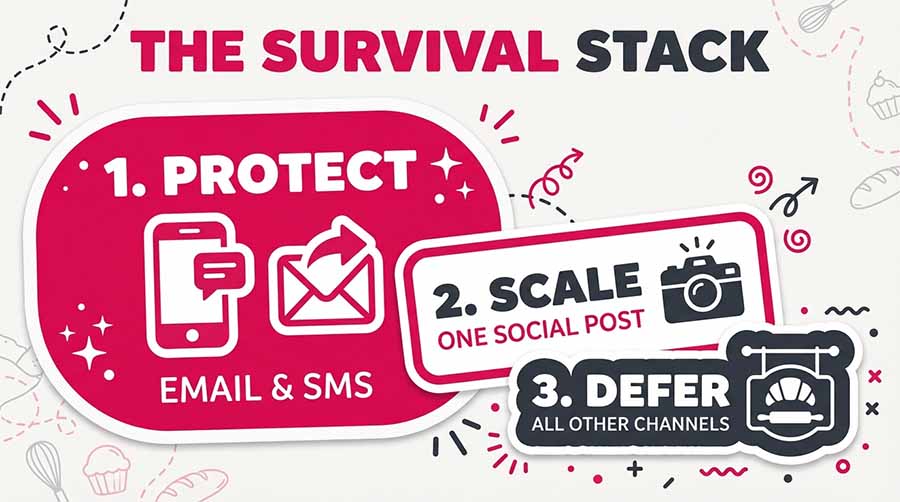
Protect Block 1 at all costs. Email and SMS are your only direct revenue channels. Even a basic "here's what's available this weekend" email in 90 seconds keeps you visible. A text about one featured item beats total silence. These are the channels you control completely.
Scale Block 2 to one post. Skip the three-post schedule. Pick your single best photo from the week. Write two sentences. Schedule it for Saturday morning. You've maintained presence without the time investment. One post isn't ideal, but it's infinitely better than ghosting your feed for two weeks.
Defer Block 3 if necessary. Your counter signage can stay static for a week. Not perfect, but it won't crater your momentum if blocks one and two are running. Update it next week when you have breathing room.
This priority order isn't random. It's based on control and conversion. You own your email list. The algorithm owns your social reach. Act accordingly when time is scarce.
The Minimum Viable Week
When you're genuinely slammed and three hours is impossible, here's the 60-minute emergency version:
| Task | Time | Outcome |
|---|---|---|
| Send one email to your list | 20 min | Retention signal sent |
| Send one SMS offer | 10 min | Immediate revenue opportunity |
| Post one piece of social content | 15 min | Brand visibility maintained |
| Reply to customer messages | 10 min | Engagement sustained |
| Update one in-store sign | 5 min | Point-of-sale optimized |
Total: 60 minutes. This is the absolute floor. It keeps your marketing alive during crisis weeks without letting the system collapse entirely. Run this version more than once a month and you're not executing a plan. You're treading water. Get back to the full three-hour schedule as soon as operations stabilize.
What to Measure
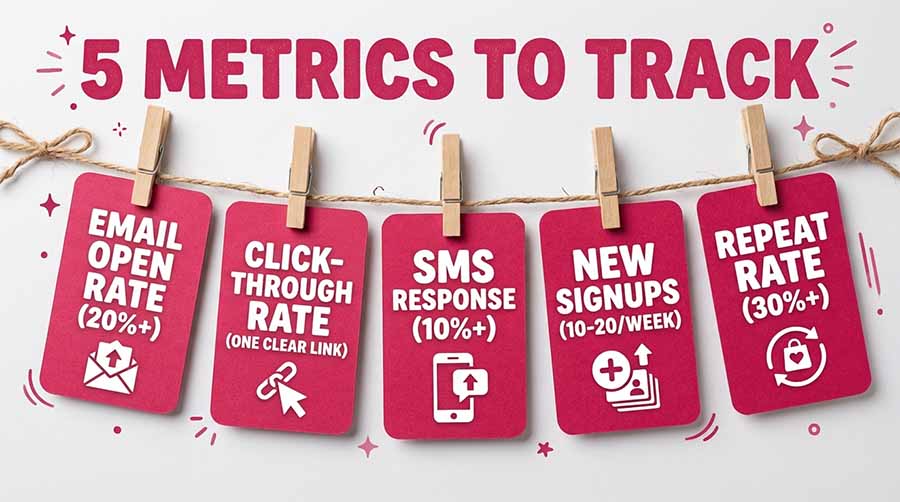
Most bakery owners track the wrong things. Instagram likes don't pay your flour bill. Here's what actually matters:
Email open rate. Shoot for 20% or higher. Below that? Your subject lines are boring or your list has gone cold. Test different send times. Cut the fluff from your copy.
Click-through rate. People open but don't click? Your offer isn't clear enough. One link per email. One action. Make it obvious.
SMS response rate. Ten percent or better means your texts are working. Lower than that? You're either too vague or texting too often.
New email signups per week. If you have foot traffic, aim for 10 to 20 new names weekly. Growth stalls? Your signup incentive is weak or the process has too much friction.
Repeat customer rate. Pull this from your POS. What percentage come back within 30 days? Under 30%? Marketing can't fix a product or experience problem.
Check these numbers every Sunday. Fifteen minutes. Look for patterns. Adjust.
Automate This, Not That
Automation saves time if you're careful about what you hand off. Get this wrong and you end up sounding like a robot that learned about bakeries from ChatGPT.
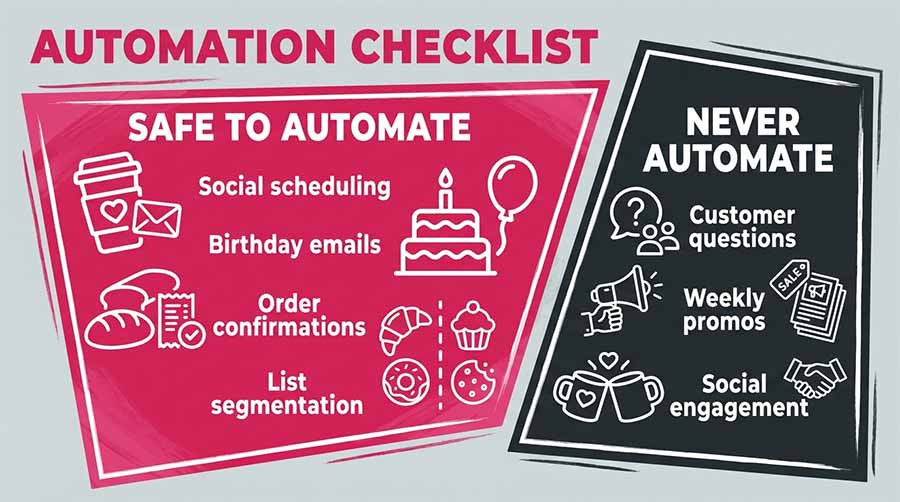
Safe to Automate
Social media scheduling. Batch your posts Thursday, schedule for the week. Meta Business Suite or Hootsuite do this free. Your customers don't care if you posted manually or scheduled it three days ago.
Birthday emails. Collect birthdays at signup. Send an automated happy birthday message with a small discount. Personal enough to feel thoughtful. Templated enough to run itself.
Order confirmation texts. Auto-confirmations cut down on "did you get my order?" calls. Customers expect this. It builds trust.
List segmentation. Tag customers by behavior. First-time buyers. Wholesale clients. Weekly regulars. Your email platform can do this automatically so you can send more relevant offers later.
Never Automate
Customer question responses. A canned reply to a real question kills goodwill instantly. Someone asks if you can do a custom cake for Saturday. A human answer in 10 minutes beats a bot in 10 seconds.
Weekly promotional emails. These have to reflect what's actually happening in your kitchen. Automate this and you'll send "fresh strawberry tarts available" the week you're sold out. Creates confusion. Erodes trust.
Social engagement. Don't auto-like or auto-comment. People can tell. It feels hollow and weird.
Avoiding Scope Creep
The three-hour schedule only works if you protect the boundaries. Here's where bakery owners blow it up:
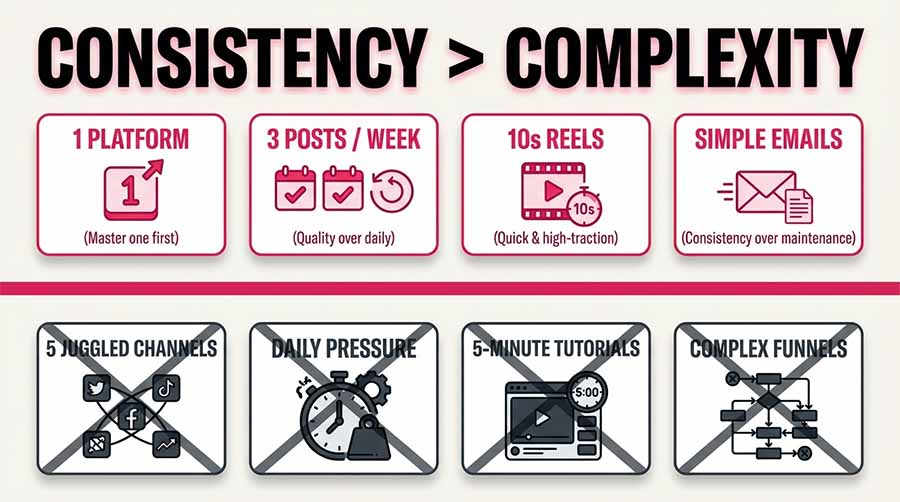
Adding platforms mid-stream. You don't need TikTok if your Instagram posting is inconsistent. Master one channel completely before adding another. We've seen owners juggle five platforms poorly instead of owning one really well.
Daily posting pressure. Three posts per week is enough. Posting daily just to post leads to weaker content and faster burnout. Quality over frequency wins the long game.
Long-form video rabbit holes. A 10-second Reel showing a cake slice gets more traction than a 5-minute decorating tutorial that took two hours to edit. Save the elaborate content for when you have staff or actual free time.
Complex email sequences. One or two emails per week. That's it. Elaborate drip campaigns and multi-step workflows sound sophisticated but they require constant maintenance you don't have bandwidth for.
Stick to the plan. Resist expansion. Consistency beats complexity every single time.
When This Won't Work
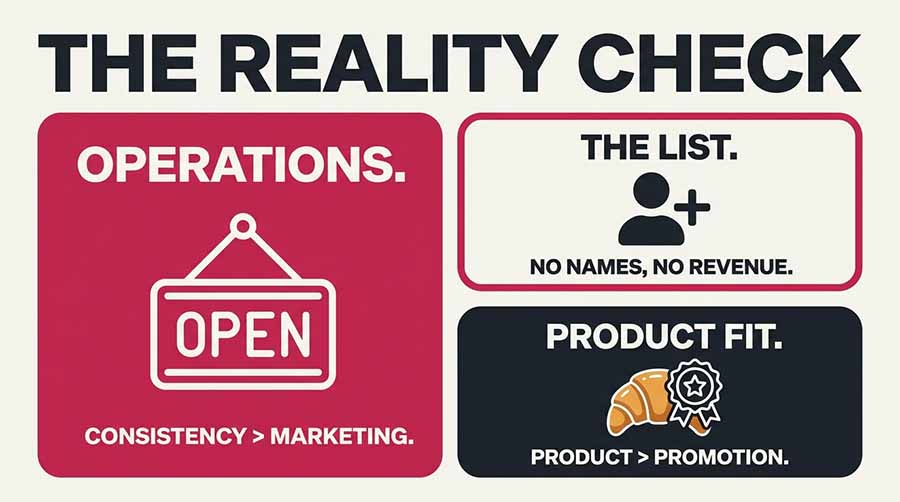
This framework assumes operational basics are solid. Marketing amplifies what's already there. It doesn't fix broken fundamentals.
Inconsistent hours or product availability. If your signature items are randomly out of stock, customers stop checking. A tight marketing schedule won't matter if the bakery experience is unpredictable. Fix operations first.
Zero existing customer list. Starting from scratch? Email won't deliver immediate returns. You need names first. Growing a bakery email list takes intentional effort: simple checkout incentives work best. Free cookie with first online order. Ten percent off next visit. Something small that feels like a fair trade for an email address.
Product-market fit issues. If your baked goods aren't selling even when you promote them, the problem isn't frequency. It's product, pricing, or positioning. Marketing makes good stuff sell faster. It can't make mediocre stuff suddenly work.
What Success Looks Like
After four weeks on this schedule, you should see tangible movement. Not viral fame. Not explosive growth. Just steady, measurable progress:
Email engagement climbs. Opens tick up. Click rates improve. People start replying to your emails asking questions or placing orders directly.
Repeat purchase windows tighten. Customers who used to come monthly start showing up every two weeks. The 30-day return rate creeps higher.
Weekend promotions hit harder. When you promote Thursday through Saturday, you see stronger Saturday sales. The rhythm starts working.
Featured products sell faster. The items you highlight in email and social move quicker. You start selling out of things you promoted, not random items.
More direct contact. Customer questions and preorders come through DM and text instead of just walk-in uncertainty.
Nothing moving after four weeks? Look deeper. Dead email list? Off-brand messaging? Products buried in-store? The schedule creates consistency. Your data tells you what needs fixing.
This bakery marketing plan is a feedback loop, not a magic trick. Show up for three hours weekly. Track what happens. Adjust what doesn't work. The results compound over months, not days.
For more bakery insights, operational strategies, and food industry updates, visit the Plastic Container City blog.
Frequently Asked Questions
Will three hours a week really make a difference?
Yes, but only if those hours are surgical. The difference isn't the time. It's the structure. Random posting whenever you remember leads to random results. A predictable Tuesday email and Thursday social routine trains your customers to expect you. That expectation builds trust. Trust drives repeat business. Three focused hours beats 10 scattered hours every time.
How often should I email my list without annoying people?
Once per week is the baseline for most bakeries. Twice weekly works if you've got strong offers or products that rotate fast. Daily is overkill unless you're running a 48-hour flash sale. Watch your unsubscribe rate like a hawk. Spike above 0.5% per send? Pull back immediately. But here's the thing most people miss: if your emails are genuinely useful, weekly feels normal, not annoying.
What if I don't have time to create content?
You're creating content every time you bake. Pull your phone out. Snap a photo of the finished product. Write one sentence. That's content. You don't need a ring light, a tripod, or a content calendar template. You need 60 seconds and a willingness to document what you're already doing. The croissants you're making anyway? That's Thursday's social post.
Can I outsource any of this?
Most bakeries can't afford a full-time marketer or agency. That's why this schedule is designed to run solo with free tools. But if you do have some budget: outsource the execution, not the strategy. A VA can batch-schedule your social posts. A designer can make your graphics look cleaner. But don't hand off customer communication or decisions about what to promote. Nobody else knows which product deserves attention this week or how to talk to your specific customers. Keep the brain work in-house. Delegate the busywork.
What's the biggest mistake bakeries make with marketing schedules?
Starting too ambitious. They commit to daily content across four platforms, design elaborate email sequences, and plan a month of promotions. Then they burn out in two weeks and quit entirely. The schedule collapses. Customers disappear. Six months later they try again with the same overbuilt plan. Small and sustainable beats big and abandoned. Lock in three hours weekly for three months and you will finally have a sustainable, high-growth bakery marketing plan.
