

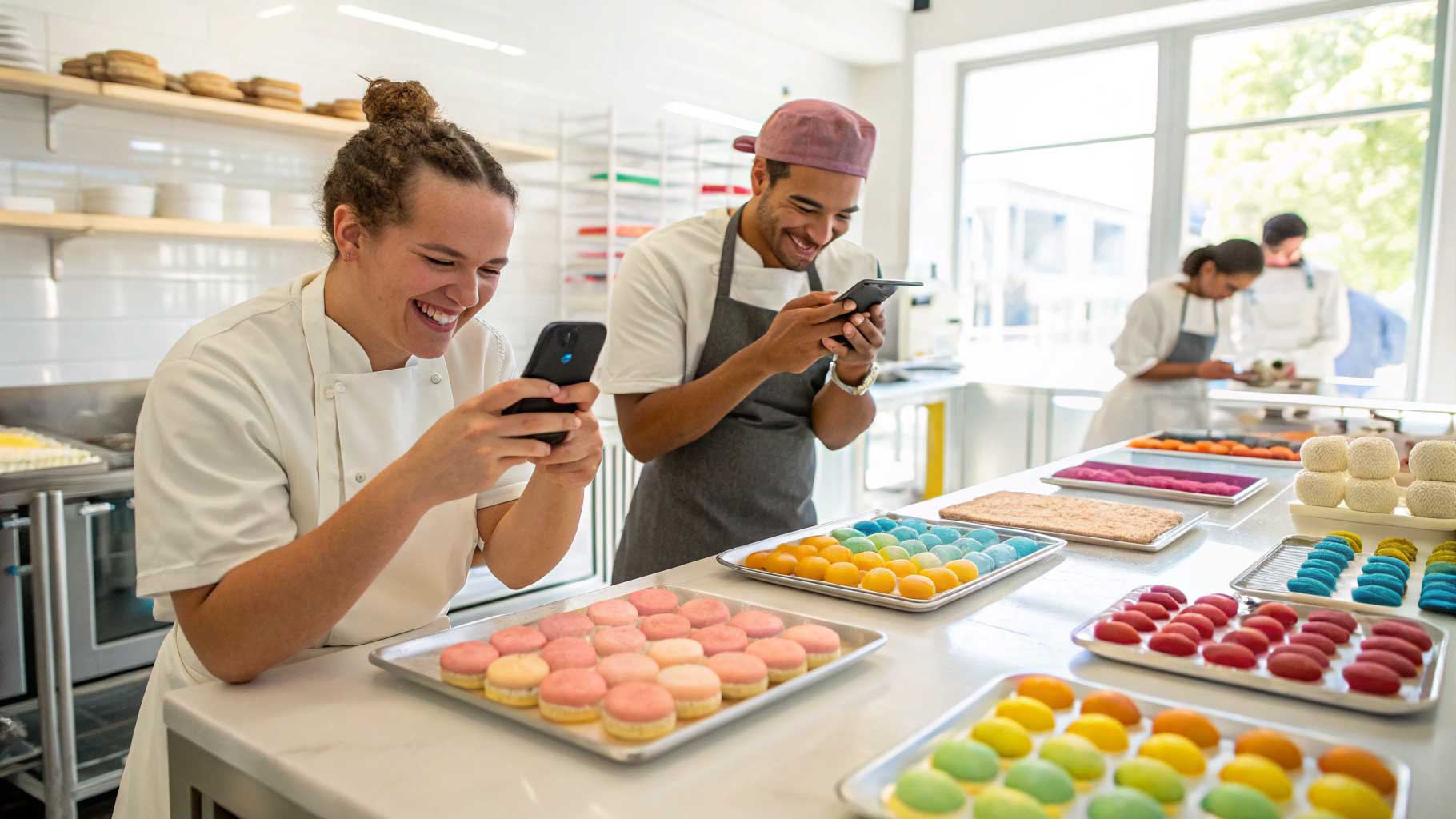
Tired of launching new pastries only to watch them sit unsold? Using social media as a test kitchen has become the secret weapon for thriving bakeries.
Forget expensive focus groups; picture this instead: you're considering a lavender honey danish. Instead of weeks perfecting a recipe, you post a simple Instagram poll: "Yay or nay?"
Within hours, you have real feedback from actual customers. That's the magic of turning your social media into a living, breathing test kitchen.
The smartest bakery owners have figured out that social media platforms function as "real-time test kitchens for identifying emerging preferences", where product concepts can be validated in days rather than months.
The Power of Social Media as Your Brand's Test Kitchen
Your social media isn't just for pretty photos anymore—it's your R&D department, focus group, and market research team all rolled into one. The numbers tell the story: 74% of diners use social media to decide where to eat, which means your potential customers are already there, scrolling, and ready to engage with your experiments.
Here's what makes social media particularly powerful as a test kitchen: instant, unfiltered feedback from real people with real money to spend. When someone comments "I need this in my life!" on your experimental croissant video, that's not just engagement—that's a pre-order waiting to happen.
User-generated content serves as an honest indicator of how your food product is perceived in the wild. When customers voluntarily become your content creators, sharing photos and tagging friends, you've hit product-market fit gold.
The beauty lies in the speed. Traditional product testing can take months. Social media testing happens in real-time. Post a behind-the-scenes video of your latest experiment at 2 PM, and by 6 PM you'll know if you're onto something special or need to pivot.
Understanding the Four Macro Forces Driving Food Innovation
Before diving into testing tactics, understanding the deeper psychology behind food trends helps you innovate more strategically. Four key forces are reshaping what customers crave:
Indulgence Redefined: Customers want guilt-free pleasure. They're seeking treats that satisfy cravings while aligning with health goals. Test variations of your bestsellers with functional ingredients—maybe protein-enriched brownies or ancient grain croissants.
Wellness with Personality: Health-conscious eating has evolved beyond bland "good for you" options. Customers want nutrition that tastes incredible and tells a story. Consider testing adaptogenic ingredients in familiar formats or superfoods in unexpected applications.
Nostalgia with a Twist: Familiar flavors reimagined for modern palates consistently perform well. Think cereal milk ice cream or s'mores croissants. Your social media audience will tell you which childhood memories they want elevated.
Global Discovery: Adventurous palates seek authentic international flavors. Test fusion concepts that blend familiar techniques with global ingredients. Your followers' reactions will guide which cultural flavors resonate locally.
Understanding these forces helps you test products that tap into deeper consumer motivations, not just surface-level trends.
How to Use Instagram Stories as Your Digital Focus Group
Instagram Stories are your secret weapon for rapid product testing. With interactive features like polls and quizzes, you can gather immediate feedback on everything from flavor preferences to packaging choices.
Start simple. Post a photo of two potential glaze options and ask followers to vote. Or show a work-in-progress shot and ask "What's missing?" The responses will surprise you—customers often spot things you've missed because you're too close to the product.
The key is asking specific questions. Instead of "Do you like this?" try "Would you order this for breakfast or dessert?" or "What would you pair this with?" These questions give you actionable insights, not just validation.
Stories with interactive elements directly engage audiences, creating a dialogue rather than a monologue. When followers feel heard, they become invested in your success.

What Makes Food Go Viral - And How to Test for It
Understanding viral mechanics helps you test products that have sharing potential. 86% of diners post about their meal if it's visually appealing, so your test products need to be camera-ready.
But virality isn't just about looks. The most shareable food content combines three elements: visual impact, emotional connection, and novelty. Consider the explosive growth of flavors like ube and pistachio. Their success isn't just about taste—it's driven by their vibrant, Instagram-worthy colors (deep purple and rich green) that pop on social feeds. When you test a new item, ask yourself: does this look as good as it tastes?
Try this: create three versions of the same product—one optimized for taste, one for visuals, one for uniqueness. Post all three and track which generates the most saves, shares, and "where can I buy this?" comments. Those engagement patterns tell you which direction to pursue.
Short-form video content works particularly well for testing. Show the process, not just the result. People love behind-the-scenes content because it makes them feel like insiders in your creative process.

How Does TikTok Influence Food Development
TikTok has become the new flavor focus group for restaurants and food brands. But here's how to use it strategically for your own product testing.
Monitor trending hashtags related to baking and desserts. When you see early signals of interest around certain flavors or techniques, create your own small-batch tests. Viral food trends now move from TikTok to mainstream menus in weeks, so timing matters.
Create "experiment" content where you test variations of recipes live. Ask viewers to vote in real-time on modifications. This collaborative approach makes followers feel invested in the outcome, and their feedback guides your final product decisions. Customers are constantly seeking novelty, often through unexpected flavor combinations. A perfect case in point is the recent "swalty" trend—a move beyond "swicy" (sweet and spicy) to embrace sweet and salty pairings. Think miso caramel tarts or candied bacon scones. Testing a "swalty" creation on TikTok isn't just about chasing a trend; it's about testing your audience's appetite for this specific type of flavor innovation.
The platform's algorithm rewards engagement, so products that generate comments, duets, and shares get more visibility. Use this to your advantage by creating content that naturally invites participation.

Building Your Social Media Testing Framework
Successful social media testing requires structure. Here's a framework that actually works:
Phase 1: Concept Testing Post concept images or descriptions to gauge initial interest. Ask specific questions: "Sweet or savory version?" or "Morning pastry or afternoon treat?" Track engagement rates and comment sentiment. Remember that poor packaging choices can significantly impact customer perception, so test packaging concepts alongside product ideas.
Phase 2: Visual Testing Share work-in-progress photos showing different presentations, colors, or styles. Visual appeal significantly influences consumer behavior, so test multiple options before committing to one approach.
Phase 3: Small Batch Validation Produce small batches and introduce them through low-risk channels, documenting the process on social media. Share customer reactions in real-time to build anticipation and gather feedback.
Phase 4: Community Feedback Loop Encourage user-generated content by asking customers to share photos and tag your bakery. This provides authentic social proof and shows how your product performs in the wild.
Social Media Platforms for Bakeries: Key Statistics & Strategic Uses
How Social Media Influences Customer Expectations
Your social media testing shapes customer expectations, so be strategic about what you share. People have high expectations for polished content, but they also crave authenticity.
Share your failures alongside successes. When an experiment doesn't work, explain why and show how customer feedback guided your next iteration. This transparency builds trust and makes customers feel like partners in your creative process.
Responding quickly to comments and questions is crucial. When someone asks about ingredients or availability, fast responses show you're listening and value their input.
Remember that your test content is also marketing content. Even failed experiments can generate engagement if you present them as learning opportunities and ask for community input on improvements.

Advanced Testing Techniques and Tools
The pros are going beyond basic polls. AI tools are helping brands analyze consumer data for real-time insights into changing preferences. Take KitKat's successful Blueberry Muffin flavor launch—they used Ai Palette's platform to analyze billions of data points and rank 25 potential flavors, leading to a product that perfectly aligned with consumer preferences and market trends. For smaller bakeries, AI recipe generators offer accessible ways to brainstorm innovative flavor combinations worth testing. Even simple tools like sentiment analysis can help you understand the emotional response to your test content.
Micro-influencer partnerships provide authentic testing opportunities. Local food bloggers with engaged audiences often give more valuable feedback than celebrity endorsements because their followers trust their recommendations.
Smart packaging with QR codes can extend your testing beyond the initial post. Customers can scan codes to provide detailed feedback, vote on future flavors, or access exclusive content about your development process.
Limited-time offerings based on social media feedback create urgency while providing real sales data. If your test croissant sells out in two hours, you know you have a winner.

Avoiding Common Testing Pitfalls
Social media testing isn't foolproof. Feedback from friends and family can be overly positive, so actively seek input from strangers who have no reason to spare your feelings.
Small test groups can skew results. Your most engaged followers might not represent your broader customer base, so balance social media insights with in-store observations and sales data.
Watch out for the viral trap. When something goes viral, it can create supply shortages and ingredient cost increases faster than you can scale production. Plan for success but remember that demand will correct to a steady state after the initial buzz. Understanding what separates lasting trends from temporary fads helps you make smarter investment decisions about which social media tests deserve full production commitment.
Consumer skepticism is real—45% of customers express skepticism after viewing social media posts. Stay authentic, admit when tests don't work, and always follow through on promises made during testing phases.

How to Identify What Your Audience Actually Wants to Buy
Instead of chasing general trends, use your social media test kitchen to discover what your specific audience craves. Your local customers might have completely different preferences than what's trending nationally, and that's your competitive advantage.
Start by analyzing your existing content performance. Which posts generate the most "where can I buy this?" comments? What flavors or styles consistently get the highest engagement? This baseline data tells you what already resonates with your audience.
Create content that encourages preference sharing. Post comparison photos asking "Team chocolate or team vanilla?" or "Classic or experimental?" The responses reveal genuine preferences rather than what people think they should like.
Pay attention to the language your customers use in comments. When someone says "I need this for my morning coffee routine," they're telling you about usage occasions. When they tag friends saying "remember when we talked about wanting something like this?" they're showing you unmet demand.
Test variations of your successful products rather than completely new concepts. If your lemon bars are popular, test lemon-lavender, lemon-blueberry, or lemon-poppy seed versions. Your audience has already shown they trust your lemon game—now optimize within that preference.

Measuring Success in Your Social Media Test Kitchen
Track the right metrics to make informed decisions. Engagement rates tell you about interest, but conversion rates tell you about purchase intent. Comments asking "when will this be available?" or "where can I buy this?" are stronger signals than simple likes.
Monitor user-generated content volume related to your test products. When customers start creating their own content featuring your experiments, you've achieved organic advocacy.
Sales data from test batches provides the ultimate validation. Track sales velocity, customer acquisition cost, and repeat purchase rates for products introduced through social media testing.
Document everything. Create a simple system tracking which social media tests led to successful products and which taught valuable lessons about your audience preferences.

The Continuous Testing Mindset
Product development is becoming iterative rather than linear. The most successful bakeries maintain ongoing dialogue with their audiences, constantly testing new ideas and refining existing products.
Seasonal testing keeps content fresh and relevant. Summer might be perfect for testing tropical flavors, while fall calls for experimenting with warming spices. Each season brings new opportunities to engage audiences and validate concepts.
Create feedback loops that inform long-term strategy. Track which social media tests translate to sustained sales and which generate buzz but little revenue. This intelligence guides future innovation efforts and resource allocation.
Your social media test kitchen never closes. Consumer preferences evolve rapidly, and staying relevant requires continuous adaptation through ongoing testing, learning, and refinement.
Ready to master every aspect of bakery success? Dive deeper into industry insights, proven strategies, and cutting-edge trends at Plastic Container City's comprehensive blog collection—your complete resource for staying ahead in today's competitive food landscape.
Frequently Asked Questions
How do I get honest feedback instead of polite responses on social media?
Ask specific, actionable questions rather than seeking general approval. Instead of "Do you like this?" try "What would make this better?" or "Which version would you actually buy?" Also, actively engage with strangers' comments, not just friends who might sugarcoat their responses.
What's the minimum audience size needed for reliable social media testing?
Quality matters more than quantity. 100 highly engaged followers who regularly comment and share provide better insights than 10,000 passive followers. Focus on engagement rates rather than follower counts when evaluating test results.
How quickly should I move from social media test to full production?
Test for at least 1-2 weeks to see if initial enthusiasm sustains. Create small batches for actual sale to validate purchase intent, not just social media interest. If people buy repeatedly, you likely have a winner.
What if my social media test product fails completely?
Document the failure and share what you learned. Failed tests often generate more engagement than successes because people appreciate honesty. Use failures to ask your audience what went wrong and how to improve.
How do I balance following social media feedback with my own creative vision?
Use social media to guide refinement, not replace creativity. Your unique perspective is what sets you apart. Let customer feedback help you perfect your vision rather than completely changing direction based on every comment.
