
TL;DR: Here is how to price food truck catering: build the price from the full cost of the job plus your target margin, then quote it per person, as a flat package or as an hourly rate with a food minimum. Set a minimum that covers the cost of showing up, price travel and setup as separate parts, and put every term in writing. Treat the numbers below as a worksheet, not a price list.
How to price food truck catering is the question that lands at 9 p.m., right after a host asks what it costs to feed 80 people. Guess low and you eat the difference on a Saturday you could have spent at the window. Guess high and the host books someone else.
Here is the catch. A catering job is not a long day at the window. The host wants a number, you give up a service day to deliver it, and the quote must cover the drive, the setup and the crew. That is why food truck catering pricing needs its own math.
This guide is for the operator holding the pen: who pays whom, how to build a price from your costs, per-person rates versus flat packages, minimums, travel and setup charges, and what the written quote should say.
How Is a Catering Quote Different From Window Sales?
Direct Answer: In private catering, the host pays the truck and guests eat free. A quote says how the price is counted, what it covers and what costs extra.
The National Food Truck Association (NFTA) draws the line in its June 2026 booking guide. At a private event, it tells the host, "your guests eat for free and you pay the truck." At a revenue-share event, "the truck shows up and your guests pay out of pocket."
Those are two different businesses. At the window, a slow hour costs you a few sales. In a booked event, you have promised a date, a crew and a menu, and the service day you gave up does not come back. A quote has to beat that lost day, not just cover the food.
What a truck pays hosts and organizers is covered in our guide to what it really costs to run a food truck. This article covers the other direction: what the customer pays you.
How to Price Food Truck Catering From Your Costs?
Direct Answer: Add food, labor, supplies, transport and a share of overhead. Then divide that total by one minus your target margin to get the price.
Start with a cost sheet for this one job, not last year's averages. Costs move, so rebuild it for every event. The usual lines:
- Food: ingredients for the guest count you expect.
- Labor: everyone on the truck, you included, from prep to teardown, not just window hours.
- Supplies: containers, utensils, napkins and bags. We sell disposable packaging, so we are biased, but supplies belong on the sheet like any other cost.
- Transport: fuel and vehicle use for the round trip.
- Overhead: a fair share of what it costs to keep the truck running, without counting anything twice.
Next, pick a profit margin. Margin and markup are not twins. Margin uses the selling price as its base. Markup uses your cost. A 50% markup is only a 33.3% margin. To hit a target margin, divide your costs by one minus that margin.
| Target margin | Price to quote on $100 of costs | Same result as a markup of |
|---|---|---|
| 20% | $125.00 | 25.00% |
| 30% | $142.86 | 42.86% |
| 40% | $166.67 | 66.67% |
That is illustrative arithmetic, not a margin to aim for, and it only covers the costs on your sheet. Notice what is not on the sheet: the day you give up. That is a test, not a cost line, and it comes at the end. For the food portion of the sheet, our guide on how to price your menu covers food cost.
How Much Do Food Trucks Charge Per Person?
Direct Answer: One published sample of 269 corporate bookings had a median of $28.00 per person. It is one platform's data, not a national price list.
The NFTA's 2026 corporate event cost report looked at 269 confirmed and completed corporate catering requests from one affiliated booking platform over 18 months, leaving out records with missing guest or budget data. So how much do food trucks charge for catering? In that sample, the median was $28.00 per person, the middle half of bookings landed between $20.51 and $35.00, and the average was $30.58.
| Guest count | Bookings | Average per person |
|---|---|---|
| Under 50 | 48 | $50.86 |
| 50 to 150 | 178 | $27.48 |
| Over 150 | 43 | $20.77 |
Read it with care. One affiliated platform, corporate events only, no published raw data, and the report's author also runs the platform. The size bands describe this sample, not a rule about headcount. Do not stretch them to weddings, festivals or private parties, or treat them as what you should charge.
Why do small events cost more per head? The drive and setup cost about the same whether 30 or 130 people eat, so a small count spreads them thin. Crew may flex with the count, so check it separately. As for structure, the NFTA guide describes flat catering fees, per-person pricing and, for a few trucks, an hourly rate with a food minimum on top. Which one wins depends on the job, so here is how we would choose.
- Per person fits a single menu and a firm guest count. Divide the total event price by guests billed (illustrative: $2,400 for 80 guests is $30 per person) and say whether the count is a guarantee or an estimate.
- Flat package fits a job with a fixed shape: set menu, set hours, set crew and a count that barely moves.
- Hourly rate with a food minimum fits events where your time on site, more than the food, drives the cost.
How Do Food Truck Minimums Work?
Direct Answer: A minimum is a floor, so a small event still covers the cost of showing up. Terms are not standardized, so your quote must define them.
The NFTA guide puts it this way: "If your headcount is small, you may need to hit that minimum regardless of what your guests eat." A small crowd still needs the same truck and the same drive.
To set yours, run the full price math for the smallest job you would take, margin included, and treat that as your floor. Minimum spend, minimum guarantee and guaranteed headcount have no standard definition, so say which you mean.
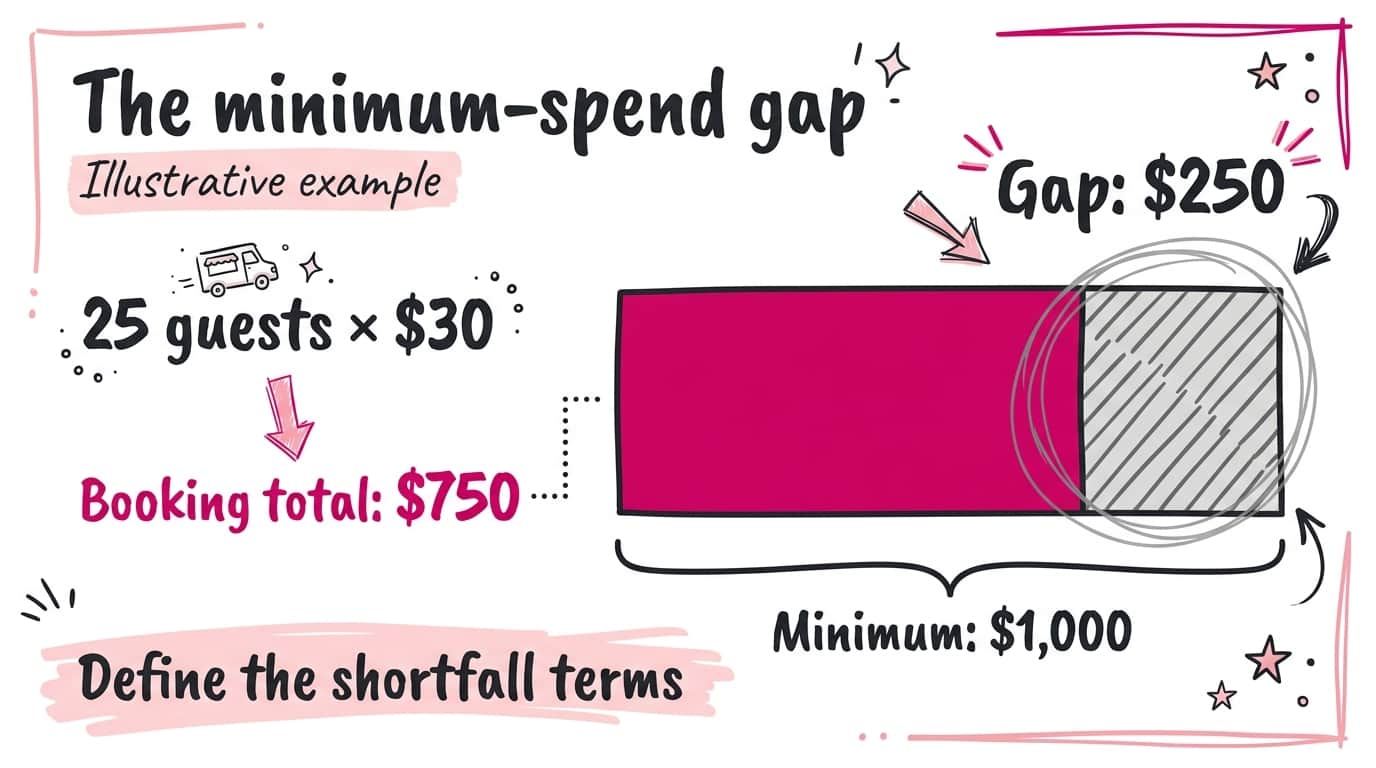
Illustrative numbers, not a recommended minimum: your minimum is $1,000 and the host books 25 guests at $30 each. That is $750, a $250 gap. The quote should say whether the host pays the difference, adds guests or upgrades the menu.
What Is a Food Truck Minimum Guarantee?
Direct Answer: There is no standard definition. In a private catering quote, state the lowest dollar amount or guest count the host will be billed for.
Write it as one plain sentence, plus the date the host must confirm the final number. No national standard sets that cutoff, so your agreement does.
How Do You Charge for Travel, Setup and Service Time?
Direct Answer: Price travel, setup and service time as separate parts. The NFTA says trucks usually need 30 to 60 minutes for setup and a two-hour window is typical.
- Drive time and vehicle cost: price the round trip, not one way, and keep the food truck travel fee separate from the menu. Count it once, on the cost sheet or as its own line, never both. For the math, use our round-trip delivery fee formula.
- Setup and teardown: budget the 30 to 60 minutes the NFTA cites for setup before service starts, then add teardown on the back end.
- Service window: state the hours you are selling and what extra time costs.
For a vehicle cost reference, the IRS business standard mileage rate is 76 cents per mile for July 1 to December 31, 2026, up from 72.5 cents for January 1 to June 30. It is a federal tax rate, not a price list and not your actual cost. Set it beside your own fuel and wear numbers, and check the current rate before you quote.
How to Write a Catering Quote for a Food Truck?
Direct Answer: A written quote should state the date, address, guest count, service hours, menu, minimum, fees, payment timing and cancellation terms.
Collect from the host:
- Date and time, and the full address, not just the city
- Estimated guest count, and whether it is a guarantee
- How long the truck serves
- Indoor or outdoor, space or access limits, and parking
- Their budget or per-person target (optional, but it turns a range into a real number)
Put in your quote:
- Menu and what is included
- Your minimum, and who pays if the count drops
- Travel and setup charges
- Whether gratuity and service fees are included or added
- Deposit and cancellation terms, and when payment is due
- The deadline for the final guest count
The NFTA tells hosts to ask: "Are gratuity and service fees included in the quote or added later?" and "What is your cancellation policy, in both directions?" Answer both in writing first, because a surprise fee is a bad way to meet a new customer. No national standard sets a deposit percentage or cancellation window, so those numbers are yours. Our guide to common catering mistakes covers locking the guest count and writing scope into the quote. For what is enforceable, check with an attorney or your state's guidance.
How Do You Check a Quote Before Sending It?
Direct Answer: Compare the job's profit with a normal service day. Then divide the total by guests billed and test that rate against your cost per guest.
- Job against a normal day: over the same hours, does this booking leave you with more after costs than a regular day at your usual spot would? If not, raise the price or minimum, shrink the scope or pass.
- Per-person test: divide the quote by guests billed and set it beside your cost per guest. If the gap looks thin, check that the drive, setup and crew made it into the total.
A quote is a promise with your name on it. Build it from your costs, set the floor, price the travel and setup, and write down every term. Do that and the 9 p.m. email stops being a gut call.
Food Truck Catering Pricing FAQs
How to Price Food for a Food Truck?
Direct Answer: Price each menu item from its own food cost plus labor, supplies and the margin you want. Catering is quoted per job, as covered above.
Start with what each item costs you, then set the price from there. The event quote is a different job, because it also carries travel and setup, and it has to beat the service day you give up.
Do Food Trucks Pay to Park at a Small Event?
Direct Answer: It depends on the event. In private catering the host pays the truck, and fees trucks pay organizers are a separate cost.
At revenue-share events, guests buy their own food, and any fee a truck pays the host depends on the agreement. Fees are what a truck pays; the quote is what a host pays, which is the money side of how to price food truck catering.