
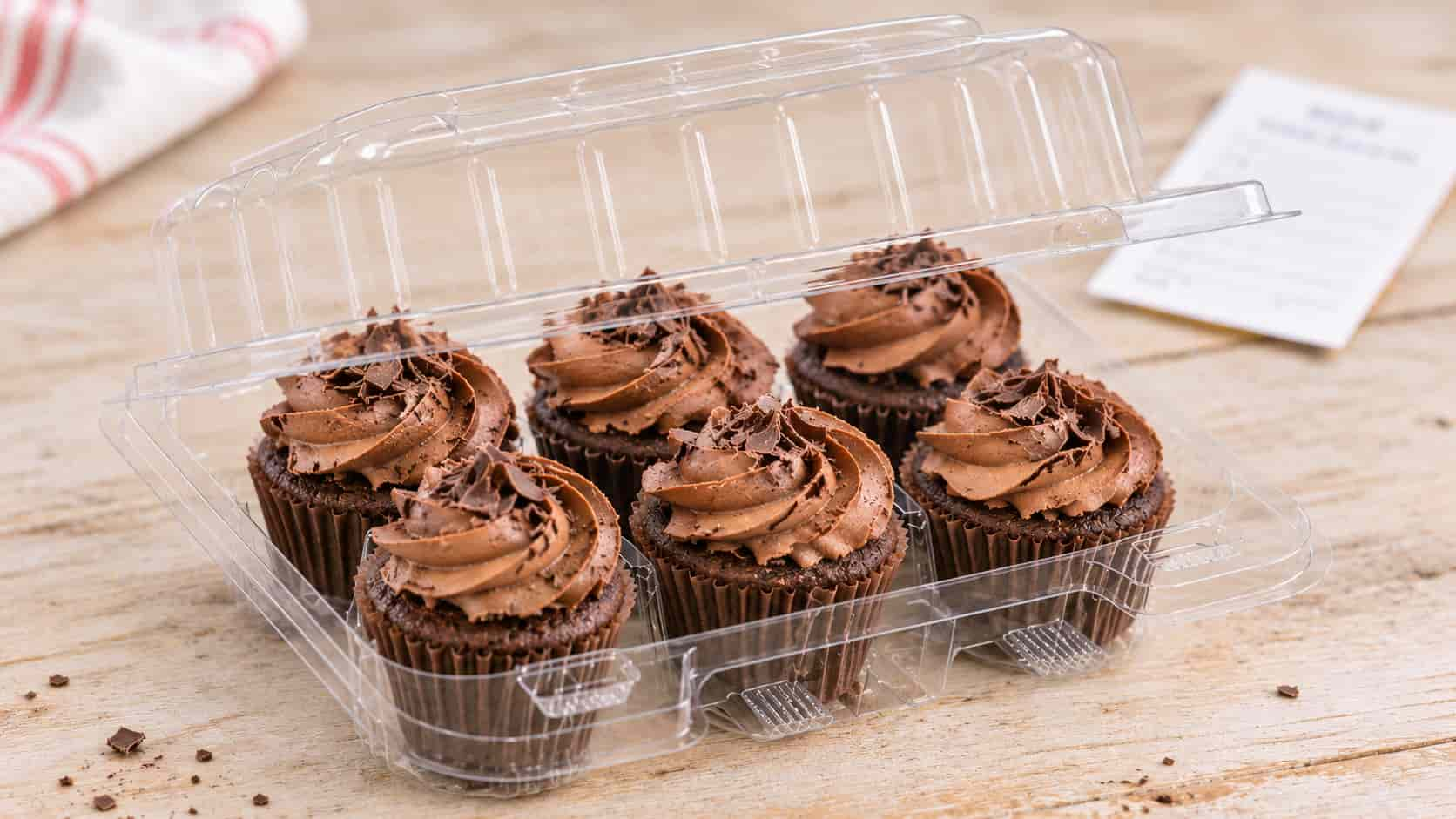
TL;DR: Knowing how to price baked goods for wholesale comes down to a method, not a magic discount. Work out your full cost per finished unit, set the price from cost and your target margin, then check it against your own retail price and the buyer's resale price. Recalculate for larger orders, keep markup and margin apart, put your terms on a price list on one page, and rerun the numbers when costs move.
A café wants your cupcakes on its counter, and now you are googling how to price baked goods for wholesale. Your shelf price will not do. A wholesale price is a number your buyer has to resell and still profit from, while it covers your costs and leaves you something.
This guide will not hand you one magic wholesale discount, because there is not one. The same discount leaves very different margins depending on how high retail was set, so a single number would only mislead you. What you get is a method in six steps to run on your own costs: unit cost, markup versus margin, a price you set and then test, volume tiers, payment terms and a price list on one page.
Is Wholesale Pricing Just Retail Minus a Discount?
Direct Answer: No. A percent off retail only means something once you know the retail multiple, because the same discount leaves very different margins.
Start by naming your retail. Is it the price on your own shelf, or the price on the café's menu? They are different numbers, and mixing them up is an easy way to underprice. Then name who needs a margin: you, a distributor if you use one, and the café, restaurant or grocer reselling to its own customers.
Here is why it matters: with retail at 2.0 times cost, 40% off leaves a thin margin, and at 3.0 times the same 40% off leaves a much fatter one (exact figures in Step 3). Our guide to bakery pricing in 2026 covers the retail side, so this one stays on wholesale.
Step 1: How Do You Work Out Wholesale Cost Per Unit?
Direct Answer: Add ingredients, labor, packaging, overhead, waste and delivery for one finished unit. That total is the floor under every wholesale price you quote.
Define the unit your buyer receives first: one muffin, a box of six, a case of twelve. Then cost that unit:
- Ingredients: flour, butter, chocolate and the rest, from your costed recipe.
- Labor: wages for the minutes each unit takes, not the whole shift.
- Packaging: container, liner, label and any outer carton.
- Overhead and waste: a share of rent and equipment, plus product that never sells.
- Delivery: fuel and driving time, if you deliver.
Count waste once, in the overhead and waste line. Decide now whether delivery sits inside the unit cost or gets billed separately (Step 5 covers it), and do one or the other, never both.
Costs move, so check them again before you price any new account.
How Much of a Wholesale Price Should Packaging Be?
Direct Answer: There is no standard share. Cost the container, liner, label and outer carton per finished unit, then see how pack size moves that line.
Our 6 Mini Cupcake Container page makes a handy real example because it lists pack prices as of November 2026: $19.86 for 50 (about $0.40 each), $43.65 for 200 (about $0.22 each) and $86.30 for 400 (about $0.22 each). At these prices, one case of 400 costs $1.00 less than two cases of 200, before shipping, so weigh that small saving against storage space and upfront cash. We sell it, so double check the math. To compare sizes side by side, see our Mini Cupcake Containers category.
Now put it in a box of six mini cupcakes with a full cost of $2.00 (delivery billed separately): ingredients $0.80, labor $0.55, container $0.22, overhead and waste $0.43. Buy the container as a pack of 50 at about $0.40 instead and full cost becomes $2.18. At a fixed $3.00 price, your margin slips from 33.3% to 27.3%. Same cupcakes, same price, less money, all from pack size.
Illustrative. The container prices come from our product page (November 2026). The other cost lines are example numbers to show the method, not a benchmark for any bakery.
Step 2: What Is the Difference Between Markup and Margin?
Direct Answer: Markup is a percent of cost. Margin is a percent of price. A 30% markup is a 23.1% margin, and a 30% margin needs a 42.9% markup.
Xero's glossary gives the formulas: markup is (price minus cost) ÷ cost, and margin is (price minus cost) ÷ price. Its example is a $100 cost sold at $130, which is a 30% markup and a 23.1% margin. Same profit, two percentages.
The classic slip goes like this. You want a "40% profit," add 40% to cost, and walk away with a 28.6% margin. Markup is the easy one to calculate, so the slip is easy to make.
| Price as a multiple of cost | Price | Markup on cost | Margin on price |
|---|---|---|---|
| 1.3× | $2.60 | 30% | 23.1% |
| 1.4× | $2.80 | 40% | 28.6% |
| 1.5× | $3.00 | 50% | 33.3% |
| 2.0× | $4.00 | 100% | 50.0% |
| 2.5× | $5.00 | 150% | 60.0% |
Illustrative: a $2.00 cost per box, shown at five prices. Margin here is what is left after the costs counted in Step 1.
Step 3: How Do You Set and Test a Wholesale Price?
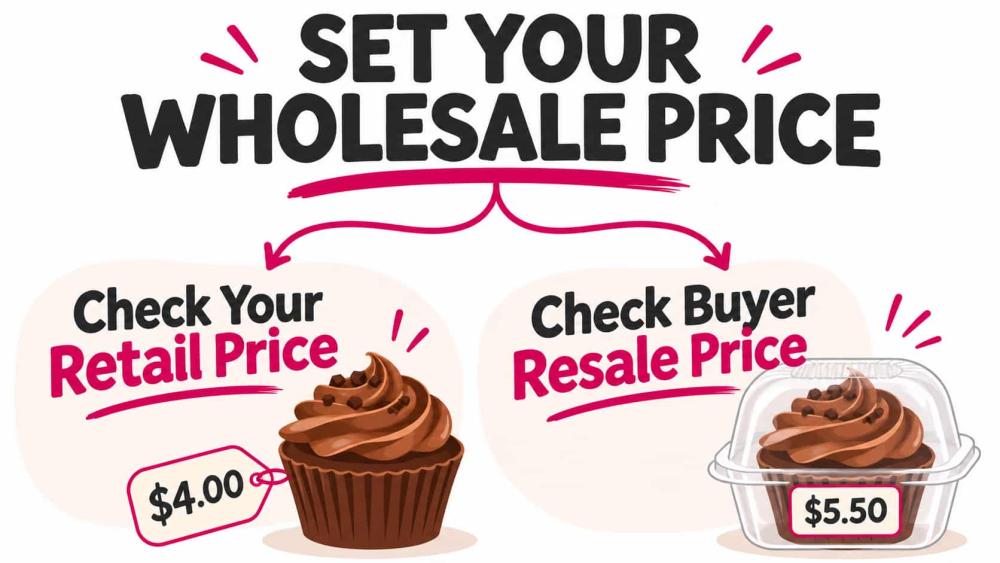
Direct Answer: Set your wholesale price from cost and a target margin, then check it against your retail price and the buyer's resale price.
One formula sets the price, two checks test it, and Step 4 reruns it for bigger orders.
What Is the Formula for Wholesale Pricing?
Direct Answer: Price equals cost divided by one minus your target margin. A $2.00 cost at a 33.3% margin gives a price of about $3.00 per box.
That margin formula also appears in the UVM Extension fact sheet on markup and margins. Pick the margin on the price, not on the cost. Check: $2.00 ÷ (1 minus 0.333) lands on $3.00.
What Is a Typical Profit Margin for Baked Goods?
Direct Answer: No single reliable figure fits every bakery. Work it out from your own costed recipes, then check it against retail and the buyer's resale price.
Margins vary by product and account. Start with the full cost from Step 1, then choose a margin that leaves enough profit for you and gives the buyer room to resell.
What Percentage Should I Take Off for Wholesale Price?
Direct Answer: There is no standard percentage. Check what margin each discount leaves at your retail multiple, then take off only what the margin can afford.
Treat this as a check, not a starting point. Here is a $2.00 cost at three retail prices and three discounts:
| Retail price (multiple of cost) | 30% off | 40% off | 50% off |
|---|---|---|---|
| $4.00 (2.0×) | $2.80, margin 28.6% | $2.40, margin 16.7% | $2.00, margin 0.0% |
| $5.00 (2.5×) | $3.50, margin 42.9% | $3.00, margin 33.3% | $2.50, margin 20.0% |
| $6.00 (3.0×) | $4.20, margin 52.4% | $3.60, margin 44.4% | $3.00, margin 33.3% |
Look at the 40% off column: 16.7%, 33.3% or 44.4%, depending on where retail started. A discount only compares once the retail multiple is stated, and this table is teaching arithmetic, not a benchmark. When a buyer asks for more off, run your own retail price through it first. At 50% off a 2.0× retail, you sell at cost.
What Does a Café Need to Charge to Resell My Product?
Direct Answer: Divide the café's cost per sellable unit by one minus its target margin. At a $3.00 cost and a 60% target, it must charge $7.50.
When the café works out its cost per sellable unit, it should include what it pays you plus any direct costs it pays to get the product ready for sale (University of Maryland Extension).
This assumes the café's total cost is $3.00 for the same box of six it sells. If it sells the cupcakes individually, work out the cost per cupcake first: $0.50 each at a 60% target gives $1.25. The 60% is an assumed target for this example, not an industry figure. If the café's customers will only pay $6.00 for the box of six, its margin is 50%. Run this check once per account. If the shelf price it needs looks unrealistic for a coffee shop counter, your price may be too high, or the item may not belong there.
Step 4: How Do You Set Volume Tiers and Minimum Orders?
Direct Answer: Tie each tier to a real saving, such as fewer deliveries, bigger batches or less packing time. Set the minimum where an order pays for itself.
A volume tier is not a reward for being a big account. It passes along cost you actually save:
- Fewer drops: one delivery for a large order costs less per unit than several small ones.
- Bigger batches: a longer run of one recipe spreads setup and labor across more units.
- Less packing time: packing one big order takes less time per unit than packing many small ones.
To price a tier, rerun Step 1 for the larger order with those savings in it, then price from the new cost. If you cannot point to the saving, you do not have a tier, you have a discount. Packaging follows the same logic: the price break in Step 1 comes from buying more at once, up to a point, and our guide to bakery packaging case quantities shows how to cost by case size.
The minimum works the same way. The smallest order you would deliver still has to pay for the drive, the packing and the invoice.
Step 5: What Do Payment Terms and Delivery Cost You?
Direct Answer: Waiting to be paid costs money. A $3,000 invoice carried 30 days at an assumed 12% annual rate has an estimated carrying cost of $29.59.
The 12% is an assumption for the example, so swap in your own cost of money. The point holds either way: payment due in 30 days is a price component, and a long wait eats into the margin you worked out in Step 3. How much cash cushion wholesale needs is covered in our wholesale bakery readiness guide.
Delivery is a component too. Quote it as a delivery charge or a drop minimum, and say which. If you fold delivery into the unit price, cost it once in Step 1 and nowhere else.
Step 6: What Goes on a Bakery Wholesale Price List?
Direct Answer: List item, unit or case, price, minimum order, lead time, delivery terms, payment terms, a valid until date and a contact on one page.
Keep it to one page, so a buyer can read it between deliveries. Two lines earn their space. The unit definition stops "a dozen" from meaning two things. The valid until date tells buyers how long your quote holds. It also gives you a natural time to rerun the numbers before sending the next one.
When Should You Raise Prices for a Wholesale Account?
Direct Answer: Reprice when ingredient costs, packaging costs or an account's volume change enough to move your margin. Rerun Step 1 first, then the price checks.
Flour and butter do not warn you before they move, so let the valid until date on your price list force a review. Check your costs before you quote a new account too. A price built on last season's numbers is a gift to the buyer.
What Should You Do Once the Price Is Set?
Direct Answer: Put the price on a one page list with a valid until date, then use that date as your cue to recheck your costs and terms.
Six steps, one thread: know your full cost per finished unit, keep markup and margin apart, set the price from cost and target margin and check it against retail and the buyer's resale price, earn your tiers by recalculating for larger orders, price in the cost of waiting, and put it on one page. Cost the packaging early too. It is the line that is easiest to leave off the sheet.
For more bakery insights, news and food industry tips, visit the Plastic Container City blog.
Once you know how to price baked goods for wholesale, run the numbers again whenever the order size, delivery terms or costs change.