

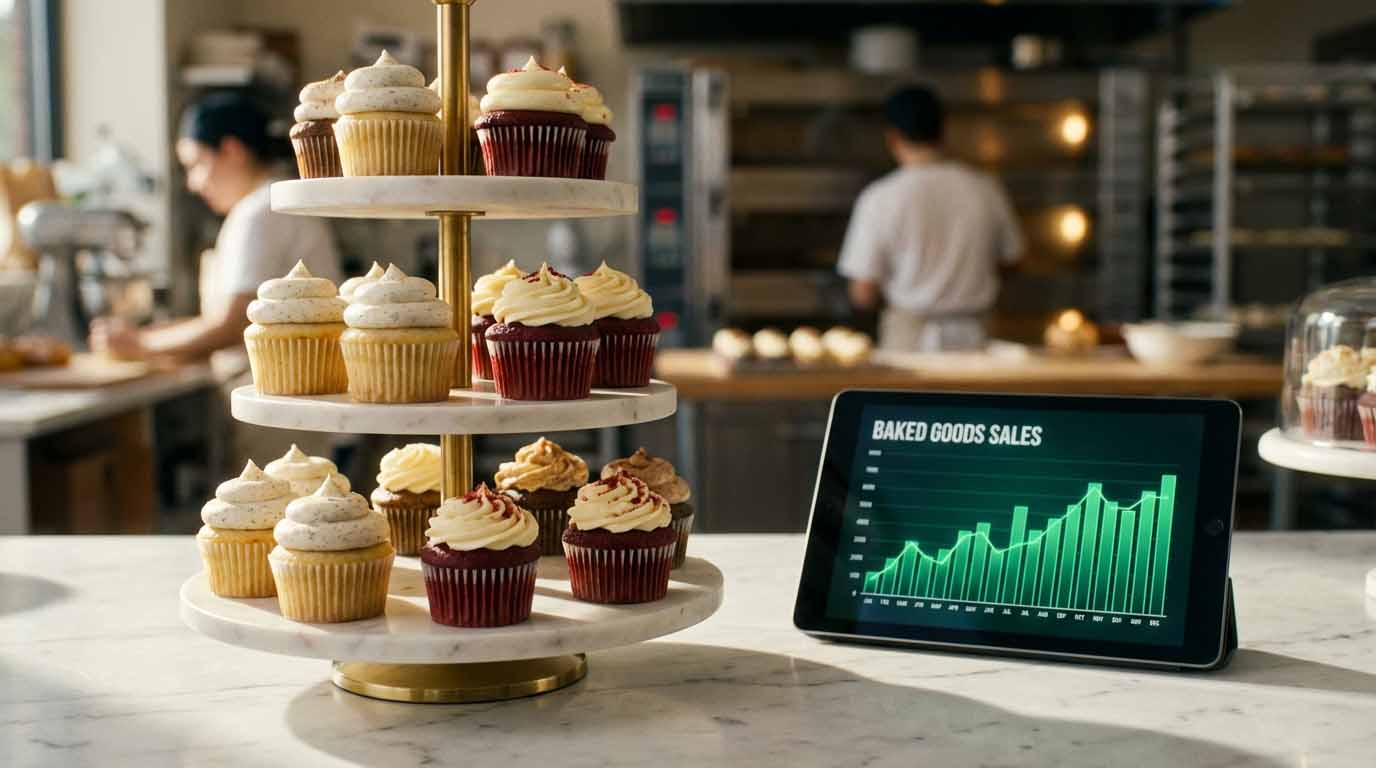
Want to know how to use ChatGPT for sales data without drowning in spreadsheets? Here's the answer: run a complete best-seller audit in 10 minutes. No formulas, no pivot tables. Just copy, paste, and get three concrete decisions about what to promote, what to fix, and what to cut.
You already know your croissants fly off the shelf. You know that experimental lavender tart sits there looking pretty. But which items are quietly draining your profit margin? Which high-margin products need better visibility? Your gut feeling won't tell you. A quick AI analysis will.
This isn't about replacing your expertise. It's about getting a second opinion that can analyze your entire menu faster than you can brew a pot of coffee.
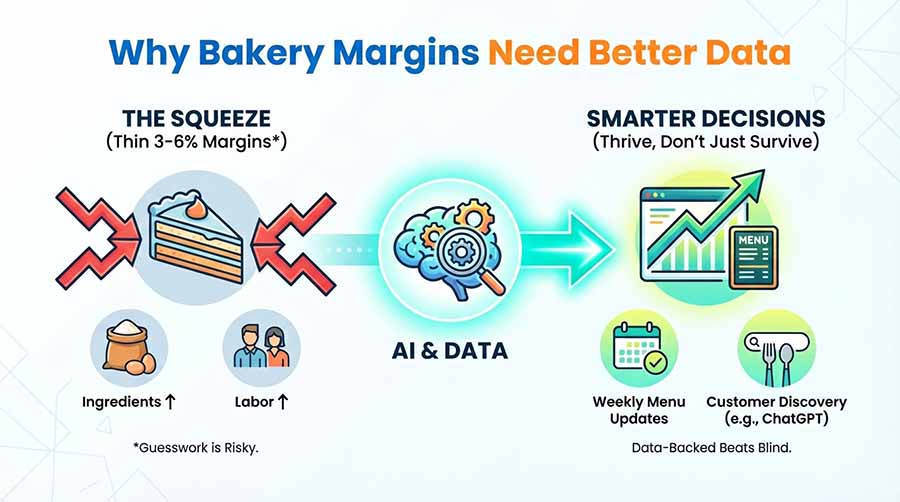
Why Bakery Margins Demand Better Data
Your profit margin is thinner than you think. Full-service restaurants operate on 3 to 6% margins, and bakeries face the same squeeze. When ingredient costs spike and labor gets expensive, every menu decision counts.
Here's what changed in 2025: 54% of restaurant operators are investing more in AI tools. Not because it's trendy. Because data-backed decisions beat guesswork when margins are this tight. And it's not just backend operations—ChatGPT is actively changing how customers discover restaurants, making these data-driven menu decisions even more critical.
At Plastic Container City, we work with thousands of bakery owners across the U.S. The ones thriving right now stopped flying blind with their menus. They're making data-backed menu decisions weekly, not quarterly.
How to Use ChatGPT for Sales Data: The 10-Minute Audit
You don't need a data science degree. You need 10 minutes and a willingness to look at your numbers honestly.
Step 1: Export Your Sales Report
Most bakery POS systems make this simple. You need three columns: Item Name, Quantity Sold, and Total Revenue. That's it.
Square: Dashboard > Reports > Item Sales > Export CSV
Toast: Reports > Sales > Item Performance > Download
Clover: Web Dashboard > Orders/Transactions > Export to Excel
Don't stress about perfection. AI handles messy data. Just make sure your item names are consistent. "Choc Chip Cookie" and "Chocolate Chip Cookie" will confuse the analysis.
Step 2: Paste Into Your AI Tool
Tool-agnostic reality: This process works in ChatGPT, Claude, or Google Gemini. The examples here use ChatGPT because it's the most common starting point, but the prompts work anywhere.
Open your AI tool. Copy your sales data. Paste it directly into the chat. Here's what a sample looks like:
| Item | Qty Sold | Total Sales | Cost per Unit |
|---|---|---|---|
| Croissant | 420 | $1,680 | $0.85 |
| Blueberry Muffin | 310 | $1,085 | $0.65 |
| Sourdough Loaf | 180 | $1,260 | $2.10 |
| Lavender Lemon Tart | 45 | $270 | $1.80 |
The Three Prompts That Actually Work
These aren't vague requests. They're specific prompts that tell you exactly what to do next.
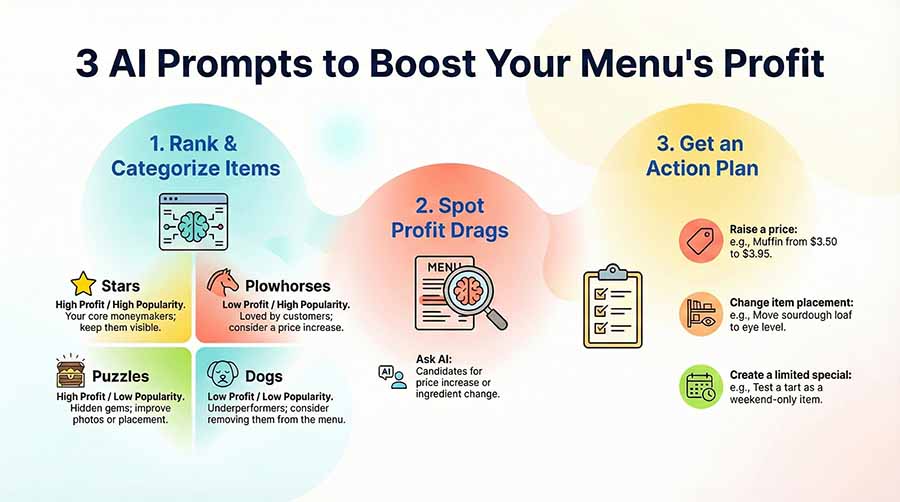
Prompt 1: Rank and Categorize
"Group these items by popularity and revenue. Show me which ones are high-volume sellers, which are low-volume but profitable, and which are underperforming on both metrics."
This gives you the classic menu engineering matrix without building it yourself:
Stars: High profit, high popularity. Your moneymakers. Keep them front and center.
Plowhorses: Low profit, high popularity. People love them, but they're not making you money. Consider a price increase or ingredient swap.
Puzzles: High profit, low popularity. Hidden gems. Better photos, better placement, or a name change could turn them into stars.
Dogs: Low profit, low popularity. Cut them. They're taking up mental space, ingredient inventory, and display room for no reason.
Once you identify your stars and dogs, learn which specific desserts drive the highest margins for your bakery type.
Prompt 2: Profit Spotter
"Assuming a 30% food cost, which items are dragging down my margin? Show me the top three candidates for a price increase or ingredient adjustment."
This is where reality hits. You might discover your best-selling muffin is losing money because butter prices went up and you never adjusted. Or your fancy tart uses $1.80 in ingredients and sells for $6, which sounds great until you realize you only sell five per week.
If your analysis reveals pricing gaps, here's a systematic pricing approach that protects both margin and customer loyalty.
AI won't know your grandma's secret recipe is a loss leader on purpose. But it will flag the items that deserve a closer look.
Prompt 3: Action Plan
"Give me three specific changes I can make this week to increase profit. Be concrete."
Expect answers like:
- Raise the price of your blueberry muffin from $3.50 to $3.95
- Move your sourdough loaf to eye level and add a small chalkboard sign
- Remove the lavender lemon tart from your daily menu and test it as a weekend-only special
These aren't generic tips. They're moves you can execute before your next shift.
What AI Gets Right (and What It Misses)
ChatGPT isn't a bakery owner. It doesn't know your loss-leader croissants bring in customers who then buy $20 worth of other stuff. It doesn't understand your ugly-but-delicious cookies are a neighborhood tradition.
Use these insights as a second opinion, not a command. If the AI tells you to cut something you know works for strategic reasons, ignore it. But if it flags three low-margin items you've been ignoring, listen.
The biggest mistake? Treating AI like a crystal ball. It's not. It's a calculator that speaks English. Feed it good data and clear questions, and you get useful answers. Feed it garbage, and you get nonsense back.
Privacy and Data Accuracy
Can you put company data into ChatGPT? Technically, yes. Should you paste your full financial records? No.
Stick to anonymized sales data. Remove dollar signs if you're nervous. Use "Item A" and "Item B" instead of real product names. The analysis still works. AI doesn't need your tax returns to tell you which muffin is underperforming.
As for accuracy, AI adoption among small businesses hit 8.8% by Q3 2025. Operators are seeing real results. But the tool is only as good as your data. If your POS labels everything as "Misc Item," you're getting useless output.
Watch Out for Seasonal Bias
Don't run this analysis in January and then cut your lemonade because nobody bought it in December. Context matters.
If you're analyzing holiday sales, tell the AI. If you just launched a new item, mention it. Seasonal bias will wreck your decisions if you're not paying attention. Give your AI assistant the full picture, not just the raw numbers.
Track Your Changes
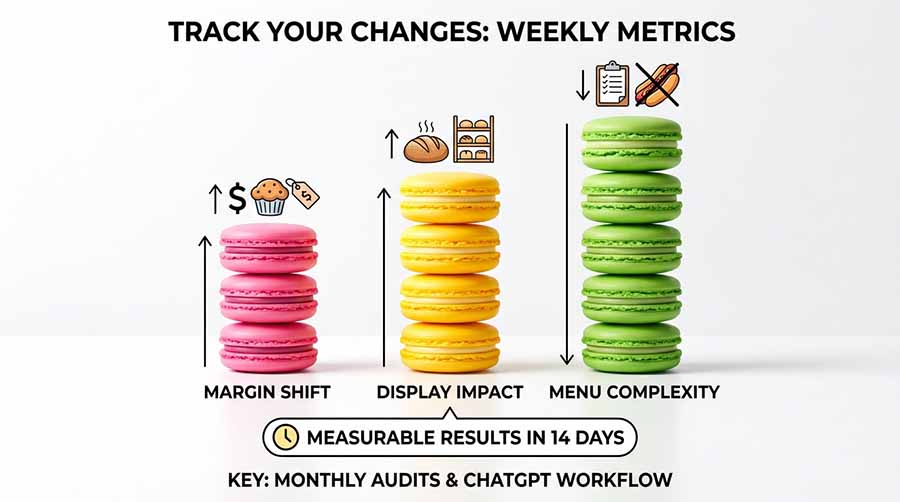
After running your first audit, track these three metrics weekly:
Margin shift: Did raising that muffin price change sales volume?
Display impact: Did moving your sourdough increase daily sales?
Menu complexity: Did cutting two dogs make operations smoother?
Most bakery owners see measurable results within 14 days. The key is running this monthly so that learning how to use ChatGPT for sales data becomes part of your regular workflow.
Your 5-Step Action Plan
Stop reading. Start doing:
- Export 30 days of sales data from your POS. Three columns: item name, quantity sold, total revenue.
- Open ChatGPT, Claude, or Gemini and paste your data directly into the chat.
- Run all three prompts (Rank and Categorize, Profit Spotter, Action Plan). Copy the responses.
- Pick one action from the output. Implement it this week. Raise a price, move a display, cut a dog.
- Run this audit monthly. Track what changes. Adjust as you go.
This isn't a one-time exercise. Make it a habit. Spend 10 minutes every month comparing what's actually selling versus what you think is selling. The gap between those two things is where your profit lives.
At Plastic Container City, we see it constantly: the operators who win combine great products with smart decisions. You can have both. You just need to look at the numbers once in a while.
For more bakery insights and food industry strategies, visit the Plastic Container City blog.
FAQ
Can ChatGPT analyze sales data?
Yes. ChatGPT processes sales reports, identifies patterns, and suggests menu changes based on profitability and popularity metrics. You don't need to upload files. Pasting text directly into the chat works fine.
How accurate is ChatGPT data analysis?
AI is as accurate as the data you provide. Clean POS data with consistent item names produces reliable insights. If your system labels everything as "Misc Item," results will be useless. Always cross-check AI suggestions against your real-world business knowledge before implementing changes.
What is the 30% rule in AI?
The 30% rule refers to food cost percentage. It means assuming your ingredient costs are 30% of your menu price, which is a standard benchmark for calculating gross margin. AI uses this to identify which items are dragging down profitability.
Which AI tool is best for sales?
ChatGPT, Claude, and Google Gemini all handle basic sales data analysis well. ChatGPT is the most widely used, but the prompts in this article work across platforms. Choose based on what you already have access to.
