


Your Delivery Orders Just Got Intercepted. Here's Your 30-Day Response Plan
How can AI food delivery make your restaurant invisible overnight?
It starts when ChatGPT lets 800 million users order from Uber Eats and DoorDash without ever opening a delivery app. That's not a future trend. That's happening right now.
Here's what that means for your restaurant: customers aren't scrolling through delivery apps anymore. They're having conversations with an AI that decides which restaurants show up and which ones don't. If your menu, reviews, and online presence aren't optimized for these conversational searches, you're invisible.
While most operators are still trying to figure out what just happened, smart ones are already repositioning their businesses for this shift. This isn't about keeping up. It's about getting ahead before your competitors do.
How ChatGPT Food Ordering Changes Restaurant Discovery
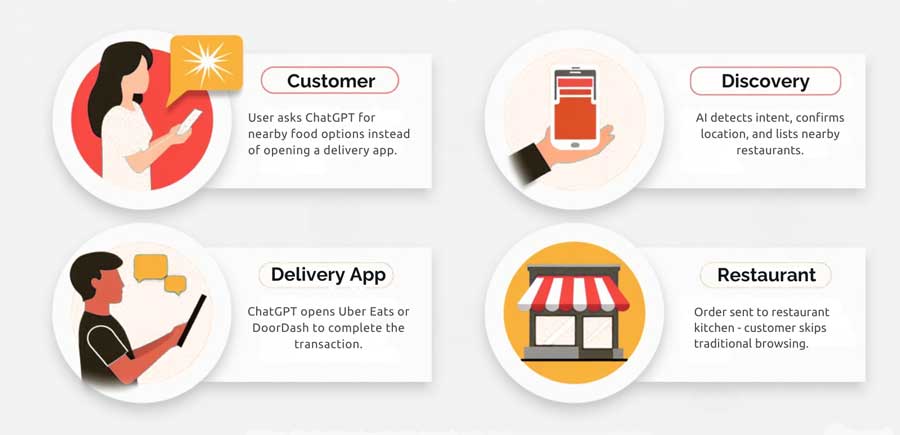
ChatGPT users can now start ordering food directly within the ChatGPT interface. The system detects when someone wants food, confirms their address, shows nearby options, then launches the delivery app to complete the transaction.
The United States represents approximately 16% to 19% of ChatGPT's global user base, translating to millions of potential customers bypassing traditional restaurant discovery entirely.
Nobody Knows How Restaurants Get Prioritized
Here's what keeps operators up at night: nobody has clarified how ChatGPT prioritizes restaurants or who owns the data from these conversational orders.
This matters because third-party platforms already own customer data under the current model. You get a first name, last initial, and order details. They get everything else and build the loyalty while you cook the food.
The numbers tell the story: owning customer data increases lifetime value by 67% through direct marketing and loyalty programs. But when orders come through ChatGPT and then get handed off to delivery platforms, that data relationship gets even more complicated.
A federal judge ruled in September 2024 that delivery apps don't have to share detailed customer information with restaurants, citing First Amendment rights. So that data gap? It just got legally protected.
Why Traditional Menu Descriptions Don't Work Anymore
Old search: "Pizza near me."
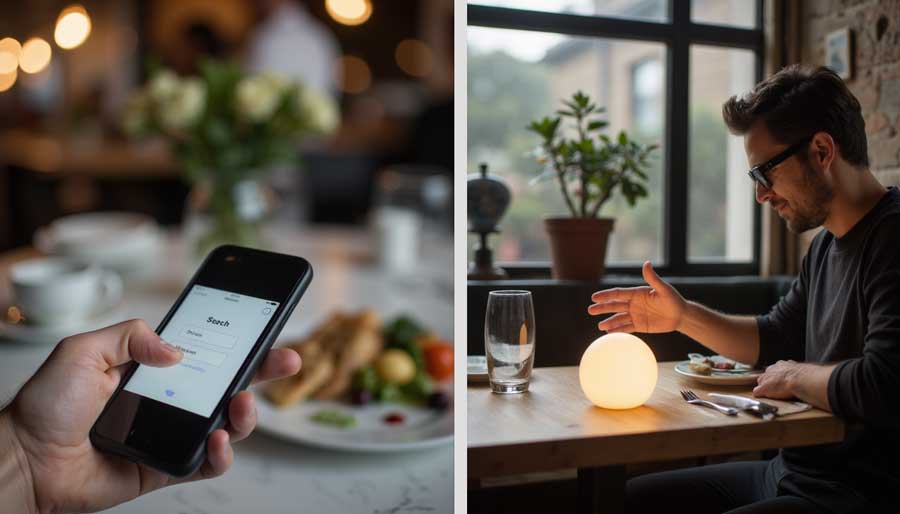
New search: "I need something quick for dinner. My partner is vegetarian but I want something with protein. We like spicy food but nothing too heavy. What's good around here that delivers fast?"
See the difference? People aren't typing keywords anymore. They're having full conversations about what they want, why they want it, and what constraints they're working with.
AI search engines retrieve fragments of meaning from structured and unstructured content. They don't return ten blue links. They give one confident, specific answer based on the conversation. If you're not that one answer, you're completely invisible for that search.
Your menu needs to speak AI's language.
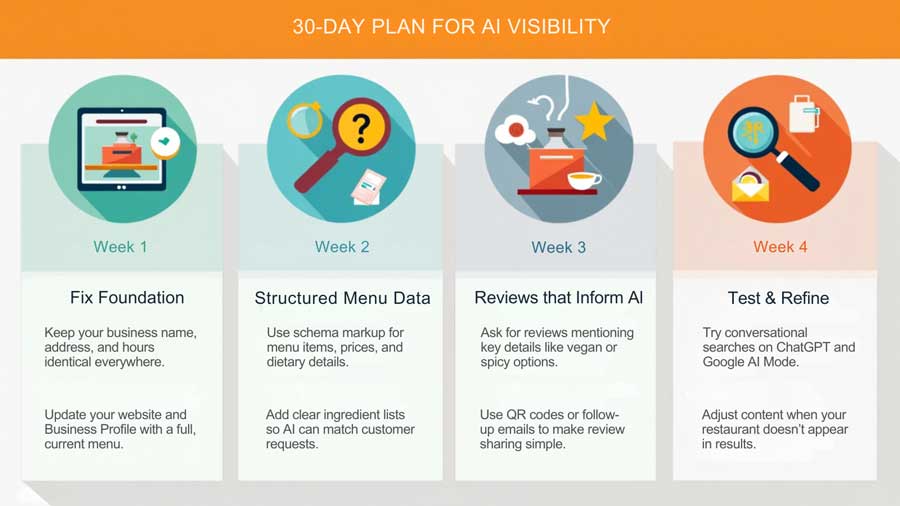
Your 30-Day Action Plan: Getting Visible in AI Search
Week 1: Fix Your Foundation (SEO and Local SEO)
Mastering GEO depends on excelling at traditional SEO. If your basic SEO is broken, AI won't find you.
Start with consistency. Your name, address, phone number, hours, and menu need to match across your website, Google Business Profile, and every delivery platform.
Check your Google Business Profile. Current hours? Menu uploaded? Recent reviews answered? These basics matter more now than ever.
Week 2: Add Structured Data to Your Menu
AI platforms use schema markup to understand menu items, price ranges, and dietary accommodations. Without it, you're making AI guess.
Go beyond pretty descriptions. Include detailed ingredient lists and accommodation capabilities so AI can match your restaurant to specific needs.
When someone asks for "gluten-free pasta with dairy-free sauce," AI needs to know you can deliver.
Week 3: Collect and Optimize Customer Reviews
AI loves Human Generated Content because it's authentic. Detailed customer reviews mentioning your brand name alongside specific keywords are gold.
Push for reviews with details: "vegan options," "outdoor seating," "spicy levels," "quick service," "date night atmosphere." These descriptors help AI understand when to recommend you.
We've noticed food businesses getting creative with review collection at Plastic Container City. QR codes on takeout containers, post-purchase email sequences, table tents asking specific questions. The ones gaining traction ask the right questions to get useful answers that feed AI discovery.
Week 4: Test and Refine Your AI Visibility
Search for your own restaurant using conversational queries in ChatGPT, Google's AI Mode, and Perplexity:
"I need a family dinner spot with vegetarian options and outdoor seating in [your neighborhood]"
"Quick lunch under $15 near [your address] with gluten-free choices"
"Date night restaurant with craft cocktails and cozy atmosphere in [your area]"
Not showing up? You know what needs work.
The Voice AI Opportunity Everyone's Missing
While everyone obsesses over ChatGPT, there's a bigger play with voice ordering. 89% of Americans would use an AI agent to interact with a restaurant.
The numbers get better: 63% cite calling as their preferred contact method, and 69% give up if nobody answers.
Think about revenue walking out the door when your staff is too slammed to answer calls.
Major Chains Are Already Moving
Dine Brands (Applebee's and IHOP) announced Voice AI Agent plans in June 2025 for phone orders. When big chains move, they've done the math.
Square launched AI-Powered Voice Ordering in October 2025 that answers 100% of incoming calls, handles customizations, and sends orders directly to your POS. No errors. No missed calls. No labor cost for phone coverage.
The ROI: AI hosts generate $3,000 to $18,000 per month per location in additional revenue, with returns up to 25 times the cost.
What This Means For Delivery Operations
Voice AI isn't just for dine-in. It's critical for delivery-focused businesses and cloud kitchens where phone orders drive revenue. AI chatbots already handle 70% of U.S. restaurant reservations in major cities. That trend applies to takeout and delivery too.
The Real Cost of Third-Party Delivery
Third-party platforms charge 15% to 30% commission on delivery orders, usually 6% on pickup.
But that's the advertised rate. Add payment processing, marketing costs, and delivery fees, and the real cost exceeds 40% of revenue.
ChatGPT adds another layer between you and the customer. Same commissions, but discovery happens somewhere else entirely.
Source: ActiveMenus Third-Party Delivery Cost Analysis
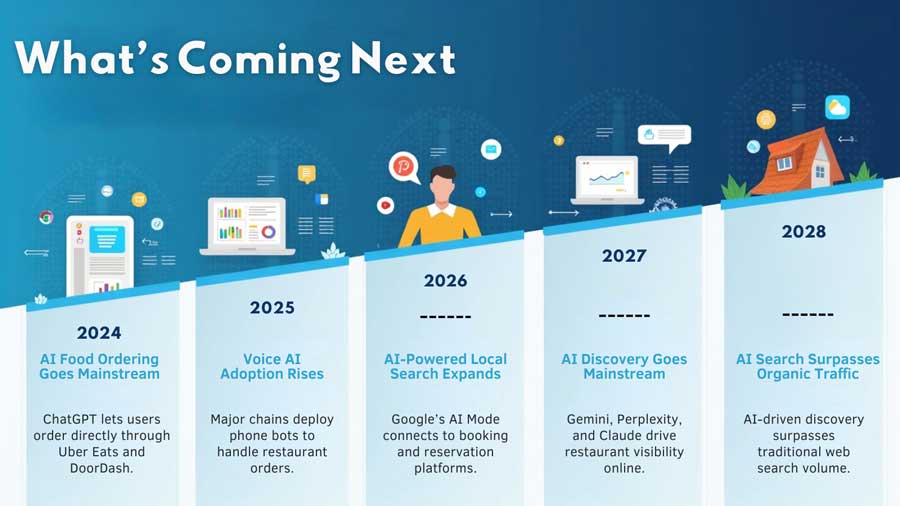
What's Coming Next
Google Search is rolling out agentic capabilities in AI Mode that searches OpenTable, Resy, and Tock for real-time availability.
Gemini, Perplexity, and Claude are influencing consumer behavior too. Traffic from AI search engines is projected to overtake organic search by 2028.
You can't optimize for just one platform. The playbook works across all of them: clear information, structured data, authentic reviews, conversational content.
Turn AI Into Your Operational Advantage
While optimizing for AI discovery, use AI for operational tasks like real-time food cost analysis, personalized pricing, and seasonal menu planning.
TGI Fridays saw a seven-fold ROI in year one of AI implementation and nearly tripled off-premise revenue. Early adoption pays.
What Restaurant Owners Should Do Right Now
Stop waiting for clarity from ChatGPT, OpenAI, or the delivery platforms. They're not slowing down.
Control what you can: your online presence, menu descriptions, review strategy, and data collection from direct orders. Make your restaurant discoverable through clear, structured, conversational content.
Consider voice AI as a direct ordering channel that bypasses the discovery problem. When customers call directly, you control the experience and keep the data.
Restaurants that move now gain the advantage. Those waiting will play catch-up while competitors capture market share.
This isn't about technology for technology's sake. It's about staying visible when 800 million people can order food without thinking about your restaurant by name. That's the new reality of AI food delivery, and it's not slowing down for anyone.
Want more insights on navigating the evolving food industry? Explore our complete library of guides, trends, and actionable strategies written specifically for food professionals like you.
Frequently Asked Questions
How does ChatGPT food ordering actually work?
ChatGPT detects when you want to order food, confirms your delivery address, shows nearby restaurants and menus, then prompts you to open Uber Eats or DoorDash to complete the transaction. The order itself still goes through the traditional delivery apps, but discovery happens in ChatGPT.
Does using ChatGPT for ordering change commission rates for restaurants?
No. Since orders ultimately go through DoorDash, Uber Eats, or Instacart, the same commission structures apply (typically 15-30% for delivery). ChatGPT just changes how customers discover restaurants, not how they pay or how restaurants get charged.
Can restaurants opt out of appearing in ChatGPT search results?
There's no clear opt-out mechanism announced yet. Since ChatGPT pulls from existing online information and delivery platform data, controlling your visibility means optimizing your presence on those platforms and your own website.
What's the difference between SEO and GEO for restaurants?
Traditional SEO optimizes for keywords and search rankings. GEO (GPT Engine Optimization) or AIO (Artificial Intelligence Optimization) optimizes for conversational queries and AI retrievability through structured data, detailed descriptions, and authentic customer reviews that mention specific attributes.
Will voice AI replace human phone order-takers?
Voice AI handles routine orders and customizations, freeing staff for in-person service and complex requests. Major chains like Applebee's and IHOP are implementing voice AI not to eliminate jobs but to capture orders they're currently missing when phones go unanswered during busy periods.
