
TL;DR: Bakery packaging laws 2026 are already in effect across several U.S. states. PFAS grease-proofers are off the market. Foam clamshells are banned in New York, California, and rolling out in Virginia. California's plastic bag rule is live. Whether you run a café, food truck, or home kitchen, this guide breaks down exactly what to swap, what stays the same, and what the fines look like if you fall behind.
If you haven't updated your packaging order since last year, bakery packaging laws 2026 may have already put you out of step with the rules. Not theoretically. Not "coming soon." Several state-level bans took effect January 1, 2026, with real penalties behind them.
The shift covers three main areas: PFAS chemicals in paper-based food packaging, expanded polystyrene (EPS) foam bans, and California's complete prohibition on plastic checkout bags. Taken together, they touch bakeries of every size, from full commercial operations down to food trucks and cottage bakers selling at farmers' markets.
At Plastic Container City, we supply food businesses across the U.S., which gives us a front-row seat to what is actually changing on the ground. The most common question we hear from our customers? "Does this really apply to me?" The short answer: probably yes. Here is the full picture.
What Are the New Bakery Packaging Laws for 2026?
U.S. states now ban foam containers and PFAS-treated paper. California prohibits plastic checkout bags. These rules are active as of January 2026.
The laws fall into three distinct categories.
- PFAS restrictions affect greaseproof liners, parchment alternatives, and bakery bags that were historically treated with per- and polyfluoroalkyl substances.
- Foam and EPS bans target single-use clamshells, cups, trays, and cold storage containers made from expanded polystyrene.
- California's SB 1053 bag law means retail stores, including bakeries, can no longer hand out plastic checkout bags at point of sale.
None of these are federal mandates yet. The proposed "Farewell to Foam Act" in Congress targets a federal phase-out from January 2028, but it has not been enacted. For now, compliance is state-driven. Between New York, California, Virginia, and Maine, a substantial portion of U.S. food businesses are already covered.
Does This Apply to My Bakery?
Yes, for most operations. Brick-and-mortar bakeries, food trucks, and home bakers selling direct-to-consumer in California, New York, or Virginia are covered under at least one new rule.
Use this table as your first check:
| Business Type | CA | NY | VA | ME | All Others |
|---|---|---|---|---|---|
| Brick-and-mortar bakery | Yes (bags + EPS + PFAS) | Yes (EPS) | Yes (EPS from July 2026) | Check local rules | Check state rules |
| Food truck | Yes | Yes | Yes | Check local rules | Check state rules |
| Cottage food / home baker | Yes (if selling in retail) | Yes (if operating as food service) | Partial | Check local rules | Check state rules |
| Catering operation | Yes | Yes | Yes | Check local rules | Check state rules |
If you operate in multiple states, the strictest state law applies to your operations in that state. You can't average it out across locations.
What Is PFAS and How Does It Affect Your Bakery Packaging?
PFAS make paper grease-resistant. The FDA confirmed these chemicals are no longer sold for food-contact use in the U.S. as of February 2024.
PFAS stands for per- and polyfluoroalkyl substances. In plain terms: they were the chemicals that made your greaseproof liners actually grease-resistant. Baking paper, pastry boxes, and deli sheets all historically used PFAS coatings to stop butter and oil from soaking through.
The FDA confirmed in February 2024 that PFAS-containing substances used as grease-proofers on paper and paperboard are no longer being sold by manufacturers into the U.S. market for food-contact use. By January 2025, a Federal Register notice formally declared 35 PFAS-related food contact notifications no longer effective.
The FDA's position on authorized PFAS uses in food contact makes clear that paper and paperboard grease-proofers were the main category raising dietary exposure concerns. Other uses, such as PFAS in nonstick cookware coatings or equipment gaskets, involve negligible migration and remain lower-priority.
Which Bakery Packaging Formats Are Affected?
The formats most likely to have carried PFAS grease-proofing treatments:
- Greaseproof parchment liners and baking sheets
- Waxed paper and deli-style sheets
- Pastry bags and bakery tissue
- Grease-resistant boxes for pastries, croissants, and pies
- Pizza-style and carry-out bakery bags
What to Ask Your Supplier
Don't wait for your supplier to volunteer this. Ask directly: "Are any of your paper-based food-contact products treated with PFAS?" Request a written confirmation or certificate of compliance. If they can't provide one, that is a sign to look elsewhere. For a full breakdown of what food-safe packaging your bakery actually needs, the guide on must-have food packaging for bakeries covers the essentials.
Pro tip: Don't assume every roll of parchment paper is naturally PFAS-free. While many brands have switched, you need to look for a PFAS-free certified label. The FDA also states that standard total fluorine testing cannot actually distinguish PFAS from other fluorine-containing compounds, which means a written certificate of compliance from your supplier is the only documentation that genuinely covers you.
Which Foam Formats Are Banned and Where?
EPS foam food containers are banned in New York and California. Virginia bans them for chains from July 2025 and all food vendors from July 2026. Clear PET clamshells are the accepted replacement.
Foam and polystyrene are the same material. If you're selling baked goods in an EPS clamshell, cup, or tray, here is the state-by-state picture:
New York banned foam disposable food service containers in 2022. As of January 1, 2026, the NY DEC added a Cold Storage Container Ban, prohibiting EPS containers designed for cold storage (including foam coolers and ice chests) from being sold or distributed by any covered food service provider, manufacturer, or store.
California required EPS food service ware producers to demonstrate a 25% recycling rate as of January 1, 2025. That rate was not met. CalRecycle confirmed that producers are now prohibited from selling, offering, or distributing EPS food service ware, including single-use takeout containers and cups, in or into California.
Virginia is rolling this out in phases. Chains operating 20 or more locations in Virginia must comply from July 1, 2025. All other food vendors must comply from July 1, 2026. Civil penalties of up to $50 per day per location apply, with a required written warning before any fine is issued.
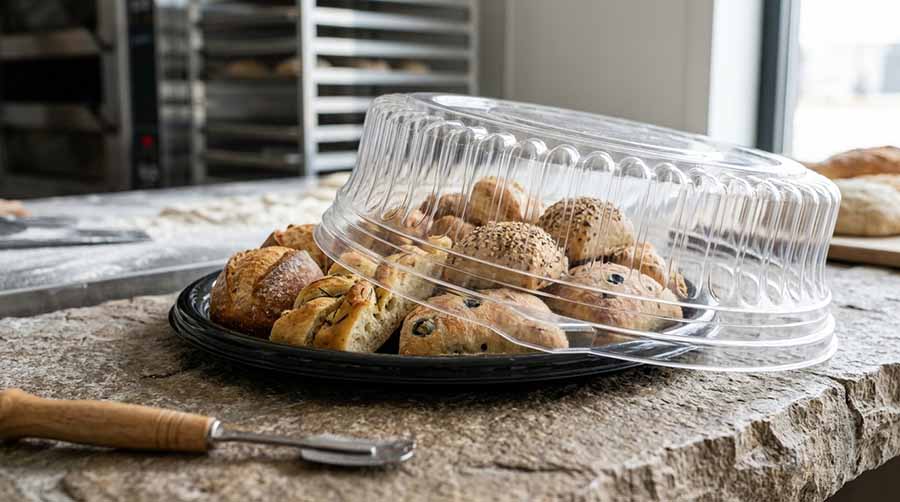
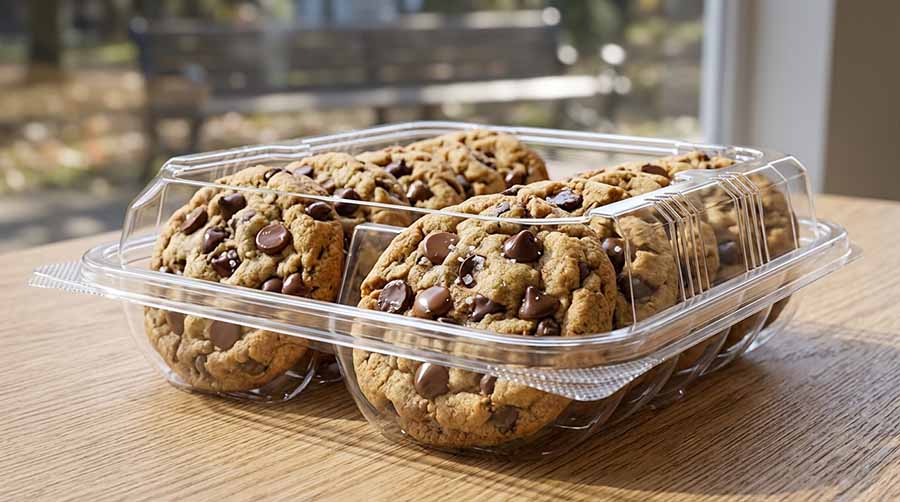
The compliant replacement: Clear PET clamshells. They're food-safe, widely stocked, and visually better for displaying baked goods. Virginia's DEQ lists PET among its recommended alternatives, and they're accepted across all three states.
California's Bag Law: What Bakeries Actually Need to Know
California's SB 1053 took effect January 1, 2026. Retail bakeries cannot provide plastic bags at checkout. Recycled paper bags must be sold for at least $0.10. WIC and EBT customers receive a bag free.
The law applies to businesses meeting California's statutory definition of a "store," which covers most retail bakery operations. If your bakery sells packaged goods at a checkout point, you can no longer hand out a standard plastic carrier bag.
You may offer a recycled paper bag for a minimum charge of $0.10. If a customer pays using a WIC voucher or an electronic benefits transfer card, that bag must be provided free of charge.
Penalties under the CalRecycle enforcement framework start at $1,000 per day for a first violation, $2,000 per day for a second, and $5,000 per day for a third and any subsequent violation. Enforcement sits with cities, counties, and the California Attorney General. CalRecycle itself does not hold enforcement authority. Food trucks operating as mobile retail units in California should verify their status with local authorities, as the definition of "store" may apply depending on how the operation is structured.
What Must Appear on Your Bakery Labels?
Labeling requirements haven't changed dramatically in 2026, but they're worth reviewing alongside your packaging update.
Retail and commercial bakery packaging must include:
- Product name
- Net weight or quantity
- Allergen declarations (the FDA's Big 9: milk, eggs, fish, shellfish, tree nuts, peanuts, wheat, soy, sesame)
- Ingredient list in descending order by weight
- Name and address of manufacturer or distributor
- "Best by" or use-by date where applicable
Cottage food packaging also requires:
- The statement "Made in a home kitchen not inspected by [State] Department of Agriculture" (exact wording varies by state)
- Producer contact details
- Full ingredient and allergen list
- Net weight
- A clear production date or shelf life indicator
Always cross-check with your state's department of agriculture, as individual states can layer additional requirements on top of federal minimums.
The Bakery Packaging Swap Table
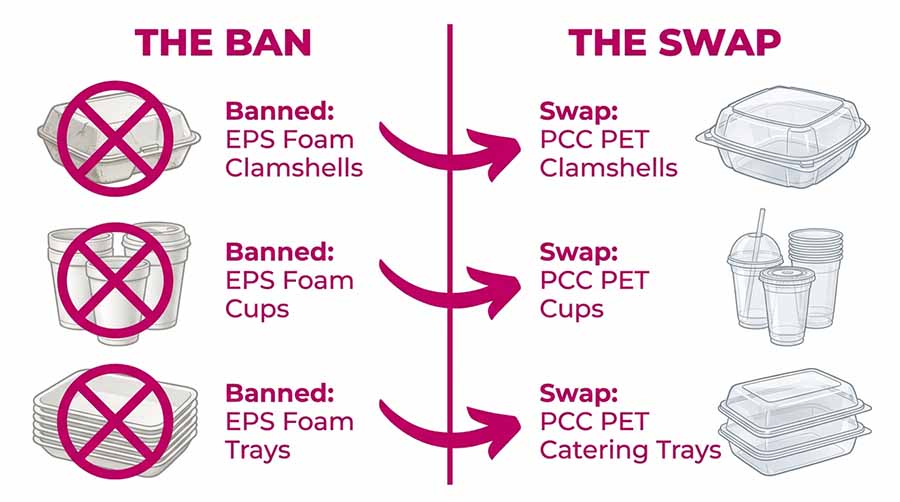
This is the practical heart of the article. Here is what to replace and what to replace it with:
| Banned or Phased-Out Item | Compliant Replacement |
|---|---|
| PFAS-treated greaseproof parchment liner | PFAS-free certified parchment or uncoated baking paper |
| Foam (EPS) clamshell container | Clear PET clamshell |
| Plastic checkout bag | Recycled paper bag or certified compostable bag |
| PFAS greaseproof liner or deli sheet | Unbleached wax paper or PFAS-free certified liner |
| Foam cup | Paper cup (single or double wall) |
| Thin plastic retail bakery bag | Kraft paper bag, glassine, or natural cellophane |
| EPS cold storage container (foam cooler) | Insulated paper alternative or PET-based cooler |
Compliant versions of every item in this table are available at Plastic Container City, with options sized and priced for bakeries of every scale. You can also check the guide on bakery delivery packaging for format-specific guidance on keeping baked goods intact during transport.
Key Compliance Deadlines for 2026 and Beyond
| Deadline | What Is Changing | States Affected |
|---|---|---|
| January 1, 2026 | Plastic bag ban (SB 1053); EPS cold storage container ban | California, New York |
| July 1, 2025 (passed) | EPS ban for chains with 20+ Virginia locations | Virginia |
| July 1, 2026 | EPS ban extended to all food vendors | Virginia |
| May 2026 | PFAS packaging restrictions | Maine |
| July 20, 2028 | FSMA 204 traceability enforcement begins | Federal (all states) |
| 2032 | 100% recyclable or compostable single-use packaging goal | California (SB 54) |
On FSMA 204: the FDA's traceability rule covers shell eggs and nut butters, both common bakery ingredients. Congress directed the FDA not to enforce the rule before July 20, 2028. The original compliance date was January 20, 2026. If your bakery uses these ingredients at scale, start building traceability records now rather than scrambling closer to the deadline.
What Is NOT Changing?
Most standard bakery packaging is unaffected. The 2026 rules target EPS foam, PFAS-treated paper, and plastic checkout bags only. PET, kraft, cardboard, and cellophane are all fine.
The clear majority of what most bakeries use every day is completely unaffected. PET clamshells are fine. Kraft and paper bags are fine. Cardboard boxes are fine. Greaseproof liners that don't use PFAS coatings are fine. Cellophane wrap, tissue paper, and printed labels are all unaffected.
This is not a full packaging overhaul. It is a targeted removal of a small number of materials that have been on the way out for years. If your current setup already skips foam containers and uses paper-based alternatives, your compliance lift is minimal. The businesses getting caught out are usually the ones running old stock without realising the rules have changed.
One more thing worth flagging: you may have seen claims that Illinois has a 2026 state-level bakery foam ban. That is a common mix-up with Illinois SB 2960, a law that actually targets hotel toiletry bottles, not food service containers. As of now, Illinois has no statewide bakery foam ban for 2026. Local city and county ordinances can vary, so it is still worth checking with your municipality, but the statewide ban does not exist.
What Happens If You Don't Comply?
California bag law fines start at $1,000 per day. Virginia foam violations carry up to $50 per day after a written warning. New York enforces EPS bans through graduated state-level penalties.
Here is the breakdown by state:
- California (bag law): $1,000 per day for a first violation, $2,000 per day for a second, and $5,000 per day for a third and any subsequent violation. Enforcement is by cities, counties, and the state Attorney General.
- Virginia (EPS ban): Civil penalties of up to $50 per day per location. A written warning must come before any fine is imposed. Localities can grant a one-year exemption where no affordable alternatives exist.
- New York (EPS ban): Graduated fines enforced at state level through the NY DEC. Repeated violations attract increasing penalties.
The tone of enforcement so far is compliance-focused, not punitive. Written warnings typically precede any financial penalty. That is not an invitation to stall. It simply means that businesses making a good-faith effort to switch are less likely to face immediate fines than those ignoring the rules outright.
Home Bakers and Cottage Food: Yes, This Applies to You Too
If you sell at farmers' markets or direct-to-consumer in California, New York, or Virginia, bag laws and EPS bans apply to you, even as a home baker operating under cottage food rules.
The "I'm just a home baker" assumption is exactly where a lot of small operators get caught. If you're selling in California and handing goods out in a plastic bag, you're subject to the bag law. If you use EPS clamshells to package cookies or pastries in New York, the foam ban applies to you too.
Your labeling requirements don't shrink because your kitchen is small. Cottage food producers across most U.S. states must include a home kitchen disclosure, full allergen details, net weight, and a production or shelf-life date. Several states require this text verbatim; check your state's agriculture department for exact wording.
At Plastic Container City, we often hear from customers who built a thriving home operation without ever checking whether their packaging was compliant. It's a quick fix, but only if you catch it early. The guide on running a profitable cottage food business covers the compliance side alongside the commercial one.
Bakery packaging laws 2026 are a real compliance shift, but they are not a crisis if you act now. The foam bans are specific. The PFAS restrictions are clear. The bag law has a simple, low-cost fix. Businesses that run into trouble are almost always the ones who assumed the rules didn't apply to them.
Start with your most-used packaging formats and check each one against the swap table above. Replace anything on the banned list, ask your supplier for written confirmation on PFAS status, and make sure your labels cover the full required fields. None of that is complicated. It just needs to be done.
For more bakery insights, packaging guidance, and food-industry news, visit the Plastic Container City blog. Staying on top of new packaging laws in 2026 doesn't have to be a distraction from what you do best.
Frequently Asked Questions
Are foam clamshells completely banned across the U.S.?
Not federally, but they are banned in New York, California, and Virginia (all vendors from July 2026). A federal phase-out bill has been proposed in Congress but has not yet been passed into law.
The "Farewell to Foam Act" proposes a federal phase-out starting January 2028. Until that becomes law, EPS restrictions remain state-driven. If you operate across multiple states, you need to check each state individually. The safest move for multi-state businesses is to standardise on PET clamshells now and stop worrying about which location needs what.
What does PFAS-free packaging actually mean?
It means the packaging contains no intentionally added per- and polyfluoroalkyl substances. Look for supplier certifications or request a written statement confirming no PFAS are used in production.
Be aware that the FDA has noted highly sensitive testing methods may detect trace PFAS as environmental contaminants even in packaging not intentionally treated with them. What you're looking for is the absence of intentionally applied PFAS grease-proofing agents, not a zero-detect result on every possible compound.
Do California's new bag rules apply to food trucks?
It depends on whether the food truck meets California's statutory "store" definition. Mobile retail operations may qualify. Check with your local authority or the California Attorney General's guidance for a definitive answer.
California's SB 1053 defines the businesses it covers through the statutory "store" definition. If your food truck sells packaged goods at a point-of-sale exchange, it may fall within scope. When in doubt, use a recycled paper bag and charge the 10-cent minimum. The cost of compliance is far lower than the first day's fine.
When does FSMA 204 traceability enforcement start for bakeries?
The FDA will not enforce FSMA 204 traceability recordkeeping before July 20, 2028, following a direct congressional directive. Bakeries using shell eggs or nut butters should begin building records well ahead of that date.
The original compliance date was January 20, 2026, but Congress directed the FDA not to enforce before July 20, 2028 via the Continuing Appropriations Act of 2026. If shell eggs or nut butters appear in your products, those are on the FDA's Food Traceability List and will eventually require full Key Data Element recordkeeping. Start now, and 2028 will be straightforward.
Are PET clamshells compliant in all states with EPS bans?
Yes. Clear PET clamshells are the accepted, widely recommended alternative to EPS foam in New York, California, and Virginia. No current state regulation bans PET food service containers.
Virginia's DEQ specifically names PET among recommended alternatives for food vendors moving away from EPS. They are food-safe, widely available, and generally lower cost than the EPS alternatives they replace. For a full audit of where your business stands with bakery packaging laws 2026, start with your most-used formats, check them against the swap table, and work through the list methodically.
