
Your EBT bakery question has a clear answer: fresh-baked goods are still fully covered by SNAP, and nothing in the 2026 rule changes affects them. If your customers have been walking past your counter because they caught a headline about food stamp bans, this is what you need to set the record straight. At Plastic Container City, we work with thousands of food professionals across the U.S., and the questions about SNAP eligibility for bakery items have been some of the most common we’ve heard this year.
What Did the 2026 SNAP Restrictions Actually Ban?
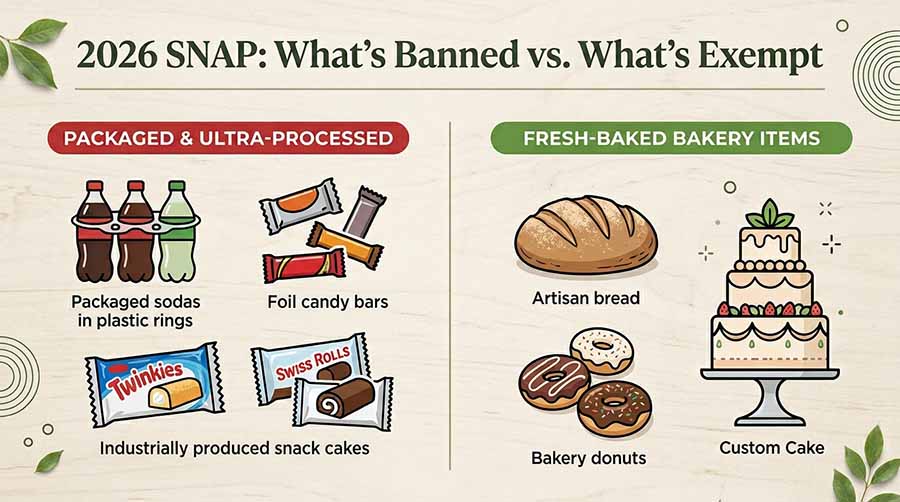
The 2026 SNAP restrictions ban packaged candy, sodas, and ultra-processed snacks in 18 states. Fresh-baked bakery items are fully exempt.
As of February 2026, 18 states secured federal waivers under Section 17 of the Food and Nutrition Act of 2008 to restrict certain SNAP purchases. The rollout began January 1, 2026, and the final wave of states follows in October 2026.
The targets are industrial packaged foods: candy bars, sodas, shelf-stable ultra-processed snacks like Twinkies and Little Debbies. Think gas station rack, not your bakery display case. These waivers were built around factory-produced processed foods, not the croissant your customer picks up on a Sunday morning.
The confusion comes from how the news framed it. “SNAP ban on desserts” sounds like it covers birthday cakes. It does not. The federal waivers are product-category restrictions, and every state’s waiver works around the ingredient definitions that protect fresh-baked goods.
Does EBT Cover Fresh Bakery Items in 2026?
Yes. EBT covers fresh bread, cakes, donuts, pastries, and pies at any authorized bakery. The 2026 SNAP restrictions do not affect fresh bakery goods.
Fresh bread, birthday cakes, muffins, cupcakes, pies, donuts, pastries, croissants, and bagels all still qualify for EBT payment at any SNAP-authorized shop. The 2026 bans in every participating state target packaged and shelf-stable processed foods only. Baked goods made and sold fresh sit in an entirely different legal category.
Two technical rules protect most bakery products at the ingredient level:
- The Flour Rule: States including Idaho and Indiana legally exclude any food prepared with flour from the definition of “candy.” Under this classification, essentially everything in a standard bakery case passes without question.
- The Refrigeration Test: Indiana and Texas exempt bakery items that require cold-chain storage for food safety from the candy ban. Cream-filled pastries, cheesecakes, and refrigerated bakery items are categorically excluded.
What About Custom and Decorated Cakes?
Custom cakes for birthdays, weddings, and occasions remain EBT eligible. The one rule to know: non-edible decorations cannot exceed 50% of the total retail price of the finished cake. For most custom bakery orders, that threshold is not close to being triggered. The cake is mostly cake.
State-by-State EBT Bakery Rules: Where to Pay Attention
Florida protects fresh bakery goods. Iowa links SNAP eligibility to sales tax. Tennessee restricts items where sugar heads the ingredient list.
Most states applying 2026 restrictions are clear-cut for bakeries. A handful deserve a closer look:
| State | Bakery Status | Key Rule |
|---|---|---|
| Florida | ✅ Eligible | Freshly prepared baked goods are explicitly exempted from the ultra-processed dessert ban |
| Missouri | ✅ Eligible | Fresh bakery items are explicitly exempted from the ultra-processed dessert ban |
| Iowa | ✅ Eligible with nuance | SNAP covers only sales-tax-exempt items; bakery goods sold by the baker qualify under Iowa Code 701-220.4 |
| Tennessee | ⚠️ Check your labels | Products with sugar, cane sugar, or corn syrup as the first ingredient are restricted. Flour-led recipes are almost always safe |
| North Dakota | ⚠️ Monitor | Waiver language is broader than most states; worth watching as definitions are tested through 2026 |
| Idaho / Indiana / Texas | ✅ Eligible | Protected by the Flour Rule and/or Refrigeration Test |
Iowa, explained plainly: Iowa’s SNAP eligibility is tied to its sales tax code. Items sold tax-exempt are EBT-eligible. Bakery goods sold by the baker who made them are tax-exempt by state law, so Iowa bakery owners qualify, provided you’re the one who baked them.
Tennessee flag: If you carry any packaged product where sugar or corn syrup leads the ingredient list, that item falls under the restriction. Your scratch-baked goods, where flour leads the formula, are almost certainly safe. Check the labels on any packaged items you stock alongside fresh bakes.
One broad caveat: the food stamp rules are not uniform across all 18 participating states. What qualifies in Florida may read differently elsewhere, and as state definitions get tested throughout 2026, checking your state’s waiver language directly is the right call.
What If You Sell Both Fresh and Packaged Items?
Mixed-inventory bakeries must split transactions at checkout. EBT pays for fresh-baked items; restricted packaged goods are paid separately.
This is where operations get more involved. If your bakery carries packaged goods alongside fresh-baked items, your checkout process needs to handle split-tender transactions: EBT-eligible fresh items on one payment, restricted packaged items on another.
Retailers must manually update their POS pricebooks to flag each item’s SNAP status correctly. This is not optional. Under the Two-Strike compliance policy, a second violation results in involuntary removal from the SNAP program. To put the scale of this in perspective: the U.S. food retail industry faces a $1.6 billion one-time implementation cost to manage state-specific SNAP restrictions across all retail formats. For a small bakery carrying mixed inventory, getting your pricebook right is the difference between staying in the program and losing access entirely.
Three things to do now:
- Audit every packaged product against your state’s restricted list.
- Update your POS pricebook with correct SNAP flags for each SKU.
- Train staff on split-tender checkout before it comes up live with a customer.
Staying current on compliance is part of a broader 2026 picture for bakery operators. The 2026 compliance traps every bakery should know extend beyond SNAP.
Are You a Cottage Food Baker? Here’s Your Answer.
Cottage food bakers cannot accept EBT without USDA SNAP retailer authorization. The 2026 rule changes do not alter or affect this requirement.
If you bake from home and sell through direct orders or farmers markets, the EBT question works differently. Under standard USDA policy, accepting food stamps requires being registered as a SNAP-authorized retailer. Without that authorization, EBT payments are not available regardless of what you sell or how fresh it is. This is a long-standing federal requirement that the 2026 restrictions do not change.
If you’re building out your home bakery operation, the path from cottage baker to authorized seller is more accessible than most people assume. The USDA application is online, and for businesses that qualify as staple food retailers, it’s a realistic and worthwhile step.
The Real Risk Is Customer Confusion, Not Product Eligibility
The biggest threat to EBT bakery revenue in 2026 is customers self-disqualifying from misleading headlines, not actual product restrictions.
Your cakes, bread, donuts, pastries, and custom birthday cakes are EBT eligible. But if your regular SNAP and food assistance customers walk past your counter because they assumed the ban covers fresh bakes, that’s lost revenue for no reason.
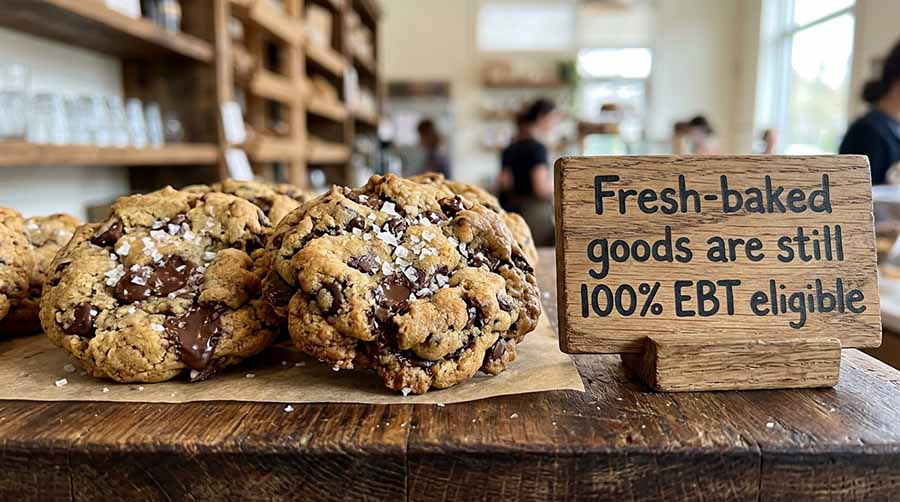
The fix is a small one. Post a sign at the counter: “Fresh-baked goods are still 100% EBT eligible.” Brief your staff so they can answer the question in one sentence. Put a post on social media. It takes 20 minutes and protects weeks of sales.
How you present your bakery shapes how customers feel about spending money there. Poor presentation costs bakeries real money, and unclear payment messaging is the same problem in a different form. Make it easy for EBT customers to feel welcome and informed.
The Hot Food Rule Has Not Changed
Items sold warm or hot at the point of sale have never been EBT eligible under SNAP, and 2026 changes nothing about that. Warm rolls, hot breakfast pastries, or anything handed to a customer at eating temperature cannot be paid with SNAP benefits. Cold or room-temperature baked goods remain fully eligible. Make this a standard piece of staff checkout training.
Not SNAP Authorized Yet? Here’s How to Start
If your bakery hasn’t registered as a SNAP retailer, none of the above eligibility rules apply until you do. Many full-service bakeries qualify as staple food retailers and can apply through the USDA’s online retailer portal. SNAP serves more than 40 million Americans, and being able to accept EBT is access to a large, consistent customer base. If you’re thinking about ways to grow, payment accessibility belongs in that plan.
Frequently Asked Questions
Does EBT work at bakeries?
Yes. EBT works at any SNAP-authorized bakery for fresh-baked goods. The 2026 SNAP changes restricted packaged candy and sodas, not fresh bakery items. Bread, cakes, donuts, and pastries remain fully eligible.
Does EBT cover cakes from a bakery?
Yes, including custom cakes. The one rule: non-edible decorations must not exceed 50% of the retail price. Standard birthday and celebration cakes almost always fall well under this threshold.
Can I get bakery donuts with EBT?
Yes. Fresh donuts sold from a bakery case are SNAP eligible. The 2026 restrictions apply only to packaged, shelf-stable processed snacks, not freshly made bakery items.
What foods are not allowed on SNAP in 2026?
In the 18 participating states, the restrictions cover packaged candy, sodas, and shelf-stable ultra-processed snacks. Fresh produce, bread, meat, dairy, and fresh-baked goods all remain fully SNAP eligible.
Does Whole Foods take EBT for bakery items?
Yes. Whole Foods is SNAP-authorized, and its fresh bakery items follow the same eligibility rules as any authorized bakery. Fresh-baked goods there are fully covered by EBT, same as before the 2026 changes.
The rules are clear: EBT bakery eligibility is intact in 2026, and your fresh-baked products are protected. Post a sign, brief your team, audit your packaged inventory if you carry it, and get SNAP-authorized if you aren’t already. For more bakery business guides and food industry insights, visit the Plastic Container City blog and keep serving your EBT bakery customers with confidence.
