

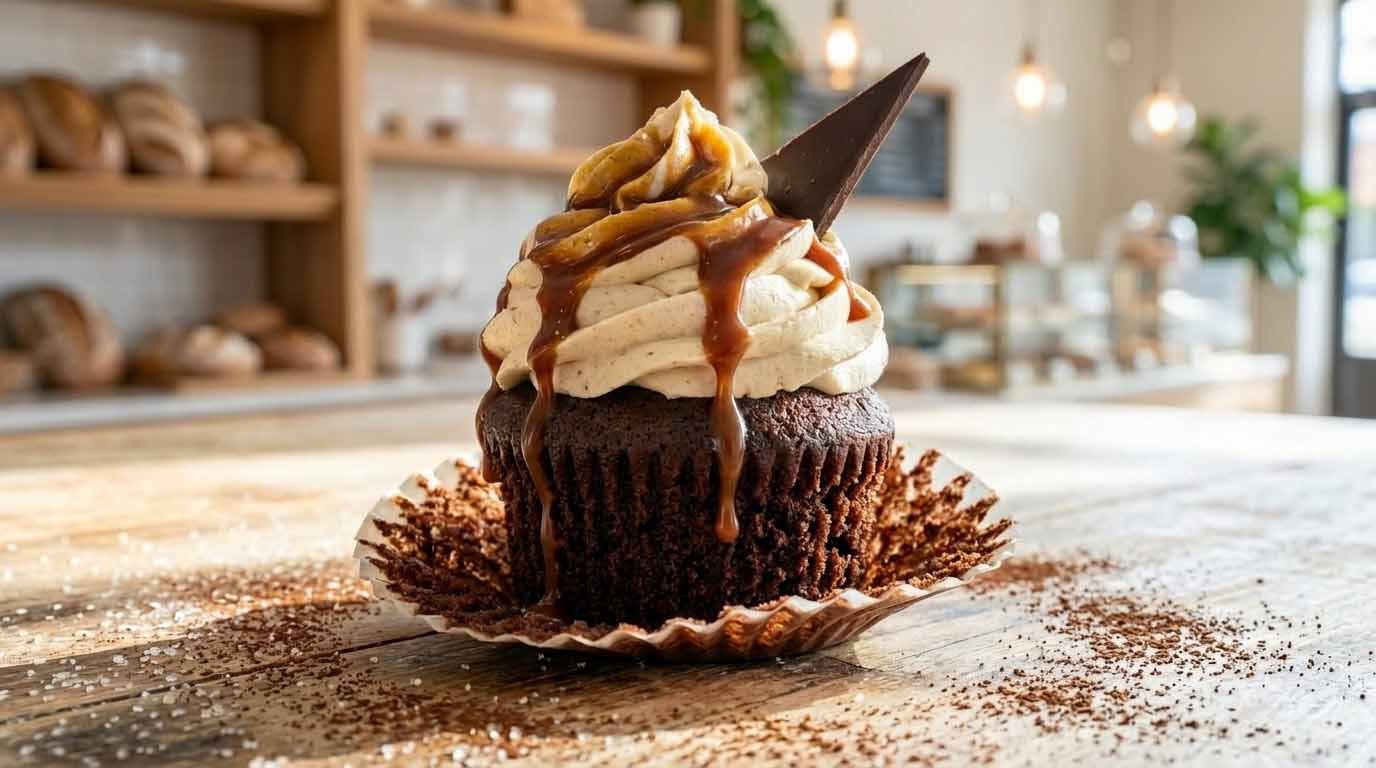
Which best selling items in a bakery are genuinely earning their keep, and which ones are just filling your oven time? For most operators, the answer is uncomfortable: the product with the longest daily queue is often the one with the thinnest margin.
This guide cuts past the generic listicle territory. You will find trade-backed data on what moves in U.S. bakeries right now, a clean framework for separating Stars from Plowhorses, a six-dimension scorecard for choosing one true signature item, and a four-lever rescue plan for popular items that quietly drain your cash flow.
What Are the Best Selling Items in a Bakery?
Bread holds the largest share of the U.S. bakery market, projected at 44.47% by Fortune Business Insights for 2026. Cookies and biscuits rank second by production frequency at a 6.89% CAGR. Specialty items, gluten-free, high-fiber, and whole-grain, are growing at 6.73% annually, roughly double the pace of conventional staples.
But those are market-wide averages. What moves in a wholesale bread plant is nothing like what drives revenue at a boutique cupcake counter. Here is the shop-type breakdown that matters:
| Shop Type | Volume Leaders | Margin Leaders | Watch Out For |
|---|---|---|---|
| Full-Line Retail | Sandwich bread, dinner rolls, donuts | Custom cakes, artisan sourdough | Commodity margin compression on bread |
| Specialty / Artisan | Sourdough, croissants, signature pastry | Laminated doughs, seasonal specials | High labor cost per batch |
| Café-Bakery Hybrid | Muffins, scones, cookies | Latte-and-pastry bundles, cookies | Daypart dead zones (2pm to 4pm) |
| Home / Cottage Bakery | Cookies, cupcakes, brownies | Custom decorated items, subscriptions | Underpricing skilled labor hours |
| Wholesale / Production | Bread loaves, buns, muffin tops | Private label contracts, large-batch items | Ingredient cost volatility |
At Plastic Container City, we work with thousands of food professionals across the U.S., from home bakers scaling up to full commercial operations. The most consistent finding: operators who benchmark by their own shop type make far better decisions than those chasing an industry average that doesn't describe their business. If you're running a home operation and weighing whether cupcakes justify your oven schedule, the profitability math is worth checking first.
What Is the Difference Between Popular and Profitable?
Popularity is units sold. Profitability is contribution margin in dollars: sale price minus every variable cost tied to making that item. Not gross profit percentage. Actual cash.
A $3 cookie at 70% gross margin generates $2.10 per unit. A $28 custom cake at 35% generates $9.80. If you are tracking GP% on your bread without knowing the dollar contribution, you are optimizing the wrong number. The Profit Playbook for bakery desserts covers exactly how to build this thinking into your day-to-day menu decisions.
Menu engineering puts every item in one of four quadrants. Knowing where yours sit is the difference between scaling smart and grinding harder for the same result:
| Quadrant | Definition | Example | Action |
|---|---|---|---|
| Stars | High popularity, high contribution margin | Artisan sourdough, signature cupcakes | Scale it, feature it, protect the recipe |
| Plowhorses | High popularity, low contribution margin | Conventional sliced bread, plain donuts | Rescue with the playbook below |
| Puzzles | Low popularity, high contribution margin | Specialty tarts, gluten-free loaves | Move to prime display zones, build LTO urgency |
| Dogs | Low popularity, low contribution margin | Rarely-ordered danish varieties | Remove. Do not let them occupy oven time. |
Disciplined menu engineering is projected to increase bakery profitability by 10 to 15% in 2026. That is not a minor gain. That is the margin between a tough quarter and a cash-flow crisis.
How Do You Pick a Signature Item? The Star Scorecard
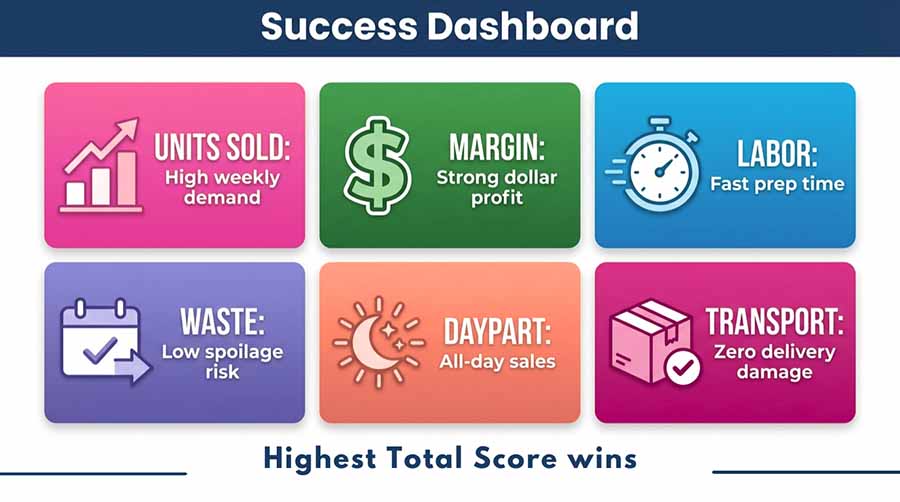
A signature item is not just your bestseller. It is the one you can scale, protect, and build a reputation around without it destroying your back-of-house. Rate each candidate from 1 to 5 on these six dimensions. The item with the highest total is your signature:
| Dimension | What to Measure | Score 5 Means |
|---|---|---|
| Units Sold | 30-day POS average, weekly unit count | Consistently high weekly demand |
| Contribution Margin ($) | Sale price minus all variable costs | Strong dollar margin per unit |
| Labor Minutes per Batch | Hands-on prep and finishing time only | Under 15 minutes per saleable unit |
| Waste Risk | Shelf life, end-of-day write-off rate | Low waste, long shelf life or freezable |
| Daypart Fit | Sells across morning, lunch, and afternoon | Sells across three or more dayparts |
| Pack / Transport Survivability | Survives pickup, delivery, and catering intact | 30-minute delivery with zero damage (packaging guide here) |
A cookie scoring 4, 5, 5, 4, 3, 5 (total: 26) beats a fancy entremet scoring 1, 5, 1, 2, 1, 2 (total: 12) every week. High contribution margin alone does not make a signature. Scalability and reliability do.
How Do You Fix a Plowhorse Without Losing Its Fans?
Your highest-volume item and your lowest-margin item are often the same product. Customers love it, so you keep making it. But thin margins at high volume means more losses, not just a break-even.
Lever 1: Tighten the Recipe Cost
Audit every ingredient. Are you using a branded input where a comparable commodity performs the same job? A 10% reduction in food cost on a high-volume item can flip a Plowhorse to a Star without touching the price. With prime cost, meaning combined food and labor, now running at 67% to 73% of revenue in high-cost regions, these small recipe adjustments are no longer a nice-to-have. They are a survival mechanism.
Lever 2: Standardize the Portion
If your cinnamon roll has crept from 4.2oz to 5oz through shift-to-shift drift, standardizing it back is achievable without customer reaction, especially when visual presentation stays strong.
Lever 3: Run a Small Price Test
A $0.25 to $0.50 increase on a beloved item often goes unnoticed when supported by quality signals: cleaner packaging, a chalkboard description, a seasonal name. Test it on 20% of your traffic first.
Lever 4: Build a Bundle
A brownie that barely breaks even at $2.50 a la carte may perform well at $4.25 as part of a coffee-and-pastry combo. The bundle creates a new price anchor. Grab-and-go bundle construction is one of the most underused margin tools in café-bakery operations.
How Do You Use Your POS Data to Classify Your Menu?
You do not need a consultant for this. You need a spreadsheet and about 90 minutes.
- Export item name, units sold, and gross revenue for the last 30 to 60 days from your POS.
- Add a column for estimated variable cost per unit: ingredients, direct packaging, per-unit labor.
- Calculate contribution margin: sale price minus variable cost.
- Set your midpoints by averaging both units sold and contribution margin across the full menu. These become your matrix axes.
- Plot each item. Above both midpoints: Star. Below both: Dog. High units, low margin: Plowhorse. Low units, high margin: Puzzle.
Do this quarterly. Your menu mix shifts with seasons and ingredient costs. The item that was a Star in November may be a Plowhorse by March when egg prices spike and you have not adjusted cake pricing to match.
What Is Shifting in the Market Right Now?
Two forces are running simultaneously, and both are real.
Private label pressure is structural. 61% of consumers now report noticing a quality improvement in store-brand bakery items, driving a 30% rise in private label purchases per Innova Market Insights. That is your grocery competitor getting better, not just cheaper. Commodity staples face margin compression that pricing alone cannot fix.
The treat mindset is equally real. 52% of consumers still buy small experiential treats as emotional rewards despite cost pressures. And 93% express high interest in limited-time bakery offerings per the American Bakers Association. Scarcity and seasonality still command a premium. A well-named seasonal item with a clear quality story is not competing with the grocery shelf. It is in a different category entirely.
Ingredient volatility compounds all of this. Cocoa prices surged dramatically from 2024 into early 2026 before partial stabilization, and egg prices hit $5.89 per dozen in early 2025. High-egg products like brioche and custom cakes took a direct margin hit. If those are your Plowhorses, the rescue levers above are not optional.
Federal food policy is also reshaping what sells. The 2026 federal sugar-reduction strategy is targeting added-sugar claims and the FDA is reviewing the regulatory status of refined carbohydrates. The 2025 to 2030 Dietary Guidelines formally recommend cutting refined carbs. This does not mean your chocolate brownie is finished. It does mean that Star items will increasingly need to balance indulgence with ingredient transparency to hold consumer trust as labeling pressure builds.
Wrapping Up
The best selling items in a bakery are only half the story. The other half is knowing which of those items is building your business and which is just filling the rack.
Run the POS audit. Score your items through the Star Scorecard. Pick one signature and invest in it. Rescue your Plowhorses before they quietly drain the margin you worked all week to earn. That is the full play for any bakery owner serious about turning the best selling items in a bakery into a business that actually holds its ground.
For more bakery business insights, pricing guides, and food-industry analysis, visit the Plastic Container City blog.
Frequently Asked Questions
What baked good has the highest profit margin?
Custom decorated cakes often generate the highest dollar margin per unit, but only when skilled labor hours are correctly priced in. The real answer comes from your own POS data, not a blanket ranking.
What is the most profitable bakery item to sell?
Artisan sourdough is a close second for specialty operators who can hold a premium price point. Your most profitable item is always specific to your shop type, daypart mix, and cost structure.
What sells fast at a bake sale?
Items priced under $3 lower the buyer's hesitation threshold sharply. Good packaging that makes items easy to carry without damage also increases impulse purchases at the point of sale.
What do bakeries usually sell?
Café-bakery hybrids optimize a grab-and-go range for morning daypart volume alongside coffee service. Shop type shapes the product mix far more than any regional trend.
What bakery item is easiest to make?
They are also among the most forgiving items to batch-produce during early morning prep, which is why they dominate home bakery menus and bake sale tables alike.
