

Bakery cost control separates the thriving shops from the ones barely scraping by. Small bakeries burn through thousands of dollars every month on hidden leaks most owners don't even see: spoiled inventory sitting in the walk-in, overstaffed Tuesday mornings, and recipes priced like it's still 2019. The difference between a 6% profit margin and a 15% one? It's not luck. It's knowing exactly where your money disappears and plugging those holes before they sink you.
Let's talk about the real culprits draining bakery profits and what you can actually do about them.
The Ingredient Black Hole: When Your Walk-In Becomes a Money Pit
Raw materials eat up 50 to 70% of your total production costs, making ingredient management your biggest profit lever. But here's where it gets messy. Most small bakeries treat inventory like a guessing game, ordering based on last week's memory instead of actual data. The result? You're either running out mid-service or tossing expired stock that never had a chance. Mold alone accounts for 65% of all bakery waste globally, which means your shelf life game better be tight.
Ingredient waste typically runs between 5% and 15% of your total product output, and that's before you factor in theft, spillage, or the croissants nobody wanted on a rainy Wednesday.
The Price Shocks That Keep Coming
If you think flour and sugar fluctuations were bad, the egg crisis hit bakeries like a freight train. One Pittsburgh bakery owner watched his 30-pound bucket of pre-beaten eggs jump 345% in just one year. That's not a typo. We're talking $43 for a case of eggs one week, $87 the next.
Cocoa isn't much better. Prices have spiked dramatically, with tariffs on processed cocoa imports pushing costs even higher. Your chocolate croissant just got a lot more expensive to make.
The fix? Start tracking ingredient costs per recipe, not just per order. When butter spikes from $6.90 to $8.00 per kilogram overnight, you need to know which products are bleeding margin and adjust pricing immediately.
Labor Costs: Your Biggest Line Item Is Leaking
Labor eats 20 to 35% of production expenses in most bakeries, and it's only getting worse. 68% of bakeries report difficulty filling open positions right now, and by 2030, the industry faces 53,500 unfilled jobs. That means you're paying more for less experienced workers while competing with every other food business in town.
This isn't a short-term headache. By 2030, the industry faces 53,500 unfilled jobs, a crisis projected to wipe out $36.2 billion in economic output. The fight for talent is only getting more intense.
Entry-level positions that paid $10 to $12 an hour three years ago now start at $13 to $15. Skilled bakers in metro areas? Try $18 to $22. California bakeries deal with a $16 minimum wage while West Virginia operators pay $8.75, creating wildly different cost structures depending on where you bake.
But the real waste isn't the hourly rate. It's the scheduling.
Overstaffing Is Killing Your Margins
Most small bakeries staff based on "what if" scenarios instead of actual traffic patterns. You've got four people clocked in on a Tuesday morning when two could handle it. That's not smart management. That's expensive insurance you don't need.
At Plastic Container City, we work with thousands of food professionals across the U.S., and the bakeries making real money use production scheduling software to align labor with demand. They're not guessing. They're tracking sales patterns, predicting busy periods, and building schedules around data, not gut feelings.
Beyond ingredient spoilage, human error accounts for more than 10% of food waste at the production level, mostly from poor training and inconsistent procedures. This is waste on top of waste: burnt batches, wrong measurements, dropped trays. You're paying for labor that destroys product. When your staff isn't dialed in, you're paying twice: once in wasted labor, once in ruined product.

Pricing Mistakes That Quietly Destroy Profitability
Here's the painful truth: most small bakery owners are terrible at pricing. They either undercharge because they're scared of losing customers, or they slap a random markup on their products and hope it works out. Neither strategy pays the bills.
Where Your Money Actually Goes
Before you can price correctly, you need to know what "normal" looks like and where you're bleeding:
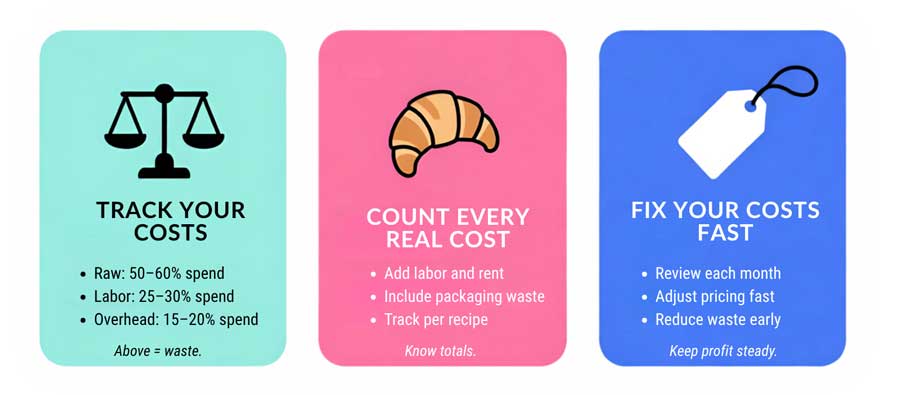
| Cost Category | Healthy Range | Warning Signs You’re Wasting Money |
|---|---|---|
| Raw Materials | 50–60% | Above 65%: ingredient waste, theft, or underpricing |
| Labor | 25–30% | Above 35%: overstaffing or inefficient scheduling |
| Energy & Overhead | 15–20% | Above 25%: outdated equipment or poor lease terms |
If your numbers fall outside these ranges, you've found your leak. Calculate your percentages monthly, not yearly. Waiting 12 months to discover you're running at 40% labor cost means you've already burned through tens of thousands you can't get back.
The Real Cost of a Croissant
To price baked goods correctly, you need to know your true cost per item, and that means going deeper than flour and butter. You're missing:
. Overhead costs: rent, utilities, equipment depreciation, insurance
. Packaging: bags, boxes, labels, ribbons (poor choices here can cost you thousands, so choosing the right bakery packaging is crucial.
. Labor time: production hours at fully loaded hourly rates
. Waste factor: that 5 to 15% loss you're pretending doesn't exist
Let's say your croissant costs $0.50 in raw materials. Add labor, overhead, packaging, and waste, and you're closer to $0.75. Apply the recommended multiplier of 4 to 7, and you should be selling at $3.00 to $5.25, not the $2.50 you're charging because the shop down the street does.
Need a systematic approach? Our menu pricing guide walks through the complete formula.
Profit margins for well-managed bakeries run 6 to 12%, with city center locations pushing 15%. Home-based operations? You're looking at 4 to 9%. If you're below these numbers, your pricing is off, your costs are out of control, or both.
The Utility Bill Nobody Talks About
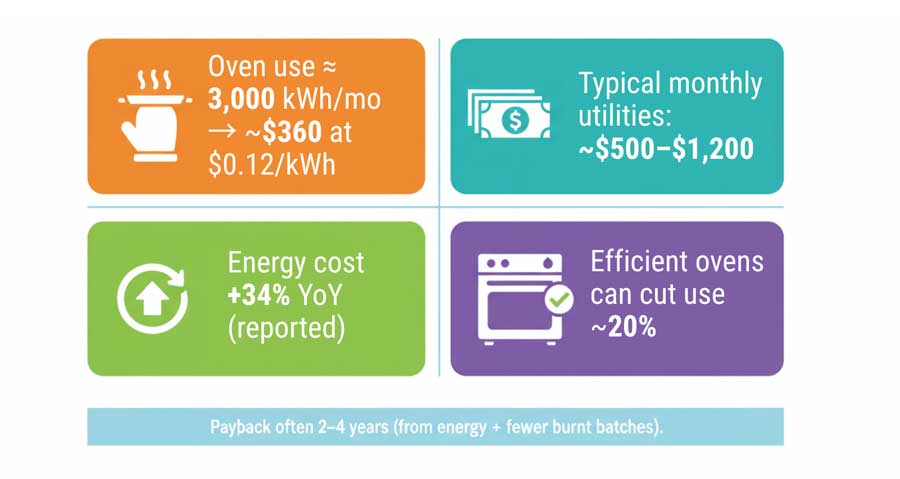
Energy costs are the silent profit killer. A typical small bakery spends $500 to $1,200 monthly just on electricity, gas, and water. That electric oven running 12 hours a day? It's pulling roughly 3,000 kWh per month at $0.12 per kWh, which adds up to $360 before you even turn on the mixers and refrigerators.
Here's the kicker: bakeries reported average increases of 34% year over year in energy costs. Medium-sized bakeries are paying $18,000 to $25,000 more annually than they did just a few years ago. That's a direct hit to your bottom line.
The Equipment Upgrade That Actually Pays Back
Energy-efficient ovens with heat recovery systems and AI-driven baking controls can reduce energy consumption by 20% or more. In Europe, bakeries using compact oven systems have cut energy use by 22% while maintaining product quality.
The math works. If you're spending $15,000 a year on energy and you cut that by 20%, you save $3,000 annually. A $20,000 oven upgrade pays for itself in under seven years from energy savings alone. Factor in reduced waste (fewer burnt batches) and higher throughput (faster baking cycles), and most operators see payback in 2 to 4 years, not seven.
Technology: The Hidden Cost of Running Manual
Here's the expensive mistake: running your bakery on spreadsheets, memory, and paper tickets. You don't know what sold yesterday until you count tonight. You don't know you're out of flour until production stops. You're making ordering decisions based on gut feeling, not data.
This manual approach costs you in three ways:
-
Overordering to avoid stockouts ties up thousands in unused inventory
-
Underordering forces emergency supplier runs at premium prices (often 15-30% markups)
-
No waste tracking means you don't know where 5-15% of your inventory disappears
The bakeries pulling ahead aren't winging it. They're using bakery management software that tracks inventory down to the last gram of flour, automates ordering before you run out, and shows exactly where waste is happening.
Real-time inventory tracking prevents both stockouts and overordering. When a customer buys a croissant, the system automatically adjusts not just your croissant count but also your butter, flour, and egg inventory. One bakery using Edge AI technology reduced food spoilage by 37% by predicting demand patterns and optimizing production schedules. That's real money saved, not theoretical efficiency.
The global bakery software market sits at $250 million and growing at 15% annually because operators finally realize that spreadsheets and gut feelings don't cut it anymore. The investment pays for itself fast when you stop throwing away product and cash.

Bulk Buying Gone Wrong: When "Savings" Cost You More
Here's where bakeries think they're being smart but bleed money instead. That 20-pound bag of almond flour at 40% off? You tossed half of it when it expired. The 50-pound sugar sack that seemed like a steal? It's been absorbing humidity for three months, clumping into unusable bricks.
Bulk purchasing wastes money in three ways:
. Spoilage before use: Ingredients expire before you can use them
. Storage costs: Tying up cash in inventory that sits for months
. Opportunity cost: Money locked in unused stock instead of covering immediate needs
The fix isn't avoiding bulk buying. It's matching order sizes to actual consumption. Track your usage rates religiously. If you go through 10 pounds of almond flour monthly, buying a 50-pound bag makes zero sense, even at a discount. You're paying for 40 pounds you'll throw away.
Smart bakeries build relationships with multiple suppliers to negotiate better prices without overcommitting to quantities they can't move. They know their burn rate for every ingredient and order accordingly.
Because we supply all kinds of food businesses, we see this pattern constantly. The operators who win aren't buying the cheapest ingredients. They're buying strategically, matching order sizes to actual consumption, and adjusting fast when usage patterns change.
The Waste You're Not Tracking
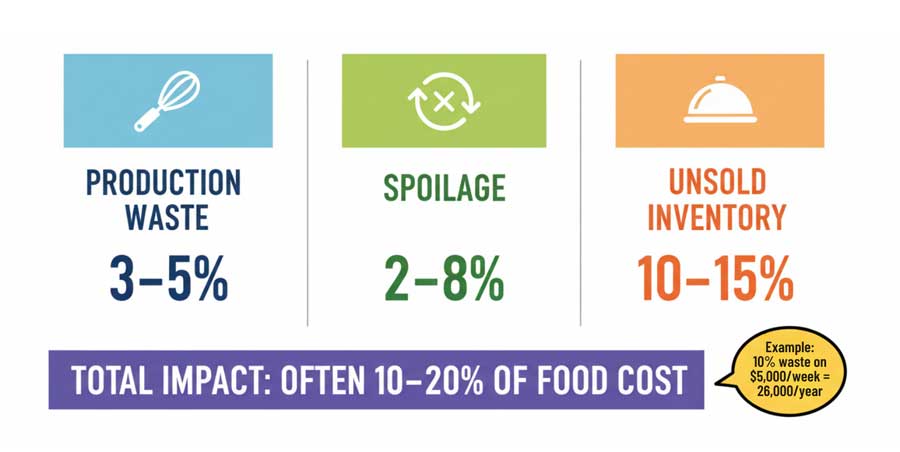
Most bakery owners know they waste product. What they don't know is how much it costs them. That "little bit" of waste adds up fast: 10% waste on $5,000 weekly ingredient spend is $26,000 gone annually. Overproduction, spoilage, and poor storage are the usual suspects, but the real issue is that most bakeries don't measure waste systematically.
You need to track these three waste streams separately:
. Production waste: trimming, dosage errors, burnt batches (typically 3-5% of production)
. Spoilage: products that expire before sale (2-8% depending on shelf life management)
. Unsold inventory: that tray of muffins nobody wanted (can hit 10-15% without demand forecasting)
Add those together and you're looking at 10-20% of your food cost walking straight into the trash. On $60,000 annual ingredient spend, that's $6,000 to $12,000 you could've kept.
Repurposing surplus products helps but doesn't solve the core problem. Day-old bread becomes croutons or bread pudding. Slightly imperfect pastries sell at a discount. You're still generating revenue instead of tossing perfectly good food. But the real fix is producing less waste in the first place: better demand forecasting, tighter production schedules, and staff training that reduces human error. For more practical strategies, check out our guide on cutting down bakery waste.
Your 7-Day Cost Control Fix Checklist
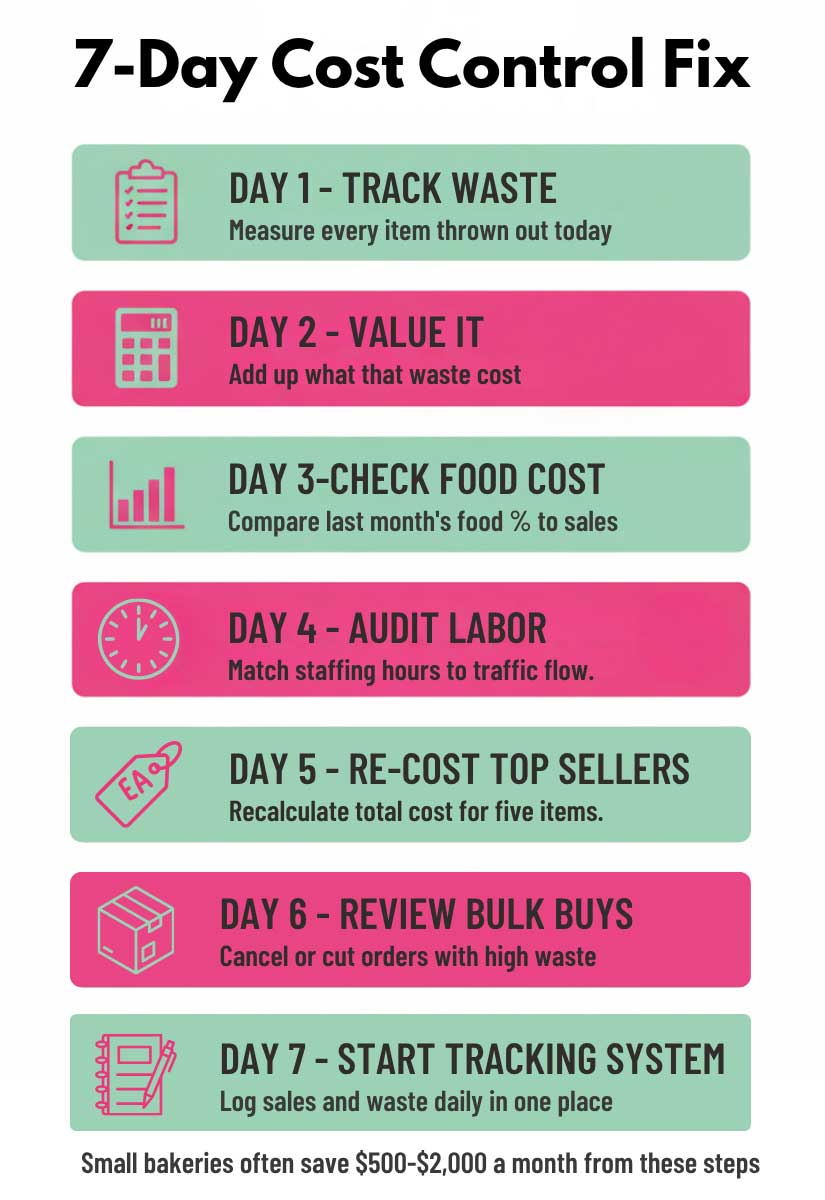
Want to stop the bleeding now? Here's what to tackle this week:
Day 1-2: Track Your Current Waste
. Measure and record every item you throw away for two days
. Separate waste into categories: production errors, spoilage, unsold inventory
. Calculate the dollar value (cost, not selling price)
Day 3: Calculate Your True Food Cost Percentage
. Add up last month's ingredient purchases
. Divide by total sales
. If you're above 30%, you've found problem #1
Day 4: Audit Your Labor Schedule
. Compare actual customer traffic to staffing levels by day and hour
. Identify your slowest periods
. Cut one shift from your lowest-traffic day this week
Day 5: Review Your Top 5 Products
. Calculate the true cost (ingredients + labor + overhead + waste) for your five best sellers
. Apply the 4-7x multiplier
. Adjust prices on anything underpriced by more than $0.50
Day 6: Check Your Bulk Purchases
. List every bulk item you bought in the last 60 days
. Note how much you actually used vs. what expired or went bad
. Cancel or reduce the next order on anything with 20%+ waste
Day 7: Set Up One Tracking System
. Start a simple spreadsheet or try free bakery management software
. Track daily sales and waste for your top 10 items
. Review weekly to spot patterns
This checklist won't fix everything, but it'll show you exactly where your biggest leaks are. Most bakeries find $500 to $2,000 in monthly savings just from these seven steps.
The Bottom Line
Small bakeries waste money on predictable, fixable problems: untracked ingredient costs, overstaffed shifts, underpriced products, runaway utility bills, and manual systems that can't keep up. The bakeries thriving right now aren't necessarily the ones with the best recipes. They're the ones who know their numbers cold, adjust pricing fast, and use technology to eliminate guesswork.
Bakery cost control isn't glamorous, but it's the difference between paying yourself a real salary and working 70-hour weeks for minimum wage. Master these fundamentals first. Once you've plugged the leaks and stabilized your margins, dive deeper into our guide on how to slash restaurant costs and boost your bottom line. Start tracking your true costs today. Your future self will thank you.
FAQ
What are three variable costs for a bakery?
The big three are raw materials (flour, sugar, butter, eggs), labor (hourly wages that scale with production), and packaging (boxes, bags, labels that vary with sales volume).
What is a good food cost percentage for a bakery?
Aim for below 30%. Anything around 25% ensures higher profitability. If you're running above 35%, your ingredient costs are eating too much margin or your pricing is too low.
What makes the most money in a bakery?
The items with the lowest waste rates and highest margins: specialty cakes, custom orders, and catering. These are made-to-order, so there's zero waste from unsold inventory. Standard bread and daily pastries? Lower margins because you're always gambling on demand and dealing with day-old write-offs. Focus your energy on products where you control waste, not products where you're throwing away 10-15% every night.
How to reduce cost in a bakery?
Track ingredient usage per recipe, eliminate overstaffing during slow periods, negotiate with multiple suppliers, reduce waste through better production planning, and invest in energy-efficient equipment that pays for itself.
Why do small bakeries fail?
Most fail because they underestimate costs, underprice products, run out of cash managing slow periods, and can't compete with larger operations on price. Poor bakery cost control kills more bakeries than bad baking ever will.
Want more bakery insights, food industry trends, and profit-boosting strategies? Visit the Plastic Container City blog for expert guidance on everything from seasonal menu planning to delivery packaging solutions.
