

Is one bad online review holding your food business hostage? Imagine this: You’ve spent years perfecting your grandma’s secret pancake recipe. Your café is cozy, your coffee is rich, and your regulars rave about your cinnamon rolls. But one day, a customer leaves a scathing review online: “Worst service ever! Pancakes were cold.” Suddenly, your phone stops ringing. New customers hesitate to walk in. Your hard work feels invisible.
Sound familiar? You’re not alone. Food for thought: a massive 94% of diners are swayed by online reviews when deciding where to eat. Yeah, reviews are that important
A single bad review can feel like a storm cloud over your business. But here’s the good news: With the right strategies, you can turn those frowns upside down—and even grow stronger. Let’s dive in.
Why Online Reviews Are Your Secret Sauce
Think of online reviews as your digital handshake. They’re the first thing people see when they Google your restaurant, food truck, or bakery. Here’s why they matter:
-
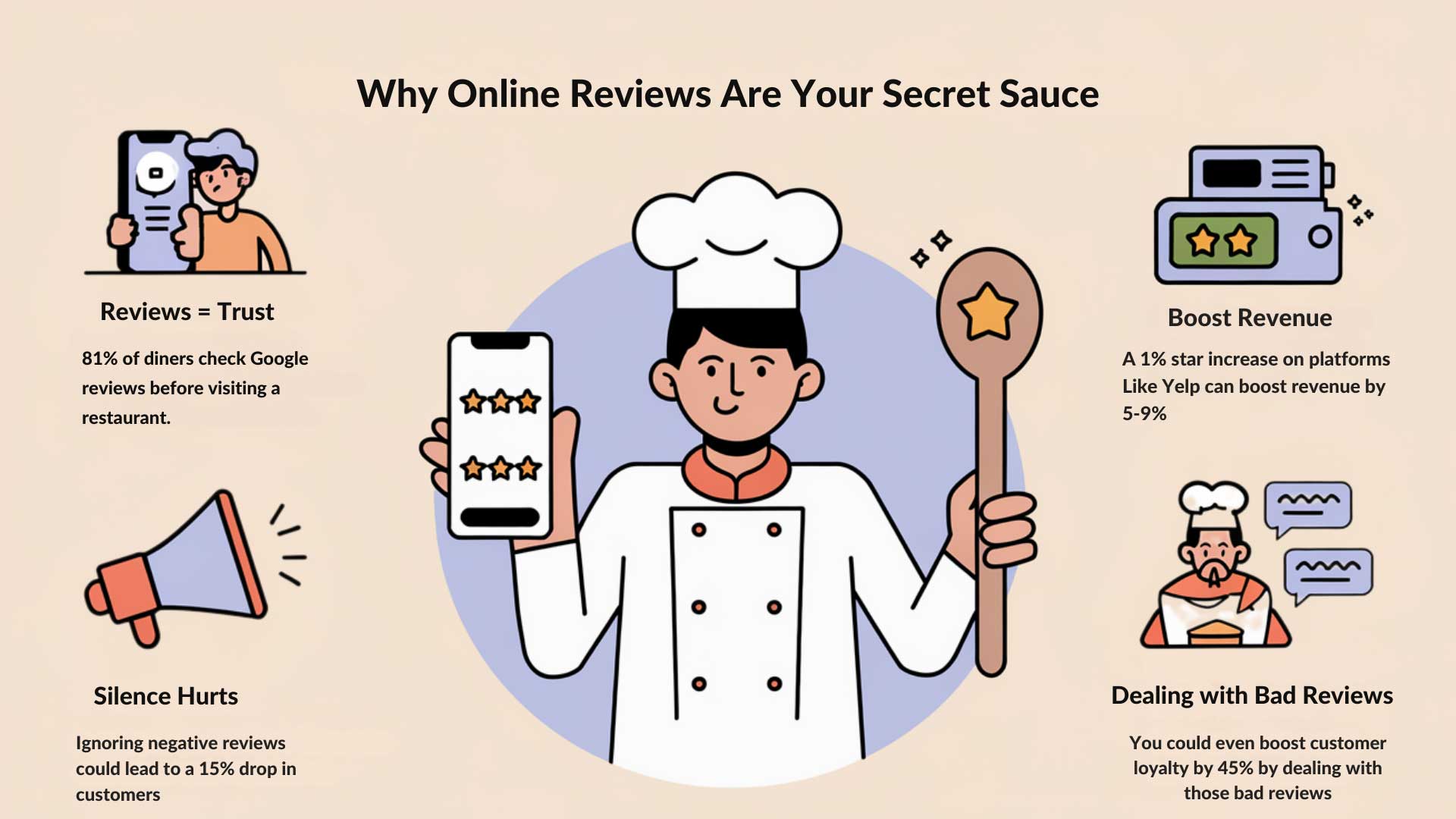
Reviews = Trust: A study found that 81% of diners check Google reviews before visiting a restaurant. Positive feedback acts like a friendly wave, inviting newcomers in.
-
Stars Mean Dollars: A 1-star increase on platforms like Yelp can boost revenue by 5–9%. Even small improvements add up.
-
Silence Hurts: Ignoring negative reviews? That could lead to a 15% drop in customers (Source).
And it’s not just about reeling in new customers either. Think about the loyal fans you've already got. They're more likely to stick with you. You could even boost customer loyalty by a solid 45% if they see you actually dealing with those bad reviews. Seriously, ignoring complaints isn't just rude; it's bad business. You have to show you're paying attention. You have to show you care. Because these days, your online rep? That is your real rep. It's make or break time.
I once worked with a bakery in Austin that faced a tidal wave of negative reviews after a busy holiday rush. Complaints about slow service and out-of-stock items flooded their Google Business Profile. By responding thoughtfully and fixing recurring issues—like adding a second cashier during peak hours—they not only saved their reputation but doubled catering orders within months.
To truly thrive in today's food scene, understanding the power of online presence is key; explore the crucial role of social media in the food industry and how it intertwines with your online reputation.
Tips for Dealing With Bad Reviews
Bad reviews sting, but they’re not the end. Here’s how to handle them like a pro:
1. Act Fast (But Don’t Panic)
Aim to reply within 48 hours. Quick responses show you care.
Why the urgency? Because people expect it. Over half of reviewers – yeah, 53% of them are waiting for you to jump on those negative comments, like, now. They're not just blowing off steam; they're seeing what you're made of. Take too long to reply? You're basically saying "I don't care." But a fast answer? That's like a virtual handshake.
Pro Tip: Use the reviewer’s name and apologize sincerely. For example:
“Hi Sarah, we’re so sorry your takeout order was cold. That’s not the experience we want for you. Let’s make it right—next meal’s on us.”
This approach turned a frustrated Yelp reviewer into a loyal regular for my client’s taco truck.
2. Fix the Root Problem
Look for patterns. Are multiple reviews complaining about soggy fries or long wait times? Train your team, tweak your menu, or adjust staffing.
Think bad reviews are just noise? Think again. Restaurants that actually listen to what people are saying online and make changes? Those are the ones that bounce back and win.
Pro tip: Don't just slap a smiley face on it with some canned apology. Go deeper. Seeing the same gripes over and over? Slow service? Cold food? Grumpy staff? Those are patterns screaming at you that something's broken. Treat those bad reviews like free intel. They're spotlighting what's weak in your setup. Fix that, and you'll fix your review headache at the source.
3. Balance the Scales
Encourage happy customers to share their experiences. Slip a note into takeout bags: “Loved your meal? We’d adore a Google review!”
Want to pump up those positive vibes? Sometimes, just asking happy customers to drop you a review can work wonders. Seriously, don't be shy – a little nudge can go a long way online.

Is There a Way to Remove Bad Reviews?
See a review that’s totally out of bounds? Most platforms have a 'report' button for a reason. Use it for stuff that's genuinely offensive or fake.
For example, a bakery owner in Seattle successfully removed a review that falsely claimed their cupcakes gave someone food poisoning. But remember: You can’t delete honest criticism. Instead, use it as fuel to improve.
Pro Tip: Spot a review that's breaking all the rules? Flag it. Every bad review you don't have to worry about is a win for your peace of mind.
Your Google Business Profile: Make It Shine
Your Google Business Profile (GBP) is your digital storefront. Here’s how to optimize it:
-
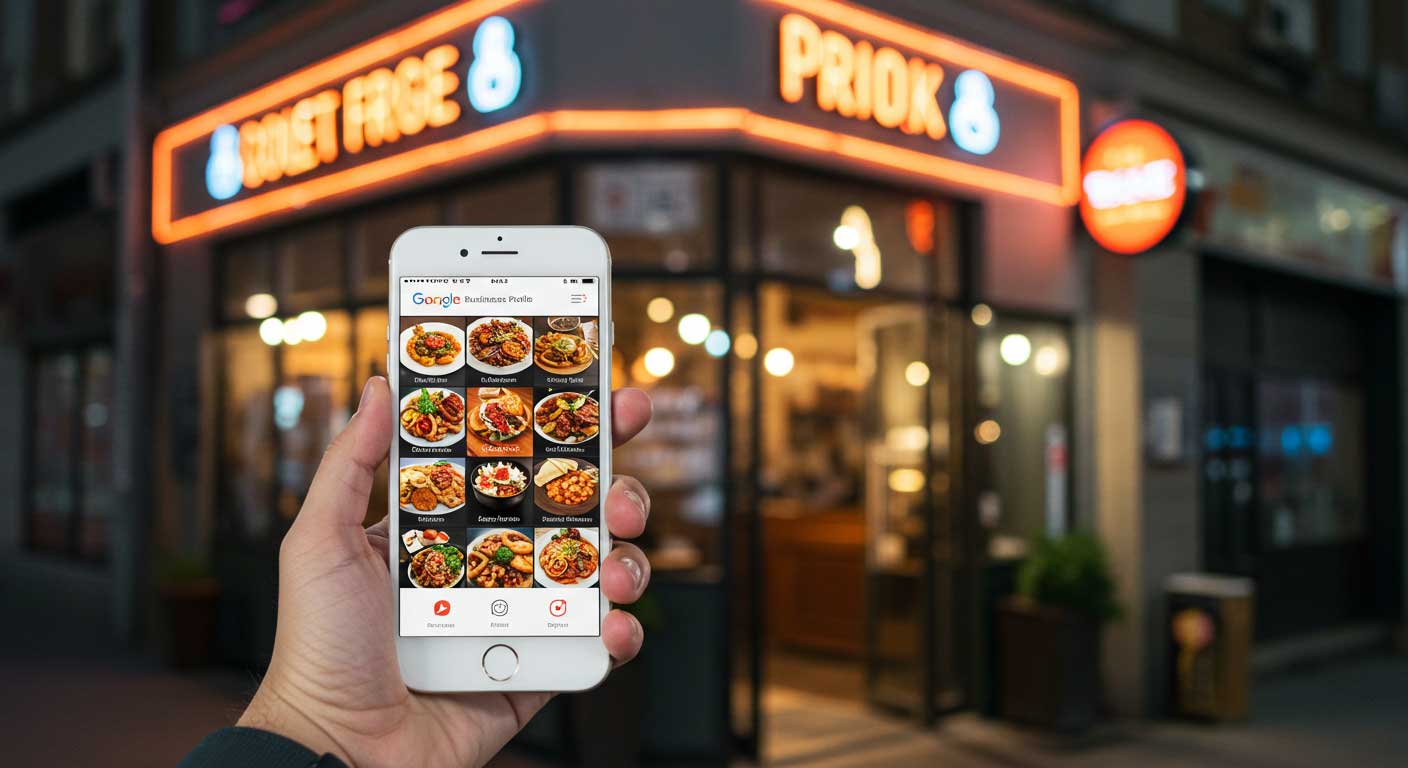
Post Fresh Photos Weekly: Show off new dishes or seasonal specials. Your Google Business Profile? It's like your digital curb appeal. Make it mouthwatering! Post fresh, tempting photos of your food – think of it as your always-open window display for hungry eyes online.
-
Update Hours Religiously: Nothing frustrates customers more than arriving to a closed sign. Use GBP’s “Special Hours” feature during holidays.
-
Respond to Every Review: Even a simple “Thank you!” builds loyalty. For negative feedback, address specifics: Seriously, answering reviews – every single one – isn't just being polite; it's sharp business. Almost 90% of customers say they actually check out how businesses reply to online feedback. They're sizing you up, seeing if you're legit, if you're on the ball, if you deserve their cash. So, every reply is a chance to make a solid impression, even on the complainers.
“Hi Mark, we’re sorry your burger was overcooked. We’ve retrained our grill team—come back for a free meal on us.”
Bottom line? Responding to reviews isn't optional – it's essential. It shows you're present, you're listening, and you actually care about your customers' experience. That's priceless for your reputation.
Tools to Save Time (And Sanity)
Juggling reviews across Google, Yelp, and Facebook? These tools help streamline restaurant reputation management:
|
Tool |
Best For |
Why It Rocks |
|
Tracking reviews in real-time |
Alerts you the moment a new review drops. |
|
|
Fixing bad SEO from negative reviews |
Pushes positive content higher in search. |
|
|
Crafting personalized responses |
Saves hours with templates you can tweak. |
|
|
Staff training based on feedback |
Tracks recurring complaints to target training. |
Proactive Reputation Management: Stay Ahead of the Game
Don’t wait for crises. Build a loyal community with these strategies:
-
Monitor Reviews Daily: So, how do you stay on top of this review game, day in and day out? Simple: Monitor Reviews Daily. Use free tools like Google Alerts to track mentions of your business. Why daily check-ins? Because the internet's a 24/7 thing, and your reputation game should be too. Catch problems early, jump on replies fast, and shut down those mini-PR fires before they blow up into full-on infernos. Think of it as your early warning system for your brand's health.
-
Encourage In-Person Feedback: Place QR codes on receipts linking to your review profiles
Pro Tip: Want to make leaving reviews ridiculously easy for your fans? QR codes on receipts are your secret weapon. Point, click, review – done. Make it brain-dead simple to give you props
-
Leverage Social Proof: Share glowing reviews on Instagram Stories or your website.
Take your online promotion a step further. Leveraging influencer marketing to amplify your restaurant's reach and positive buzz, work hand-in-hand with your strong review profile.
Don't hide your best reviews! Shout them from the rooftops (or at least your social media). Share those glowing testimonials – let potential customers see the love. Social proof is your best friend in the review game.

Final Word: Turn Critics Into Cheerleaders
Bad reviews aren’t personal—they’re opportunities. A coffee shop owner in Portland once told me, “Every critique is a free consulting session.” By listening, adapting, and staying human, you’ll not only protect your reputation but build a community that roots for you.
By listening and adapting, you’ll not only protect your reputation but build a community that roots for you. Staying attuned to the latest trends and evolving customer preferences is also vital for long-term success; adapt your menu and offerings to stay relevant and exciting in a dynamic market.
Now go show those reviews who’s boss. Your pancakes (and customers) will thank you.
FAQs: Your Burning Questions, Answered
Q: Should I respond to every review?
A: Absolutely! A simple “Thank you!” for positive reviews builds loyalty. For negatives, address the issue politely.
Q: Can I offer discounts to unhappy customers?
A: Yes—but keep it offline. Publicly say, “Let’s discuss how we can make it up to you,” then email a voucher.
Q: How do I handle fake reviews?
A: Report them immediately. Platforms like Yelp and Google have strict policies against fraudulent feedback.
Q: What if the review is just mean, not helpful?
A: Stay classy. A short, “We’re sorry you had that experience. We’re always working to improve,” shows maturity.
Q: How many reviews is "enough"?
A: when it comes to reviews, more is definitely more. Almost half of people – like, 43% of them would rather buy from businesses with over 100 reviews. So, if you're just starting out, or your review count's looking a little sad, make getting reviews a priority, ASAP. The more you got, the more legit you look.
